Common Core Perimeter Lesson Plans
Common Core Quick Links:
Common Core State Standards
Subtopics:
Common Core Perimeter Lesson Plans
Common Core Quick Links:
Common Core State Standards3 results
Math
✕Lesson Plans
✕Common Core
✕3 results


About Common Core Perimeter Lesson Plans
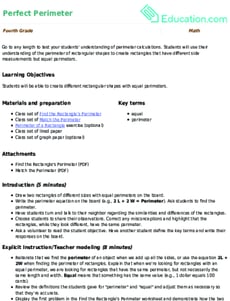
On Education.com, parents and teachers can find lesson plans focused on teaching the concept of perimeter through visual, hands-on activities for elementary students (grades 2-3). These lesson plans use manipulatives like string, ruler-based activities, and physical exploration to help students understand how to measure and calculate the perimeter of polygons. Clear, guided instructions and themed exercises support practical learning by linking to everyday experiences, such as fencing a yard or framing artwork. The curriculum emphasizes hands-on engagement with getting students involved in measuring to build foundational geometry skills.
In addition to lesson plans, Education.com offers worksheets, printable exercises, and interactive activities that help students practice calculating and applying perimeter measurements. These materials reinforce key standards, provide visual aids, and include real-world problem-solving scenarios. Educators and parents can access a variety of structured resources that break down concepts into manageable steps while maintaining engaging and educational content. This structured approach ensures consistent practice and progression along mathematical standards while keeping learning interactive and fun.
Discussions of hands-on geometry in the classroom also highlight the importance of movement and observational strategies. Classroom activities incorporate walking around the room to measure tables or objects, conceptualizing nearby boundaries, and applying these ideas to larger shapes in a collaborative, practical way. By blending tactile exploration with mathematical reasoning, students gain confidence in measurements and develop spatial awareness that supports broader geometry and measurement learning. Educators can utilize these checkpoints to connect math learning to everyday contexts, encouraging critical thinking, collaboration, and hands-on discovery.
In addition to lesson plans, Education.com offers worksheets, printable exercises, and interactive activities that help students practice calculating and applying perimeter measurements. These materials reinforce key standards, provide visual aids, and include real-world problem-solving scenarios. Educators and parents can access a variety of structured resources that break down concepts into manageable steps while maintaining engaging and educational content. This structured approach ensures consistent practice and progression along mathematical standards while keeping learning interactive and fun.
Discussions of hands-on geometry in the classroom also highlight the importance of movement and observational strategies. Classroom activities incorporate walking around the room to measure tables or objects, conceptualizing nearby boundaries, and applying these ideas to larger shapes in a collaborative, practical way. By blending tactile exploration with mathematical reasoning, students gain confidence in measurements and develop spatial awareness that supports broader geometry and measurement learning. Educators can utilize these checkpoints to connect math learning to everyday contexts, encouraging critical thinking, collaboration, and hands-on discovery.