SKIP TO CONTENT
Worksheet Generator
Subjects
Grades
Worksheets
Games
Build a Worksheet
More Resources
Roly Recommends
Subjects
Grades
Worksheets
Games
Build a Worksheet
More Resources
Roly Recommends
Kindergarten - 6th Grade Lesson Plans : Page 17
Filters
2,422 results
Lesson Plans
✕
Kindergarten - 6th Grade
✕
Clear all
2,422 results
Filters
Lesson Plans
✕
Kindergarten - 6th Grade
✕
Subjects
Math
English Language Arts
Science
Social Studies
Technology
Grade Level
Pre-K
K
1st
2nd
3rd
4th
5th
6th
7th
8th
Early Childhood
Elementary School
Middle School
Resource Type
Worksheets
Games
Lesson Plans
Interactive Worksheets
Workbooks
Activities
Exercises
Stories
Songs
Offline Games
Guided Lessons
Teacher Resources
Teacher Editions
Occasion
Back to School
Common Core
Yes
Roly Recommends
Social Emotional Learning
Arts & Crafts
Paper & Glue Crafts
English Language Support
Yes
Clear all
View 2,422 results
Kindergarten - 6th Grade Lesson Plans : Page 17
Filters
2,422 results
Lesson Plans
✕
Kindergarten - 6th Grade
✕
Clear all
2,422 results
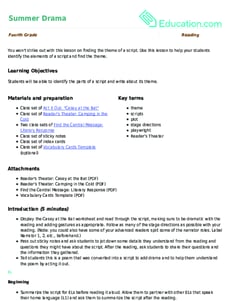
Summer Drama
Lesson Plan
Summer Drama
Fourth Grade
Vocabulary
You won't strike out with this lesson on finding the theme of a script. Use this lesson to help your students identify the elements of a script and find the theme.
Lesson Plan
Summer Drama
Lesson Plan
Summer Drama
You won't strike out with this lesson on finding the theme of a script. Use this lesson to help your students identify the elements of a script and find the theme.
Fourth Grade
Vocabulary
Lesson Plan
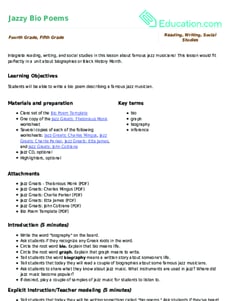
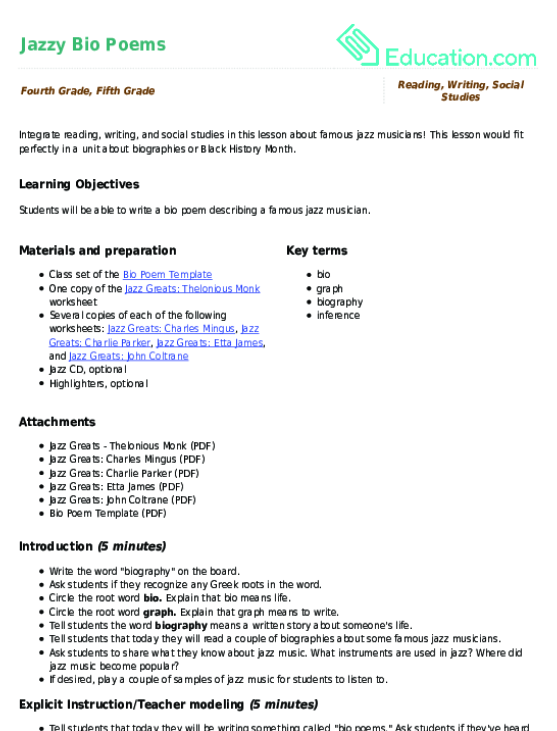
Jazzy Bio Poems
Lesson Plan
Jazzy Bio Poems
Fourth Grade
Integrate reading, writing, and social studies in this lesson about famous jazz musicians! This lesson would fit perfectly in a unit about biographies or Black History Month.
Lesson Plan
Jazzy Bio Poems
Lesson Plan
Jazzy Bio Poems
Integrate reading, writing, and social studies in this lesson about famous jazz musicians! This lesson would fit perfectly in a unit about biographies or Black History Month.
Fourth Grade
Lesson Plan
EL
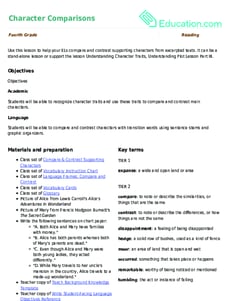
Character Comparisons
Lesson Plan
Character Comparisons
Fourth Grade
Reading
Use this lesson to help your ELs compare and contrast supporting characters from excerpted texts. It can be a stand-alone lesson or support the lesson Understanding Character Traits, Understanding Plot Lesson Part III.
Lesson Plan
EL
Character Comparisons
Lesson Plan
Character Comparisons
Use this lesson to help your ELs compare and contrast supporting characters from excerpted texts. It can be a stand-alone lesson or support the lesson Understanding Character Traits, Understanding Plot Lesson Part III.
Fourth Grade
Reading
Lesson Plan
EL
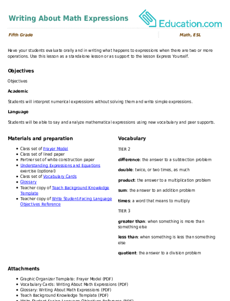
Writing About Math Expressions
Lesson Plan
Writing About Math Expressions
Fifth Grade
Have your students evaluate orally and in writing what happens to expressions when there are two or more operations. Use this lesson as a standalone lesson or as support to the lesson Express Yourself.
Lesson Plan
EL
Writing About Math Expressions
Lesson Plan
Writing About Math Expressions
Have your students evaluate orally and in writing what happens to expressions when there are two or more operations. Use this lesson as a standalone lesson or as support to the lesson Express Yourself.
Fifth Grade
Lesson Plan
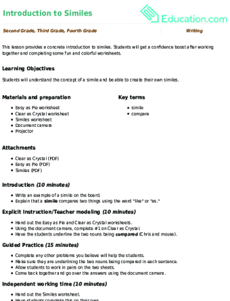
Introduction to Similes
Lesson Plan
Introduction to Similes
Second Grade
This lesson provides a concrete introduction to similes. Students will get a confidence boost after working together and completing some fun and colorful worksheets.
Lesson Plan
Introduction to Similes
Lesson Plan
Introduction to Similes
This lesson provides a concrete introduction to similes. Students will get a confidence boost after working together and completing some fun and colorful worksheets.
Second Grade
Lesson Plan
EL
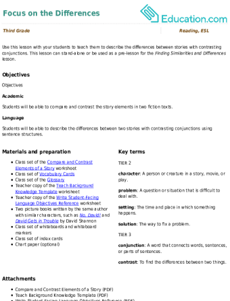
Focus on the Differences
Lesson Plan
Focus on the Differences
Third Grade
Reading
Use this lesson with your students to teach them to describe the differences between stories with contrasting conjunctions. This lesson can stand-alone or be used as a pre-lesson for the
Finding Similarities and Differences
lesson.
Lesson Plan
EL
Focus on the Differences
Lesson Plan
Focus on the Differences
Use this lesson with your students to teach them to describe the differences between stories with contrasting conjunctions. This lesson can stand-alone or be used as a pre-lesson for the
Finding Similarities and Differences
lesson.
Third Grade
Reading
Lesson Plan
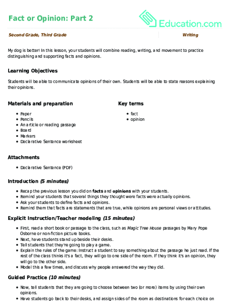
Fact or Opinion: Part 2
Lesson Plan
Fact or Opinion: Part 2
Second Grade
My dog is better! In this lesson, your students will combine reading, writing, and movement to practice distinguishing and supporting facts and opinions.
Lesson Plan
Fact or Opinion: Part 2
Lesson Plan
Fact or Opinion: Part 2
My dog is better! In this lesson, your students will combine reading, writing, and movement to practice distinguishing and supporting facts and opinions.
Second Grade
Lesson Plan
Learning About Family Traditions
Lesson Plan
Learning About Family Traditions
Kindergarten
Use this lesson to give your students an opportunity to share about their family traditions. Prior to the lesson, they'll complete a worksheet to gather information about the way their family honors their culture and beliefs with traditions. They'll bring their information back to the classroom to share with their peers.
Lesson Plan
Learning About Family Traditions
Lesson Plan
Learning About Family Traditions
Use this lesson to give your students an opportunity to share about their family traditions. Prior to the lesson, they'll complete a worksheet to gather information about the way their family honors their culture and beliefs with traditions. They'll bring their information back to the classroom to share with their peers.
Kindergarten
Lesson Plan
Calling All Characters!
Lesson Plan
Calling All Characters!
Third Grade
Come one, come all! In this lesson, reading and writing are intertwined as students determine a character's traits from the character's actions. Reading extends into creative writing as students imagine what a character might do next.
Lesson Plan
Calling All Characters!
Lesson Plan
Calling All Characters!
Come one, come all! In this lesson, reading and writing are intertwined as students determine a character's traits from the character's actions. Reading extends into creative writing as students imagine what a character might do next.
Third Grade
Lesson Plan
EL
Compound Sentences in Nonfiction
Lesson Plan
Compound Sentences in Nonfiction
Fourth Grade
Writing
This lesson helps your ELs identify the role of coordinating conjunctions and compound sentences in nonfiction texts. Use it as a stand-alone lesson or as a pre-lesson to Nonfiction Genres.
Lesson Plan
EL
Compound Sentences in Nonfiction
Lesson Plan
Compound Sentences in Nonfiction
This lesson helps your ELs identify the role of coordinating conjunctions and compound sentences in nonfiction texts. Use it as a stand-alone lesson or as a pre-lesson to Nonfiction Genres.
Fourth Grade
Writing
Lesson Plan
Asking and Answering Questions
Lesson Plan
Asking and Answering Questions
Second Grade
This lesson helps students learn about asking and answering questions about a text. It also exposes them to valuable lessons about trying to figure out their dreams and not giving up along the way.
Lesson Plan
Asking and Answering Questions
Lesson Plan
Asking and Answering Questions
This lesson helps students learn about asking and answering questions about a text. It also exposes them to valuable lessons about trying to figure out their dreams and not giving up along the way.
Second Grade
Lesson Plan
EL
Characters and Dialogue
Lesson Plan
Characters and Dialogue
Third Grade
Writing
Help your ELs identify the characters and their dialogue in a story. This lesson can stand alone or be used as a pre-lesson for the
Action! Students Create Reader’s Theater
lesson.
Lesson Plan
EL
Characters and Dialogue
Lesson Plan
Characters and Dialogue
Help your ELs identify the characters and their dialogue in a story. This lesson can stand alone or be used as a pre-lesson for the
Action! Students Create Reader’s Theater
lesson.
Third Grade
Writing
Lesson Plan
EL
Main Idea and Supporting Evidence
Lesson Plan
Main Idea and Supporting Evidence
Fourth Grade
Use this lesson to help your ELs identify the main idea and supporting evidence in a short fictional text. It can be a stand-alone lesson or used as support for the lesson Reading Closely.
Lesson Plan
EL
Main Idea and Supporting Evidence
Lesson Plan
Main Idea and Supporting Evidence
Use this lesson to help your ELs identify the main idea and supporting evidence in a short fictional text. It can be a stand-alone lesson or used as support for the lesson Reading Closely.
Fourth Grade
Lesson Plan
Endangered Species Exploration
Lesson Plan
Endangered Species Exploration
Fourth Grade
Reading
Teach your students the importance of text features with informational readings about endangered species around the world. This lesson on wildlife doubles as a great way for young learners to hone their reading comprehension skills.
Lesson Plan
Endangered Species Exploration
Lesson Plan
Endangered Species Exploration
Teach your students the importance of text features with informational readings about endangered species around the world. This lesson on wildlife doubles as a great way for young learners to hone their reading comprehension skills.
Fourth Grade
Reading
Lesson Plan
The Sound of Silence
Lesson Plan
The Sound of Silence
Fourth Grade
Students will read a story and listen to a song to explore the sound of silence, its meaning, and significance. They will share their experience and reflect on how and why silence or space can be important.
Lesson Plan
The Sound of Silence
Lesson Plan
The Sound of Silence
Students will read a story and listen to a song to explore the sound of silence, its meaning, and significance. They will share their experience and reflect on how and why silence or space can be important.
Fourth Grade
Lesson Plan
Let’s Get Irregular
Lesson Plan
Let’s Get Irregular
Second Grade
Second graders know about plural nouns, but things get trickier when they are introduced to irregular forms. In this lesson, students will receive an introduction to irregular plural nouns.
Lesson Plan
Let’s Get Irregular
Lesson Plan
Let’s Get Irregular
Second graders know about plural nouns, but things get trickier when they are introduced to irregular forms. In this lesson, students will receive an introduction to irregular plural nouns.
Second Grade
Lesson Plan
Poetry Harvest
Lesson Plan
Poetry Harvest
Fifth Grade
Looking for a fun way to assess your students' knowledge of poetry? Try having a poetry harvest! With fun decorations, unexpected elements, and activity-based workstations, this fun test is sure to get your students excited.
Lesson Plan
Poetry Harvest
Lesson Plan
Poetry Harvest
Looking for a fun way to assess your students' knowledge of poetry? Try having a poetry harvest! With fun decorations, unexpected elements, and activity-based workstations, this fun test is sure to get your students excited.
Fifth Grade
Lesson Plan
Running On: Copy Editing for Run-on Sentences
Lesson Plan
Running On: Copy Editing for Run-on Sentences
Third Grade
Writing
Equip your students to stop run-on sentences with punctuation and capitalization! In this lesson, your students will explore copyediting symbols for capitalization and punctuation and use these symbols as they edit writing.
Lesson Plan
Running On: Copy Editing for Run-on Sentences
Lesson Plan
Running On: Copy Editing for Run-on Sentences
Equip your students to stop run-on sentences with punctuation and capitalization! In this lesson, your students will explore copyediting symbols for capitalization and punctuation and use these symbols as they edit writing.
Third Grade
Writing
Lesson Plan
Text Features: Reading that Makes Sense
Lesson Plan
Text Features: Reading that Makes Sense
Third Grade
Reading
Improve your students' comprehension of non-fictional reading through this lesson that teaches them about text features. Students will find their own text features and explain why they aid in the reading process.
Lesson Plan
Text Features: Reading that Makes Sense
Lesson Plan
Text Features: Reading that Makes Sense
Improve your students' comprehension of non-fictional reading through this lesson that teaches them about text features. Students will find their own text features and explain why they aid in the reading process.
Third Grade
Reading
Lesson Plan
A Picture Is Worth a Thousand Words: Connecting Text and Illustrations
Lesson Plan
A Picture Is Worth a Thousand Words: Connecting Text and Illustrations
Fourth Grade
By analzying picture books, students will make connections between the text and the illustrations of a story. They will compare and contrast the text and the illustrations and reflect upon how they impact their comprehension of a text.
Lesson Plan
A Picture Is Worth a Thousand Words: Connecting Text and Illustrations
Lesson Plan
A Picture Is Worth a Thousand Words: Connecting Text and Illustrations
By analzying picture books, students will make connections between the text and the illustrations of a story. They will compare and contrast the text and the illustrations and reflect upon how they impact their comprehension of a text.
Fourth Grade
Lesson Plan
Multiply Decimals with Models
Lesson Plan
Multiply Decimals with Models
Fifth Grade
How well do your students know decimals? In this lesson, introduce your students to decimal multiplication using models.
Lesson Plan
Multiply Decimals with Models
Lesson Plan
Multiply Decimals with Models
How well do your students know decimals? In this lesson, introduce your students to decimal multiplication using models.
Fifth Grade
Lesson Plan
Same Sounds: Homophones
Lesson Plan
Same Sounds: Homophones
Third Grade
Can you hear the words here? Help your students distinguish homophones with this lesson. They'll be identifying the correct words in no time!
Lesson Plan
Same Sounds: Homophones
Lesson Plan
Same Sounds: Homophones
Can you hear the words here? Help your students distinguish homophones with this lesson. They'll be identifying the correct words in no time!
Third Grade
Lesson Plan
Red Light, Green Light Questions
Lesson Plan
Red Light, Green Light Questions
Third Grade
Statistics
Teach your students to ask and differentiate between recall questions and inferential questions. This lesson will help build a classroom culture around asking deep, inferential questions.
Lesson Plan
Red Light, Green Light Questions
Lesson Plan
Red Light, Green Light Questions
Teach your students to ask and differentiate between recall questions and inferential questions. This lesson will help build a classroom culture around asking deep, inferential questions.
Third Grade
Statistics
Lesson Plan
Idiom Pictionary and Charades
Lesson Plan
Idiom Pictionary and Charades
Fourth Grade
Idioms can be a pain in the neck to understand! Help your students become acquainted with many of the English language's funny and confusing idioms in this lesson that has them using their creativity to act out or illustrate idioms.
Lesson Plan
Idiom Pictionary and Charades
Lesson Plan
Idiom Pictionary and Charades
Idioms can be a pain in the neck to understand! Help your students become acquainted with many of the English language's funny and confusing idioms in this lesson that has them using their creativity to act out or illustrate idioms.
Fourth Grade
Lesson Plan
Battle of the Texts: Print vs. Electronics
Lesson Plan
Battle of the Texts: Print vs. Electronics
Fourth Grade
Are you a page turner or a mouse clicker? In this lesson, students compare and contrast text features in two types of nonfictions texts: print and electronic.
Lesson Plan
Battle of the Texts: Print vs. Electronics
Lesson Plan
Battle of the Texts: Print vs. Electronics
Are you a page turner or a mouse clicker? In this lesson, students compare and contrast text features in two types of nonfictions texts: print and electronic.
Fourth Grade
Lesson Plan
Associating Adjectives
Lesson Plan
Associating Adjectives
Fourth Grade
Can your students associate similar adjectives and nouns using the roots and suffixes? In this lesson, students will learn how to associate nouns with adjectives. Along the way, they will use the roots and affixes to determine the meaning.
Lesson Plan
Associating Adjectives
Lesson Plan
Associating Adjectives
Can your students associate similar adjectives and nouns using the roots and suffixes? In this lesson, students will learn how to associate nouns with adjectives. Along the way, they will use the roots and affixes to determine the meaning.
Fourth Grade
Lesson Plan
EL
Compare with Adjectives
Lesson Plan
Compare with Adjectives
First Grade
Which traits do your students share with their favorite characters? Find out as you introduce new adjectives! This lesson can be used alone or with the lesson plan All About Me: Character Traits.
Lesson Plan
EL
Compare with Adjectives
Lesson Plan
Compare with Adjectives
Which traits do your students share with their favorite characters? Find out as you introduce new adjectives! This lesson can be used alone or with the lesson plan All About Me: Character Traits.
First Grade
Lesson Plan
Growing by Powers of Ten
Lesson Plan
Growing by Powers of Ten
Fifth Grade
Multiplication
Make multiplying by powers of ten more accessible to your students by focusing on patterns in the number of zeros!
Lesson Plan
Growing by Powers of Ten
Lesson Plan
Growing by Powers of Ten
Make multiplying by powers of ten more accessible to your students by focusing on patterns in the number of zeros!
Fifth Grade
Multiplication
Lesson Plan
Use Your Mind and Visualize!
Lesson Plan
Use Your Mind and Visualize!
Kindergarten
Help students learn the crucial reading strategy of visualizing. Visualizing is a key component of learning to infer from a text. Kids will love using their imagination and drawing pictures of their visualizations.
Lesson Plan
Use Your Mind and Visualize!
Lesson Plan
Use Your Mind and Visualize!
Help students learn the crucial reading strategy of visualizing. Visualizing is a key component of learning to infer from a text. Kids will love using their imagination and drawing pictures of their visualizations.
Kindergarten
Lesson Plan
EL
Sharing Facts from Nonfiction
Lesson Plan
Sharing Facts from Nonfiction
First Grade
Tap into children's curiosity by having them record and share key details found in nonfiction texts! This lesson can be used alone or with the Nonfiction Reading: Learning and Recording New Information lesson plan.
Lesson Plan
EL
Sharing Facts from Nonfiction
Lesson Plan
Sharing Facts from Nonfiction
Tap into children's curiosity by having them record and share key details found in nonfiction texts! This lesson can be used alone or with the Nonfiction Reading: Learning and Recording New Information lesson plan.
First Grade
Lesson Plan
1
…
16
17
18
…
81