1st Grade Common Core Equal Parts Lesson Plans
Common Core Quick Links:
Common Core Standards for 1st Grade Math, Common Core Standards for 1st Grade ELA
2 results
Math
✕1st Grade
✕Lesson Plans
✕Common Core
✕2 results
Subtopics:
1st Grade Common Core Equal Parts Lesson Plans
Common Core Quick Links:
Common Core Standards for 1st Grade Math, Common Core Standards for 1st Grade ELA2 results
Math
✕1st Grade
✕Lesson Plans
✕Common Core
✕2 results


About 1st Grade Common Core Equal Parts Lesson Plans
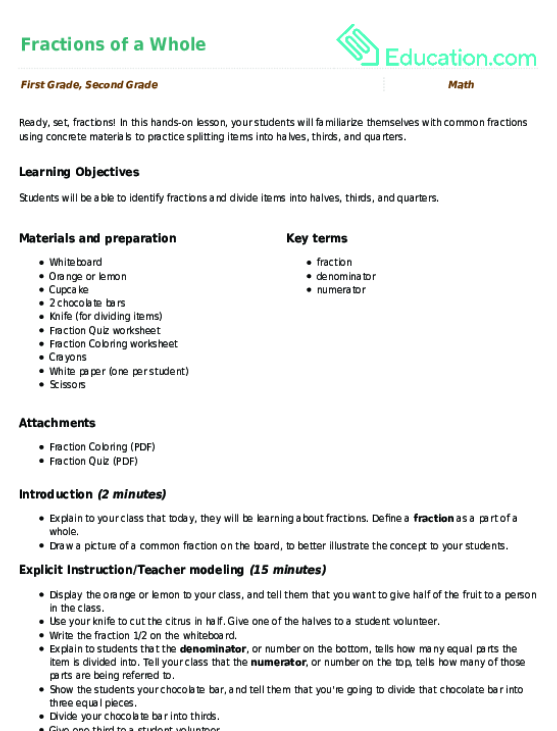
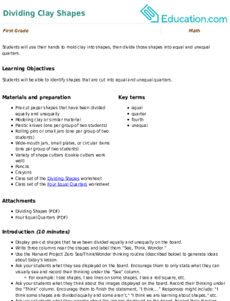
On Education.com, 1st Grade Common Core Equal Parts lesson plans introduce young students to the concept of partitioning circles and rectangles into two and four equal shares, using hands-on activities like folding paper, dividing fruit, or measuring shapes. These lessons help children understand fractions by visualizing and working with parts of a whole, reinforcing foundational math skills for future learning.
This website offers a variety of teaching resources, including printable worksheets, interactive games, and activity ideas that support 1.G.A.3. Educators and parents can access materials that guide students through identifying halves and fourths, using familiar objects such as snack food, Play-Doh, and craft projects to make learning engaging and practical.
Using these lesson plans at school or home, educators and parents can provide structured, experiential learning that builds students' understanding of equal parts, fractions, and related vocabulary. This approach makes abstract concepts concrete, encourages critical thinking, and fosters confidence in early math abilities.
This website offers a variety of teaching resources, including printable worksheets, interactive games, and activity ideas that support 1.G.A.3. Educators and parents can access materials that guide students through identifying halves and fourths, using familiar objects such as snack food, Play-Doh, and craft projects to make learning engaging and practical.
Using these lesson plans at school or home, educators and parents can provide structured, experiential learning that builds students' understanding of equal parts, fractions, and related vocabulary. This approach makes abstract concepts concrete, encourages critical thinking, and fosters confidence in early math abilities.