SKIP TO CONTENT
Worksheet Generator
Subjects
Grades
Worksheets
Games
Build a Worksheet
More Resources
Roly Recommends
Art Contest
Subjects
Grades
Worksheets
Games
Build a Worksheet
More Resources
Roly Recommends
Art Contest
1st - 4th Grade Lesson Plans : Page 10
Filters
1,670 results
Lesson Plans
✕
1st - 4th Grade
✕
Clear all
1,670 results
Filters
Lesson Plans
✕
1st - 4th Grade
✕
Subjects
Math
English Language Arts
Science
Social Studies
Technology
Grade Level
Pre-K
K
1st
2nd
3rd
4th
5th
6th
7th
8th
Early Childhood
Elementary School
Middle School
Resource Type
Worksheets
Games
Lesson Plans
Interactive Worksheets
Workbooks
Activities
Exercises
Stories
Songs
Offline Games
Guided Lessons
Teacher Resources
Teacher Editions
Occasion
Back to School
Common Core
Yes
Roly Recommends
Social Emotional Learning
English Language Support
Yes
Clear all
View 1,670 results
1st - 4th Grade Lesson Plans : Page 10
Filters
1,670 results
Lesson Plans
✕
1st - 4th Grade
✕
Clear all
1,670 results
Onomatopoeia: Bing, Bam, Boom!
Lesson Plan
Onomatopoeia: Bing, Bam, Boom!
Third Grade
Bing! Bam! Boom! In this bombastic lesson, students will learn about onomatopoeia and create word art to describe the sounds these words make.
Lesson Plan
Onomatopoeia: Bing, Bam, Boom!
Lesson Plan
Onomatopoeia: Bing, Bam, Boom!
Bing! Bam! Boom! In this bombastic lesson, students will learn about onomatopoeia and create word art to describe the sounds these words make.
Third Grade
Lesson Plan
What's Your Opinion?
Lesson Plan
What's Your Opinion?
Third Grade
Writing
Being able to express and support opinions is greatly beneficial for young learners. This lesson plan includes fun exercises to help students learn about opinions and write supporting statements for their own opinions.
Lesson Plan
What's Your Opinion?
Lesson Plan
What's Your Opinion?
Being able to express and support opinions is greatly beneficial for young learners. This lesson plan includes fun exercises to help students learn about opinions and write supporting statements for their own opinions.
Third Grade
Writing
Lesson Plan
Reviewing the Research Process
Lesson Plan
Reviewing the Research Process
Fourth Grade
Writing a research paper is a huge undertaking. Getting curious about your topic and breaking it down into steps makes it more inviting and doable. Use this lesson to review the research process.
Lesson Plan
Reviewing the Research Process
Lesson Plan
Reviewing the Research Process
Writing a research paper is a huge undertaking. Getting curious about your topic and breaking it down into steps makes it more inviting and doable. Use this lesson to review the research process.
Fourth Grade
Lesson Plan
Same Sounds: Homophones
Lesson Plan
Same Sounds: Homophones
Third Grade
Can you hear the words here? Help your students distinguish homophones with this lesson. They'll be identifying the correct words in no time!
Lesson Plan
Same Sounds: Homophones
Lesson Plan
Same Sounds: Homophones
Can you hear the words here? Help your students distinguish homophones with this lesson. They'll be identifying the correct words in no time!
Third Grade
Lesson Plan
Sequencing: Order in the Court!
Lesson Plan
Sequencing: Order in the Court!
Third Grade
Writing
This lesson gives students the chance to demonstrate and reinforce their knowledge of sequencing. Have them role play a fantasy text to practice sequencing!
Lesson Plan
Sequencing: Order in the Court!
Lesson Plan
Sequencing: Order in the Court!
This lesson gives students the chance to demonstrate and reinforce their knowledge of sequencing. Have them role play a fantasy text to practice sequencing!
Third Grade
Writing
Lesson Plan
My Teacher for President!
Lesson Plan
My Teacher for President!
Second Grade
Writing
Need a promotion? Then have your students participate in a writing lesson that will have them voting for you! Give students the opportunity to place teachers in the spotlight, as they persuade others why teachers make the best presidents.
Lesson Plan
My Teacher for President!
Lesson Plan
My Teacher for President!
Need a promotion? Then have your students participate in a writing lesson that will have them voting for you! Give students the opportunity to place teachers in the spotlight, as they persuade others why teachers make the best presidents.
Second Grade
Writing
Lesson Plan
Literary Argument Writing: Defining Your Topic
Lesson Plan
Literary Argument Writing: Defining Your Topic
Fourth Grade
Writing
This lesson will help your young writers develop a claim, or thesis, and construct an argument around it. You may have students complete the essay by continuing the process with the lesson Literary Argument Writing: Drafting Your Essay.
Lesson Plan
Literary Argument Writing: Defining Your Topic
Lesson Plan
Literary Argument Writing: Defining Your Topic
This lesson will help your young writers develop a claim, or thesis, and construct an argument around it. You may have students complete the essay by continuing the process with the lesson Literary Argument Writing: Drafting Your Essay.
Fourth Grade
Writing
Lesson Plan
Red Light, Green Light Questions
Lesson Plan
Red Light, Green Light Questions
Third Grade
Statistics
Teach your students to ask and differentiate between recall questions and inferential questions. This lesson will help build a classroom culture around asking deep, inferential questions.
Lesson Plan
Red Light, Green Light Questions
Lesson Plan
Red Light, Green Light Questions
Teach your students to ask and differentiate between recall questions and inferential questions. This lesson will help build a classroom culture around asking deep, inferential questions.
Third Grade
Statistics
Lesson Plan
Onomatopoeia Poetry
Lesson Plan
Onomatopoeia Poetry
Third Grade
Pop, whoosh, ding! Onomatopoeia is a writing technique that makes text come alive. In this lesson, students will learn about onomatopoeia, and apply it to their writing process to create poetry, as a class and individually.
Lesson Plan
Onomatopoeia Poetry
Lesson Plan
Onomatopoeia Poetry
Pop, whoosh, ding! Onomatopoeia is a writing technique that makes text come alive. In this lesson, students will learn about onomatopoeia, and apply it to their writing process to create poetry, as a class and individually.
Third Grade
Lesson Plan
EL
Compare with Adjectives
Lesson Plan
Compare with Adjectives
First Grade
Which traits do your students share with their favorite characters? Find out as you introduce new adjectives! This lesson can be used alone or with the lesson plan All About Me: Character Traits.
Lesson Plan
EL
Compare with Adjectives
Lesson Plan
Compare with Adjectives
Which traits do your students share with their favorite characters? Find out as you introduce new adjectives! This lesson can be used alone or with the lesson plan All About Me: Character Traits.
First Grade
Lesson Plan
What's Your Phase?
Lesson Plan
What's Your Phase?
Third Grade
Earth and Space Science
This lesson engages students in activity to help them understand the phases of the Moon, and why they occur. Students read literature, analyze it, and then apply it to the small group performance of one cycle of the Moon’s phases.
Lesson Plan
What's Your Phase?
Lesson Plan
What's Your Phase?
This lesson engages students in activity to help them understand the phases of the Moon, and why they occur. Students read literature, analyze it, and then apply it to the small group performance of one cycle of the Moon’s phases.
Third Grade
Earth and Space Science
Lesson Plan
Battle of the Texts: Print vs. Electronics
Lesson Plan
Battle of the Texts: Print vs. Electronics
Fourth Grade
Are you a page turner or a mouse clicker? In this lesson, students compare and contrast text features in two types of nonfictions texts: print and electronic.
Lesson Plan
Battle of the Texts: Print vs. Electronics
Lesson Plan
Battle of the Texts: Print vs. Electronics
Are you a page turner or a mouse clicker? In this lesson, students compare and contrast text features in two types of nonfictions texts: print and electronic.
Fourth Grade
Lesson Plan
Completing Sentences
Lesson Plan
Completing Sentences
Third Grade
If your students are drawn to using
and
or
because
at the beginning of their sentences, then this lesson is for you! With this lesson, you will empower your students to combine words and phrases to create single sentences.
Lesson Plan
Completing Sentences
Lesson Plan
Completing Sentences
If your students are drawn to using
and
or
because
at the beginning of their sentences, then this lesson is for you! With this lesson, you will empower your students to combine words and phrases to create single sentences.
Third Grade
Lesson Plan
Associating Adjectives
Lesson Plan
Associating Adjectives
Fourth Grade
Can your students associate similar adjectives and nouns using the roots and suffixes? In this lesson, students will learn how to associate nouns with adjectives. Along the way, they will use the roots and affixes to determine the meaning.
Lesson Plan
Associating Adjectives
Lesson Plan
Associating Adjectives
Can your students associate similar adjectives and nouns using the roots and suffixes? In this lesson, students will learn how to associate nouns with adjectives. Along the way, they will use the roots and affixes to determine the meaning.
Fourth Grade
Lesson Plan
Use Your Mind and Visualize!
Lesson Plan
Use Your Mind and Visualize!
Kindergarten
Help students learn the crucial reading strategy of visualizing. Visualizing is a key component of learning to infer from a text. Kids will love using their imagination and drawing pictures of their visualizations.
Lesson Plan
Use Your Mind and Visualize!
Lesson Plan
Use Your Mind and Visualize!
Help students learn the crucial reading strategy of visualizing. Visualizing is a key component of learning to infer from a text. Kids will love using their imagination and drawing pictures of their visualizations.
Kindergarten
Lesson Plan
What’s Your Angle?
Lesson Plan
What’s Your Angle?
Third Grade
Obtuse, acute, and right angles, oh my! In this hands-on lesson, students will learn about different kinds of angles through motion. Mastering this pre-geometry skill will help kids tackle advanced math as they get older.
Lesson Plan
What’s Your Angle?
Lesson Plan
What’s Your Angle?
Obtuse, acute, and right angles, oh my! In this hands-on lesson, students will learn about different kinds of angles through motion. Mastering this pre-geometry skill will help kids tackle advanced math as they get older.
Third Grade
Lesson Plan
How My Life Will Be
Lesson Plan
How My Life Will Be
First Grade
Writing
It's never to early to start dreaming about the future! In this lesson, engage your students in thinking about how their lives will be, all while practicing persuasive writing and using future tense verbs!
Lesson Plan
How My Life Will Be
Lesson Plan
How My Life Will Be
It's never to early to start dreaming about the future! In this lesson, engage your students in thinking about how their lives will be, all while practicing persuasive writing and using future tense verbs!
First Grade
Writing
Lesson Plan
Is It True?
Lesson Plan
Is It True?
Fourth Grade
Don't believe everything you read! Teach students to differentiate between statements of fact and opinion. This important skill will help students become critical and discerning readers.
Lesson Plan
Is It True?
Lesson Plan
Is It True?
Don't believe everything you read! Teach students to differentiate between statements of fact and opinion. This important skill will help students become critical and discerning readers.
Fourth Grade
Lesson Plan
Mapping My Heart
Lesson Plan
Mapping My Heart
Third Grade
Love is in the air! This Valentine's Day lesson helps your students practice brainstorming. They will use a heart as a visual to record important things in their lives that they could potentially write about.
Lesson Plan
Mapping My Heart
Lesson Plan
Mapping My Heart
Love is in the air! This Valentine's Day lesson helps your students practice brainstorming. They will use a heart as a visual to record important things in their lives that they could potentially write about.
Third Grade
Lesson Plan
Elements of Traditional Literature
Lesson Plan
Elements of Traditional Literature
Second Grade
Reading
Teach your class about the genre of traditional literature, made up of stories from around the world that have been told for generations. In this lesson, students will read fairy tales and compare story elements in each piece of literature.
Lesson Plan
Elements of Traditional Literature
Lesson Plan
Elements of Traditional Literature
Teach your class about the genre of traditional literature, made up of stories from around the world that have been told for generations. In this lesson, students will read fairy tales and compare story elements in each piece of literature.
Second Grade
Reading
Lesson Plan
Color by Sum: A Valentine's Day Math and Art Activity
Lesson Plan
Color by Sum: A Valentine's Day Math and Art Activity
First Grade
In this fun Valentine’s Day lesson plan, students will practice addition facts up to 10 and then use the sums to design their own Valentine’s Day-themed color by sum worksheet to trade with a partner.
Lesson Plan
Color by Sum: A Valentine's Day Math and Art Activity
Lesson Plan
Color by Sum: A Valentine's Day Math and Art Activity
In this fun Valentine’s Day lesson plan, students will practice addition facts up to 10 and then use the sums to design their own Valentine’s Day-themed color by sum worksheet to trade with a partner.
First Grade
Lesson Plan
Letter Roll Reading: Blending Sounds
Lesson Plan
Letter Roll Reading: Blending Sounds
Kindergarten
Phonics
Read and roll! This interactive game can be used as an engaging activity or an assessment tool that allows you to easily monitor your students’ ability to blend phonemes together to create words.
Lesson Plan
Letter Roll Reading: Blending Sounds
Lesson Plan
Letter Roll Reading: Blending Sounds
Read and roll! This interactive game can be used as an engaging activity or an assessment tool that allows you to easily monitor your students’ ability to blend phonemes together to create words.
Kindergarten
Phonics
Lesson Plan
Sums for Mixed Numbers and Improper Fractions
Lesson Plan
Sums for Mixed Numbers and Improper Fractions
Third Grade
Teach your students to add mixed numbers and improper fractions with the same denominator using the counting up strategy with number lines.
Lesson Plan
Sums for Mixed Numbers and Improper Fractions
Lesson Plan
Sums for Mixed Numbers and Improper Fractions
Teach your students to add mixed numbers and improper fractions with the same denominator using the counting up strategy with number lines.
Third Grade
Lesson Plan
How Do You Solve a Problem?
Lesson Plan
How Do You Solve a Problem?
Third Grade
Some problems are easy to fix, while some are more complicated. Use this lesson to teach your students to identify the characters’ attempts in a story to solve problems.
Lesson Plan
How Do You Solve a Problem?
Lesson Plan
How Do You Solve a Problem?
Some problems are easy to fix, while some are more complicated. Use this lesson to teach your students to identify the characters’ attempts in a story to solve problems.
Third Grade
Lesson Plan
Determining Relative Size: Measure Up!
Lesson Plan
Determining Relative Size: Measure Up!
First Grade
The world is their measuring stick! In this lesson, students will practice measuring objects using the world around them for units of measurement.
Lesson Plan
Determining Relative Size: Measure Up!
Lesson Plan
Determining Relative Size: Measure Up!
The world is their measuring stick! In this lesson, students will practice measuring objects using the world around them for units of measurement.
First Grade
Lesson Plan
Wowza Word Walls!
Lesson Plan
Wowza Word Walls!
First Grade
Students will use the classroom word wall to read and spell tricky sight words.
Lesson Plan
Wowza Word Walls!
Lesson Plan
Wowza Word Walls!
Students will use the classroom word wall to read and spell tricky sight words.
First Grade
Lesson Plan
EL
Circles in a Cup
Lesson Plan
Circles in a Cup
First Grade
Addition
Help students visualize the missing addend in an addition problem with this fun game. Use this scaffolded EL lesson alone or for more practice before teaching the
Mystery Addends: Representing Word Problems
lesson.
Lesson Plan
EL
Circles in a Cup
Lesson Plan
Circles in a Cup
Help students visualize the missing addend in an addition problem with this fun game. Use this scaffolded EL lesson alone or for more practice before teaching the
Mystery Addends: Representing Word Problems
lesson.
First Grade
Addition
Lesson Plan
EL
Solving Elapsed Time Word Problems
Lesson Plan
Solving Elapsed Time Word Problems
Third Grade
Get your students thinking about how the number line and the word problem are related! Use this lesson alongside
Get There On Time: Elapsed Time Word Problems
or on its own.
Lesson Plan
EL
Solving Elapsed Time Word Problems
Lesson Plan
Solving Elapsed Time Word Problems
Get your students thinking about how the number line and the word problem are related! Use this lesson alongside
Get There On Time: Elapsed Time Word Problems
or on its own.
Third Grade
Lesson Plan
Readers Record Their Thinking
Lesson Plan
Readers Record Their Thinking
First Grade
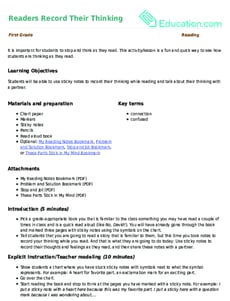
It is important for students to stop and think as they read. This activity/lesson is a fun and quick way to see how students are thinking as they read.
Lesson Plan
Readers Record Their Thinking
Lesson Plan
Readers Record Their Thinking
It is important for students to stop and think as they read. This activity/lesson is a fun and quick way to see how students are thinking as they read.
First Grade
Lesson Plan
EL
Multiples and Skip Counting
Lesson Plan
Multiples and Skip Counting
Fourth Grade
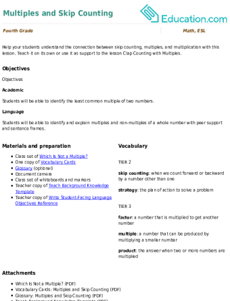
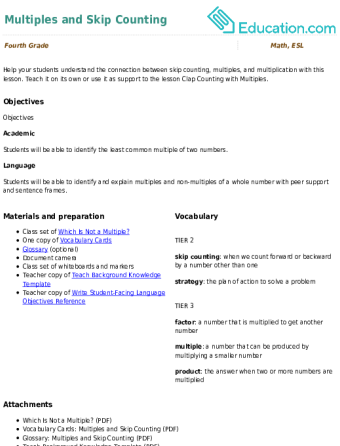
Help your students understand the connection between skip counting, multiples, and multiplication with this lesson. Teach it on its own or use it as support to the lesson Clap Counting with Multiples.
Lesson Plan
EL
Multiples and Skip Counting
Lesson Plan
Multiples and Skip Counting
Help your students understand the connection between skip counting, multiples, and multiplication with this lesson. Teach it on its own or use it as support to the lesson Clap Counting with Multiples.
Fourth Grade
Lesson Plan
1
…
9
10
11
…
56