SKIP TO CONTENT
Worksheet Generator
Subjects
Grades
Worksheets
Games
Build a Worksheet
More Resources
Roly Recommends
Halloween
Subjects
Grades
Worksheets
Games
Build a Worksheet
More Resources
Roly Recommends
Halloween
Lesson Plans for 'packet 1' : Page 5
Filters
2,364 results
Search for: packet, 1
✕
Lesson Plans
✕
Clear all
2,364 results
Filters
Search for: packet, 1
✕
Lesson Plans
✕
Subjects
Math
English Language Arts
Science
Social Studies
Technology
Grade Level
Pre-K
K
1st
2nd
3rd
4th
5th
6th
7th
8th
Early Childhood
Elementary School
Middle School
Resource Type
Worksheets
Games
Lesson Plans
Interactive Worksheets
Workbooks
Activities
Exercises
Stories
Songs
Offline Games
Guided Lessons
Teacher Resources
Teacher Editions
Occasion
Back to School
Black History Month
Common Core
Yes
Roly Recommends
Social Emotional Learning
English Language Support
Yes
Clear all
View 2,364 results
Lesson Plans for 'packet 1' : Page 5
Filters
2,364 results
Search for: packet, 1
✕
Lesson Plans
✕
Clear all
2,364 results
EL
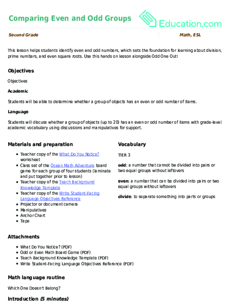
Comparing Even and Odd Groups
Lesson Plan
Comparing Even and Odd Groups
Second Grade
This lesson helps students identify even and odd numbers, which sets the foundation for learning about division, prime numbers, and even square roots. Use this hands on lesson alongside Odd One Out!
Lesson Plan
EL
Comparing Even and Odd Groups
Lesson Plan
Comparing Even and Odd Groups
This lesson helps students identify even and odd numbers, which sets the foundation for learning about division, prime numbers, and even square roots. Use this hands on lesson alongside Odd One Out!
Second Grade
Lesson Plan
EL
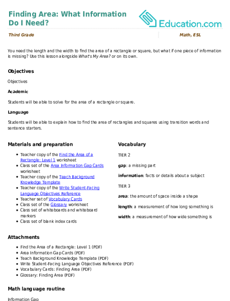
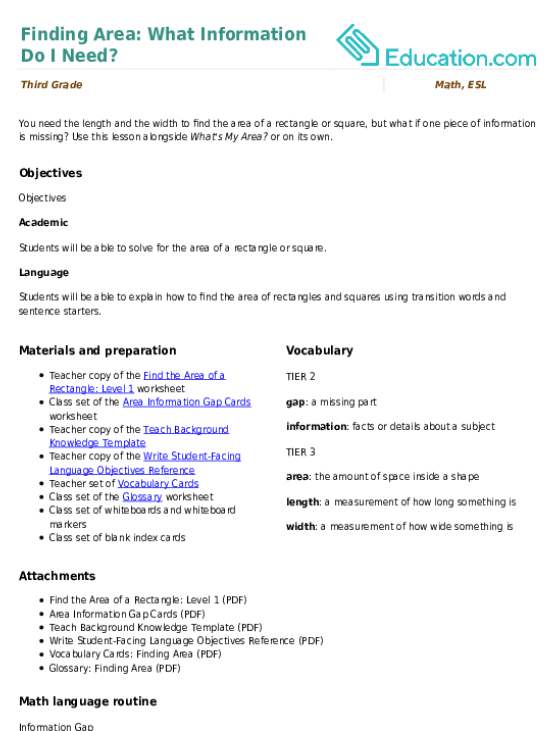
Finding Area: What Information Do I Need?
Lesson Plan
Finding Area: What Information Do I Need?
Third Grade
You need the length and the width to find the area of a rectangle or square, but what if one piece of information is missing? Use this lesson alongside
What's My Area?
or on its own.
Lesson Plan
EL
Finding Area: What Information Do I Need?
Lesson Plan
Finding Area: What Information Do I Need?
You need the length and the width to find the area of a rectangle or square, but what if one piece of information is missing? Use this lesson alongside
What's My Area?
or on its own.
Third Grade
Lesson Plan
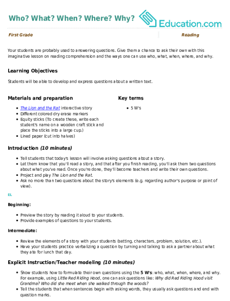
Who? What? When? Where? Why?
Lesson Plan
Who? What? When? Where? Why?
First Grade
Your students are probably used to answering questions. Give them a chance to ask their own with this imaginative lesson on reading comprehension and the ways one can use who, what, when, where, and why.
Lesson Plan
Who? What? When? Where? Why?
Lesson Plan
Who? What? When? Where? Why?
Your students are probably used to answering questions. Give them a chance to ask their own with this imaginative lesson on reading comprehension and the ways one can use who, what, when, where, and why.
First Grade
Lesson Plan
What's Your Phase?
Lesson Plan
What's Your Phase?
Third Grade
Earth and Space Science
This lesson engages students in activity to help them understand the phases of the Moon, and why they occur. Students read literature, analyze it, and then apply it to the small group performance of one cycle of the Moon’s phases.
Lesson Plan
What's Your Phase?
Lesson Plan
What's Your Phase?
This lesson engages students in activity to help them understand the phases of the Moon, and why they occur. Students read literature, analyze it, and then apply it to the small group performance of one cycle of the Moon’s phases.
Third Grade
Earth and Space Science
Lesson Plan
EL
Strategies for Multiplying by Multiples of 10
Lesson Plan
Strategies for Multiplying by Multiples of 10
Third Grade
Help your students become detail-oriented mathematicians as they explore two strategies for multiplying a one-digit number by a multiple of 10. Use this as a stand alone lesson or alongside
Multiplying by Multiples of 10.
Lesson Plan
EL
Strategies for Multiplying by Multiples of 10
Lesson Plan
Strategies for Multiplying by Multiples of 10
Help your students become detail-oriented mathematicians as they explore two strategies for multiplying a one-digit number by a multiple of 10. Use this as a stand alone lesson or alongside
Multiplying by Multiples of 10.
Third Grade
Lesson Plan
Living or Nonliving? How to Tell
Lesson Plan
Living or Nonliving? How to Tell
Second Grade
Life Science
One of the basic concepts in science is recognizing that all things can be classified as living or nonliving. In this lesson, your students will explore the characteristics of living and nonliving things with engaging hands-on activities.
Lesson Plan
Living or Nonliving? How to Tell
Lesson Plan
Living or Nonliving? How to Tell
One of the basic concepts in science is recognizing that all things can be classified as living or nonliving. In this lesson, your students will explore the characteristics of living and nonliving things with engaging hands-on activities.
Second Grade
Life Science
Lesson Plan
Chemistry Is Marie Curie
Lesson Plan
Chemistry Is Marie Curie
Fourth Grade
Reading
Marie Curie’s monumental achievements in chemistry and physics are remarkable. In this lesson, your students will read two accounts of her life, integrate the details, and assess the importance of having more than one source of information.
Lesson Plan
Chemistry Is Marie Curie
Lesson Plan
Chemistry Is Marie Curie
Marie Curie’s monumental achievements in chemistry and physics are remarkable. In this lesson, your students will read two accounts of her life, integrate the details, and assess the importance of having more than one source of information.
Fourth Grade
Reading
Lesson Plan
101 and Out!
Lesson Plan
101 and Out!
Second Grade
Get the dice out and help students get targeted practice in adding 1 and 10! In this fun place value game, students keep adding to try to get to a maximum score of 100. But be careful. If you go over 100 you’re out!
Lesson Plan
101 and Out!
Lesson Plan
101 and Out!
Get the dice out and help students get targeted practice in adding 1 and 10! In this fun place value game, students keep adding to try to get to a maximum score of 100. But be careful. If you go over 100 you’re out!
Second Grade
Lesson Plan
Parts of Speech: Interjections
Lesson Plan
Parts of Speech: Interjections
Fourth Grade
Grammar and Mechanics
Interjections, one of the eight parts of speech, can be the most exciting. They help students interject some fun and drama into their writing and conversations. In this lesson, they'll brainstorm how to use interjections in their sentences.
Lesson Plan
Parts of Speech: Interjections
Lesson Plan
Parts of Speech: Interjections
Interjections, one of the eight parts of speech, can be the most exciting. They help students interject some fun and drama into their writing and conversations. In this lesson, they'll brainstorm how to use interjections in their sentences.
Fourth Grade
Grammar and Mechanics
Lesson Plan
Graphing Data: Tally Marks and Bar Graphs
Lesson Plan
Graphing Data: Tally Marks and Bar Graphs
First Grade
Collecting and graphing data can be a fantastic tool for getting to know your students and for your students to get to know one another! In this lesson, students will poll their classmates to gather data and then graph the results!
Lesson Plan
Graphing Data: Tally Marks and Bar Graphs
Lesson Plan
Graphing Data: Tally Marks and Bar Graphs
Collecting and graphing data can be a fantastic tool for getting to know your students and for your students to get to know one another! In this lesson, students will poll their classmates to gather data and then graph the results!
First Grade
Lesson Plan
Parts of Speech and Using Suffixes to Turn Adjectives Into Nouns
Lesson Plan
Parts of Speech and Using Suffixes to Turn Adjectives Into Nouns
Fifth Grade
This engaging lesson will revisit the basic parts of speech and address why some words have can have more than one part of speech. Students will then enjoy a fun group challenge to turn adjectives into nouns by modifying the word endings.
Lesson Plan
Parts of Speech and Using Suffixes to Turn Adjectives Into Nouns
Lesson Plan
Parts of Speech and Using Suffixes to Turn Adjectives Into Nouns
This engaging lesson will revisit the basic parts of speech and address why some words have can have more than one part of speech. Students will then enjoy a fun group challenge to turn adjectives into nouns by modifying the word endings.
Fifth Grade
Lesson Plan
Flipped Coin
Lesson Plan
Flipped Coin
Fourth Grade
In this lesson, students will listen to, discuss, and understand two perspectives on a difficult situation. They will flip a coin, with each side representing one side of the story, and role-play the perspectives and reach a resolution.
Lesson Plan
Flipped Coin
Lesson Plan
Flipped Coin
In this lesson, students will listen to, discuss, and understand two perspectives on a difficult situation. They will flip a coin, with each side representing one side of the story, and role-play the perspectives and reach a resolution.
Fourth Grade
Lesson Plan
Short Vowel Name Sort
Lesson Plan
Short Vowel Name Sort
First Grade
Phonics
Short vowels can be found just about anywhere. One great place to look is inside your own classroom. In this lesson, students will enjoy going through the class list to sort the names of their peers based on short vowel sounds.
Lesson Plan
Short Vowel Name Sort
Lesson Plan
Short Vowel Name Sort
Short vowels can be found just about anywhere. One great place to look is inside your own classroom. In this lesson, students will enjoy going through the class list to sort the names of their peers based on short vowel sounds.
First Grade
Phonics
Lesson Plan
EL
Dividing with the Divvy Out Method
Lesson Plan
Dividing with the Divvy Out Method
Fourth Grade
Share the divvy out method for division and provide a foundation for learning the partial quotients method. This lesson can be used on its own or as support for Using the Partial Quotients Strategy for Division with One-Digit Divisors.
Lesson Plan
EL
Dividing with the Divvy Out Method
Lesson Plan
Dividing with the Divvy Out Method
Share the divvy out method for division and provide a foundation for learning the partial quotients method. This lesson can be used on its own or as support for Using the Partial Quotients Strategy for Division with One-Digit Divisors.
Fourth Grade
Lesson Plan
Using Adjectives and Verbs to Make Writing Come to Life
Lesson Plan
Using Adjectives and Verbs to Make Writing Come to Life
Fourth Grade
Writing
Imagery is one of the most important tools in a narrative writer's arsenal. In this lesson, students will will learn to craft vivid scenes by selecting powerful verbs and adjectives, as well as to critique descriptive writing using the same criteria.
Lesson Plan
Using Adjectives and Verbs to Make Writing Come to Life
Lesson Plan
Using Adjectives and Verbs to Make Writing Come to Life
Imagery is one of the most important tools in a narrative writer's arsenal. In this lesson, students will will learn to craft vivid scenes by selecting powerful verbs and adjectives, as well as to critique descriptive writing using the same criteria.
Fourth Grade
Writing
Lesson Plan
Slice it Up! (Part Two)
Lesson Plan
Slice it Up! (Part Two)
Second Grade
Fractions
Slice those pieces and mix it up! In this lesson that follows “Slice It Up! Part One,” students will begin recognizing different ways to create equal shares in whole shapes, creating a fraction poster by the end of the lesson.
Lesson Plan
Slice it Up! (Part Two)
Lesson Plan
Slice it Up! (Part Two)
Slice those pieces and mix it up! In this lesson that follows “Slice It Up! Part One,” students will begin recognizing different ways to create equal shares in whole shapes, creating a fraction poster by the end of the lesson.
Second Grade
Fractions
Lesson Plan
All About Me: A Kindergarten Report
Lesson Plan
All About Me: A Kindergarten Report
Kindergarten
I am me, and there's no one else I'd rather be! Your students will love sharing about their lives as they write a report all about them. Young writers will practice using their very best handwriting as they fill out colorful worksheets.
Lesson Plan
All About Me: A Kindergarten Report
Lesson Plan
All About Me: A Kindergarten Report
I am me, and there's no one else I'd rather be! Your students will love sharing about their lives as they write a report all about them. Young writers will practice using their very best handwriting as they fill out colorful worksheets.
Kindergarten
Lesson Plan
EL
How to Compare?
Lesson Plan
How to Compare?
Kindergarten
This lesson is a great introduction to comparing numbers 1-10 using greater than, less than, or equal to. Using hands-on practice and language supports this can be used as a stand alone or pre-lesson for the
More, Less, or Equal: Comparing Quantities
lesson plan.
Lesson Plan
EL
How to Compare?
Lesson Plan
How to Compare?
This lesson is a great introduction to comparing numbers 1-10 using greater than, less than, or equal to. Using hands-on practice and language supports this can be used as a stand alone or pre-lesson for the
More, Less, or Equal: Comparing Quantities
lesson plan.
Kindergarten
Lesson Plan
EL
Who Am I?
Lesson Plan
Who Am I?
Pre-K
Your animal loving students will have a blast reviewing a common sight word as they give their friends clues to guess one another's animal! Can be used as a stand-alone lesson or support lesson for the
Sight Word Fun: AM
lesson plan.
Lesson Plan
EL
Who Am I?
Lesson Plan
Who Am I?
Your animal loving students will have a blast reviewing a common sight word as they give their friends clues to guess one another's animal! Can be used as a stand-alone lesson or support lesson for the
Sight Word Fun: AM
lesson plan.
Pre-K
Lesson Plan
African American Poets
Lesson Plan
African American Poets
Third Grade
Students will use a combination of graphic organizers in this lesson plan to learn about famous African American poets and their poetry. They will work in groups to research a famous poet, and choose one of their poems to analyze. Then, they'll share their findings with the class.
Lesson Plan
African American Poets
Lesson Plan
African American Poets
Students will use a combination of graphic organizers in this lesson plan to learn about famous African American poets and their poetry. They will work in groups to research a famous poet, and choose one of their poems to analyze. Then, they'll share their findings with the class.
Third Grade
Lesson Plan
Black Revolutionaries: Malcolm X
Lesson Plan
Black Revolutionaries: Malcolm X
Second Grade
Writing
This lesson teaches kids all about Malcolm X and how his childhood influenced him to become one of America's most well known, controversial, and revolutionary figures. First kids will listen to a read-aloud authored by Malcolm X's daughter, Ilyasah Shabazz, and then they will write an informative paragraph.
Lesson Plan
Black Revolutionaries: Malcolm X
Lesson Plan
Black Revolutionaries: Malcolm X
This lesson teaches kids all about Malcolm X and how his childhood influenced him to become one of America's most well known, controversial, and revolutionary figures. First kids will listen to a read-aloud authored by Malcolm X's daughter, Ilyasah Shabazz, and then they will write an informative paragraph.
Second Grade
Writing
Lesson Plan
Writing Opinions About Sor Juana Inés de la Cruz
Lesson Plan
Writing Opinions About Sor Juana Inés de la Cruz
Fourth Grade
Reading
Sor Juana Inés de la Cruz was a 17th century writer and philosopher who today is considered one of the first documented feminists and advocates for women’s education. In this lesson, students will read two nonfiction texts about Sor Juana and discuss her life and accomplishments before writing an opinion piece about her.
Lesson Plan
Writing Opinions About Sor Juana Inés de la Cruz
Lesson Plan
Writing Opinions About Sor Juana Inés de la Cruz
Sor Juana Inés de la Cruz was a 17th century writer and philosopher who today is considered one of the first documented feminists and advocates for women’s education. In this lesson, students will read two nonfiction texts about Sor Juana and discuss her life and accomplishments before writing an opinion piece about her.
Fourth Grade
Reading
Lesson Plan
All About Matter: Chemical vs. Physical Changes
Lesson Plan
All About Matter: Chemical vs. Physical Changes
Fifth Grade
Physical Science
Show your class how combining two objects can create a new object in this hands-on science lesson. Students will learn why breaking apart an object doesn't change its mass.
Lesson Plan
All About Matter: Chemical vs. Physical Changes
Lesson Plan
All About Matter: Chemical vs. Physical Changes
Show your class how combining two objects can create a new object in this hands-on science lesson. Students will learn why breaking apart an object doesn't change its mass.
Fifth Grade
Physical Science
Lesson Plan
Place Value Party
Lesson Plan
Place Value Party
First Grade
Now that your first graders are able to count consecutively, introduce them to the tens and ones place values. Using tens and ones blocks will make math easy and fun for everyone!
Lesson Plan
Place Value Party
Lesson Plan
Place Value Party
Now that your first graders are able to count consecutively, introduce them to the tens and ones place values. Using tens and ones blocks will make math easy and fun for everyone!
First Grade
Lesson Plan
Myths and Man
Lesson Plan
Myths and Man
Fourth Grade
Reading
Popular fiction throughout the ages colors the way people speak. In this short lesson, students will read a myth and non-fiction paragraph in order to identify and define words that come from mythology.
Lesson Plan
Myths and Man
Lesson Plan
Myths and Man
Popular fiction throughout the ages colors the way people speak. In this short lesson, students will read a myth and non-fiction paragraph in order to identify and define words that come from mythology.
Fourth Grade
Reading
Lesson Plan
Place Value Practice
Lesson Plan
Place Value Practice
Kindergarten
Numbers and Counting
Introduce place value to your emerging mathematicians while focusing on the numbers 11–20. In this lesson, students will practice separating teen numbers into 10 ones and some additional ones using unifix cubes and ten frames.
Lesson Plan
Place Value Practice
Lesson Plan
Place Value Practice
Introduce place value to your emerging mathematicians while focusing on the numbers 11–20. In this lesson, students will practice separating teen numbers into 10 ones and some additional ones using unifix cubes and ten frames.
Kindergarten
Numbers and Counting
Lesson Plan
Sub Plans for First Grade
Lesson Plan
Sub Plans for First Grade
First Grade
Get ready to learn all about animals! In this week, students will learn about animals that live in different habitats. They will connect to literacy through classic stories like the
Three Little Pigs
and
The Very Hungry Caterpillar.
Lesson Plan
Sub Plans for First Grade
Lesson Plan
Sub Plans for First Grade
Get ready to learn all about animals! In this week, students will learn about animals that live in different habitats. They will connect to literacy through classic stories like the
Three Little Pigs
and
The Very Hungry Caterpillar.
First Grade
Lesson Plan
Wacky Windmill Challenge
Lesson Plan
Wacky Windmill Challenge
Fourth Grade
Engineering and Science Inquiry
Windmills have been around for generations to grind food and create energy. During this challenge, students will use various materials and put their engineering skills to work by creating their own windmills.
Lesson Plan
Wacky Windmill Challenge
Lesson Plan
Wacky Windmill Challenge
Windmills have been around for generations to grind food and create energy. During this challenge, students will use various materials and put their engineering skills to work by creating their own windmills.
Fourth Grade
Engineering and Science Inquiry
Lesson Plan
Heartbeats: Learning about the Heart
Lesson Plan
Heartbeats: Learning about the Heart
Third Grade
Life Science
This lesson will make your students realize that even though they take their heart for granted, the heart is working hard to pump blood to different parts of the body to keep them healthy and running!
Lesson Plan
Heartbeats: Learning about the Heart
Lesson Plan
Heartbeats: Learning about the Heart
This lesson will make your students realize that even though they take their heart for granted, the heart is working hard to pump blood to different parts of the body to keep them healthy and running!
Third Grade
Life Science
Lesson Plan
Homophones: Hold the Homophone!
Lesson Plan
Homophones: Hold the Homophone!
Fourth Grade
Want your students to/too/two use the right/write words when/win writing? This lesson will teach them about homophones and the different ways/weighs they are used.
Lesson Plan
Homophones: Hold the Homophone!
Lesson Plan
Homophones: Hold the Homophone!
Want your students to/too/two use the right/write words when/win writing? This lesson will teach them about homophones and the different ways/weighs they are used.
Fourth Grade
Lesson Plan
1
…
4
5
6
…
79