SKIP TO CONTENT
Worksheet Generator
Subjects
Grades
Worksheets
Games
Build a Worksheet
More Resources
Roly Recommends
Subjects
Grades
Worksheets
Games
Build a Worksheet
More Resources
Roly Recommends
Filters
Search for: use, comma, to, separate, an, interrupter
✕
Lesson Plans
✕
Subjects
Math
English Language Arts
Science
Social Studies
Grade Level
Pre-K
K
1st
2nd
3rd
4th
5th
6th
7th
8th
Early Childhood
Elementary School
Middle School
Resource Type
Worksheets
Games
Lesson Plans
Interactive Worksheets
Workbooks
Activities
Exercises
Stories
Songs
Offline Games
Guided Lessons
Teacher Resources
Occasion
Black History Month
Common Core
Yes
Roly Recommends
Social Emotional Learning
English Language Support
Yes
See More
Clear All
View 2,288 results
Showing Results for use comma to separate an interrupter : Page 3
2,288 results
Search for: use, comma, to, separate, an, interrupter
✕
Lesson Plans
✕
Clear All
Sort by:
Relevance
Most recent
Most popular
Alphabetical A-Z
Alphabetical Z-A
All filters
2,288 results
Sort by:
Relevance
Most recent
Most popular
Alphabetical A-Z
Alphabetical Z-A
Two Perspectives
Lesson Plan
Two Perspectives
Fifth Grade
Reading
Use this lesson to help your ELs understand how to use conjunctions when contrasting information from two different characters’ perspectives. It can be a stand-alone lesson or used as support to the Whose Point Is It Anyway? lesson.
Lesson Plan
Two Perspectives
Lesson Plan
Two Perspectives
Use this lesson to help your ELs understand how to use conjunctions when contrasting information from two different characters’ perspectives. It can be a stand-alone lesson or used as support to the Whose Point Is It Anyway? lesson.
Fifth Grade
Reading
Lesson Plan
Expanded Form to Millions
Lesson Plan
Expanded Form to Millions
Fifth Grade
Saying lengthy numbers doesn't have to be a challenge! Relate the digits in numbers to their place value to help students say the expanded form. Use this lesson on its own or use it as support to the lesson Many, Many Millions.
Lesson Plan
Expanded Form to Millions
Lesson Plan
Expanded Form to Millions
Saying lengthy numbers doesn't have to be a challenge! Relate the digits in numbers to their place value to help students say the expanded form. Use this lesson on its own or use it as support to the lesson Many, Many Millions.
Fifth Grade
Lesson Plan
Main Idea and Details in Fiction
Lesson Plan
Main Idea and Details in Fiction
Fifth Grade
Vocabulary
In this EL support lesson, your students will use introductory phrases to write about the main idea and details in a fictional story.
Lesson Plan
Main Idea and Details in Fiction
Lesson Plan
Main Idea and Details in Fiction
In this EL support lesson, your students will use introductory phrases to write about the main idea and details in a fictional story.
Fifth Grade
Vocabulary
Lesson Plan
Stepping Through Addition and Subtraction Word Problems
Lesson Plan
Stepping Through Addition and Subtraction Word Problems
Third Grade
Subtraction
Use this lesson to teach your students how to determine if they should use addition, subtraction, or both operations to solve a word problem by following four simple steps.
Lesson Plan
Stepping Through Addition and Subtraction Word Problems
Lesson Plan
Stepping Through Addition and Subtraction Word Problems
Use this lesson to teach your students how to determine if they should use addition, subtraction, or both operations to solve a word problem by following four simple steps.
Third Grade
Subtraction
Lesson Plan
Find ‘Em and Quote ‘Em! Facts and Opinions
Lesson Plan
Find ‘Em and Quote ‘Em! Facts and Opinions
Fifth Grade
Reading
Got facts? Got opinions? Use this lesson plan to teach your students to evaluate texts for facts and opinions. Students will use a non-fiction text selection to collect quotes as proof.
Lesson Plan
Find ‘Em and Quote ‘Em! Facts and Opinions
Lesson Plan
Find ‘Em and Quote ‘Em! Facts and Opinions
Got facts? Got opinions? Use this lesson plan to teach your students to evaluate texts for facts and opinions. Students will use a non-fiction text selection to collect quotes as proof.
Fifth Grade
Reading
Lesson Plan
Doubling Multiples for Division
Lesson Plan
Doubling Multiples for Division
Fifth Grade
Division
Challenge students to use their understanding of standard algorithm division to list multiples while solving division problems. Focus on their language use and opinions in this pre-lesson to the Partial Quotients Method lesson.
Lesson Plan
Doubling Multiples for Division
Lesson Plan
Doubling Multiples for Division
Challenge students to use their understanding of standard algorithm division to list multiples while solving division problems. Focus on their language use and opinions in this pre-lesson to the Partial Quotients Method lesson.
Fifth Grade
Division
Lesson Plan
Elements of Fairy Tales
Lesson Plan
Elements of Fairy Tales
Second Grade
Reading
Use this lesson to help students identify the elements of a fictional text while gaining more knowledge about parts of speech. Use as a stand alone activity or a support lesson for Fairy Tales: Identifying Story Elements.
Lesson Plan
Elements of Fairy Tales
Lesson Plan
Elements of Fairy Tales
Use this lesson to help students identify the elements of a fictional text while gaining more knowledge about parts of speech. Use as a stand alone activity or a support lesson for Fairy Tales: Identifying Story Elements.
Second Grade
Reading
Lesson Plan
Amazing Adjectives
Lesson Plan
Amazing Adjectives
First Grade
In this lesson, students use descriptive adjectives to write interesting sentences and create pictures.
Lesson Plan
Amazing Adjectives
Lesson Plan
Amazing Adjectives
In this lesson, students use descriptive adjectives to write interesting sentences and create pictures.
First Grade
Lesson Plan
Distributive Property
Lesson Plan
Distributive Property
Fourth Grade
Teach your students to recognize and use the distributive property of multiplication.
Lesson Plan
Distributive Property
Lesson Plan
Distributive Property
Teach your students to recognize and use the distributive property of multiplication.
Fourth Grade
Lesson Plan
Associative Property of Multiplication
Lesson Plan
Associative Property of Multiplication
Third Grade
Teach your students to recognize and use the associative property of multiplication.
Lesson Plan
Associative Property of Multiplication
Lesson Plan
Associative Property of Multiplication
Teach your students to recognize and use the associative property of multiplication.
Third Grade
Lesson Plan
Many MVPs
Lesson Plan
Many MVPs
Third Grade
Most Valuable Players are the spotlight of every sports season, but do your students know how they can use their own Most Valuable Possessions and Most Valuable Places to inspire their informational writing? In this lesson, students will use a variety of MVPs to examine and elaborate on a topic of choice.
Lesson Plan
Many MVPs
Lesson Plan
Many MVPs
Most Valuable Players are the spotlight of every sports season, but do your students know how they can use their own Most Valuable Possessions and Most Valuable Places to inspire their informational writing? In this lesson, students will use a variety of MVPs to examine and elaborate on a topic of choice.
Third Grade
Lesson Plan
Shark Feeding Frenzy
Lesson Plan
Shark Feeding Frenzy
Pre-K
Numbers and Counting
Use your students' fascination with sharks to create a math feeding frenzy! Students will match numerals to quantity using "shark teeth" in this sensory rich math lesson.
Lesson Plan
Shark Feeding Frenzy
Lesson Plan
Shark Feeding Frenzy
Use your students' fascination with sharks to create a math feeding frenzy! Students will match numerals to quantity using "shark teeth" in this sensory rich math lesson.
Pre-K
Numbers and Counting
Lesson Plan
Area Models and Multiplication
Lesson Plan
Area Models and Multiplication
Fifth Grade
Multiplication
Area models are building blocks to more complicated multiplication and division. Use this lesson to refresh students on the relationship between multiplication and area to prepare them to use the area models strategy with larger numbers.
Lesson Plan
Area Models and Multiplication
Lesson Plan
Area Models and Multiplication
Area models are building blocks to more complicated multiplication and division. Use this lesson to refresh students on the relationship between multiplication and area to prepare them to use the area models strategy with larger numbers.
Fifth Grade
Multiplication
Lesson Plan
Transition Word Hunter
Lesson Plan
Transition Word Hunter
Fifth Grade
Writing
Help your students learn how to move smoothly between ideas and paragraphs using transition words and phrases. Young writers will use real texts as mentors as they study how authors use words to transition between ideas and support their claims. As a result, they will have a word bank to use in their own writing.
Lesson Plan
Transition Word Hunter
Lesson Plan
Transition Word Hunter
Help your students learn how to move smoothly between ideas and paragraphs using transition words and phrases. Young writers will use real texts as mentors as they study how authors use words to transition between ideas and support their claims. As a result, they will have a word bank to use in their own writing.
Fifth Grade
Writing
Lesson Plan
Decimal Placement with Division
Lesson Plan
Decimal Placement with Division
Fifth Grade
Encourage learners to discuss decimal point placement with division and apply their understanding of standard algorithm decimal division. Use this lesson on its own or use it as support to the lesson Dividing Decimals Dash.
Lesson Plan
Decimal Placement with Division
Lesson Plan
Decimal Placement with Division
Encourage learners to discuss decimal point placement with division and apply their understanding of standard algorithm decimal division. Use this lesson on its own or use it as support to the lesson Dividing Decimals Dash.
Fifth Grade
Lesson Plan
Reading Fluently to Support Comprehension
Lesson Plan
Reading Fluently to Support Comprehension
Second Grade
Writing
Use this lesson to teach students about the importance of reading fluently to support comprehension. Use as a stand alone activity or a support for the Increasing Reading Stamina and Comprehension lesson plan.
Lesson Plan
Reading Fluently to Support Comprehension
Lesson Plan
Reading Fluently to Support Comprehension
Use this lesson to teach students about the importance of reading fluently to support comprehension. Use as a stand alone activity or a support for the Increasing Reading Stamina and Comprehension lesson plan.
Second Grade
Writing
Lesson Plan
Leafy Numbers
Lesson Plan
Leafy Numbers
Kindergarten
Numbers and Counting
In this leafy, plant-themed lesson, students will use leaves as they practice recognizing various numbers from 1 to 15. This lesson can be easily adapted for use with specific ranges of numbers.
Lesson Plan
Leafy Numbers
Lesson Plan
Leafy Numbers
In this leafy, plant-themed lesson, students will use leaves as they practice recognizing various numbers from 1 to 15. This lesson can be easily adapted for use with specific ranges of numbers.
Kindergarten
Numbers and Counting
Lesson Plan
Problem and Solution Summaries
Lesson Plan
Problem and Solution Summaries
Third Grade
Use this lesson to guide your ELs towards identifying and discussing the problem and solution in a story. Teach this lesson as a stand-alone lesson or as support to the lesson Traditional Literature: Story Mapping.
Lesson Plan
Problem and Solution Summaries
Lesson Plan
Problem and Solution Summaries
Use this lesson to guide your ELs towards identifying and discussing the problem and solution in a story. Teach this lesson as a stand-alone lesson or as support to the lesson Traditional Literature: Story Mapping.
Third Grade
Lesson Plan
Exploring Sequence with Signal Words
Lesson Plan
Exploring Sequence with Signal Words
Third Grade
Use this lesson to teach your students how to retell the beginning, middle, and end of a story using sequencing words and phrases. This lesson can stand alone or be used as a pre-lesson for the
Story Structure Rollercoaster
lesson.
Lesson Plan
Exploring Sequence with Signal Words
Lesson Plan
Exploring Sequence with Signal Words
Use this lesson to teach your students how to retell the beginning, middle, and end of a story using sequencing words and phrases. This lesson can stand alone or be used as a pre-lesson for the
Story Structure Rollercoaster
lesson.
Third Grade
Lesson Plan
Using Picture Walks to Examine Purpose
Lesson Plan
Using Picture Walks to Examine Purpose
Second Grade
Reading
Teach your students about picture walks as a strategy to understand the author's purpose in a fictional text. This lesson can be used as a stand-alone lesson or as support for the Examining Author's Purpose in a Fictional Text lesson.
Lesson Plan
Using Picture Walks to Examine Purpose
Lesson Plan
Using Picture Walks to Examine Purpose
Teach your students about picture walks as a strategy to understand the author's purpose in a fictional text. This lesson can be used as a stand-alone lesson or as support for the Examining Author's Purpose in a Fictional Text lesson.
Second Grade
Reading
Lesson Plan
Close Reading Through Word Choice
Lesson Plan
Close Reading Through Word Choice
Fourth Grade
Reading
Every great reader and writer knows that syntax matters. During this lesson, students will use the close reading strategy to focus on word choice, and use their understanding of syntax to develop theories about patterns in the text.
Lesson Plan
Close Reading Through Word Choice
Lesson Plan
Close Reading Through Word Choice
Every great reader and writer knows that syntax matters. During this lesson, students will use the close reading strategy to focus on word choice, and use their understanding of syntax to develop theories about patterns in the text.
Fourth Grade
Reading
Lesson Plan
Using Counting Aids
Lesson Plan
Using Counting Aids
Pre-K
Numbers and Counting
Prepare students for more complex math skills and build their current math skills with this hands-on lesson.
Lesson Plan
Using Counting Aids
Lesson Plan
Using Counting Aids
Prepare students for more complex math skills and build their current math skills with this hands-on lesson.
Pre-K
Numbers and Counting
Lesson Plan
How Many Are There?
Lesson Plan
How Many Are There?
Second Grade
Multiplication
Lay the foundation for multiplication by introducing your second graders to the concepts of skip counting and repeated addition. This lesson can be used alongside Up, Up, and Array, or separately to reinforce these important skills.
Lesson Plan
How Many Are There?
Lesson Plan
How Many Are There?
Lay the foundation for multiplication by introducing your second graders to the concepts of skip counting and repeated addition. This lesson can be used alongside Up, Up, and Array, or separately to reinforce these important skills.
Second Grade
Multiplication
Lesson Plan
Fractional Tape Diagram Descriptions
Lesson Plan
Fractional Tape Diagram Descriptions
Fifth Grade
Target math academic language in this multidisciplinary lesson! Write descriptive sentences about tape diagrams that show fractional parts. Use this lesson on its own or use it as support for the lesson Fractions and Word Problems.
Lesson Plan
Fractional Tape Diagram Descriptions
Lesson Plan
Fractional Tape Diagram Descriptions
Target math academic language in this multidisciplinary lesson! Write descriptive sentences about tape diagrams that show fractional parts. Use this lesson on its own or use it as support for the lesson Fractions and Word Problems.
Fifth Grade
Lesson Plan
The Missing Numerator in Equivalent Fractions
Lesson Plan
The Missing Numerator in Equivalent Fractions
Fourth Grade
Are these fractions really equal? Use this lesson to introduce the concept of equivalent fractions with your students. Teach this on its own or use it as support for the lesson Equivalent Fractions Using Area Models.
Lesson Plan
The Missing Numerator in Equivalent Fractions
Lesson Plan
The Missing Numerator in Equivalent Fractions
Are these fractions really equal? Use this lesson to introduce the concept of equivalent fractions with your students. Teach this on its own or use it as support for the lesson Equivalent Fractions Using Area Models.
Fourth Grade
Lesson Plan
Describing Angles
Lesson Plan
Describing Angles
Fifth Grade
You'll see angles from every angle! Students will describe and compare different angles they see in everyday situations. Use this lesson on its own or use it as support to the lesson Classifying Triangles by Internal Angles.
Lesson Plan
Describing Angles
Lesson Plan
Describing Angles
You'll see angles from every angle! Students will describe and compare different angles they see in everyday situations. Use this lesson on its own or use it as support to the lesson Classifying Triangles by Internal Angles.
Fifth Grade
Lesson Plan
Decimal Multiplication Estimations
Lesson Plan
Decimal Multiplication Estimations
Fifth Grade
Challenge students to relate the multiplication of decimals to that of whole numbers. Have them justify their estimations in partners. Use this lesson on its own or use it as support to the lesson Multiply Decimals with Models.
Lesson Plan
Decimal Multiplication Estimations
Lesson Plan
Decimal Multiplication Estimations
Challenge students to relate the multiplication of decimals to that of whole numbers. Have them justify their estimations in partners. Use this lesson on its own or use it as support to the lesson Multiply Decimals with Models.
Fifth Grade
Lesson Plan
Pronouns, Positioned!
Lesson Plan
Pronouns, Positioned!
Third Grade
Grammar and Mechanics
Pronouns will no longer be a mystery to your students as they discover how to position and use them! In this lesson, students will explore the form and use of demonstrative and reflexive pronouns, clarifying the meaning in context.
Lesson Plan
Pronouns, Positioned!
Lesson Plan
Pronouns, Positioned!
Pronouns will no longer be a mystery to your students as they discover how to position and use them! In this lesson, students will explore the form and use of demonstrative and reflexive pronouns, clarifying the meaning in context.
Third Grade
Grammar and Mechanics
Lesson Plan
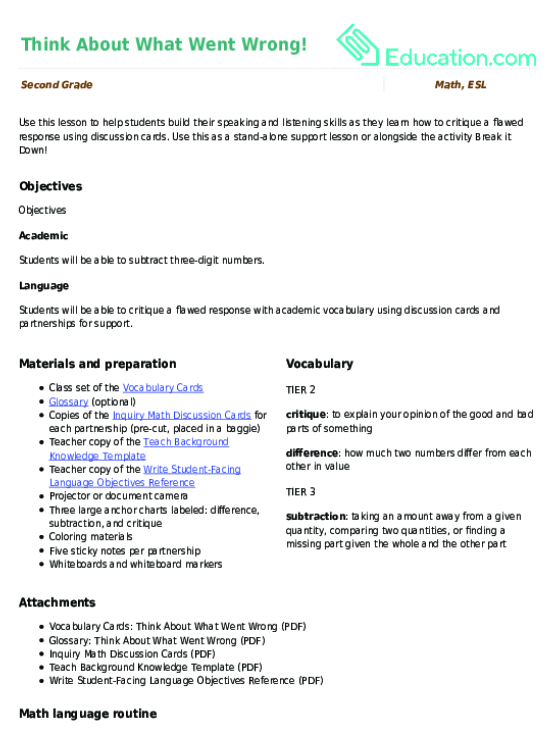
Think About What Went Wrong!
Lesson Plan
Think About What Went Wrong!
Second Grade
Use this lesson to help students build their speaking and listening skills as they learn how to critique a flawed response using discussion cards. Use this as a stand-alone support lesson or alongside the activity Break it Down!
Lesson Plan
Think About What Went Wrong!
Lesson Plan
Think About What Went Wrong!
Use this lesson to help students build their speaking and listening skills as they learn how to critique a flawed response using discussion cards. Use this as a stand-alone support lesson or alongside the activity Break it Down!
Second Grade
Lesson Plan
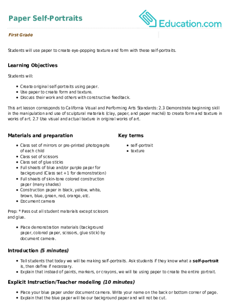
Paper Self-Portraits
Lesson Plan
Paper Self-Portraits
First Grade
Students will use paper to create eye-popping texture and form with these self-portraits.
Lesson Plan
Paper Self-Portraits
Lesson Plan
Paper Self-Portraits
Students will use paper to create eye-popping texture and form with these self-portraits.
First Grade
Lesson Plan
1
2
3
4
…
77