
Kindergarten Skip Counting Lesson Plans

About Kindergarten Skip Counting Lesson Plans
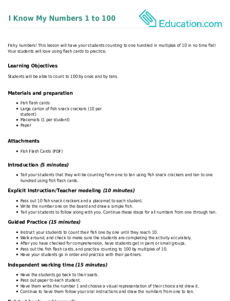
On Education.com, kindergarten skip counting lesson plans provide educators and parents with structured activities that help young children develop numerical proficiency. These plans typically include hands-on exercises, charts, interactive games, and worksheets that teach children to count by 2s, 5s, 10s, and other intervals. Such resources are essential for building a strong foundation in early math skills that support addition, subtraction, and number recognition.
This section offers a variety of printable skip counting worksheets, practice pages, and lesson plans designed for 5- to 6-year-old students. Materials include engaging exercises that gradually increase in complexity to reinforce counting patterns while promoting fine motor skills through number tracing, coloring activities, and cut-and-paste tasks. These resources can be used at classroom centers or during at-home learning to encourage independence in mathematical thinking.
Teachers can use these lesson plans to introduce skip counting as a game or challenge, making learning interactive and enjoyable. Parents can supplement classroom activities with practice sheets that reinforce skills learned during math lessons. Using structured activities, educators and families can support early numeracy, confidence, and enjoyment of mathematics for young learners.
This section offers a variety of printable skip counting worksheets, practice pages, and lesson plans designed for 5- to 6-year-old students. Materials include engaging exercises that gradually increase in complexity to reinforce counting patterns while promoting fine motor skills through number tracing, coloring activities, and cut-and-paste tasks. These resources can be used at classroom centers or during at-home learning to encourage independence in mathematical thinking.
Teachers can use these lesson plans to introduce skip counting as a game or challenge, making learning interactive and enjoyable. Parents can supplement classroom activities with practice sheets that reinforce skills learned during math lessons. Using structured activities, educators and families can support early numeracy, confidence, and enjoyment of mathematics for young learners.