SKIP TO CONTENT
Worksheet Generator
Subjects
Grades
Worksheets
Games
Build a Worksheet
More Resources
Roly Recommends
Subjects
Grades
Worksheets
Games
Build a Worksheet
More Resources
Roly Recommends
Filters
Search for: determine, meaning, using
✕
Lesson Plans
✕
Kindergarten - 4th Grade
✕
Subjects
Math
English Language Arts
Science
Social Studies
Grade Level
Pre-K
K
1st
2nd
3rd
4th
5th
6th
7th
8th
Early Childhood
Elementary School
Middle School
Resource Type
Worksheets
Games
Lesson Plans
Interactive Worksheets
Workbooks
Activities
Exercises
Stories
Songs
Offline Games
Guided Lessons
Teacher Resources
Common Core
Yes
Roly Recommends
Social Emotional Learning
English Language Support
Yes
See More
Clear All
View 1,740 results
Showing Results for determine meaning using : Page 2
1,740 results
Search for: determine, meaning, using
✕
Lesson Plans
✕
Kindergarten - 4th Grade
✕
Clear All
Sort by:
Relevance
Most recent
Most popular
Alphabetical A-Z
Alphabetical Z-A
All filters
1,740 results
Sort by:
Relevance
Most recent
Most popular
Alphabetical A-Z
Alphabetical Z-A
Problems with Parentheses
Lesson Plan
Problems with Parentheses
Fourth Grade
Students will explore how parentheses change the meaning of a number sentence. They will be challenged with a set of playing cards to make a certain number.
Lesson Plan
Problems with Parentheses
Lesson Plan
Problems with Parentheses
Students will explore how parentheses change the meaning of a number sentence. They will be challenged with a set of playing cards to make a certain number.
Fourth Grade
Lesson Plan
Math Meanings with Synonyms & Antonyms
Lesson Plan
Math Meanings with Synonyms & Antonyms
Fourth Grade
Vocabulary
Use this lesson to increase your students’ understanding of math vocabulary by completing a Frayer Model. This model focuses on finding antonyms, synonyms, and meanings for the key vocabulary term.
Lesson Plan
Math Meanings with Synonyms & Antonyms
Lesson Plan
Math Meanings with Synonyms & Antonyms
Use this lesson to increase your students’ understanding of math vocabulary by completing a Frayer Model. This model focuses on finding antonyms, synonyms, and meanings for the key vocabulary term.
Fourth Grade
Vocabulary
Lesson Plan
Pronouns, Positioned!
Lesson Plan
Pronouns, Positioned!
Third Grade
Grammar and Mechanics
Pronouns will no longer be a mystery to your students as they discover how to position and use them! In this lesson, students will explore the form and use of demonstrative and reflexive pronouns, clarifying the meaning in context.
Lesson Plan
Pronouns, Positioned!
Lesson Plan
Pronouns, Positioned!
Pronouns will no longer be a mystery to your students as they discover how to position and use them! In this lesson, students will explore the form and use of demonstrative and reflexive pronouns, clarifying the meaning in context.
Third Grade
Grammar and Mechanics
Lesson Plan
Subtracting Mixed Numbers Using the Decomposition Strategy
Lesson Plan
Subtracting Mixed Numbers Using the Decomposition Strategy
Fourth Grade
Teach your students to subtract mixed numbers with like denominators using the strategy of decomposition. This strategy helps students to manipulate and break down numbers to help them solve tricky subtraction problems.
Lesson Plan
Subtracting Mixed Numbers Using the Decomposition Strategy
Lesson Plan
Subtracting Mixed Numbers Using the Decomposition Strategy
Teach your students to subtract mixed numbers with like denominators using the strategy of decomposition. This strategy helps students to manipulate and break down numbers to help them solve tricky subtraction problems.
Fourth Grade
Lesson Plan
Why I Write
Lesson Plan
Why I Write
Second Grade
Reading
Second grade students will step into the author’s shoes as they hunt for evidence to determine what a nonfiction author’s purpose might be.
Lesson Plan
Why I Write
Lesson Plan
Why I Write
Second grade students will step into the author’s shoes as they hunt for evidence to determine what a nonfiction author’s purpose might be.
Second Grade
Reading
Lesson Plan
Describing the World Using Sensory Language
Lesson Plan
Describing the World Using Sensory Language
First Grade
Life Science
What are the five senses and how do we use them everyday? Students get a chance to practice using sensory language as they think about the world around them. Can be used as a stand alone or support for the Writing a Five Senses Poem lesson.
Lesson Plan
Describing the World Using Sensory Language
Lesson Plan
Describing the World Using Sensory Language
What are the five senses and how do we use them everyday? Students get a chance to practice using sensory language as they think about the world around them. Can be used as a stand alone or support for the Writing a Five Senses Poem lesson.
First Grade
Life Science
Lesson Plan
Adding Mixed Numbers Using the Decomposition Strategy
Lesson Plan
Adding Mixed Numbers Using the Decomposition Strategy
Fourth Grade
Make the number work for you! Use this lesson to teach your students to add mixed numbers with like denominators using the strategy of decomposition.
Lesson Plan
Adding Mixed Numbers Using the Decomposition Strategy
Lesson Plan
Adding Mixed Numbers Using the Decomposition Strategy
Make the number work for you! Use this lesson to teach your students to add mixed numbers with like denominators using the strategy of decomposition.
Fourth Grade
Lesson Plan
Article and Adverb Attachments
Lesson Plan
Article and Adverb Attachments
Third Grade
Grammar and Mechanics
Help your students attach meaning between nouns, verbs, and corresponding modifiers! In this interactive lesson, students will be an active part of a noun and verb brainstorm before they use articles and adverbs.
Lesson Plan
Article and Adverb Attachments
Lesson Plan
Article and Adverb Attachments
Help your students attach meaning between nouns, verbs, and corresponding modifiers! In this interactive lesson, students will be an active part of a noun and verb brainstorm before they use articles and adverbs.
Third Grade
Grammar and Mechanics
Lesson Plan
Searching for Suffixes
Lesson Plan
Searching for Suffixes
Fourth Grade
Invite your students to join the search for suffixes! In this lesson students will locate similar words that have gone through a suffix transformation. In addition to the mechanics, students will explore the meaning behind each word!
Lesson Plan
Searching for Suffixes
Lesson Plan
Searching for Suffixes
Invite your students to join the search for suffixes! In this lesson students will locate similar words that have gone through a suffix transformation. In addition to the mechanics, students will explore the meaning behind each word!
Fourth Grade
Lesson Plan
Odd One Out
Lesson Plan
Odd One Out
Second Grade
Will one be left out? Students will practice creative problem solving as they strive to answer this question and determine whether a group is even or odd.
Lesson Plan
Odd One Out
Lesson Plan
Odd One Out
Will one be left out? Students will practice creative problem solving as they strive to answer this question and determine whether a group is even or odd.
Second Grade
Lesson Plan
What's For Breakfast?
Lesson Plan
What's For Breakfast?
Fourth Grade
Reading
Teach your class to develop strong inferencing skills by focusing on clues and hard evidence. In this lesson, students will play a game of “What’s for Breakfast?” to help them link context clues with word meaning.
Lesson Plan
What's For Breakfast?
Lesson Plan
What's For Breakfast?
Teach your class to develop strong inferencing skills by focusing on clues and hard evidence. In this lesson, students will play a game of “What’s for Breakfast?” to help them link context clues with word meaning.
Fourth Grade
Reading
Lesson Plan
Unknown Words
Lesson Plan
Unknown Words
Second Grade
Reading
Increase student comprehension by teaching your students strategies to figure out the meaning of unknown words. This lesson can be used as a stand alone activity or a support lesson for the Be a Nonfiction Detective lesson.
Lesson Plan
Unknown Words
Lesson Plan
Unknown Words
Increase student comprehension by teaching your students strategies to figure out the meaning of unknown words. This lesson can be used as a stand alone activity or a support lesson for the Be a Nonfiction Detective lesson.
Second Grade
Reading
Lesson Plan
Gone Fishing: Equations
Lesson Plan
Gone Fishing: Equations
First Grade
In this lesson, your students will strengthen their basic fact fluency and determine whether or not number sentences are true. Engage your students by giving them worksheets at their level.
Lesson Plan
Gone Fishing: Equations
Lesson Plan
Gone Fishing: Equations
In this lesson, your students will strengthen their basic fact fluency and determine whether or not number sentences are true. Engage your students by giving them worksheets at their level.
First Grade
Lesson Plan
Location Freeze Dance
Lesson Plan
Location Freeze Dance
Kindergarten
In this fun dance lesson students will get to combine a math lesson with dancing! Help students master the meaning of location words as they move around the classroom.
Lesson Plan
Location Freeze Dance
Lesson Plan
Location Freeze Dance
In this fun dance lesson students will get to combine a math lesson with dancing! Help students master the meaning of location words as they move around the classroom.
Kindergarten
Lesson Plan
Numerous Names for Numbers
Lesson Plan
Numerous Names for Numbers
First Grade
It is important for students to gain a better understanding of different ways to write numbers. In this lesson, your students will practice seeing numbers in various ways to help them comprehend the meaning of numbers.
Lesson Plan
Numerous Names for Numbers
Lesson Plan
Numerous Names for Numbers
It is important for students to gain a better understanding of different ways to write numbers. In this lesson, your students will practice seeing numbers in various ways to help them comprehend the meaning of numbers.
First Grade
Lesson Plan
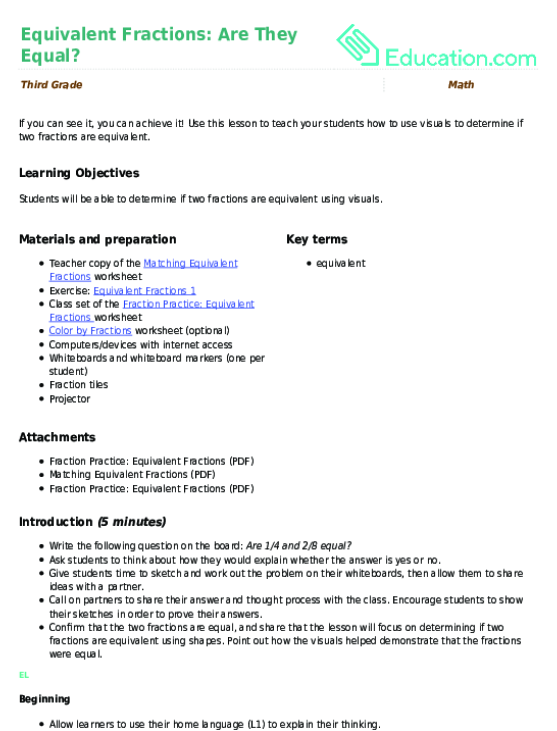
Equivalent Fractions: Are They Equal?
Lesson Plan
Equivalent Fractions: Are They Equal?
Third Grade
If you can see it, you can achieve it! Use this lesson to teach your students how to use visuals to determine if two fractions are equivalent.
Lesson Plan
Equivalent Fractions: Are They Equal?
Lesson Plan
Equivalent Fractions: Are They Equal?
If you can see it, you can achieve it! Use this lesson to teach your students how to use visuals to determine if two fractions are equivalent.
Third Grade
Lesson Plan
Characters Change Just Like We Do
Lesson Plan
Characters Change Just Like We Do
Third Grade
Writing
Change is inevitable, even for story characters! In this lesson, your students will determine how a character changes throughout a story by focusing on the character’s dialogue and actions.
Lesson Plan
Characters Change Just Like We Do
Lesson Plan
Characters Change Just Like We Do
Change is inevitable, even for story characters! In this lesson, your students will determine how a character changes throughout a story by focusing on the character’s dialogue and actions.
Third Grade
Writing
Lesson Plan
Compound Word Connections
Lesson Plan
Compound Word Connections
Second Grade
Help your students master compound words with compound words creations! Using an arts-integrated approach, this lesson incorporates diagrams and illustrations that can lead to understanding the fuller meanings of compound words.
Lesson Plan
Compound Word Connections
Lesson Plan
Compound Word Connections
Help your students master compound words with compound words creations! Using an arts-integrated approach, this lesson incorporates diagrams and illustrations that can lead to understanding the fuller meanings of compound words.
Second Grade
Lesson Plan
Author’s Purpose in Fiction Texts
Lesson Plan
Author’s Purpose in Fiction Texts
Second Grade
Introduce the concept of author’s purpose in fiction texts with this fun reading lesson! Students will discuss three examples of fictional texts to determine the purpose of each.
Lesson Plan
Author’s Purpose in Fiction Texts
Lesson Plan
Author’s Purpose in Fiction Texts
Introduce the concept of author’s purpose in fiction texts with this fun reading lesson! Students will discuss three examples of fictional texts to determine the purpose of each.
Second Grade
Lesson Plan
Using Text Features
Lesson Plan
Using Text Features
First Grade
Help students enrich their informational writing by learning to use text features.
Lesson Plan
Using Text Features
Lesson Plan
Using Text Features
Help students enrich their informational writing by learning to use text features.
First Grade
Lesson Plan
The Sound of Silence
Lesson Plan
The Sound of Silence
Fourth Grade
Students will read a story and listen to a song to explore the sound of silence, its meaning, and significance. They will share their experience and reflect on how and why silence or space can be important.
Lesson Plan
The Sound of Silence
Lesson Plan
The Sound of Silence
Students will read a story and listen to a song to explore the sound of silence, its meaning, and significance. They will share their experience and reflect on how and why silence or space can be important.
Fourth Grade
Lesson Plan
Order Up!
Lesson Plan
Order Up!
First Grade
It’s time to get measuring! In this lesson students determine the lengths of different towers and then put them in order from shortest to longest.
Lesson Plan
Order Up!
Lesson Plan
Order Up!
It’s time to get measuring! In this lesson students determine the lengths of different towers and then put them in order from shortest to longest.
First Grade
Lesson Plan
Discovering Character Traits
Lesson Plan
Discovering Character Traits
Fourth Grade
Writing
This lesson will have your EL students exploring characters' dialogue and actions to determine their personality traits! Use it on its own or as a support lesson.
Lesson Plan
Discovering Character Traits
Lesson Plan
Discovering Character Traits
This lesson will have your EL students exploring characters' dialogue and actions to determine their personality traits! Use it on its own or as a support lesson.
Fourth Grade
Writing
Lesson Plan
Stand Tall
Lesson Plan
Stand Tall
Fourth Grade
In this lesson, students will explore the meaning of integrity through the book
Stand Tall!
. They will also answer questions connected to making choices with integrity when faced with challenging situations.
Lesson Plan
Stand Tall
Lesson Plan
Stand Tall
In this lesson, students will explore the meaning of integrity through the book
Stand Tall!
. They will also answer questions connected to making choices with integrity when faced with challenging situations.
Fourth Grade
Lesson Plan
What’s Similar? What’s Different?
Lesson Plan
What’s Similar? What’s Different?
Second Grade
Measurement
How are plants’ traits affected by environmental factors? In this integrated science and reading lesson, students will use multiple sources to identify and determine how traits are influenced by the environment.
Lesson Plan
What’s Similar? What’s Different?
Lesson Plan
What’s Similar? What’s Different?
How are plants’ traits affected by environmental factors? In this integrated science and reading lesson, students will use multiple sources to identify and determine how traits are influenced by the environment.
Second Grade
Measurement
Lesson Plan
Using Pictures to Read Words
Lesson Plan
Using Pictures to Read Words
Kindergarten
Reading
This is a great introductory lesson to teach students about the importance of illustrations when reading. It can be used as a stand alone or support lesson for the Introducing Reader's Workshop lesson plan.
Lesson Plan
Using Pictures to Read Words
Lesson Plan
Using Pictures to Read Words
This is a great introductory lesson to teach students about the importance of illustrations when reading. It can be used as a stand alone or support lesson for the Introducing Reader's Workshop lesson plan.
Kindergarten
Reading
Lesson Plan
Shape Sort
Lesson Plan
Shape Sort
First Grade
Geometry
Sorting takes on a new challenge for students in this activity which engages their critical thinking skills. As students determine defining attributes, they’ll figure out what makes a shape a shape!
Lesson Plan
Shape Sort
Lesson Plan
Shape Sort
Sorting takes on a new challenge for students in this activity which engages their critical thinking skills. As students determine defining attributes, they’ll figure out what makes a shape a shape!
First Grade
Geometry
Lesson Plan
Idiom Meanings and Context Clues
Lesson Plan
Idiom Meanings and Context Clues
Third Grade
Idioms are a challenging piece of figurative language for students, but it can be an easier task with the help of context clues. Use this as a stand-alone lesson or as a pre-lesson for the
Capturing the Clues
lesson.
Lesson Plan
Idiom Meanings and Context Clues
Lesson Plan
Idiom Meanings and Context Clues
Idioms are a challenging piece of figurative language for students, but it can be an easier task with the help of context clues. Use this as a stand-alone lesson or as a pre-lesson for the
Capturing the Clues
lesson.
Third Grade
Lesson Plan
What is the Question?
Lesson Plan
What is the Question?
Third Grade
This lesson introduces students to the punctuation mark at the end of the sentence, the question mark. Your students will study sentences to determine whether or not to use a question mark.
Lesson Plan
What is the Question?
Lesson Plan
What is the Question?
This lesson introduces students to the punctuation mark at the end of the sentence, the question mark. Your students will study sentences to determine whether or not to use a question mark.
Third Grade
Lesson Plan
Using Regrouping to Add
Lesson Plan
Using Regrouping to Add
Second Grade
Guide students to use base ten blocks to solve two-digit by one-digit addition problems with regrouping. This lesson can be used independently or paired with the lesson Adding it All Up.
Lesson Plan
Using Regrouping to Add
Lesson Plan
Using Regrouping to Add
Guide students to use base ten blocks to solve two-digit by one-digit addition problems with regrouping. This lesson can be used independently or paired with the lesson Adding it All Up.
Second Grade
Lesson Plan
1
2
3
4
…
58