3rd Grade Common Core Two-Dimensional Shapes Exercises
Common Core Quick Links:
Common Core Standards for 3rd Grade Math, Common Core Standards for 3rd Grade ELA
1 result
Math
✕Exercises
✕3rd Grade
✕Common Core
✕1 result
Subtopics:
3rd Grade Common Core Two-Dimensional Shapes Exercises
Common Core Quick Links:
Common Core Standards for 3rd Grade Math, Common Core Standards for 3rd Grade ELA1 result
Math
✕Exercises
✕3rd Grade
✕Common Core
✕1 result

About 3rd Grade Common Core Two-dimensional Shapes Exercises
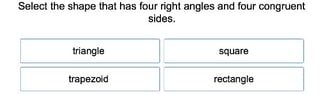
On Education.com, third grade students can practice identifying, describing, and working with two-dimensional shapes through a variety of educational worksheets and activities. These resources focus on shapes like triangles, quadrilaterals including squares, rectangles, rhombuses, and parallelograms, helping students understand shape attributes such as sides, vertices, angles, and parallel lines. By providing structured exercises like shape hunts, sorting games, and drawing challenges, educators and parents support building foundational geometry skills while engaging students in interactive learning.
Explore Education.com's Figural Shapes collection, which offers printable worksheets, shape puzzles, and digital interactive activities designed to reinforce shape recognition and comparison. These resources present fun, hands-on methods for practicing shape attributes, grouping shapes by types, and partitioning shapes into equal parts. Learning at this stage helps children develop spatial awareness, attention to detail, and critical thinking in a creative, structured way.
Parents and teachers can use these resources to teach third graders essential geometry concepts, practice classroom exercises, or provide additional practice at home. The materials make it easier to guide learners through shape identification and attribute analysis, saving planning time and providing clear, ready-to-use tools. With frequent practice, children strengthen visual perception, pattern recognition, and mathematical reasoning, laying a solid foundation for more advanced geometry curriculum in later grades.
Explore Education.com's Figural Shapes collection, which offers printable worksheets, shape puzzles, and digital interactive activities designed to reinforce shape recognition and comparison. These resources present fun, hands-on methods for practicing shape attributes, grouping shapes by types, and partitioning shapes into equal parts. Learning at this stage helps children develop spatial awareness, attention to detail, and critical thinking in a creative, structured way.
Parents and teachers can use these resources to teach third graders essential geometry concepts, practice classroom exercises, or provide additional practice at home. The materials make it easier to guide learners through shape identification and attribute analysis, saving planning time and providing clear, ready-to-use tools. With frequent practice, children strengthen visual perception, pattern recognition, and mathematical reasoning, laying a solid foundation for more advanced geometry curriculum in later grades.