SKIP TO CONTENT
Worksheet Generator
Subjects
Grades
Worksheets
Games
Build a Worksheet
More Resources
Roly Recommends
Reading Month
Subjects
Grades
Worksheets
Games
Build a Worksheet
More Resources
Roly Recommends
Reading Month
All Subjects
Science
Subtopics:
Physical Science
Life Science
Earth and Space Science
Engineering and Science Inquiry
Computer Science
Show Less
Filters
Search for: shapes, next, door
✕
Science
✕
Lesson Plans
✕
Kindergarten - 2nd Grade
✕
Subjects
Math
English Language Arts
Science
Social Studies
Grade Level
Pre-K
K
1st
2nd
3rd
4th
5th
6th
7th
8th
Early Childhood
Elementary School
Middle School
Resource Type
Worksheets
Games
Lesson Plans
Interactive Worksheets
Activities
Offline Games
Common Core
Yes
English Language Support
Yes
See More
Clear All
View 23 results
Showing Results for shapes next door
23 results
Search for: shapes, next, door
✕
Science
✕
Lesson Plans
✕
Kindergarten - 2nd Grade
✕
Clear All
Sort by:
Relevance
Most recent
Most popular
Alphabetical A-Z
Alphabetical Z-A
All filters
23 results
Sort by:
Relevance
Most recent
Most popular
Alphabetical A-Z
Alphabetical Z-A
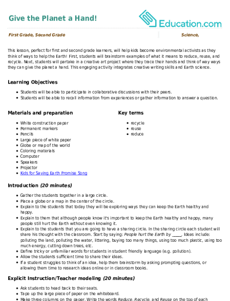
Give the Planet a Hand!
Lesson Plan
Give the Planet a Hand!
First Grade
Earth and Space Science
This lesson, perfect for first and second grade learners, will help kids become environmental activists as they think of ways to help the Earth! First, students will brainstorm examples of what it means to reduce, reuse, and recycle. Next, students will partake in a creative art project where they trace their hands and think of way ways they can give the planet a hand. This engaging activity integrates creative writing skills and Earth science.
Lesson Plan
Give the Planet a Hand!
Lesson Plan
Give the Planet a Hand!
This lesson, perfect for first and second grade learners, will help kids become environmental activists as they think of ways to help the Earth! First, students will brainstorm examples of what it means to reduce, reuse, and recycle. Next, students will partake in a creative art project where they trace their hands and think of way ways they can give the planet a hand. This engaging activity integrates creative writing skills and Earth science.
First Grade
Earth and Space Science
Lesson Plan
Parts of a Plant
Lesson Plan
Parts of a Plant
First Grade
Life Science
Root, stem, flower, leaf! In this hands-on science lesson, your students will create their own plants to help them identify and remember the parts of a plant.
Lesson Plan
Parts of a Plant
Lesson Plan
Parts of a Plant
Root, stem, flower, leaf! In this hands-on science lesson, your students will create their own plants to help them identify and remember the parts of a plant.
First Grade
Life Science
Lesson Plan
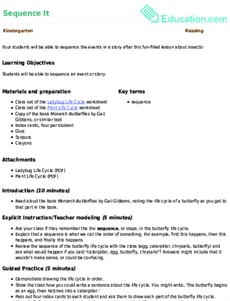
Sequence It
Lesson Plan
Sequence It
Kindergarten
Life Science
Your students will be able to sequence the events in a story after this fun-filled lesson about insects!
Lesson Plan
Sequence It
Lesson Plan
Sequence It
Your students will be able to sequence the events in a story after this fun-filled lesson about insects!
Kindergarten
Life Science
Lesson Plan
Simple Machines: Wheel and Axle
Lesson Plan
Simple Machines: Wheel and Axle
Second Grade
Physical Science
What do a bicycle and a car have in common? They both move using the simple machine wheel and axle. In this lesson, students learn about how this simple machine works, and will identify objects that use a wheel and axle.
Lesson Plan
Simple Machines: Wheel and Axle
Lesson Plan
Simple Machines: Wheel and Axle
What do a bicycle and a car have in common? They both move using the simple machine wheel and axle. In this lesson, students learn about how this simple machine works, and will identify objects that use a wheel and axle.
Second Grade
Physical Science
Lesson Plan
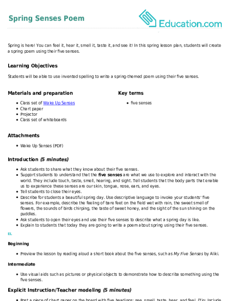
Spring Senses Poem
Lesson Plan
Spring Senses Poem
Pre-K
Life Science
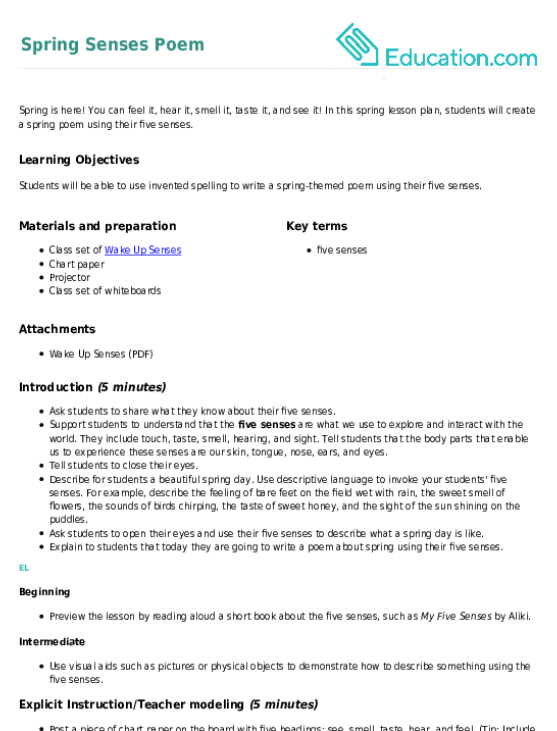
Spring is here! You can feel it, hear it, smell it, taste it, and see it! In this spring lesson plan, students will create a spring poem using their five senses.
Lesson Plan
Spring Senses Poem
Lesson Plan
Spring Senses Poem
Spring is here! You can feel it, hear it, smell it, taste it, and see it! In this spring lesson plan, students will create a spring poem using their five senses.
Pre-K
Life Science
Lesson Plan
Main Idea or Topic? You Decide!
Lesson Plan
Main Idea or Topic? You Decide!
First Grade
Life Science
Provide students with an opportunity to closely examine the difference between a topic and main idea in a nonfiction text. Use as a stand-alone activity or a support for the Finding the Main Idea and Details in a Nonfiction Text lesson.
Lesson Plan
Main Idea or Topic? You Decide!
Lesson Plan
Main Idea or Topic? You Decide!
Provide students with an opportunity to closely examine the difference between a topic and main idea in a nonfiction text. Use as a stand-alone activity or a support for the Finding the Main Idea and Details in a Nonfiction Text lesson.
First Grade
Life Science
Lesson Plan
What's that Smell?
Lesson Plan
What's that Smell?
Kindergarten
Life Science
Use this lesson to teach your students about their sense of smell. Teach them that food would not taste as good without their sense of smell. Have them imagine their favorite food and think if they like the taste or the smell of that food.
Lesson Plan
What's that Smell?
Lesson Plan
What's that Smell?
Use this lesson to teach your students about their sense of smell. Teach them that food would not taste as good without their sense of smell. Have them imagine their favorite food and think if they like the taste or the smell of that food.
Kindergarten
Life Science
Lesson Plan
The Very Hungry Caterpillar: A Butterfly's Life Cycle
Lesson Plan
The Very Hungry Caterpillar: A Butterfly's Life Cycle
First Grade
Life Science
In this lesson, you will use “The Very Hungry Caterpillar” to teach students about the butterfly life cycle. After listening to the story read aloud, students will use their knowledge to create their own butterfly life cycles!
Lesson Plan
The Very Hungry Caterpillar: A Butterfly's Life Cycle
Lesson Plan
The Very Hungry Caterpillar: A Butterfly's Life Cycle
In this lesson, you will use “The Very Hungry Caterpillar” to teach students about the butterfly life cycle. After listening to the story read aloud, students will use their knowledge to create their own butterfly life cycles!
First Grade
Life Science
Lesson Plan
Vertebrate or Invertebrate?
Lesson Plan
Vertebrate or Invertebrate?
Second Grade
Life Science
Use this lesson to teach your students about the different types of species and how to categorize them! Your students will learn characteristics about vertebrates and invertebrates.
Lesson Plan
Vertebrate or Invertebrate?
Lesson Plan
Vertebrate or Invertebrate?
Use this lesson to teach your students about the different types of species and how to categorize them! Your students will learn characteristics about vertebrates and invertebrates.
Second Grade
Life Science
Lesson Plan
Where is My Home?
Lesson Plan
Where is My Home?
First Grade
Life Science
Students will go wild for this hands-on habitat lesson. Who can help the animals find their homes?
Lesson Plan
Where is My Home?
Lesson Plan
Where is My Home?
Students will go wild for this hands-on habitat lesson. Who can help the animals find their homes?
First Grade
Life Science
Lesson Plan
Sink or Float with the Cookie Monster
Lesson Plan
Sink or Float with the Cookie Monster
Kindergarten
Physical Science
This fun and interactive lesson will teach your students the scientific method to find out if something sinks or floats with a little help from Cookie Monster.
Lesson Plan
Sink or Float with the Cookie Monster
Lesson Plan
Sink or Float with the Cookie Monster
This fun and interactive lesson will teach your students the scientific method to find out if something sinks or floats with a little help from Cookie Monster.
Kindergarten
Physical Science
Lesson Plan
Living or Nonliving? How to Tell
Lesson Plan
Living or Nonliving? How to Tell
Second Grade
Life Science
One of the basic concepts in science is recognizing that all things can be classified as living or nonliving. In this lesson, your students will explore the characteristics of living and nonliving things with engaging hands-on activities.
Lesson Plan
Living or Nonliving? How to Tell
Lesson Plan
Living or Nonliving? How to Tell
One of the basic concepts in science is recognizing that all things can be classified as living or nonliving. In this lesson, your students will explore the characteristics of living and nonliving things with engaging hands-on activities.
Second Grade
Life Science
Lesson Plan
My Robot Friend
Lesson Plan
My Robot Friend
Kindergarten
Writing
What is a robot? What can robots do? Computer programmers tell robots what to do by creating a sequence of commands. In this lesson, students work in pairs to program a robot to act out the story from the mini story book
My Friend.
Lesson Plan
My Robot Friend
Lesson Plan
My Robot Friend
What is a robot? What can robots do? Computer programmers tell robots what to do by creating a sequence of commands. In this lesson, students work in pairs to program a robot to act out the story from the mini story book
My Friend.
Kindergarten
Writing
Lesson Plan
What Is an Algorithm?
Lesson Plan
What Is an Algorithm?
Second Grade
Engineering and Science Inquiry
In this lesson, students will learn to create a simple algorithm using block code. The platform used for this activity is a website created by Google that provides free educational games that teach students to program using block code.
Lesson Plan
What Is an Algorithm?
Lesson Plan
What Is an Algorithm?
In this lesson, students will learn to create a simple algorithm using block code. The platform used for this activity is a website created by Google that provides free educational games that teach students to program using block code.
Second Grade
Engineering and Science Inquiry
Lesson Plan
Producers and Consumers!
Lesson Plan
Producers and Consumers!
Second Grade
Life Science
Use this lesson to have your students learn about producers and consumers by pretending to be one.
Lesson Plan
Producers and Consumers!
Lesson Plan
Producers and Consumers!
Use this lesson to have your students learn about producers and consumers by pretending to be one.
Second Grade
Life Science
Lesson Plan
Curious Science with Curious George
Lesson Plan
Curious Science with Curious George
Second Grade
Physical Science
The science of matter becomes as fun as it is educational when George gets in the mix! After watching Curious George work with his 'floppafication' pot, students will learn about matter and force.
Lesson Plan
Curious Science with Curious George
Lesson Plan
Curious Science with Curious George
The science of matter becomes as fun as it is educational when George gets in the mix! After watching Curious George work with his 'floppafication' pot, students will learn about matter and force.
Second Grade
Physical Science
Lesson Plan
Sprouting Seeds
Lesson Plan
Sprouting Seeds
Pre-K
Life Science
After this lesson you will have a group of prospective farmers in your class. They plant seeds and learn what seeds need to grow.
Lesson Plan
Sprouting Seeds
Lesson Plan
Sprouting Seeds
After this lesson you will have a group of prospective farmers in your class. They plant seeds and learn what seeds need to grow.
Pre-K
Life Science
Lesson Plan
Spring Showers Water Cycle
Lesson Plan
Spring Showers Water Cycle
First Grade
Earth and Space Science
Leap into a spring lesson plan about the water cycle, with the help of a friend in the book
The Little Raindrop
. Students will learn features of the water cycle and retell the journey of the raindrop verbally and in writing.
Lesson Plan
Spring Showers Water Cycle
Lesson Plan
Spring Showers Water Cycle
Leap into a spring lesson plan about the water cycle, with the help of a friend in the book
The Little Raindrop
. Students will learn features of the water cycle and retell the journey of the raindrop verbally and in writing.
First Grade
Earth and Space Science
Lesson Plan
Potential And Kinetic Energy
Lesson Plan
Potential And Kinetic Energy
First Grade
Physical Science
Walk, sleep, run, eat! We're constantly using energy, whether we're moving or not. In this lesson, students learn how their bodies are constantly converting potential energy into kinetic energy and kinetic energy back to potential energy.
Lesson Plan
Potential And Kinetic Energy
Lesson Plan
Potential And Kinetic Energy
Walk, sleep, run, eat! We're constantly using energy, whether we're moving or not. In this lesson, students learn how their bodies are constantly converting potential energy into kinetic energy and kinetic energy back to potential energy.
First Grade
Physical Science
Lesson Plan
Little Pig Algorithm
Lesson Plan
Little Pig Algorithm
Kindergarten
Engineering and Science Inquiry
Introduce students to the term
algorithm
using the familiar story of The
Three Little Pigs
. In this lesson, students will develop an algorithm, or a step-by-step
sequence
of instructions, for building a house made out of bricks.
Lesson Plan
Little Pig Algorithm
Lesson Plan
Little Pig Algorithm
Introduce students to the term
algorithm
using the familiar story of The
Three Little Pigs
. In this lesson, students will develop an algorithm, or a step-by-step
sequence
of instructions, for building a house made out of bricks.
Kindergarten
Engineering and Science Inquiry
Lesson Plan
My Five Senses Portrait
Lesson Plan
My Five Senses Portrait
Kindergarten
Phonics
This five senses art and writing lesson will give your students an up close and personal look at the five senses and themselves.
Lesson Plan
My Five Senses Portrait
Lesson Plan
My Five Senses Portrait
This five senses art and writing lesson will give your students an up close and personal look at the five senses and themselves.
Kindergarten
Phonics
Lesson Plan
Animal Life Cycles, All Around
Lesson Plan
Animal Life Cycles, All Around
Second Grade
Life Science
Life cycles go around and around! In this technology-integrated lesson, students will research various animal life cycles and write about them.
Lesson Plan
Animal Life Cycles, All Around
Lesson Plan
Animal Life Cycles, All Around
Life cycles go around and around! In this technology-integrated lesson, students will research various animal life cycles and write about them.
Second Grade
Life Science
Lesson Plan
Understanding Academic Vocabulary in a Nonfiction Text
Lesson Plan
Understanding Academic Vocabulary in a Nonfiction Text
Second Grade
Grammar and Mechanics
This lesson will provide students with an opportunity to become more comfortable with identifying and defining academic vocabulary words in a nonfiction text about a chicken's life cycle to support comprehension.
Lesson Plan
Understanding Academic Vocabulary in a Nonfiction Text
Lesson Plan
Understanding Academic Vocabulary in a Nonfiction Text
This lesson will provide students with an opportunity to become more comfortable with identifying and defining academic vocabulary words in a nonfiction text about a chicken's life cycle to support comprehension.
Second Grade
Grammar and Mechanics
Lesson Plan
1