SKIP TO CONTENT
Worksheet Generator
Subjects
Grades
Worksheets
Games
Build a Worksheet
More Resources
Roly Recommends
Subjects
Grades
Worksheets
Games
Build a Worksheet
More Resources
Roly Recommends
Filters
Search for: and, use, of, parentheses
✕
Lesson Plans
✕
Kindergarten - 2nd Grade
✕
Subjects
Math
English Language Arts
Science
Social Studies
Grade Level
Pre-K
K
1st
2nd
3rd
4th
5th
6th
7th
8th
Early Childhood
Elementary School
Middle School
Resource Type
Worksheets
Games
Lesson Plans
Interactive Worksheets
Workbooks
Activities
Exercises
Stories
Songs
Offline Games
Guided Lessons
Teacher Resources
Common Core
Yes
Roly Recommends
Social Emotional Learning
English Language Support
Yes
See More
Clear All
View 1,111 results
Showing Results for and use of parentheses
1,111 results
Search for: and, use, of, parentheses
✕
Lesson Plans
✕
Kindergarten - 2nd Grade
✕
Clear All
Sort by:
Relevance
Most recent
Most popular
Alphabetical A-Z
Alphabetical Z-A
All filters
1,111 results
Sort by:
Relevance
Most recent
Most popular
Alphabetical A-Z
Alphabetical Z-A
Correctly Use Adverbs
Lesson Plan
Correctly Use Adverbs
Second Grade
You are on your way to the top as a writer if you can correctly use adverbs in sentences! Adverbs add description and information to a sentence. Use this lesson to teach your students how to use adverbs in sentences.
Lesson Plan
Correctly Use Adverbs
Lesson Plan
Correctly Use Adverbs
You are on your way to the top as a writer if you can correctly use adverbs in sentences! Adverbs add description and information to a sentence. Use this lesson to teach your students how to use adverbs in sentences.
Second Grade
Lesson Plan
Use Your Mind and Visualize!
Lesson Plan
Use Your Mind and Visualize!
Kindergarten
Help students learn the crucial reading strategy of visualizing. Visualizing is a key component of learning to infer from a text. Kids will love using their imagination and drawing pictures of their visualizations.
Lesson Plan
Use Your Mind and Visualize!
Lesson Plan
Use Your Mind and Visualize!
Help students learn the crucial reading strategy of visualizing. Visualizing is a key component of learning to infer from a text. Kids will love using their imagination and drawing pictures of their visualizations.
Kindergarten
Lesson Plan
Using Text Features
Lesson Plan
Using Text Features
First Grade
Help students enrich their informational writing by learning to use text features.
Lesson Plan
Using Text Features
Lesson Plan
Using Text Features
Help students enrich their informational writing by learning to use text features.
First Grade
Lesson Plan
Using Regrouping to Add
Lesson Plan
Using Regrouping to Add
Second Grade
Guide students to use base ten blocks to solve two-digit by one-digit addition problems with regrouping. This lesson can be used independently or paired with the lesson Adding it All Up.
Lesson Plan
Using Regrouping to Add
Lesson Plan
Using Regrouping to Add
Guide students to use base ten blocks to solve two-digit by one-digit addition problems with regrouping. This lesson can be used independently or paired with the lesson Adding it All Up.
Second Grade
Lesson Plan
Using Sentence Level Context to Decode Text
Lesson Plan
Using Sentence Level Context to Decode Text
Second Grade
Reading
Use this lesson to reinforce using sentence level context clues to decode challenging words in a nonfiction text. This can be used as a stand alone activity or a support the Using Context Clues to Understand Word Meanings lesson.
Lesson Plan
Using Sentence Level Context to Decode Text
Lesson Plan
Using Sentence Level Context to Decode Text
Use this lesson to reinforce using sentence level context clues to decode challenging words in a nonfiction text. This can be used as a stand alone activity or a support the Using Context Clues to Understand Word Meanings lesson.
Second Grade
Reading
Lesson Plan
Synonyms: Using Shades of Meaning
Lesson Plan
Synonyms: Using Shades of Meaning
Second Grade
Why walk when you can mosey? In this lesson, students will learn how to use synonyms to express shades of meaning in their writing. Introduce the topic with a book, then brainstorm descriptive options for overused words.
Lesson Plan
Synonyms: Using Shades of Meaning
Lesson Plan
Synonyms: Using Shades of Meaning
Why walk when you can mosey? In this lesson, students will learn how to use synonyms to express shades of meaning in their writing. Introduce the topic with a book, then brainstorm descriptive options for overused words.
Second Grade
Lesson Plan
Using Evidence to Analyze a Character
Lesson Plan
Using Evidence to Analyze a Character
First Grade
Writing
Your students will love learning all about the playful characters in a classic read-aloud text while digging into what makes characters unique. Use as a stand-alone or support lesson for the How to Analyze a Character lesson plan.
Lesson Plan
Using Evidence to Analyze a Character
Lesson Plan
Using Evidence to Analyze a Character
Your students will love learning all about the playful characters in a classic read-aloud text while digging into what makes characters unique. Use as a stand-alone or support lesson for the How to Analyze a Character lesson plan.
First Grade
Writing
Lesson Plan
Describing the World Using Sensory Language
Lesson Plan
Describing the World Using Sensory Language
First Grade
Life Science
What are the five senses and how do we use them everyday? Students get a chance to practice using sensory language as they think about the world around them. Can be used as a stand alone or support for the Writing a Five Senses Poem lesson.
Lesson Plan
Describing the World Using Sensory Language
Lesson Plan
Describing the World Using Sensory Language
What are the five senses and how do we use them everyday? Students get a chance to practice using sensory language as they think about the world around them. Can be used as a stand alone or support for the Writing a Five Senses Poem lesson.
First Grade
Life Science
Lesson Plan
Telling Time Using Skip Counting
Lesson Plan
Telling Time Using Skip Counting
Second Grade
Vocabulary
Teach your students to read time to the nearest five minutes by counting by fives! Use this lesson as a stand-alone support lesson for ELs or alongside Tricky Time Telling.
Lesson Plan
Telling Time Using Skip Counting
Lesson Plan
Telling Time Using Skip Counting
Teach your students to read time to the nearest five minutes by counting by fives! Use this lesson as a stand-alone support lesson for ELs or alongside Tricky Time Telling.
Second Grade
Vocabulary
Lesson Plan
Using a Dictionary to Clarify the Meaning of Unknown Words
Lesson Plan
Using a Dictionary to Clarify the Meaning of Unknown Words
Second Grade
Vocabulary
This lesson will help students explore using a dictionary to figure out tricky words with suffixes. Use as a stand-alone activity or a support for the Understanding Academic Vocabulary in a Nonfiction Text lesson.
Lesson Plan
Using a Dictionary to Clarify the Meaning of Unknown Words
Lesson Plan
Using a Dictionary to Clarify the Meaning of Unknown Words
This lesson will help students explore using a dictionary to figure out tricky words with suffixes. Use as a stand-alone activity or a support for the Understanding Academic Vocabulary in a Nonfiction Text lesson.
Second Grade
Vocabulary
Lesson Plan
Using Context Clues to Understand Word Meanings
Lesson Plan
Using Context Clues to Understand Word Meanings
Second Grade
Reading
This lesson will help your students use sentence level context clues to decode challenging words in a nonfiction text. Students will enjoy learning about maps and figuring out tricky words along the way!
Lesson Plan
Using Context Clues to Understand Word Meanings
Lesson Plan
Using Context Clues to Understand Word Meanings
This lesson will help your students use sentence level context clues to decode challenging words in a nonfiction text. Students will enjoy learning about maps and figuring out tricky words along the way!
Second Grade
Reading
Lesson Plan
One, Two, Three Resources!
Lesson Plan
One, Two, Three Resources!
Second Grade
Community and Culture
What do you use to make what you need? Resources! Students will explore the three kinds of resources producers use to create the products the use and sell.
Lesson Plan
One, Two, Three Resources!
Lesson Plan
One, Two, Three Resources!
What do you use to make what you need? Resources! Students will explore the three kinds of resources producers use to create the products the use and sell.
Second Grade
Community and Culture
Lesson Plan
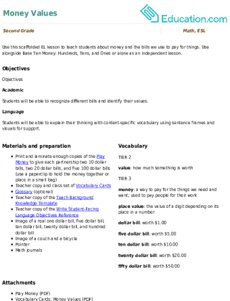
Money Values
Lesson Plan
Money Values
Second Grade
Place Value
Use this scaffolded EL lesson to teach students about money and the bills we use to pay for things. Use alongside Base Ten Money: Hundreds, Tens, and Ones or alone as an independent lesson.
Lesson Plan
Money Values
Lesson Plan
Money Values
Use this scaffolded EL lesson to teach students about money and the bills we use to pay for things. Use alongside Base Ten Money: Hundreds, Tens, and Ones or alone as an independent lesson.
Second Grade
Place Value
Lesson Plan
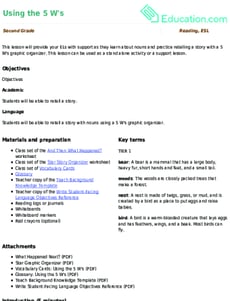
Using the 5 W's
Lesson Plan
Using the 5 W's
Second Grade
Reading
This lesson will provide your ELs with support as they learn about nouns and practice retelling a story with a 5 W's graphic organizer. This lesson can be used as a stand alone activity or a support lesson.
Lesson Plan
Using the 5 W's
Lesson Plan
Using the 5 W's
This lesson will provide your ELs with support as they learn about nouns and practice retelling a story with a 5 W's graphic organizer. This lesson can be used as a stand alone activity or a support lesson.
Second Grade
Reading
Lesson Plan
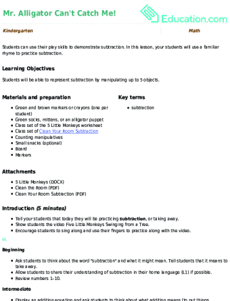
Mr. Alligator Can't Catch Me!
Lesson Plan
Mr. Alligator Can't Catch Me!
Kindergarten
Students can use their play skills to demonstrate subtraction. In this lesson, your students will use a familiar rhyme to practice subtraction.
Lesson Plan
Mr. Alligator Can't Catch Me!
Lesson Plan
Mr. Alligator Can't Catch Me!
Students can use their play skills to demonstrate subtraction. In this lesson, your students will use a familiar rhyme to practice subtraction.
Kindergarten
Lesson Plan
Using Pictures to Read Words
Lesson Plan
Using Pictures to Read Words
Kindergarten
Reading
This is a great introductory lesson to teach students about the importance of illustrations when reading. It can be used as a stand alone or support lesson for the Introducing Reader's Workshop lesson plan.
Lesson Plan
Using Pictures to Read Words
Lesson Plan
Using Pictures to Read Words
This is a great introductory lesson to teach students about the importance of illustrations when reading. It can be used as a stand alone or support lesson for the Introducing Reader's Workshop lesson plan.
Kindergarten
Reading
Lesson Plan
Master Decoders
Lesson Plan
Master Decoders
First Grade
Being a fluent reader means being able to use different strategies to figure out unknown words. In this lesson, students learn how to use pictures and context clues.
Lesson Plan
Master Decoders
Lesson Plan
Master Decoders
Being a fluent reader means being able to use different strategies to figure out unknown words. In this lesson, students learn how to use pictures and context clues.
First Grade
Lesson Plan
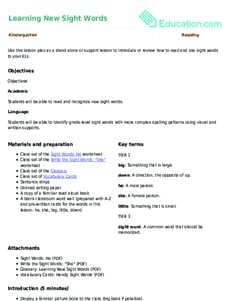
Learning New Sight Words
Lesson Plan
Learning New Sight Words
Kindergarten
Use this lesson plan as a stand alone or support lesson to introduce or review how to read and use sight words to your ELs.
Lesson Plan
Learning New Sight Words
Lesson Plan
Learning New Sight Words
Use this lesson plan as a stand alone or support lesson to introduce or review how to read and use sight words to your ELs.
Kindergarten
Lesson Plan
Exploring Reflexive Pronouns
Lesson Plan
Exploring Reflexive Pronouns
Second Grade
Grammar and Mechanics
Use this lesson to help your EL students recognize and use reflexive pronouns. This lesson can be used as a stand alone activity or a support lesson for Preview with Post-Its.
Lesson Plan
Exploring Reflexive Pronouns
Lesson Plan
Exploring Reflexive Pronouns
Use this lesson to help your EL students recognize and use reflexive pronouns. This lesson can be used as a stand alone activity or a support lesson for Preview with Post-Its.
Second Grade
Grammar and Mechanics
Lesson Plan
Amazing Adjectives
Lesson Plan
Amazing Adjectives
First Grade
In this lesson, students use descriptive adjectives to write interesting sentences and create pictures.
Lesson Plan
Amazing Adjectives
Lesson Plan
Amazing Adjectives
In this lesson, students use descriptive adjectives to write interesting sentences and create pictures.
First Grade
Lesson Plan
Irregular Verbs in Context
Lesson Plan
Irregular Verbs in Context
Second Grade
Irregular verbs do not follow the same rules as other verbs. Use this lesson to teach your scholars how to form the past tense of irregular verbs and correctly use them in context.
Lesson Plan
Irregular Verbs in Context
Lesson Plan
Irregular Verbs in Context
Irregular verbs do not follow the same rules as other verbs. Use this lesson to teach your scholars how to form the past tense of irregular verbs and correctly use them in context.
Second Grade
Lesson Plan
Reading Fluently to Support Comprehension
Lesson Plan
Reading Fluently to Support Comprehension
Second Grade
Writing
Use this lesson to teach students about the importance of reading fluently to support comprehension. Use as a stand alone activity or a support for the Increasing Reading Stamina and Comprehension lesson plan.
Lesson Plan
Reading Fluently to Support Comprehension
Lesson Plan
Reading Fluently to Support Comprehension
Use this lesson to teach students about the importance of reading fluently to support comprehension. Use as a stand alone activity or a support for the Increasing Reading Stamina and Comprehension lesson plan.
Second Grade
Writing
Lesson Plan
Leafy Numbers
Lesson Plan
Leafy Numbers
Kindergarten
Numbers and Counting
In this leafy, plant-themed lesson, students will use leaves as they practice recognizing various numbers from 1 to 15. This lesson can be easily adapted for use with specific ranges of numbers.
Lesson Plan
Leafy Numbers
Lesson Plan
Leafy Numbers
In this leafy, plant-themed lesson, students will use leaves as they practice recognizing various numbers from 1 to 15. This lesson can be easily adapted for use with specific ranges of numbers.
Kindergarten
Numbers and Counting
Lesson Plan
Using Picture Walks to Examine Purpose
Lesson Plan
Using Picture Walks to Examine Purpose
Second Grade
Reading
Teach your students about picture walks as a strategy to understand the author's purpose in a fictional text. This lesson can be used as a stand-alone lesson or as support for the Examining Author's Purpose in a Fictional Text lesson.
Lesson Plan
Using Picture Walks to Examine Purpose
Lesson Plan
Using Picture Walks to Examine Purpose
Teach your students about picture walks as a strategy to understand the author's purpose in a fictional text. This lesson can be used as a stand-alone lesson or as support for the Examining Author's Purpose in a Fictional Text lesson.
Second Grade
Reading
Lesson Plan
Think About What Went Wrong!
Lesson Plan
Think About What Went Wrong!
Second Grade
Use this lesson to help students build their speaking and listening skills as they learn how to critique a flawed response using discussion cards. Use this as a stand-alone support lesson or alongside the activity Break it Down!
Lesson Plan
Think About What Went Wrong!
Lesson Plan
Think About What Went Wrong!
Use this lesson to help students build their speaking and listening skills as they learn how to critique a flawed response using discussion cards. Use this as a stand-alone support lesson or alongside the activity Break it Down!
Second Grade
Lesson Plan
Paper Self-Portraits
Lesson Plan
Paper Self-Portraits
First Grade
Students will use paper to create eye-popping texture and form with these self-portraits.
Lesson Plan
Paper Self-Portraits
Lesson Plan
Paper Self-Portraits
Students will use paper to create eye-popping texture and form with these self-portraits.
First Grade
Lesson Plan
Multiple-Meaning Words
Lesson Plan
Multiple-Meaning Words
Second Grade
Grammar and Mechanics
This lesson will help students understand multiple-meaning words through the use of artistic and theatrical representation! Use as a stand-alone activity or a support lesson for Let's Compare and Contrast Nonfiction Texts!
Lesson Plan
Multiple-Meaning Words
Lesson Plan
Multiple-Meaning Words
This lesson will help students understand multiple-meaning words through the use of artistic and theatrical representation! Use as a stand-alone activity or a support lesson for Let's Compare and Contrast Nonfiction Texts!
Second Grade
Grammar and Mechanics
Lesson Plan
Leprechaun Traps
Lesson Plan
Leprechaun Traps
Pre-K
What says St. Patrick’s Day more than leprechauns? After reading a story, get students to use recycled materials to make their their own leprechaun traps. They will use the story's setting as inspiration for their projects!
Lesson Plan
Leprechaun Traps
Lesson Plan
Leprechaun Traps
What says St. Patrick’s Day more than leprechauns? After reading a story, get students to use recycled materials to make their their own leprechaun traps. They will use the story's setting as inspiration for their projects!
Pre-K
Lesson Plan
Wowza Word Walls!
Lesson Plan
Wowza Word Walls!
First Grade
Students will use the classroom word wall to read and spell tricky sight words.
Lesson Plan
Wowza Word Walls!
Lesson Plan
Wowza Word Walls!
Students will use the classroom word wall to read and spell tricky sight words.
First Grade
Lesson Plan
Regular vs. Irregular Verbs
Lesson Plan
Regular vs. Irregular Verbs
Second Grade
Are you a rule-follower or a rule-breaker? Irregular verbs break all the rules! Use this lesson to teach your students how to use the correct past tense form of regular and irregular verbs.
Lesson Plan
Regular vs. Irregular Verbs
Lesson Plan
Regular vs. Irregular Verbs
Are you a rule-follower or a rule-breaker? Irregular verbs break all the rules! Use this lesson to teach your students how to use the correct past tense form of regular and irregular verbs.
Second Grade
Lesson Plan
1
2
3
4
…
38