
4th Grade Syllables Exercises


About 4th Grade Syllables Exercises
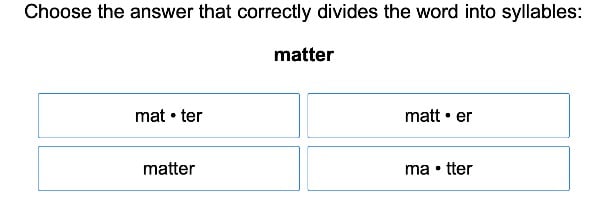
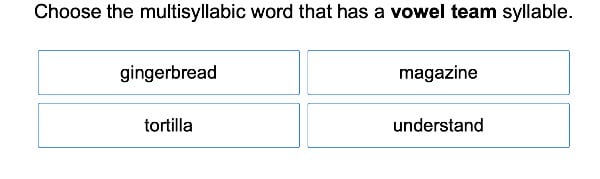
On Education.com, fourth-grade syllables exercises help children practice dividing mult-syllable words by applying rules like VCCV, VCV, R-controlled syllables, vowel teams, and magic-e. Students learn to sort words by syllable type, read and blend syllables, and improve decoding skills for more complex words. These exercises include printable worksheets and guided activities that reinforce phonics, vocabulary, and reading fluency.
A variety of comprehensive, curriculum-aligned resources on Education.com make practicing fourth-grade syllables engaging and effective. Parents and teachers can access exercises that break words into syllables using multiple rules, introduce syllable-based word families, or incorporate reading passages to students. Interactive learning pages incorporate vocabulary building, spelling practice, and hands-on exercises like hopping and sorting to deepen understanding and retention.
Using Education.com syllable exercises allows caregivers and educators to provide structured, scaffolded practice that strengthens reading and decoding abilities. These materials save preparation time while offering flexible activities suited for classroom or at-home use. Students develop confidence reading more complex words, improve phonological awareness, and make meaningful progress in reading and language arts.
A variety of comprehensive, curriculum-aligned resources on Education.com make practicing fourth-grade syllables engaging and effective. Parents and teachers can access exercises that break words into syllables using multiple rules, introduce syllable-based word families, or incorporate reading passages to students. Interactive learning pages incorporate vocabulary building, spelling practice, and hands-on exercises like hopping and sorting to deepen understanding and retention.
Using Education.com syllable exercises allows caregivers and educators to provide structured, scaffolded practice that strengthens reading and decoding abilities. These materials save preparation time while offering flexible activities suited for classroom or at-home use. Students develop confidence reading more complex words, improve phonological awareness, and make meaningful progress in reading and language arts.