3rd Grade Common Core Arts & Crafts Classifying Two-Dimensional Shapes Resources
Common Core Quick Links:
Common Core Standards for 3rd Grade Math, Common Core Standards for 3rd Grade ELA
1 result
Math
✕3rd Grade
✕Arts & Crafts
✕Common Core
✕1 result
3rd Grade Common Core Arts & Crafts Classifying Two-Dimensional Shapes Resources
Common Core Quick Links:
Common Core Standards for 3rd Grade Math, Common Core Standards for 3rd Grade ELA1 result
Math
✕3rd Grade
✕Arts & Crafts
✕Common Core
✕1 result

About 3rd Grade Common Core Arts & Crafts Classifying Two-dimensional Shapes Resources
On Education.com, young learners can explore a variety of resources and activities designed to help students in 3rd grade label, identify, and group two-dimensional shapes. These include printable worksheets that provide visual exercises for classifying shapes by sides, angles, and symmetry, allowing students to develop fundamental geometry skills. Other materials, such as worksheets on shapes in nature, interactive charts, and shape comparison exercises, enrich understanding and reinforce concepts through engaging activities.
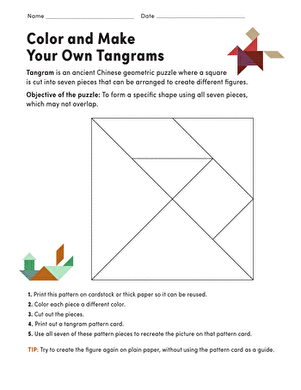
Alongside shape classification practice, Education.com offers educational pages that incorporate hands-on arts-and-crafts projects and digital worksheets centered on geometric design. These resources help students apply math skills creatively while making structures and art pieces using ideal angles and shapes. Such assignments make geometry accessible and fun by integrating shape recognition with visual arts activities that nurture collaboration, fine motor skills, and creative expression.
Teachers and parents can use these resources to plan lesson sequences, support at-home learning, or introduce shape recognition early in math instruction. Worksheets paired with real-world examples enable learners to connect geometric concepts with everyday objects and experiences. By utilizing this collection, educators and caregivers can promote both foundational math skills and creative thinking in a practical and engaging way.
Alongside shape classification practice, Education.com offers educational pages that incorporate hands-on arts-and-crafts projects and digital worksheets centered on geometric design. These resources help students apply math skills creatively while making structures and art pieces using ideal angles and shapes. Such assignments make geometry accessible and fun by integrating shape recognition with visual arts activities that nurture collaboration, fine motor skills, and creative expression.
Teachers and parents can use these resources to plan lesson sequences, support at-home learning, or introduce shape recognition early in math instruction. Worksheets paired with real-world examples enable learners to connect geometric concepts with everyday objects and experiences. By utilizing this collection, educators and caregivers can promote both foundational math skills and creative thinking in a practical and engaging way.