3rd Grade Arts & Crafts Classifying Two-Dimensional Shapes Resources

3 results
Math
✕3rd Grade
✕Arts & Crafts
✕3 results
3rd Grade Arts & Crafts Classifying Two-Dimensional Shapes Resources
3 results
Math
✕3rd Grade
✕Arts & Crafts
✕3 results




About 3rd Grade Arts & Crafts Classifying Two-dimensional Shapes Resources
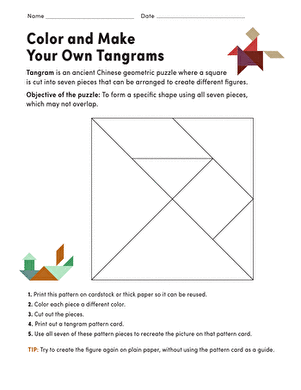
On Education.com, students can explore activities and lessons related to classifying two-dimensional shapes through arts and crafts. These materials help children understand geometric concepts by creating paper shapes, sorting shapes by attributes, and engaging in hands-on projects that reinforce shape identification. The resources combine learning math with creativity, making it accessible and enjoyable for third-grade learners.
Educators and parents can access printable worksheets, shape sorting games, step-by-step craft guides, and interactive classroom activities that promote geometry skills. Each resource provides structured exercises that reinforce concepts like recognition of circles, squares, triangles, and rectangles while fostering fine motor skills and spatial awareness. These materials support teaching shape classification value in a playful and educational way.
Using these materials in the classroom or at home makes learning geometry engaging and interactive. Children practice identifying shapes in real-world objects, organizing shapes by size or sides, and creating categorization systems that enhance both visual and analytical thinking. Educators and parents can integrate arts, crafts, and exercises to strengthen understanding and retention of two-dimensional shape classification.
Educators and parents can access printable worksheets, shape sorting games, step-by-step craft guides, and interactive classroom activities that promote geometry skills. Each resource provides structured exercises that reinforce concepts like recognition of circles, squares, triangles, and rectangles while fostering fine motor skills and spatial awareness. These materials support teaching shape classification value in a playful and educational way.
Using these materials in the classroom or at home makes learning geometry engaging and interactive. Children practice identifying shapes in real-world objects, organizing shapes by size or sides, and creating categorization systems that enhance both visual and analytical thinking. Educators and parents can integrate arts, crafts, and exercises to strengthen understanding and retention of two-dimensional shape classification.