3rd Grade Common Core Classifying Three-Dimensional Shapes Resources
Common Core Quick Links:
Common Core Standards for 3rd Grade Math, Common Core Standards for 3rd Grade ELA
9 results
Math
✕3rd Grade
✕Common Core
✕9 results
Subtopics:
3rd Grade Common Core Classifying Three-Dimensional Shapes Resources
Common Core Quick Links:
Common Core Standards for 3rd Grade Math, Common Core Standards for 3rd Grade ELA9 results
Math
✕3rd Grade
✕Common Core
✕9 results



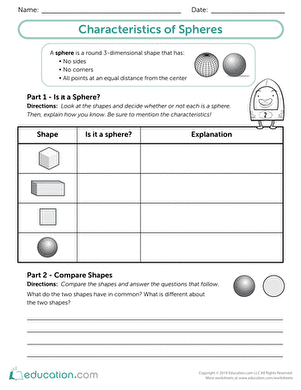
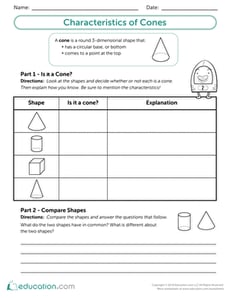

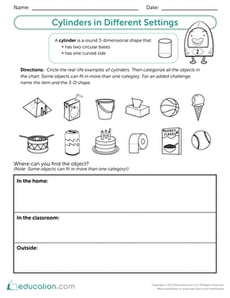

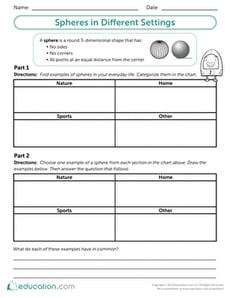

About 3rd Grade Common Core Classifying Three-dimensional Shapes Resources
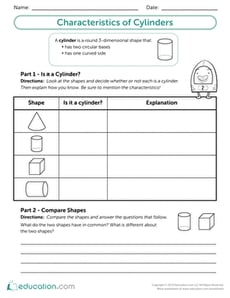
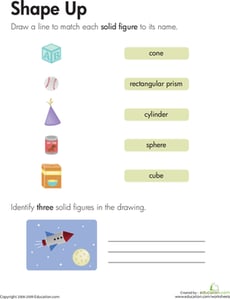
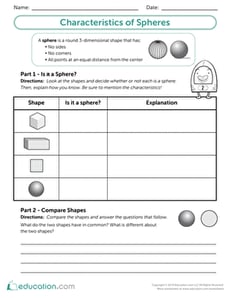
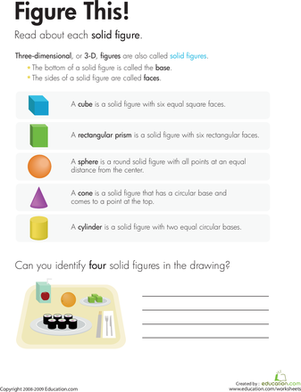
On Education.com, this page provides classroom-ready resources for 3rd grade students to learn how to classify and analyze three-dimensional shapes. These materials include lesson plans, worksheets, and digital activities that teach students to identify faces, edges, and vertices, and group shapes by attributes. Educators and parents can access guided activities that build foundational geometry skills, aligned with CCSS.Math.Content.1.G.A.2. The resources make it easier to introduce geometry concepts to young learners in engaging, hands-on ways.
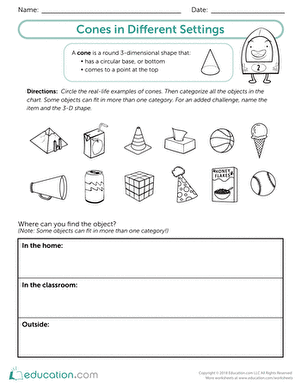
This page offers printable worksheets, digital puzzles, and interactive games that help students practice classifying 3D shapes. The varied formats enable students to see how shapes relate to real-world objects, understand symmetry, and explore attributes like number of faces and sides. By providing materials that progress from identifying simple features to classifying shapes by multiple attributes, educators can support deeper geometry learning and critical thinking.
Using this collection helps parents and teachers save time by providing ready-made, standards-based resources for teaching 3D shape classification. Kids can engage with hands-on exercises that strengthen spatial reasoning and pattern recognition, while educators can incorporate these materials into lesson plans to reinforce geometry standards. With diverse activities available, learners stay motivated while developing essential math skills.
This page offers printable worksheets, digital puzzles, and interactive games that help students practice classifying 3D shapes. The varied formats enable students to see how shapes relate to real-world objects, understand symmetry, and explore attributes like number of faces and sides. By providing materials that progress from identifying simple features to classifying shapes by multiple attributes, educators can support deeper geometry learning and critical thinking.
Using this collection helps parents and teachers save time by providing ready-made, standards-based resources for teaching 3D shape classification. Kids can engage with hands-on exercises that strengthen spatial reasoning and pattern recognition, while educators can incorporate these materials into lesson plans to reinforce geometry standards. With diverse activities available, learners stay motivated while developing essential math skills.