SKIP TO CONTENT
Worksheet Generator
Subjects
Grades
Worksheets
Games
Build a Worksheet
More Resources
Roly Recommends
Summer Boost
Subjects
Grades
Worksheets
Games
Build a Worksheet
More Resources
Roly Recommends
Summer Boost
Showing Results for read me : Page 6
Filters
601 results
Search for: read, me
✕
Lesson Plans
✕
3rd and 4th Grade
✕
Clear all
601 results
Filters
Search for: read, me
✕
Lesson Plans
✕
3rd and 4th Grade
✕
Subjects
Math
English Language Arts
Science
Social Studies
Technology
Grade Level
Pre-K
K
1st
2nd
3rd
4th
5th
6th
7th
8th
Early Childhood
Elementary School
Middle School
Resource Type
Worksheets
Games
Lesson Plans
Interactive Worksheets
Workbooks
Activities
Exercises
Stories
Offline Games
Guided Lessons
Teacher Resources
Common Core
Yes
Roly Recommends
Social Emotional Learning
English Language Support
Yes
Clear all
View 601 results
Showing Results for read me : Page 6
Filters
601 results
Search for: read, me
✕
Lesson Plans
✕
3rd and 4th Grade
✕
Clear all
601 results
Let's Play Ball
Lesson Plan
Let's Play Ball
Third Grade
Multiplication
Students will have a ball with this data collection lesson plan where they learn about collecting and plotting data on a chart and line plot.
Lesson Plan
Let's Play Ball
Lesson Plan
Let's Play Ball
Students will have a ball with this data collection lesson plan where they learn about collecting and plotting data on a chart and line plot.
Third Grade
Multiplication
Lesson Plan
Interesting Introductions
Lesson Plan
Interesting Introductions
Third Grade
Reading
Teach young authors how to "hook" readers with this hands-on lesson. By examining novels and developing their own introductions, students will be able to hone their writing skills.
Lesson Plan
Interesting Introductions
Lesson Plan
Interesting Introductions
Teach young authors how to "hook" readers with this hands-on lesson. By examining novels and developing their own introductions, students will be able to hone their writing skills.
Third Grade
Reading
Lesson Plan
Elements of Poetry
Lesson Plan
Elements of Poetry
Fourth Grade
Reading
Introduce your students to some of the major structural elements of poetry in this comprehensive lesson.
Lesson Plan
Elements of Poetry
Lesson Plan
Elements of Poetry
Introduce your students to some of the major structural elements of poetry in this comprehensive lesson.
Fourth Grade
Reading
Lesson Plan
How Do You Solve a Problem?
Lesson Plan
How Do You Solve a Problem?
Third Grade
Some problems are easy to fix, while some are more complicated. Use this lesson to teach your students to identify the characters’ attempts in a story to solve problems.
Lesson Plan
How Do You Solve a Problem?
Lesson Plan
How Do You Solve a Problem?
Some problems are easy to fix, while some are more complicated. Use this lesson to teach your students to identify the characters’ attempts in a story to solve problems.
Third Grade
Lesson Plan
EL
Summarizing with Sequence Words
Lesson Plan
Summarizing with Sequence Words
Fourth Grade
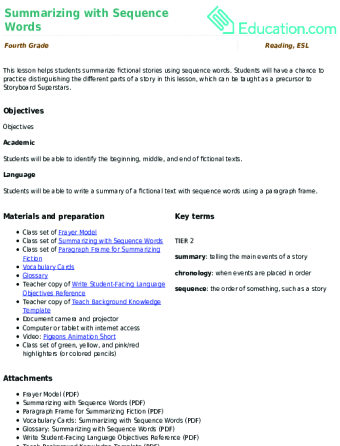
This lesson helps students summarize fictional stories using sequence words. Students will have a chance to practice distinguishing the different parts of a story in this lesson, which can be taught as a precursor to Storyboard Superstars.
Lesson Plan
EL
Summarizing with Sequence Words
Lesson Plan
Summarizing with Sequence Words
This lesson helps students summarize fictional stories using sequence words. Students will have a chance to practice distinguishing the different parts of a story in this lesson, which can be taught as a precursor to Storyboard Superstars.
Fourth Grade
Lesson Plan
EL
Who Is Telling the Story?
Lesson Plan
Who Is Telling the Story?
Fourth Grade
Help your ELs see the connection between nouns and pronouns and the author's point of view, or perspective, in fiction and nonfiction texts. This lesson can be taught on its own or used as support for the lesson Two Points of View.
Lesson Plan
EL
Who Is Telling the Story?
Lesson Plan
Who Is Telling the Story?
Help your ELs see the connection between nouns and pronouns and the author's point of view, or perspective, in fiction and nonfiction texts. This lesson can be taught on its own or used as support for the lesson Two Points of View.
Fourth Grade
Lesson Plan
Sub Plans for Fourth Grade
Lesson Plan
Sub Plans for Fourth Grade
Fourth Grade
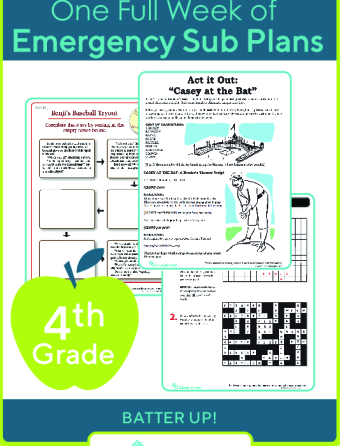
Planning for a substitute teacher in the classroom has never been easier than with this week-long sub packet for fourth grade! Your substitute can supercharge learning with lessons that will educate and inspire your students!
Lesson Plan
Sub Plans for Fourth Grade
Lesson Plan
Sub Plans for Fourth Grade
Planning for a substitute teacher in the classroom has never been easier than with this week-long sub packet for fourth grade! Your substitute can supercharge learning with lessons that will educate and inspire your students!
Fourth Grade
Lesson Plan
EL
Adjectives in Informational Texts
Lesson Plan
Adjectives in Informational Texts
Fourth Grade
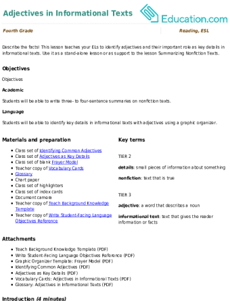
Describe the facts! This lesson teaches your ELs to identify adjectives and their important role as key details in informational texts. Use it as a stand-alone lesson or as support to the lesson Summarizing Nonfiction Texts.
Lesson Plan
EL
Adjectives in Informational Texts
Lesson Plan
Adjectives in Informational Texts
Describe the facts! This lesson teaches your ELs to identify adjectives and their important role as key details in informational texts. Use it as a stand-alone lesson or as support to the lesson Summarizing Nonfiction Texts.
Fourth Grade
Lesson Plan
Summer Drama
Lesson Plan
Summer Drama
Fourth Grade
Vocabulary
You won't strike out with this lesson on finding the theme of a script. Use this lesson to help your students identify the elements of a script and find the theme.
Lesson Plan
Summer Drama
Lesson Plan
Summer Drama
You won't strike out with this lesson on finding the theme of a script. Use this lesson to help your students identify the elements of a script and find the theme.
Fourth Grade
Vocabulary
Lesson Plan
EL
Nonfiction Main Idea
Lesson Plan
Nonfiction Main Idea
Fourth Grade
Reading
Let's get reading! In this lesson, students will identify the main idea and details of a nonfiction text. Use this on its own or as support for the lesson Connecting the Coasts: Effects of the Transcontinental Railroad.
Lesson Plan
EL
Nonfiction Main Idea
Lesson Plan
Nonfiction Main Idea
Let's get reading! In this lesson, students will identify the main idea and details of a nonfiction text. Use this on its own or as support for the lesson Connecting the Coasts: Effects of the Transcontinental Railroad.
Fourth Grade
Reading
Lesson Plan
Let's Hook 'Em!
Lesson Plan
Let's Hook 'Em!
Second Grade
Reading
Are your students hooking their readers? Use this creative and imaginative writing exercise that will bring student beginnings to life.
Lesson Plan
Let's Hook 'Em!
Lesson Plan
Let's Hook 'Em!
Are your students hooking their readers? Use this creative and imaginative writing exercise that will bring student beginnings to life.
Second Grade
Reading
Lesson Plan
Biomes: Comparing and Contrasting
Lesson Plan
Biomes: Comparing and Contrasting
Fourth Grade
Reading
This lesson combines an introduction to biomes with some fun Venn diagram exercises. Not only will students learn more about nature, they'll also learn how to make comparisons between different things in nature.
Lesson Plan
Biomes: Comparing and Contrasting
Lesson Plan
Biomes: Comparing and Contrasting
This lesson combines an introduction to biomes with some fun Venn diagram exercises. Not only will students learn more about nature, they'll also learn how to make comparisons between different things in nature.
Fourth Grade
Reading
Lesson Plan
Paragraphs That POP!
Lesson Plan
Paragraphs That POP!
Fourth Grade
Writing
If young writers can learn how to write a solid paragraph, then they have the building blocks of an essay. In this lesson, students will study paragraph structure and practice organizing ideas into paragraphs.
Lesson Plan
Paragraphs That POP!
Lesson Plan
Paragraphs That POP!
If young writers can learn how to write a solid paragraph, then they have the building blocks of an essay. In this lesson, students will study paragraph structure and practice organizing ideas into paragraphs.
Fourth Grade
Writing
Lesson Plan
We’ve Got a Problem!
Lesson Plan
We’ve Got a Problem!
Third Grade
What’s the problem? Teach your students to identify the problem and solution in a piece of fiction.
Lesson Plan
We’ve Got a Problem!
Lesson Plan
We’ve Got a Problem!
What’s the problem? Teach your students to identify the problem and solution in a piece of fiction.
Third Grade
Lesson Plan
EL
Text Features and Their Purposes
Lesson Plan
Text Features and Their Purposes
Fourth Grade
This lesson helps your ELs identify nonfiction text features and explain how they enhance comprehension of the text. Use it as a stand-alone lesson or a support lesson for the Searching for Text Features lesson plan.
Lesson Plan
EL
Text Features and Their Purposes
Lesson Plan
Text Features and Their Purposes
This lesson helps your ELs identify nonfiction text features and explain how they enhance comprehension of the text. Use it as a stand-alone lesson or a support lesson for the Searching for Text Features lesson plan.
Fourth Grade
Lesson Plan
Compare and Contrast W.E.B. Du Bois and George Washington Carver
Lesson Plan
Compare and Contrast W.E.B. Du Bois and George Washington Carver
Fourth Grade
Reading
In this lesson, ask students to compare and contrast two important African-American historical figures. Students will write an informational paragraph on the similarities and differences between W.E.B. Du Bois and George Washington Carver.
Lesson Plan
Compare and Contrast W.E.B. Du Bois and George Washington Carver
Lesson Plan
Compare and Contrast W.E.B. Du Bois and George Washington Carver
In this lesson, ask students to compare and contrast two important African-American historical figures. Students will write an informational paragraph on the similarities and differences between W.E.B. Du Bois and George Washington Carver.
Fourth Grade
Reading
Lesson Plan
What's the Big Idea? Summarizing Nonfiction Texts
Lesson Plan
What's the Big Idea? Summarizing Nonfiction Texts
Fourth Grade
Writing
Understanding the big idea of a nonfiction text and being able to write a succinct summary are key fourth grade skills. This lesson focuses on summarizing a nonfiction passage in 3-4 sentences.
Lesson Plan
What's the Big Idea? Summarizing Nonfiction Texts
Lesson Plan
What's the Big Idea? Summarizing Nonfiction Texts
Understanding the big idea of a nonfiction text and being able to write a succinct summary are key fourth grade skills. This lesson focuses on summarizing a nonfiction passage in 3-4 sentences.
Fourth Grade
Writing
Lesson Plan
A Deeper Look into the Preamble to the Constitution
Lesson Plan
A Deeper Look into the Preamble to the Constitution
Fourth Grade
Understanding the Constitution is an important civic duty. This lesson gives your students a chance to break down the Preamble to the Constitution into manageable chunks, and translate it into student-friendly language.
Lesson Plan
A Deeper Look into the Preamble to the Constitution
Lesson Plan
A Deeper Look into the Preamble to the Constitution
Understanding the Constitution is an important civic duty. This lesson gives your students a chance to break down the Preamble to the Constitution into manageable chunks, and translate it into student-friendly language.
Fourth Grade
Lesson Plan
Diving into Earth's Oceans
Lesson Plan
Diving into Earth's Oceans
Fourth Grade
Writing
Get your students excited about geography with a lesson on Earth's oceans. After reading two different texts, they'll be ready to dive right into ocean paragraph writing.
Lesson Plan
Diving into Earth's Oceans
Lesson Plan
Diving into Earth's Oceans
Get your students excited about geography with a lesson on Earth's oceans. After reading two different texts, they'll be ready to dive right into ocean paragraph writing.
Fourth Grade
Writing
Lesson Plan
Finding Similarities and Differences
Lesson Plan
Finding Similarities and Differences
Third Grade
Reading
Good readers analyze texts by looking at similarities and differences. Use this lesson to teach your students to compare and contrast the story elements of two fiction texts.
Lesson Plan
Finding Similarities and Differences
Lesson Plan
Finding Similarities and Differences
Good readers analyze texts by looking at similarities and differences. Use this lesson to teach your students to compare and contrast the story elements of two fiction texts.
Third Grade
Reading
Lesson Plan
Questions that Gauge Comprehension
Lesson Plan
Questions that Gauge Comprehension
Third Grade
Vocabulary
Use this lesson to gauge your students’ basic comprehension of fiction text. If they can answer who, what, when, where, why, and how questions, you know they have a handle on it and it’s time to get into more critical thinking!
Lesson Plan
Questions that Gauge Comprehension
Lesson Plan
Questions that Gauge Comprehension
Use this lesson to gauge your students’ basic comprehension of fiction text. If they can answer who, what, when, where, why, and how questions, you know they have a handle on it and it’s time to get into more critical thinking!
Third Grade
Vocabulary
Lesson Plan
EL
Focus on the Similarities
Lesson Plan
Focus on the Similarities
Third Grade
Reading
Use this lesson to teach your students to describe the similarities between stories with words that signal comparison. This lesson can stand-alone or be used as a pre-lesson for the
The Same or Different? You Decide!
lesson.
Lesson Plan
EL
Focus on the Similarities
Lesson Plan
Focus on the Similarities
Use this lesson to teach your students to describe the similarities between stories with words that signal comparison. This lesson can stand-alone or be used as a pre-lesson for the
The Same or Different? You Decide!
lesson.
Third Grade
Reading
Lesson Plan
Storyboard Superstars
Lesson Plan
Storyboard Superstars
Fourth Grade
Help your students become super readers! In this lesson, your students will create storyboards to identify the beginning, middle, and end in fictional texts.
Lesson Plan
Storyboard Superstars
Lesson Plan
Storyboard Superstars
Help your students become super readers! In this lesson, your students will create storyboards to identify the beginning, middle, and end in fictional texts.
Fourth Grade
Lesson Plan
The Same or Different? You Decide!
Lesson Plan
The Same or Different? You Decide!
Third Grade
Reading
Are the stories the same or different? You decide! Use this lesson with your students to practice comparing the story elements in two fictional stories written by the same author.
Lesson Plan
The Same or Different? You Decide!
Lesson Plan
The Same or Different? You Decide!
Are the stories the same or different? You decide! Use this lesson with your students to practice comparing the story elements in two fictional stories written by the same author.
Third Grade
Reading
Lesson Plan
EL
Deciphering Division Word Problems
Lesson Plan
Deciphering Division Word Problems
Fourth Grade
Word problems present an additional challenge for English learners. This division lesson gives them a concrete strategy to decipher word problems. Teach it on its own or prior to teaching Division Word Problems.
Lesson Plan
EL
Deciphering Division Word Problems
Lesson Plan
Deciphering Division Word Problems
Word problems present an additional challenge for English learners. This division lesson gives them a concrete strategy to decipher word problems. Teach it on its own or prior to teaching Division Word Problems.
Fourth Grade
Lesson Plan
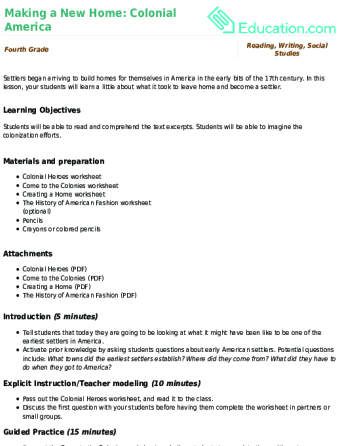
Making a New Home: Colonial America
Lesson Plan
Making a New Home: Colonial America
Fourth Grade
Settlers began arriving to build homes for themselves in America in the early bits of the 17th century. In this lesson, your students will learn a little about what it took to leave home and become a settler.
Lesson Plan
Making a New Home: Colonial America
Lesson Plan
Making a New Home: Colonial America
Settlers began arriving to build homes for themselves in America in the early bits of the 17th century. In this lesson, your students will learn a little about what it took to leave home and become a settler.
Fourth Grade
Lesson Plan
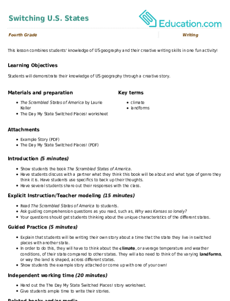
Switching U.S. States
Lesson Plan
Switching U.S. States
Fourth Grade
Measurement
This lesson combines students' knowledge of US geography and their creative writing skills in one fun activity!
Lesson Plan
Switching U.S. States
Lesson Plan
Switching U.S. States
This lesson combines students' knowledge of US geography and their creative writing skills in one fun activity!
Fourth Grade
Measurement
Lesson Plan
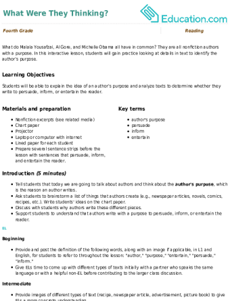
What Were They Thinking?
Lesson Plan
What Were They Thinking?
Fourth Grade
What do Malala Yousafzai, Al Gore, and Michelle Obama all have in common? They are all nonfiction authors with a purpose. In this interactive lesson, students will gain practice looking at details in text to identify the author’s purpose.
Lesson Plan
What Were They Thinking?
Lesson Plan
What Were They Thinking?
What do Malala Yousafzai, Al Gore, and Michelle Obama all have in common? They are all nonfiction authors with a purpose. In this interactive lesson, students will gain practice looking at details in text to identify the author’s purpose.
Fourth Grade
Lesson Plan
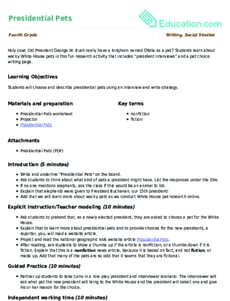
Presidential Pets
Lesson Plan
Presidential Pets
Fourth Grade
Writing
Holy cow! Did President George W. Bush really have a longhorn named Ofelia as a pet? Students learn about wacky White House pets in this fun research activity that includes “president interviews” and a pet choice writing page.
Lesson Plan
Presidential Pets
Lesson Plan
Presidential Pets
Holy cow! Did President George W. Bush really have a longhorn named Ofelia as a pet? Students learn about wacky White House pets in this fun research activity that includes “president interviews” and a pet choice writing page.
Fourth Grade
Writing
Lesson Plan
EL
Strategy Work: Skip Counting to Multiply
Lesson Plan
Strategy Work: Skip Counting to Multiply
Third Grade
Use this lesson to teach your students about the strategy of skip counting. It can stand alone or be used as a pre-lesson for
Multiply by 5
.
Lesson Plan
EL
Strategy Work: Skip Counting to Multiply
Lesson Plan
Strategy Work: Skip Counting to Multiply
Use this lesson to teach your students about the strategy of skip counting. It can stand alone or be used as a pre-lesson for
Multiply by 5
.
Third Grade
Lesson Plan
1
…
5
6
7
…
21