SKIP TO CONTENT
Worksheet Generator
Subjects
Grades
Worksheets
Games
Build a Worksheet
More Resources
Roly Recommends
Subjects
Grades
Worksheets
Games
Build a Worksheet
More Resources
Roly Recommends
Filters
Search for: just, write
✕
3rd and 4th Grade
✕
English Language Support
✕
Subjects
Math
English Language Arts
Science
Grade Level
Pre-K
K
1st
2nd
3rd
4th
5th
6th
7th
8th
Early Childhood
Elementary School
Middle School
Resource Type
Lesson Plans
Common Core
Yes
English Language Support
Yes
See More
Clear All
View 154 results
Showing Results for just write
154 results
Search for: just, write
✕
3rd and 4th Grade
✕
English Language Support
✕
Clear All
Sort by:
Relevance
Most recent
Most popular
Alphabetical A-Z
Alphabetical Z-A
All filters
154 results
Sort by:
Relevance
Most recent
Most popular
Alphabetical A-Z
Alphabetical Z-A
Beyond Just Addition
Lesson Plan
Beyond Just Addition
Third Grade
In this interactive lesson that includes the use of clock manipulatives, students will discover that addition goes beyond straightforward addition problems. Finding the elapsed time is easy with addition!
Lesson Plan
Beyond Just Addition
Lesson Plan
Beyond Just Addition
In this interactive lesson that includes the use of clock manipulatives, students will discover that addition goes beyond straightforward addition problems. Finding the elapsed time is easy with addition!
Third Grade
Lesson Plan
Characters Change Just Like We Do
Lesson Plan
Characters Change Just Like We Do
Third Grade
Writing
Change is inevitable, even for story characters! In this lesson, your students will determine how a character changes throughout a story by focusing on the character’s dialogue and actions.
Lesson Plan
Characters Change Just Like We Do
Lesson Plan
Characters Change Just Like We Do
Change is inevitable, even for story characters! In this lesson, your students will determine how a character changes throughout a story by focusing on the character’s dialogue and actions.
Third Grade
Writing
Lesson Plan
Determining Importance
Lesson Plan
Determining Importance
Third Grade
Is that fact important, or is it just interesting? Use this lesson to help your students determine importance in nonfiction text.
Lesson Plan
Determining Importance
Lesson Plan
Determining Importance
Is that fact important, or is it just interesting? Use this lesson to help your students determine importance in nonfiction text.
Third Grade
Lesson Plan
Simple Summaries
Lesson Plan
Simple Summaries
Third Grade
Reading
Keep it simple! Teach your students to write a summary using the Somebody-Wanted-But-So-Then frame for analyzing a story.
Lesson Plan
Simple Summaries
Lesson Plan
Simple Summaries
Keep it simple! Teach your students to write a summary using the Somebody-Wanted-But-So-Then frame for analyzing a story.
Third Grade
Reading
Lesson Plan
Get There On Time: Elapsed Time Word Problem Strategies
Lesson Plan
Get There On Time: Elapsed Time Word Problem Strategies
Third Grade
In this lesson, students will practice strategies of subtracting time and apply them to real life scenarios. Also, use this game with the lesson that teaches addition of elapsed time called Beyond Just Addition.
Lesson Plan
Get There On Time: Elapsed Time Word Problem Strategies
Lesson Plan
Get There On Time: Elapsed Time Word Problem Strategies
In this lesson, students will practice strategies of subtracting time and apply them to real life scenarios. Also, use this game with the lesson that teaches addition of elapsed time called Beyond Just Addition.
Third Grade
Lesson Plan
What's the Big Idea? Summarizing Nonfiction Texts
Lesson Plan
What's the Big Idea? Summarizing Nonfiction Texts
Fourth Grade
Reading
Understanding the big idea of a nonfiction text and being able to write a succinct summary are key fourth grade skills. This lesson focuses on summarizing a nonfiction passage in three to four sentences.
Lesson Plan
What's the Big Idea? Summarizing Nonfiction Texts
Lesson Plan
What's the Big Idea? Summarizing Nonfiction Texts
Understanding the big idea of a nonfiction text and being able to write a succinct summary are key fourth grade skills. This lesson focuses on summarizing a nonfiction passage in three to four sentences.
Fourth Grade
Reading
Lesson Plan
Two-Step Word Problems with Mixed Operations - Gamified!
Lesson Plan
Two-Step Word Problems with Mixed Operations - Gamified!
Third Grade
Students will have fun learning the Read, Draw, Write (RDW) strategy on two-step, mixed operation problems. First they will learn RDW, and then they will practice it in a game called Four in a Row.
Lesson Plan
Two-Step Word Problems with Mixed Operations - Gamified!
Lesson Plan
Two-Step Word Problems with Mixed Operations - Gamified!
Students will have fun learning the Read, Draw, Write (RDW) strategy on two-step, mixed operation problems. First they will learn RDW, and then they will practice it in a game called Four in a Row.
Third Grade
Lesson Plan
Close Reading: Reading Through Character Emotion
Lesson Plan
Close Reading: Reading Through Character Emotion
Fourth Grade
Close reading isn’t about just ticking through words on a page; it’s about absorbing ideas and expanding on them. In this lesson, students will use this strategy to make interpretations about a character's emotions through their actions.
Lesson Plan
Close Reading: Reading Through Character Emotion
Lesson Plan
Close Reading: Reading Through Character Emotion
Close reading isn’t about just ticking through words on a page; it’s about absorbing ideas and expanding on them. In this lesson, students will use this strategy to make interpretations about a character's emotions through their actions.
Fourth Grade
Lesson Plan
Multiplication Models: Fractions and Whole Numbers
Lesson Plan
Multiplication Models: Fractions and Whole Numbers
Fourth Grade
Teach your students to multiply fractions by whole numbers in this dynamic hands-on lesson!
Lesson Plan
Multiplication Models: Fractions and Whole Numbers
Lesson Plan
Multiplication Models: Fractions and Whole Numbers
Teach your students to multiply fractions by whole numbers in this dynamic hands-on lesson!
Fourth Grade
Lesson Plan
There’s No I in Theme-work!
Lesson Plan
There’s No I in Theme-work!
Fourth Grade
Vocabulary
That’s right! The theme applies to everyone! Use this interactive lesson to teach your students how to find the theme of a fictional text.
Lesson Plan
There’s No I in Theme-work!
Lesson Plan
There’s No I in Theme-work!
That’s right! The theme applies to everyone! Use this interactive lesson to teach your students how to find the theme of a fictional text.
Fourth Grade
Vocabulary
Lesson Plan
Fraction of a Whole
Lesson Plan
Fraction of a Whole
Fourth Grade
Teach your students to use bar models and multiplication to find a fraction of a whole number.
Lesson Plan
Fraction of a Whole
Lesson Plan
Fraction of a Whole
Teach your students to use bar models and multiplication to find a fraction of a whole number.
Fourth Grade
Lesson Plan
Subtracting Mixed Numbers Using the Decomposition Strategy
Lesson Plan
Subtracting Mixed Numbers Using the Decomposition Strategy
Fourth Grade
Teach your students to subtract mixed numbers with like denominators using the strategy of decomposition. This strategy helps students to manipulate and break down numbers to help them solve tricky subtraction problems.
Lesson Plan
Subtracting Mixed Numbers Using the Decomposition Strategy
Lesson Plan
Subtracting Mixed Numbers Using the Decomposition Strategy
Teach your students to subtract mixed numbers with like denominators using the strategy of decomposition. This strategy helps students to manipulate and break down numbers to help them solve tricky subtraction problems.
Fourth Grade
Lesson Plan
Fluently Subtracting within 1000
Lesson Plan
Fluently Subtracting within 1000
Third Grade
Start your students on subtracting three-digit numbers with this lesson that breaks the problems down by place values!
Lesson Plan
Fluently Subtracting within 1000
Lesson Plan
Fluently Subtracting within 1000
Start your students on subtracting three-digit numbers with this lesson that breaks the problems down by place values!
Third Grade
Lesson Plan
Equivalent Fractions Using Area Models
Lesson Plan
Equivalent Fractions Using Area Models
Fourth Grade
Teach your students to create equivalent fractions by multiplying by different fraction forms of 1 whole like 2/2 or 4/4. This lesson also includes drafts of area models.
Lesson Plan
Equivalent Fractions Using Area Models
Lesson Plan
Equivalent Fractions Using Area Models
Teach your students to create equivalent fractions by multiplying by different fraction forms of 1 whole like 2/2 or 4/4. This lesson also includes drafts of area models.
Fourth Grade
Lesson Plan
Factors Over the Rainbow
Lesson Plan
Factors Over the Rainbow
Fourth Grade
Make math colorful! Teach your students to find the factors of a number using the factor rainbow strategy.
Lesson Plan
Factors Over the Rainbow
Lesson Plan
Factors Over the Rainbow
Make math colorful! Teach your students to find the factors of a number using the factor rainbow strategy.
Fourth Grade
Lesson Plan
Parking Lot Multiplication
Lesson Plan
Parking Lot Multiplication
Third Grade
Help your students make sense of the commutative property of multiplication by relating it to arrangements of cars in parking lots.
Lesson Plan
Parking Lot Multiplication
Lesson Plan
Parking Lot Multiplication
Help your students make sense of the commutative property of multiplication by relating it to arrangements of cars in parking lots.
Third Grade
Lesson Plan
Divide it Up!
Lesson Plan
Divide it Up!
Third Grade
Division
Make division come to life with this hands-on, introductory lesson on the operation of division! Students will use authentic problems and manipulatives to experience division in action.
Lesson Plan
Divide it Up!
Lesson Plan
Divide it Up!
Make division come to life with this hands-on, introductory lesson on the operation of division! Students will use authentic problems and manipulatives to experience division in action.
Third Grade
Division
Lesson Plan
What is it Telling Me? Creating and Interpreting Line Plots
Lesson Plan
What is it Telling Me? Creating and Interpreting Line Plots
Third Grade
Data and Graphing
Line plots are a great way to introduce your students to graphing data. In this lesson, your students will learn how to create a line plot and also practice interpreting line plots.
Lesson Plan
What is it Telling Me? Creating and Interpreting Line Plots
Lesson Plan
What is it Telling Me? Creating and Interpreting Line Plots
Line plots are a great way to introduce your students to graphing data. In this lesson, your students will learn how to create a line plot and also practice interpreting line plots.
Third Grade
Data and Graphing
Lesson Plan
Do You Know Your Math Facts?
Lesson Plan
Do You Know Your Math Facts?
Third Grade
In this lesson, your students will create their own math facts and practice them! They will understand that multiplication and division are opposites.
Lesson Plan
Do You Know Your Math Facts?
Lesson Plan
Do You Know Your Math Facts?
In this lesson, your students will create their own math facts and practice them! They will understand that multiplication and division are opposites.
Third Grade
Lesson Plan
Exploring Author's Purpose and Point of View
Lesson Plan
Exploring Author's Purpose and Point of View
Third Grade
Life Science
We aren’t mind readers, but we can still figure out why the author wrote a text and what an author thinks about the topic! This lesson will teach your students the main purposes for writing.
Lesson Plan
Exploring Author's Purpose and Point of View
Lesson Plan
Exploring Author's Purpose and Point of View
We aren’t mind readers, but we can still figure out why the author wrote a text and what an author thinks about the topic! This lesson will teach your students the main purposes for writing.
Third Grade
Life Science
Lesson Plan
What Were They Thinking?
Lesson Plan
What Were They Thinking?
Fourth Grade
What do Malala Yousafzai, Al Gore, and Michelle Obama all have in common? They are all nonfiction authors with a purpose. In this interactive lesson, students will gain practice looking at details in text to identify the author’s purpose.
Lesson Plan
What Were They Thinking?
Lesson Plan
What Were They Thinking?
What do Malala Yousafzai, Al Gore, and Michelle Obama all have in common? They are all nonfiction authors with a purpose. In this interactive lesson, students will gain practice looking at details in text to identify the author’s purpose.
Fourth Grade
Lesson Plan
Regrouping with Popsicle Sticks: Double-Digit Subtraction
Lesson Plan
Regrouping with Popsicle Sticks: Double-Digit Subtraction
Third Grade
Can you break a ten? An everyday exchange of money can help students think about regrouping to subtract. Students will use bundled popsicle sticks to see how values grouped into tens can be regrouped into ones to allow us to subtract.
Lesson Plan
Regrouping with Popsicle Sticks: Double-Digit Subtraction
Lesson Plan
Regrouping with Popsicle Sticks: Double-Digit Subtraction
Can you break a ten? An everyday exchange of money can help students think about regrouping to subtract. Students will use bundled popsicle sticks to see how values grouped into tens can be regrouped into ones to allow us to subtract.
Third Grade
Lesson Plan
Distributive Property
Lesson Plan
Distributive Property
Fourth Grade
Teach your students to recognize and use the distributive property of multiplication.
Lesson Plan
Distributive Property
Lesson Plan
Distributive Property
Teach your students to recognize and use the distributive property of multiplication.
Fourth Grade
Lesson Plan
Is It True?
Lesson Plan
Is It True?
Fourth Grade
Don't believe everything you read! Teach students to differentiate between statements of fact and opinion. This important skill will help students become critical and discerning readers.
Lesson Plan
Is It True?
Lesson Plan
Is It True?
Don't believe everything you read! Teach students to differentiate between statements of fact and opinion. This important skill will help students become critical and discerning readers.
Fourth Grade
Lesson Plan
Traditional Literature: Story Mapping
Lesson Plan
Traditional Literature: Story Mapping
Second Grade
Reading
Students will learn how to identify story elements and create a short and sweet summary. They will fill out a graphic organizer and solidify their understanding by creating illustrations to show major plot points that they find themselves!
Lesson Plan
Traditional Literature: Story Mapping
Lesson Plan
Traditional Literature: Story Mapping
Students will learn how to identify story elements and create a short and sweet summary. They will fill out a graphic organizer and solidify their understanding by creating illustrations to show major plot points that they find themselves!
Second Grade
Reading
Lesson Plan
In Search of the Main Idea
Lesson Plan
In Search of the Main Idea
Third Grade
Writing
Young learners will love finding the main ideas in short informational texts. Featuring a bunch of fun worksheets, this lesson will help students learn about different topics while improving their reading skills.
Lesson Plan
In Search of the Main Idea
Lesson Plan
In Search of the Main Idea
Young learners will love finding the main ideas in short informational texts. Featuring a bunch of fun worksheets, this lesson will help students learn about different topics while improving their reading skills.
Third Grade
Writing
Lesson Plan
Fact or Opinion: Part 1
Lesson Plan
Fact or Opinion: Part 1
Second Grade
Vocabulary
Cats are the best! Pizza is better! My teacher rules! In Fact or Opinion: Part 1, your students will combine reading and writing to learn about the differences between facts and opinions and how those differences are communicated.
Lesson Plan
Fact or Opinion: Part 1
Lesson Plan
Fact or Opinion: Part 1
Cats are the best! Pizza is better! My teacher rules! In Fact or Opinion: Part 1, your students will combine reading and writing to learn about the differences between facts and opinions and how those differences are communicated.
Second Grade
Vocabulary
Lesson Plan
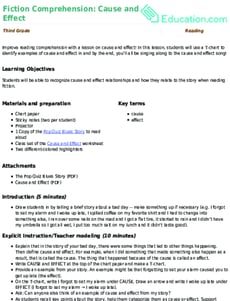
Fiction Comprehension: Cause and Effect
Lesson Plan
Fiction Comprehension: Cause and Effect
Third Grade
Improve reading comprehension with a lesson on cause and effect! In this lesson, students will use a T-chart to identify examples of cause and effect in and by the end, you’ll all be singing along to the cause and effect song!
Lesson Plan
Fiction Comprehension: Cause and Effect
Lesson Plan
Fiction Comprehension: Cause and Effect
Improve reading comprehension with a lesson on cause and effect! In this lesson, students will use a T-chart to identify examples of cause and effect in and by the end, you’ll all be singing along to the cause and effect song!
Third Grade
Lesson Plan
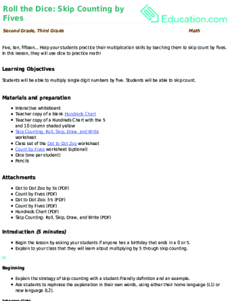
Roll the Dice: Skip Counting by Fives
Lesson Plan
Roll the Dice: Skip Counting by Fives
Second Grade
Five, ten, fifteen... Help your students practice their multiplication skills by teaching them to skip count by fives. In this lesson, they will use dice to practice math!
Lesson Plan
Roll the Dice: Skip Counting by Fives
Lesson Plan
Roll the Dice: Skip Counting by Fives
Five, ten, fifteen... Help your students practice their multiplication skills by teaching them to skip count by fives. In this lesson, they will use dice to practice math!
Second Grade
Lesson Plan
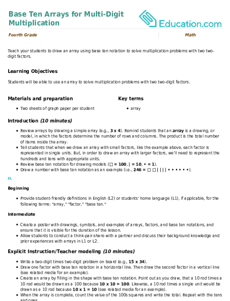
Base Ten Arrays for Multi-Digit Multiplication
Lesson Plan
Base Ten Arrays for Multi-Digit Multiplication
Fourth Grade
Teach your students to draw an array using base ten notation to solve multiplication problems with two two-digit factors.
Lesson Plan
Base Ten Arrays for Multi-Digit Multiplication
Lesson Plan
Base Ten Arrays for Multi-Digit Multiplication
Teach your students to draw an array using base ten notation to solve multiplication problems with two two-digit factors.
Fourth Grade
Lesson Plan
1
2
3
4
5
6