SKIP TO CONTENT
Worksheet Generator
Subjects
Grades
Worksheets
Games
Build a Worksheet
More Resources
Roly Recommends
Subjects
Grades
Worksheets
Games
Build a Worksheet
More Resources
Roly Recommends
Filters
Search for: once, upon, a, point, of, view
✕
Lesson Plans
✕
2nd - 5th Grade
✕
Subjects
Math
English Language Arts
Science
Social Studies
Grade Level
Pre-K
K
1st
2nd
3rd
4th
5th
6th
7th
8th
Early Childhood
Elementary School
Middle School
Resource Type
Worksheets
Games
Lesson Plans
Interactive Worksheets
Workbooks
Activities
Exercises
Stories
Offline Games
Guided Lessons
Teacher Resources
Common Core
Yes
Roly Recommends
Social Emotional Learning
English Language Support
Yes
See More
Clear All
View 867 results
Showing Results for once upon a point of view
867 results
Search for: once, upon, a, point, of, view
✕
Lesson Plans
✕
2nd - 5th Grade
✕
Clear All
Sort by:
Relevance
Most recent
Most popular
Alphabetical A-Z
Alphabetical Z-A
All filters
867 results
Sort by:
Relevance
Most recent
Most popular
Alphabetical A-Z
Alphabetical Z-A
Point of View Pronouns
Lesson Plan
Point of View Pronouns
Fifth Grade
Vocabulary
In this support lesson, your ELs will learn how to determine point of view in a text while using pronouns to support their understanding. It can be a stand-alone lesson or used as support for the lesson Mythological Creature: Vampire.
Lesson Plan
Point of View Pronouns
Lesson Plan
Point of View Pronouns
In this support lesson, your ELs will learn how to determine point of view in a text while using pronouns to support their understanding. It can be a stand-alone lesson or used as support for the lesson Mythological Creature: Vampire.
Fifth Grade
Vocabulary
Lesson Plan
Point of View Frenzy
Lesson Plan
Point of View Frenzy
First Grade
Reading
Explore a day in the life of a pencil! Your students will practice different points of view by thinking outside the box and writing as though they are something else.
Lesson Plan
Point of View Frenzy
Lesson Plan
Point of View Frenzy
Explore a day in the life of a pencil! Your students will practice different points of view by thinking outside the box and writing as though they are something else.
First Grade
Reading
Lesson Plan
Once Upon a Sentence...
Lesson Plan
Once Upon a Sentence...
Second Grade
Do your students like to read or write crazy stories? Do they students need a refresher on the different parts of a sentence? Help them with both using this fun activity-based lesson.
Lesson Plan
Once Upon a Sentence...
Lesson Plan
Once Upon a Sentence...
Do your students like to read or write crazy stories? Do they students need a refresher on the different parts of a sentence? Help them with both using this fun activity-based lesson.
Second Grade
Lesson Plan
First- and Third-Person Point of View
Lesson Plan
First- and Third-Person Point of View
Third Grade
Use this lesson to help your ELs understand which pronouns to use when writing from different points of view. Use this as a stand-alone lesson or as a support lesson for the
My View as an Ant
lesson.
Lesson Plan
First- and Third-Person Point of View
Lesson Plan
First- and Third-Person Point of View
Use this lesson to help your ELs understand which pronouns to use when writing from different points of view. Use this as a stand-alone lesson or as a support lesson for the
My View as an Ant
lesson.
Third Grade
Lesson Plan
Once Upon a Question Mark
Lesson Plan
Once Upon a Question Mark
Third Grade
What's the question? In this lesson about question marks, students will learn how to write and identify questions, generate their own questions, and read with punctuation marks in mind.
Lesson Plan
Once Upon a Question Mark
Lesson Plan
Once Upon a Question Mark
What's the question? In this lesson about question marks, students will learn how to write and identify questions, generate their own questions, and read with punctuation marks in mind.
Third Grade
Lesson Plan
My View as an Ant
Lesson Plan
My View as an Ant
Third Grade
Vocabulary
Give students a chance to experience a different point of view! This fANTastic lesson on narrative style turns young readers into characters of Chris Van Allsburg's Two Bad Ants.
Lesson Plan
My View as an Ant
Lesson Plan
My View as an Ant
Give students a chance to experience a different point of view! This fANTastic lesson on narrative style turns young readers into characters of Chris Van Allsburg's Two Bad Ants.
Third Grade
Vocabulary
Lesson Plan
Exploring Different Points of View
Lesson Plan
Exploring Different Points of View
Fifth Grade
The activities in this lesson will engage students in thinking about how a person’s position, needs, and concerns affect their point of view on an issue. Students will apply this to characters in "The Memory String" by Eve Bunting.
Lesson Plan
Exploring Different Points of View
Lesson Plan
Exploring Different Points of View
The activities in this lesson will engage students in thinking about how a person’s position, needs, and concerns affect their point of view on an issue. Students will apply this to characters in "The Memory String" by Eve Bunting.
Fifth Grade
Lesson Plan
Two Points of View
Lesson Plan
Two Points of View
Fourth Grade
Writing
Are your students ready to see narratives from a different perspective? This reading lesson will get students excited about discovering first- and third-person points of view.
Lesson Plan
Two Points of View
Lesson Plan
Two Points of View
Are your students ready to see narratives from a different perspective? This reading lesson will get students excited about discovering first- and third-person points of view.
Fourth Grade
Writing
Lesson Plan
Match Author's Point with Evidence
Lesson Plan
Match Author's Point with Evidence
Fifth Grade
Writing
Use this lesson to help your ELs identify and discuss the author's point and the information that supports it. It can be a stand-alone lesson or used as support for the What’s the Point? lesson.
Lesson Plan
Match Author's Point with Evidence
Lesson Plan
Match Author's Point with Evidence
Use this lesson to help your ELs identify and discuss the author's point and the information that supports it. It can be a stand-alone lesson or used as support for the What’s the Point? lesson.
Fifth Grade
Writing
Lesson Plan
Whose Point Is It Anyway?
Lesson Plan
Whose Point Is It Anyway?
Fourth Grade
Writing
What if Cinderella’s stepsisters weren’t really evil? In this engaging lesson, you will introduce your students to multiple points of view and discuss how these different perspectives can change a reader’s experience.
Lesson Plan
Whose Point Is It Anyway?
Lesson Plan
Whose Point Is It Anyway?
What if Cinderella’s stepsisters weren’t really evil? In this engaging lesson, you will introduce your students to multiple points of view and discuss how these different perspectives can change a reader’s experience.
Fourth Grade
Writing
Lesson Plan
Exploring Author's Purpose and Point of View
Lesson Plan
Exploring Author's Purpose and Point of View
Third Grade
Life Science
We aren’t mind readers, but we can still figure out why the author wrote a text and what an author thinks about the topic! This lesson will teach your students the main purposes for writing.
Lesson Plan
Exploring Author's Purpose and Point of View
Lesson Plan
Exploring Author's Purpose and Point of View
We aren’t mind readers, but we can still figure out why the author wrote a text and what an author thinks about the topic! This lesson will teach your students the main purposes for writing.
Third Grade
Life Science
Lesson Plan
Who Is Telling the Story?
Lesson Plan
Who Is Telling the Story?
Fourth Grade
Help your ELs see the connection between nouns and pronouns and the author's point of view, or perspective, in fiction and nonfiction texts. This lesson can be taught on its own or used as support for the lesson Two Points of View.
Lesson Plan
Who Is Telling the Story?
Lesson Plan
Who Is Telling the Story?
Help your ELs see the connection between nouns and pronouns and the author's point of view, or perspective, in fiction and nonfiction texts. This lesson can be taught on its own or used as support for the lesson Two Points of View.
Fourth Grade
Lesson Plan
Examining Author's Purpose in a Nonfiction Text
Lesson Plan
Examining Author's Purpose in a Nonfiction Text
Second Grade
Reading
This lesson will help students identify the author's point of view and purpose for writing an informational text.
Lesson Plan
Examining Author's Purpose in a Nonfiction Text
Lesson Plan
Examining Author's Purpose in a Nonfiction Text
This lesson will help students identify the author's point of view and purpose for writing an informational text.
Second Grade
Reading
Lesson Plan
Shifting Points of View
Lesson Plan
Shifting Points of View
Fourth Grade
Reading
This lesson gives students practice identifying first person and third person narration in fiction and nonfiction texts. It could be taught as a stand-alone lesson or as a precursor to the lesson Fiction vs. Nonfiction.
Lesson Plan
Shifting Points of View
Lesson Plan
Shifting Points of View
This lesson gives students practice identifying first person and third person narration in fiction and nonfiction texts. It could be taught as a stand-alone lesson or as a precursor to the lesson Fiction vs. Nonfiction.
Fourth Grade
Reading
Lesson Plan
What's the Point?
Lesson Plan
What's the Point?
Fifth Grade
Statistics
Give your students practice explaining how an author uses reasons and evidence to support particular points in a text. With these sports-themed texts, students will make inferences about the author and use text evidence to prove it.
Lesson Plan
What's the Point?
Lesson Plan
What's the Point?
Give your students practice explaining how an author uses reasons and evidence to support particular points in a text. With these sports-themed texts, students will make inferences about the author and use text evidence to prove it.
Fifth Grade
Statistics
Lesson Plan
What Does the Author Think?
Lesson Plan
What Does the Author Think?
Third Grade
Can you tell what the author thinks about this subject? What do
you
think about it? Use this resource to help your students recognize the author's point of view and establish their own.
Lesson Plan
What Does the Author Think?
Lesson Plan
What Does the Author Think?
Can you tell what the author thinks about this subject? What do
you
think about it? Use this resource to help your students recognize the author's point of view and establish their own.
Third Grade
Lesson Plan
Distinguish Between Facts and Opinions
Lesson Plan
Distinguish Between Facts and Opinions
Third Grade
Teach your students the difference between facts and opinions, and why an author would choose to use each type of information. This can stand-alone or be used as a pre-lesson for the
Exploring Author's Purpose and Point of View
lesson.
Lesson Plan
Distinguish Between Facts and Opinions
Lesson Plan
Distinguish Between Facts and Opinions
Teach your students the difference between facts and opinions, and why an author would choose to use each type of information. This can stand-alone or be used as a pre-lesson for the
Exploring Author's Purpose and Point of View
lesson.
Third Grade
Lesson Plan
Analyzing Alliteration
Lesson Plan
Analyzing Alliteration
Fifth Grade
Vocabulary
In this fun lesson, your students will practice identifying and writing sentences with alliteration. They will also reflect upon the purpose of alliteration and the effect it has upon the reader.
Lesson Plan
Analyzing Alliteration
Lesson Plan
Analyzing Alliteration
In this fun lesson, your students will practice identifying and writing sentences with alliteration. They will also reflect upon the purpose of alliteration and the effect it has upon the reader.
Fifth Grade
Vocabulary
Lesson Plan
Adding it All Up
Lesson Plan
Adding it All Up
First Grade
Vocabulary
In this lesson, students will learn how to add a one-digit number to a two-digit number. This will help students build upon the skills needed for regrouping larger numbers.
Lesson Plan
Adding it All Up
Lesson Plan
Adding it All Up
In this lesson, students will learn how to add a one-digit number to a two-digit number. This will help students build upon the skills needed for regrouping larger numbers.
First Grade
Vocabulary
Lesson Plan
Up, Up, and Array
Lesson Plan
Up, Up, and Array
Second Grade
In this lesson, your students will use repeated addition to find the total number of objects in arrays. This lesson will help your students build upon the skills needed to learn multiplication.
Lesson Plan
Up, Up, and Array
Lesson Plan
Up, Up, and Array
In this lesson, your students will use repeated addition to find the total number of objects in arrays. This lesson will help your students build upon the skills needed to learn multiplication.
Second Grade
Lesson Plan
A Picture Is Worth a Thousand Words: Connecting Text and Illustrations
Lesson Plan
A Picture Is Worth a Thousand Words: Connecting Text and Illustrations
Fourth Grade
By analzying picture books, students will make connections between the text and the illustrations of a story. They will compare and contrast the text and the illustrations and reflect upon how they impact their comprehension of a text.
Lesson Plan
A Picture Is Worth a Thousand Words: Connecting Text and Illustrations
Lesson Plan
A Picture Is Worth a Thousand Words: Connecting Text and Illustrations
By analzying picture books, students will make connections between the text and the illustrations of a story. They will compare and contrast the text and the illustrations and reflect upon how they impact their comprehension of a text.
Fourth Grade
Lesson Plan
Varsity Pronoun Review
Lesson Plan
Varsity Pronoun Review
Fifth Grade
Grammar and Mechanics
Once your students understand basic pronouns, introduce them to varsity level pronouns: definite and indefinite pronouns, possessive and relative pronouns, and pronoun and antecedent agreement.
Lesson Plan
Varsity Pronoun Review
Lesson Plan
Varsity Pronoun Review
Once your students understand basic pronouns, introduce them to varsity level pronouns: definite and indefinite pronouns, possessive and relative pronouns, and pronoun and antecedent agreement.
Fifth Grade
Grammar and Mechanics
Lesson Plan
Reflecting on Multiplication and Division Word Problems
Lesson Plan
Reflecting on Multiplication and Division Word Problems
Third Grade
Teach your students how to reflect upon the information in multiplication and division word problems before solving them. Use this lesson on its own or as a pre-lesson to
Stepping Through Multiplication and Division Word Problems
.
Lesson Plan
Reflecting on Multiplication and Division Word Problems
Lesson Plan
Reflecting on Multiplication and Division Word Problems
Teach your students how to reflect upon the information in multiplication and division word problems before solving them. Use this lesson on its own or as a pre-lesson to
Stepping Through Multiplication and Division Word Problems
.
Third Grade
Lesson Plan
Two Perspectives
Lesson Plan
Two Perspectives
Fifth Grade
Reading
Use this lesson to help your ELs understand how to use conjunctions when contrasting information from two different characters’ perspectives. It can be a stand-alone lesson or used as support to the Whose Point Is It Anyway? lesson.
Lesson Plan
Two Perspectives
Lesson Plan
Two Perspectives
Use this lesson to help your ELs understand how to use conjunctions when contrasting information from two different characters’ perspectives. It can be a stand-alone lesson or used as support to the Whose Point Is It Anyway? lesson.
Fifth Grade
Reading
Lesson Plan
Decimal Placement with Division
Lesson Plan
Decimal Placement with Division
Fifth Grade
Encourage learners to discuss decimal point placement with division and apply their understanding of standard algorithm decimal division. Use this lesson on its own or use it as support to the lesson Dividing Decimals Dash.
Lesson Plan
Decimal Placement with Division
Lesson Plan
Decimal Placement with Division
Encourage learners to discuss decimal point placement with division and apply their understanding of standard algorithm decimal division. Use this lesson on its own or use it as support to the lesson Dividing Decimals Dash.
Fifth Grade
Lesson Plan
What Happened?
Lesson Plan
What Happened?
First Grade
Reading
Help your students' story telling abilities grow with this lesson that helps them recount what happened in a story and has them point out key details.
Lesson Plan
What Happened?
Lesson Plan
What Happened?
Help your students' story telling abilities grow with this lesson that helps them recount what happened in a story and has them point out key details.
First Grade
Reading
Lesson Plan
Literary Argument: Drafting Your Essay
Lesson Plan
Literary Argument: Drafting Your Essay
Fourth Grade
Writing
Once students have selected a topic related to a piece of literature they have read and mapped out their argument, this lesson will help them turn their prewriting into an essay.
Lesson Plan
Literary Argument: Drafting Your Essay
Lesson Plan
Literary Argument: Drafting Your Essay
Once students have selected a topic related to a piece of literature they have read and mapped out their argument, this lesson will help them turn their prewriting into an essay.
Fourth Grade
Writing
Lesson Plan
That Old Cliché
Lesson Plan
That Old Cliché
Fifth Grade
Once in a blue moon, you will have students who completely understand clichés but they can be few and far between. In this lesson, your students will explore how clichés are popular, but overused.
Lesson Plan
That Old Cliché
Lesson Plan
That Old Cliché
Once in a blue moon, you will have students who completely understand clichés but they can be few and far between. In this lesson, your students will explore how clichés are popular, but overused.
Fifth Grade
Lesson Plan
Making a Verb Verdict
Lesson Plan
Making a Verb Verdict
Fifth Grade
Grammar and Mechanics
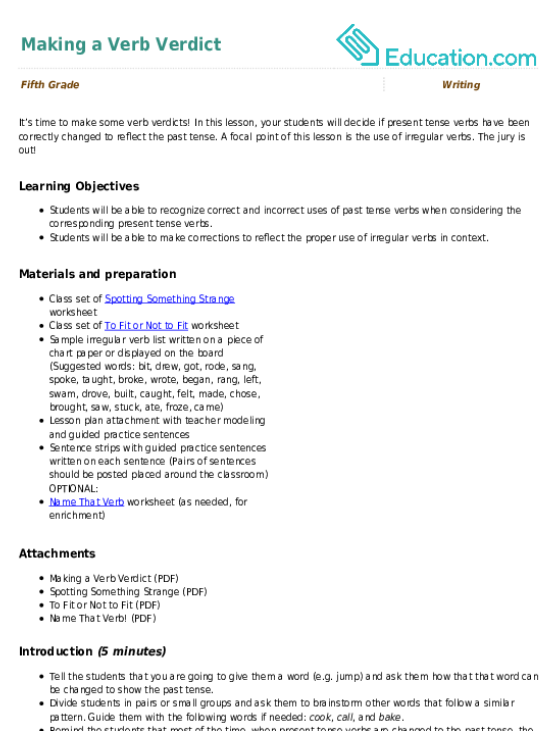
It’s time to make some verb verdicts! In this lesson, your students will decide if present tense verbs have been correctly changed to reflect the past tense. A focal point of this lesson is the use of irregular verbs. The jury is out!
Lesson Plan
Making a Verb Verdict
Lesson Plan
Making a Verb Verdict
It’s time to make some verb verdicts! In this lesson, your students will decide if present tense verbs have been correctly changed to reflect the past tense. A focal point of this lesson is the use of irregular verbs. The jury is out!
Fifth Grade
Grammar and Mechanics
Lesson Plan
Revising Your Persuasive Letter
Lesson Plan
Revising Your Persuasive Letter
Fifth Grade
Writing
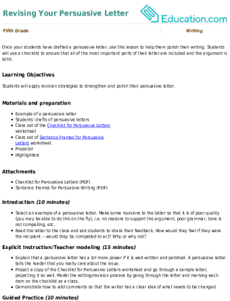
Once your students have drafted a persuasive letter, use this lesson to help them polish their writing. Students will use a checklist to ensure that all of the most important parts of their letter are included and the argument is solid.
Lesson Plan
Revising Your Persuasive Letter
Lesson Plan
Revising Your Persuasive Letter
Once your students have drafted a persuasive letter, use this lesson to help them polish their writing. Students will use a checklist to ensure that all of the most important parts of their letter are included and the argument is solid.
Fifth Grade
Writing
Lesson Plan
1
2
3
4
…
29