SKIP TO CONTENT
Worksheet Generator
Subjects
Grades
Worksheets
Games
Build a Worksheet
More Resources
Roly Recommends
Math Month
Subjects
Grades
Worksheets
Games
Build a Worksheet
More Resources
Roly Recommends
Math Month
All Subjects
English Language Arts
Subtopics:
Alphabet
Handwriting
Phonics
Reading
Writing
Grammar and Mechanics
Vocabulary
Show Less
Filters
Search for: exploring, data, sorting, comparing
✕
English Language Arts
✕
Lesson Plans
✕
2nd - 4th Grade
✕
Subjects
Math
English Language Arts
Science
Social Studies
Grade Level
Pre-K
K
1st
2nd
3rd
4th
5th
6th
7th
8th
Early Childhood
Elementary School
Middle School
Resource Type
Worksheets
Games
Lesson Plans
Interactive Worksheets
Workbooks
Activities
Exercises
Stories
Offline Games
Guided Lessons
Teacher Resources
Common Core
Yes
English Language Support
Yes
See More
Clear All
View 55 results
Showing Results for exploring data sorting comparing : Page 2
55 results
Search for: exploring, data, sorting, comparing
✕
English Language Arts
✕
Lesson Plans
✕
2nd - 4th Grade
✕
Clear All
Sort by:
Relevance
Most recent
Most popular
Alphabetical A-Z
Alphabetical Z-A
All filters
55 results
Sort by:
Relevance
Most recent
Most popular
Alphabetical A-Z
Alphabetical Z-A
Making Sense of Realism and Fantasy
Lesson Plan
Making Sense of Realism and Fantasy
Third Grade
Vocabulary
Is it real or is it fantasy? This lesson introduces students to the literary concepts of realism and fantasy. Readers will practice this skill by using details in texts to distinguish the two genre elements.
Lesson Plan
Making Sense of Realism and Fantasy
Lesson Plan
Making Sense of Realism and Fantasy
Is it real or is it fantasy? This lesson introduces students to the literary concepts of realism and fantasy. Readers will practice this skill by using details in texts to distinguish the two genre elements.
Third Grade
Vocabulary
Lesson Plan
Alphabetical Order
Lesson Plan
Alphabetical Order
Second Grade
Alphabet
Students will practice real world organizing as they learn how to alphabetize the classroom library.
Lesson Plan
Alphabetical Order
Lesson Plan
Alphabetical Order
Students will practice real world organizing as they learn how to alphabetize the classroom library.
Second Grade
Alphabet
Lesson Plan
What's the Big Idea? Summarizing Nonfiction Texts
Lesson Plan
What's the Big Idea? Summarizing Nonfiction Texts
Fourth Grade
Writing
Understanding the big idea of a nonfiction text and being able to write a succinct summary are key fourth grade skills. This lesson focuses on summarizing a nonfiction passage in 3-4 sentences.
Lesson Plan
What's the Big Idea? Summarizing Nonfiction Texts
Lesson Plan
What's the Big Idea? Summarizing Nonfiction Texts
Understanding the big idea of a nonfiction text and being able to write a succinct summary are key fourth grade skills. This lesson focuses on summarizing a nonfiction passage in 3-4 sentences.
Fourth Grade
Writing
Lesson Plan
EL
Character Comparisons
Lesson Plan
Character Comparisons
Fourth Grade
Reading
Use this lesson to help your ELs compare and contrast supporting characters from excerpted texts. It can be a stand-alone lesson or support the lesson Understanding Character Traits, Understanding Plot Lesson Part III.
Lesson Plan
EL
Character Comparisons
Lesson Plan
Character Comparisons
Use this lesson to help your ELs compare and contrast supporting characters from excerpted texts. It can be a stand-alone lesson or support the lesson Understanding Character Traits, Understanding Plot Lesson Part III.
Fourth Grade
Reading
Lesson Plan
Elements of Poetry
Lesson Plan
Elements of Poetry
Fourth Grade
Reading
Introduce your students to some of the major structural elements of poetry in this comprehensive lesson.
Lesson Plan
Elements of Poetry
Lesson Plan
Elements of Poetry
Introduce your students to some of the major structural elements of poetry in this comprehensive lesson.
Fourth Grade
Reading
Lesson Plan
What's the Big Idea? Summarizing Nonfiction Texts
Lesson Plan
What's the Big Idea? Summarizing Nonfiction Texts
Fourth Grade
Reading
Understanding the big idea of a nonfiction text and being able to write a succinct summary are key fourth grade skills. This lesson focuses on summarizing a nonfiction passage in three to four sentences.
Lesson Plan
What's the Big Idea? Summarizing Nonfiction Texts
Lesson Plan
What's the Big Idea? Summarizing Nonfiction Texts
Understanding the big idea of a nonfiction text and being able to write a succinct summary are key fourth grade skills. This lesson focuses on summarizing a nonfiction passage in three to four sentences.
Fourth Grade
Reading
Lesson Plan
EL
Close Reading Strategy
Lesson Plan
Close Reading Strategy
Third Grade
Grammar and Mechanics
This lesson teaches your students to pay attention to small words, such as adjectives, adverbs, and verbs, to make a big difference in reading comprehension! Use as a stand-alone lesson or as a pre-lesson for
Close Reading: Introduction
.
Lesson Plan
EL
Close Reading Strategy
Lesson Plan
Close Reading Strategy
This lesson teaches your students to pay attention to small words, such as adjectives, adverbs, and verbs, to make a big difference in reading comprehension! Use as a stand-alone lesson or as a pre-lesson for
Close Reading: Introduction
.
Third Grade
Grammar and Mechanics
Lesson Plan
Don’t Plateau in Geography!
Lesson Plan
Don’t Plateau in Geography!
Third Grade
Reading
Your students’ understanding will reach its peak when they ask detail-seeking questions from observations made about plateaus, mesas, canyons, and buttes. Students will use illustrations and text to assist in their questions and answers.
Lesson Plan
Don’t Plateau in Geography!
Lesson Plan
Don’t Plateau in Geography!
Your students’ understanding will reach its peak when they ask detail-seeking questions from observations made about plateaus, mesas, canyons, and buttes. Students will use illustrations and text to assist in their questions and answers.
Third Grade
Reading
Lesson Plan
R-Controlled Vowels in Context
Lesson Plan
R-Controlled Vowels in Context
Third Grade
Phonics
Syllable vowel sounds change when followed by the letter R but also reveal regular spelling patterns. This lesson plan extends student understanding of R-controlled vowels with activities built to strengthen spelling and editing skills.
Lesson Plan
R-Controlled Vowels in Context
Lesson Plan
R-Controlled Vowels in Context
Syllable vowel sounds change when followed by the letter R but also reveal regular spelling patterns. This lesson plan extends student understanding of R-controlled vowels with activities built to strengthen spelling and editing skills.
Third Grade
Phonics
Lesson Plan
Elapseable
Lesson Plan
Elapseable
Second Grade
Vocabulary
It's time to learn about time. In this hands-on lesson, students manipulate clock hands and jump across timelines in order to calculate the "distance" between different times and events.
Lesson Plan
Elapseable
Lesson Plan
Elapseable
It's time to learn about time. In this hands-on lesson, students manipulate clock hands and jump across timelines in order to calculate the "distance" between different times and events.
Second Grade
Vocabulary
Lesson Plan
I Have, Who Has? Sight Word Practice
Lesson Plan
I Have, Who Has? Sight Word Practice
First Grade
Alphabet
A fun spin on a classic game! This sight word game will help your students with their reading fluency and reinforce foundational reading skills. Students should be fairly fluent in reading Pre-Primer Dolch sight words prior to the lesson.
Lesson Plan
I Have, Who Has? Sight Word Practice
Lesson Plan
I Have, Who Has? Sight Word Practice
A fun spin on a classic game! This sight word game will help your students with their reading fluency and reinforce foundational reading skills. Students should be fairly fluent in reading Pre-Primer Dolch sight words prior to the lesson.
First Grade
Alphabet
Lesson Plan
EL
Mental Math Bingo with Multiples of 10
Lesson Plan
Mental Math Bingo with Multiples of 10
Second Grade
Vocabulary
Students will practice mentally adding and subtracting 10 to multiples of 10 up to 100 by playing an all time favorite: BINGO! Use alone or alongside the lesson Subtracting From Multiples of 100.
Lesson Plan
EL
Mental Math Bingo with Multiples of 10
Lesson Plan
Mental Math Bingo with Multiples of 10
Students will practice mentally adding and subtracting 10 to multiples of 10 up to 100 by playing an all time favorite: BINGO! Use alone or alongside the lesson Subtracting From Multiples of 100.
Second Grade
Vocabulary
Lesson Plan
Venn Diagram Collage
Lesson Plan
Venn Diagram Collage
Fourth Grade
Handwriting
Arts and crafts, Venn diagrams, and literature all come together as students compare and contrast stories. Opportunities for student creativity are endless!
Lesson Plan
Venn Diagram Collage
Lesson Plan
Venn Diagram Collage
Arts and crafts, Venn diagrams, and literature all come together as students compare and contrast stories. Opportunities for student creativity are endless!
Fourth Grade
Handwriting
Lesson Plan
It’s All in the Personality: Character Traits
Lesson Plan
It’s All in the Personality: Character Traits
Third Grade
Reading
In this lesson, students will use their creativity, a graphic organizer, and a fun story to learn about character analysis.
Lesson Plan
It’s All in the Personality: Character Traits
Lesson Plan
It’s All in the Personality: Character Traits
In this lesson, students will use their creativity, a graphic organizer, and a fun story to learn about character analysis.
Third Grade
Reading
Lesson Plan
Charts and Graphs and Diagrams, Oh My!
Lesson Plan
Charts and Graphs and Diagrams, Oh My!
Fourth Grade
Reading
Students will learn about three nonfiction text features: charts, graphs, and diagrams. They will analyze and interpret the information represented in these visual forms and discover how they aid in the comprehension of nonfiction texts.
Lesson Plan
Charts and Graphs and Diagrams, Oh My!
Lesson Plan
Charts and Graphs and Diagrams, Oh My!
Students will learn about three nonfiction text features: charts, graphs, and diagrams. They will analyze and interpret the information represented in these visual forms and discover how they aid in the comprehension of nonfiction texts.
Fourth Grade
Reading
Lesson Plan
Using Story Elements to Compare and Contrast Fiction Texts
Lesson Plan
Using Story Elements to Compare and Contrast Fiction Texts
Fourth Grade
Reading
All fictional stories have story elements but they sure can differ between stories. In this lesson, students will compare and contrast the story elements of two fictional stories and document their findings in a graphic organizer.
Lesson Plan
Using Story Elements to Compare and Contrast Fiction Texts
Lesson Plan
Using Story Elements to Compare and Contrast Fiction Texts
All fictional stories have story elements but they sure can differ between stories. In this lesson, students will compare and contrast the story elements of two fictional stories and document their findings in a graphic organizer.
Fourth Grade
Reading
Lesson Plan
Characteristics of Polygons
Lesson Plan
Characteristics of Polygons
Third Grade
Vocabulary
Bring on the polygons! Your students will build their understanding of polygons and sort shapes into categories based on their attributes in this lesson.
Lesson Plan
Characteristics of Polygons
Lesson Plan
Characteristics of Polygons
Bring on the polygons! Your students will build their understanding of polygons and sort shapes into categories based on their attributes in this lesson.
Third Grade
Vocabulary
Lesson Plan
Similes That Describe ME!
Lesson Plan
Similes That Describe ME!
Third Grade
Vocabulary
Every student is unique. This lesson emphasizes that uniqueness by having young learners use similes to share some of the traits that make them special. It features Quick as a Cricket by Audrey Wood and a fantastic storyboard exercise.
Lesson Plan
Similes That Describe ME!
Lesson Plan
Similes That Describe ME!
Every student is unique. This lesson emphasizes that uniqueness by having young learners use similes to share some of the traits that make them special. It features Quick as a Cricket by Audrey Wood and a fantastic storyboard exercise.
Third Grade
Vocabulary
Lesson Plan
Read about and Discuss Historic Heroes
Lesson Plan
Read about and Discuss Historic Heroes
Fourth Grade
Reading
In this lesson plan, students will discuss characteristics of a hero and how to get information from texts to understand why a person is considered a hero. Partner discussions will help students have a deeper understanding.
Lesson Plan
Read about and Discuss Historic Heroes
Lesson Plan
Read about and Discuss Historic Heroes
In this lesson plan, students will discuss characteristics of a hero and how to get information from texts to understand why a person is considered a hero. Partner discussions will help students have a deeper understanding.
Fourth Grade
Reading
Lesson Plan
Detective Reading
Lesson Plan
Detective Reading
Fourth Grade
Reading
Roll up your sleeves and get out the magnifying glasses! In this lesson, your students will practice finding supportive details and examples in informational texts.
Lesson Plan
Detective Reading
Lesson Plan
Detective Reading
Roll up your sleeves and get out the magnifying glasses! In this lesson, your students will practice finding supportive details and examples in informational texts.
Fourth Grade
Reading
Lesson Plan
EL
Evidence of Character Changes
Lesson Plan
Evidence of Character Changes
Third Grade
Writing
Create conversations about character changes! Use this lesson plan as a stand-alone lesson for practicing sequencing words in evidenced-based claims about a character, or before the Characters Change Just Like We Do lesson.
Lesson Plan
EL
Evidence of Character Changes
Lesson Plan
Evidence of Character Changes
Create conversations about character changes! Use this lesson plan as a stand-alone lesson for practicing sequencing words in evidenced-based claims about a character, or before the Characters Change Just Like We Do lesson.
Third Grade
Writing
Lesson Plan
EL
The Key Elements of Fictional Text
Lesson Plan
The Key Elements of Fictional Text
Second Grade
Vocabulary
This lesson will provide your ELs with support as they learn about the key elements of fictional text, including characters, setting, and plot. Use as a stand alone activity or a support lesson.
Lesson Plan
EL
The Key Elements of Fictional Text
Lesson Plan
The Key Elements of Fictional Text
This lesson will provide your ELs with support as they learn about the key elements of fictional text, including characters, setting, and plot. Use as a stand alone activity or a support lesson.
Second Grade
Vocabulary
Lesson Plan
Nonfiction Genres
Lesson Plan
Nonfiction Genres
Fourth Grade
Writing
In this lesson, your students will explore the library in search of various genres of nonfiction texts. Teach this lesson at the beginning of the year to familiarize your students with the structure and organization of the library.
Lesson Plan
Nonfiction Genres
Lesson Plan
Nonfiction Genres
In this lesson, your students will explore the library in search of various genres of nonfiction texts. Teach this lesson at the beginning of the year to familiarize your students with the structure and organization of the library.
Fourth Grade
Writing
Lesson Plan
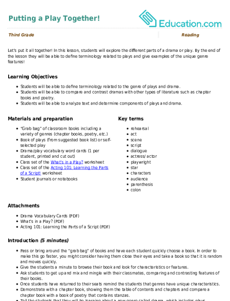
Putting a Play Together!
Lesson Plan
Putting a Play Together!
Third Grade
Writing
Let’s put it all together! In this lesson, students will explore the different parts of a drama or play. By the end of the lesson they will be able to define terminology related to plays and give examples of the unique genre features!
Lesson Plan
Putting a Play Together!
Lesson Plan
Putting a Play Together!
Let’s put it all together! In this lesson, students will explore the different parts of a drama or play. By the end of the lesson they will be able to define terminology related to plays and give examples of the unique genre features!
Third Grade
Writing
Lesson Plan
EL
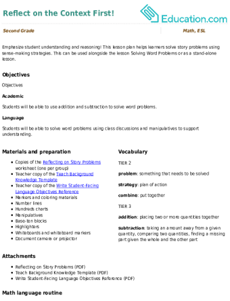
Reflect on the Context First!
Lesson Plan
Reflect on the Context First!
Second Grade
Subtraction
Emphasize student understanding and reasoning! This lesson plan helps learners solve story problems using sense-making strategies. This can be used alongside the lesson Solving Word Problems or as a stand-alone lesson.
Lesson Plan
EL
Reflect on the Context First!
Lesson Plan
Reflect on the Context First!
Emphasize student understanding and reasoning! This lesson plan helps learners solve story problems using sense-making strategies. This can be used alongside the lesson Solving Word Problems or as a stand-alone lesson.
Second Grade
Subtraction
Lesson Plan
1
2