SKIP TO CONTENT
Worksheet Generator
Subjects
Grades
Worksheets
Games
Build a Worksheet
More Resources
Roly Recommends
Math Month
Subjects
Grades
Worksheets
Games
Build a Worksheet
More Resources
Roly Recommends
Math Month
Filters
Search for: writer, reader
✕
Lesson Plans
✕
2nd - 4th Grade
✕
Subjects
Math
English Language Arts
Science
Social Studies
Grade Level
Pre-K
K
1st
2nd
3rd
4th
5th
6th
7th
8th
Early Childhood
Elementary School
Middle School
Resource Type
Worksheets
Games
Lesson Plans
Interactive Worksheets
Workbooks
Activities
Stories
Offline Games
Guided Lessons
Teacher Resources
Common Core
Yes
English Language Support
Yes
See More
Clear All
View 167 results
Showing Results for writer reader : Page 3
167 results
Search for: writer, reader
✕
Lesson Plans
✕
2nd - 4th Grade
✕
Clear All
Sort by:
Relevance
Most recent
Most popular
Alphabetical A-Z
Alphabetical Z-A
All filters
167 results
Sort by:
Relevance
Most recent
Most popular
Alphabetical A-Z
Alphabetical Z-A
Extra, Extra! Read All About It
Lesson Plan
Extra, Extra! Read All About It
First Grade
Writing
Students will learn to structure their written arguments as they create their own class paper full of opinion editorial pieces in this fun, real-world driven lesson. Step right up and write all about it!
Lesson Plan
Extra, Extra! Read All About It
Lesson Plan
Extra, Extra! Read All About It
Students will learn to structure their written arguments as they create their own class paper full of opinion editorial pieces in this fun, real-world driven lesson. Step right up and write all about it!
First Grade
Writing
Lesson Plan
Exploring the Narrative
Lesson Plan
Exploring the Narrative
Fourth Grade
Teach your students to entertain readers with narrative writing. This lesson will help your students understand the genre, the different parts of a story, and elements such as character, setting, and conflict.
Lesson Plan
Exploring the Narrative
Lesson Plan
Exploring the Narrative
Teach your students to entertain readers with narrative writing. This lesson will help your students understand the genre, the different parts of a story, and elements such as character, setting, and conflict.
Fourth Grade
Lesson Plan
Is It True?
Lesson Plan
Is It True?
Fourth Grade
Don't believe everything you read! Teach students to differentiate between statements of fact and opinion. This important skill will help students become critical and discerning readers.
Lesson Plan
Is It True?
Lesson Plan
Is It True?
Don't believe everything you read! Teach students to differentiate between statements of fact and opinion. This important skill will help students become critical and discerning readers.
Fourth Grade
Lesson Plan
EL
Characters and Dialogue
Lesson Plan
Characters and Dialogue
Third Grade
Writing
Help your ELs identify the characters and their dialogue in a story. This lesson can stand alone or be used as a pre-lesson for the
Action! Students Create Reader’s Theater
lesson.
Lesson Plan
EL
Characters and Dialogue
Lesson Plan
Characters and Dialogue
Help your ELs identify the characters and their dialogue in a story. This lesson can stand alone or be used as a pre-lesson for the
Action! Students Create Reader’s Theater
lesson.
Third Grade
Writing
Lesson Plan
Literary Argument Writing: Defining Your Topic
Lesson Plan
Literary Argument Writing: Defining Your Topic
Fourth Grade
Writing
This lesson will help your young writers develop a claim, or thesis, and construct an argument around it. You may have students complete the essay by continuing the process with the lesson Literary Argument Writing: Drafting Your Essay.
Lesson Plan
Literary Argument Writing: Defining Your Topic
Lesson Plan
Literary Argument Writing: Defining Your Topic
This lesson will help your young writers develop a claim, or thesis, and construct an argument around it. You may have students complete the essay by continuing the process with the lesson Literary Argument Writing: Drafting Your Essay.
Fourth Grade
Writing
Lesson Plan
My View as an Ant
Lesson Plan
My View as an Ant
Third Grade
Vocabulary
Give students a chance to experience a different point of view! This fANTastic lesson on narrative style turns young readers into characters of Chris Van Allsburg's Two Bad Ants.
Lesson Plan
My View as an Ant
Lesson Plan
My View as an Ant
Give students a chance to experience a different point of view! This fANTastic lesson on narrative style turns young readers into characters of Chris Van Allsburg's Two Bad Ants.
Third Grade
Vocabulary
Lesson Plan
Super Suffixes
Lesson Plan
Super Suffixes
Second Grade
Grammar and Mechanics
Suffixes can do some amazing things. They can turn "power" into "powerful," "big" into "bigger," and "fear" into "fearless." This hands-on lesson allows young writers to build their own words using different root words and suffixes.
Lesson Plan
Super Suffixes
Lesson Plan
Super Suffixes
Suffixes can do some amazing things. They can turn "power" into "powerful," "big" into "bigger," and "fear" into "fearless." This hands-on lesson allows young writers to build their own words using different root words and suffixes.
Second Grade
Grammar and Mechanics
Lesson Plan
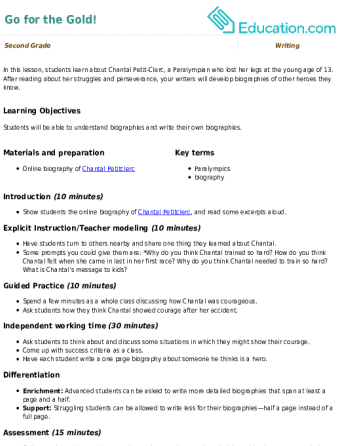
Go for the Gold!
Lesson Plan
Go for the Gold!
Second Grade
In this lesson, students learn about Chantal Petit-Clerc, a Paralympian who lost her legs at the young age of 13. After reading about her struggles and perseverance, your writers will develop biographies of other heroes they know.
Lesson Plan
Go for the Gold!
Lesson Plan
Go for the Gold!
In this lesson, students learn about Chantal Petit-Clerc, a Paralympian who lost her legs at the young age of 13. After reading about her struggles and perseverance, your writers will develop biographies of other heroes they know.
Second Grade
Lesson Plan
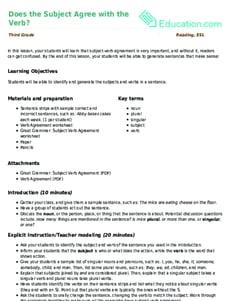
Does the Subject Agree with the Verb?
Lesson Plan
Does the Subject Agree with the Verb?
Third Grade
In this lesson, your students will learn that subject-verb agreement is very important, and without it, readers can get confused. By the end of this lesson, your students will be able to generate sentences that make sense!
Lesson Plan
Does the Subject Agree with the Verb?
Lesson Plan
Does the Subject Agree with the Verb?
In this lesson, your students will learn that subject-verb agreement is very important, and without it, readers can get confused. By the end of this lesson, your students will be able to generate sentences that make sense!
Third Grade
Lesson Plan
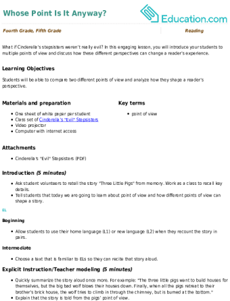
Whose Point Is It Anyway?
Lesson Plan
Whose Point Is It Anyway?
Fourth Grade
Writing
What if Cinderella’s stepsisters weren’t really evil? In this engaging lesson, you will introduce your students to multiple points of view and discuss how these different perspectives can change a reader’s experience.
Lesson Plan
Whose Point Is It Anyway?
Lesson Plan
Whose Point Is It Anyway?
What if Cinderella’s stepsisters weren’t really evil? In this engaging lesson, you will introduce your students to multiple points of view and discuss how these different perspectives can change a reader’s experience.
Fourth Grade
Writing
Lesson Plan
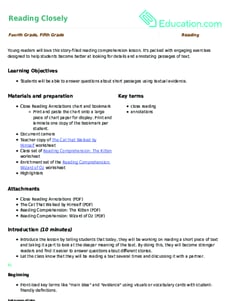
Reading Closely
Lesson Plan
Reading Closely
Fourth Grade
Reading
Young readers will love this story-filled reading comprehension lesson. It's packed with engaging exercises designed to help students become better at looking for details and annotating passages of text.
Lesson Plan
Reading Closely
Lesson Plan
Reading Closely
Young readers will love this story-filled reading comprehension lesson. It's packed with engaging exercises designed to help students become better at looking for details and annotating passages of text.
Fourth Grade
Reading
Lesson Plan
Head to Head Fiction Reflections
Lesson Plan
Head to Head Fiction Reflections
Fourth Grade
Reading reflection topics like theme, problems, and solutions can be challenging concepts for young readers. Help your students make sense of these literary elements using dynamic organizers that draw comparisons between fiction texts.
Lesson Plan
Head to Head Fiction Reflections
Lesson Plan
Head to Head Fiction Reflections
Reading reflection topics like theme, problems, and solutions can be challenging concepts for young readers. Help your students make sense of these literary elements using dynamic organizers that draw comparisons between fiction texts.
Fourth Grade
Lesson Plan
My Teacher for President!
Lesson Plan
My Teacher for President!
Second Grade
Writing
Need a promotion? Then have your students participate in a writing lesson that will have them voting for you! Give students the opportunity to place teachers in the spotlight, as they persuade others why teachers make the best presidents.
Lesson Plan
My Teacher for President!
Lesson Plan
My Teacher for President!
Need a promotion? Then have your students participate in a writing lesson that will have them voting for you! Give students the opportunity to place teachers in the spotlight, as they persuade others why teachers make the best presidents.
Second Grade
Writing
Lesson Plan
Rein in the Run-Ons
Lesson Plan
Rein in the Run-Ons
Fourth Grade
Grammar and Mechanics
Are your students having trouble taming run-on sentences into a more manageable length? In this lesson, your students will learn to not only recognize a run-on sentence, but also how to stop it in its tracks.
Lesson Plan
Rein in the Run-Ons
Lesson Plan
Rein in the Run-Ons
Are your students having trouble taming run-on sentences into a more manageable length? In this lesson, your students will learn to not only recognize a run-on sentence, but also how to stop it in its tracks.
Fourth Grade
Grammar and Mechanics
Lesson Plan
Writing: Show, Don’t Tell
Lesson Plan
Writing: Show, Don’t Tell
Third Grade
Writing
Help students learn about descriptive writing with this engaging lesson. Your class will learn to show character emotions though the “show, don’t tell” writing technique with videos, practice writing, and class participation.
Lesson Plan
Writing: Show, Don’t Tell
Lesson Plan
Writing: Show, Don’t Tell
Help students learn about descriptive writing with this engaging lesson. Your class will learn to show character emotions though the “show, don’t tell” writing technique with videos, practice writing, and class participation.
Third Grade
Writing
Lesson Plan
Examining Author's Purpose in a Fictional Text
Lesson Plan
Examining Author's Purpose in a Fictional Text
Second Grade
Reading
Students will read a short fictional story and discuss why the author included certain details and words. Use this lesson to help your students navigate parts of fictional text to determine the author's purpose!
Lesson Plan
Examining Author's Purpose in a Fictional Text
Lesson Plan
Examining Author's Purpose in a Fictional Text
Students will read a short fictional story and discuss why the author included certain details and words. Use this lesson to help your students navigate parts of fictional text to determine the author's purpose!
Second Grade
Reading
Lesson Plan
Understanding Character Traits, Understanding Plot Lesson Part III
Lesson Plan
Understanding Character Traits, Understanding Plot Lesson Part III
Fourth Grade
Have you ever read a story and immediately began to compare the characters to those of your favorite story? In this lesson, students will learn to read context clues and descriptions in order to understand characters and compare them.
Lesson Plan
Understanding Character Traits, Understanding Plot Lesson Part III
Lesson Plan
Understanding Character Traits, Understanding Plot Lesson Part III
Have you ever read a story and immediately began to compare the characters to those of your favorite story? In this lesson, students will learn to read context clues and descriptions in order to understand characters and compare them.
Fourth Grade
Lesson Plan
Letter Writes: Persuasive Opinion Writing
Lesson Plan
Letter Writes: Persuasive Opinion Writing
Second Grade
Students begin this letter-writing journey with a dog whose opinion is persuasively portrayed, and by learning that opinion is not fact. Activities include partner role-play and the chance for students to write a persuasive opinion letter of their own.
Lesson Plan
Letter Writes: Persuasive Opinion Writing
Lesson Plan
Letter Writes: Persuasive Opinion Writing
Students begin this letter-writing journey with a dog whose opinion is persuasively portrayed, and by learning that opinion is not fact. Activities include partner role-play and the chance for students to write a persuasive opinion letter of their own.
Second Grade
Lesson Plan
Examining Author's Purpose in a Nonfiction Text
Lesson Plan
Examining Author's Purpose in a Nonfiction Text
Second Grade
Reading
This lesson will help students identify the author's point of view and purpose for writing an informational text.
Lesson Plan
Examining Author's Purpose in a Nonfiction Text
Lesson Plan
Examining Author's Purpose in a Nonfiction Text
This lesson will help students identify the author's point of view and purpose for writing an informational text.
Second Grade
Reading
Lesson Plan
What Were They Thinking?
Lesson Plan
What Were They Thinking?
Fourth Grade
What do Malala Yousafzai, Al Gore, and Michelle Obama all have in common? They are all nonfiction authors with a purpose. In this interactive lesson, students will gain practice looking at details in text to identify the author’s purpose.
Lesson Plan
What Were They Thinking?
Lesson Plan
What Were They Thinking?
What do Malala Yousafzai, Al Gore, and Michelle Obama all have in common? They are all nonfiction authors with a purpose. In this interactive lesson, students will gain practice looking at details in text to identify the author’s purpose.
Fourth Grade
Lesson Plan
Paint a Word Picture
Lesson Plan
Paint a Word Picture
Fourth Grade
Writing
Students become word artists as they use ordinary pictures to practice creating detailed descriptions. This technique helps your class learn how to paint a picture with words.
Lesson Plan
Paint a Word Picture
Lesson Plan
Paint a Word Picture
Students become word artists as they use ordinary pictures to practice creating detailed descriptions. This technique helps your class learn how to paint a picture with words.
Fourth Grade
Writing
Lesson Plan
Using Font and Text Features in Your Writing
Lesson Plan
Using Font and Text Features in Your Writing
Fourth Grade
Learn to use text formatting tools like capitalization, bold, underline, and italics to give emphasis to your writing.
Lesson Plan
Using Font and Text Features in Your Writing
Lesson Plan
Using Font and Text Features in Your Writing
Learn to use text formatting tools like capitalization, bold, underline, and italics to give emphasis to your writing.
Fourth Grade
Lesson Plan
Why I Write
Lesson Plan
Why I Write
Second Grade
Reading
Second grade students will step into the author’s shoes as they hunt for evidence to determine what a nonfiction author’s purpose might be.
Lesson Plan
Why I Write
Lesson Plan
Why I Write
Second grade students will step into the author’s shoes as they hunt for evidence to determine what a nonfiction author’s purpose might be.
Second Grade
Reading
Lesson Plan
EL
Learning About Text Features
Lesson Plan
Learning About Text Features
Second Grade
In this lesson, students will read text features and discuss how each text feature relates to the main idea of a nonfiction text. Use a stand alone activity or a support for the Examining the Author's Purpose in a Nonfiction Text lesson.
Lesson Plan
EL
Learning About Text Features
Lesson Plan
Learning About Text Features
In this lesson, students will read text features and discuss how each text feature relates to the main idea of a nonfiction text. Use a stand alone activity or a support for the Examining the Author's Purpose in a Nonfiction Text lesson.
Second Grade
Lesson Plan
Determining Importance
Lesson Plan
Determining Importance
Third Grade
Is that fact important, or is it just interesting? Use this lesson to help your students determine importance in nonfiction text.
Lesson Plan
Determining Importance
Lesson Plan
Determining Importance
Is that fact important, or is it just interesting? Use this lesson to help your students determine importance in nonfiction text.
Third Grade
Lesson Plan
Compare and Contrast W.E.B. Du Bois and George Washington Carver
Lesson Plan
Compare and Contrast W.E.B. Du Bois and George Washington Carver
Fourth Grade
Reading
In this lesson, ask students to compare and contrast two important African-American historical figures. Students will write an informational paragraph on the similarities and differences between W.E.B. Du Bois and George Washington Carver.
Lesson Plan
Compare and Contrast W.E.B. Du Bois and George Washington Carver
Lesson Plan
Compare and Contrast W.E.B. Du Bois and George Washington Carver
In this lesson, ask students to compare and contrast two important African-American historical figures. Students will write an informational paragraph on the similarities and differences between W.E.B. Du Bois and George Washington Carver.
Fourth Grade
Reading
Lesson Plan
EL
Adjectives in Informational Texts
Lesson Plan
Adjectives in Informational Texts
Fourth Grade
Describe the facts! This lesson teaches your ELs to identify adjectives and their important role as key details in informational texts. Use it as a stand-alone lesson or as support to the lesson Summarizing Nonfiction Texts.
Lesson Plan
EL
Adjectives in Informational Texts
Lesson Plan
Adjectives in Informational Texts
Describe the facts! This lesson teaches your ELs to identify adjectives and their important role as key details in informational texts. Use it as a stand-alone lesson or as support to the lesson Summarizing Nonfiction Texts.
Fourth Grade
Lesson Plan
St. Patrick's Day Celebrations
Lesson Plan
St. Patrick's Day Celebrations
Third Grade
Writing
St. Patrick's Day is a widely popular holiday all over the world. Teach your students about some interesting traditions as they write an informative text about how St. Patrick's Day is celebrated.
Lesson Plan
St. Patrick's Day Celebrations
Lesson Plan
St. Patrick's Day Celebrations
St. Patrick's Day is a widely popular holiday all over the world. Teach your students about some interesting traditions as they write an informative text about how St. Patrick's Day is celebrated.
Third Grade
Writing
Lesson Plan
Editing for Capitalization and Punctuation
Lesson Plan
Editing for Capitalization and Punctuation
Fourth Grade
Writing
Students often understand the basic conventions of writing, but may need support in incorporating these skills into their work. In this lesson, students will review some of the more common capitalization and punctuation errors and apply their editing skills to real writing.
Lesson Plan
Editing for Capitalization and Punctuation
Lesson Plan
Editing for Capitalization and Punctuation
Students often understand the basic conventions of writing, but may need support in incorporating these skills into their work. In this lesson, students will review some of the more common capitalization and punctuation errors and apply their editing skills to real writing.
Fourth Grade
Writing
Lesson Plan
Author’s Purpose in Fiction Texts
Lesson Plan
Author’s Purpose in Fiction Texts
Second Grade
Introduce the concept of author’s purpose in fiction texts with this fun reading lesson! Students will discuss three examples of fictional texts to determine the purpose of each.
Lesson Plan
Author’s Purpose in Fiction Texts
Lesson Plan
Author’s Purpose in Fiction Texts
Introduce the concept of author’s purpose in fiction texts with this fun reading lesson! Students will discuss three examples of fictional texts to determine the purpose of each.
Second Grade
Lesson Plan
1
2
3
4
5
6