SKIP TO CONTENT
Worksheet Generator
Subjects
Grades
Worksheets
Games
Build a Worksheet
More Resources
Roly Recommends
Subjects
Grades
Worksheets
Games
Build a Worksheet
More Resources
Roly Recommends
Filters
Search for: proper, , 1
✕
Lesson Plans
✕
2nd - 4th Grade
✕
Subjects
Math
English Language Arts
Science
Social Studies
Grade Level
Pre-K
K
1st
2nd
3rd
4th
5th
6th
7th
8th
Early Childhood
Elementary School
Middle School
Resource Type
Worksheets
Games
Lesson Plans
Interactive Worksheets
Workbooks
Activities
Exercises
Stories
Songs
Offline Games
Guided Lessons
Teacher Resources
Teacher Editions
Common Core
Yes
Roly Recommends
Social Emotional Learning
English Language Support
Yes
See More
Clear All
View 1,163 results
Showing Results for proper 1 : Page 21
1,163 results
Search for: proper, , 1
✕
Lesson Plans
✕
2nd - 4th Grade
✕
Clear All
Sort by:
Relevance
Most recent
Most popular
Alphabetical A-Z
Alphabetical Z-A
All filters
1,163 results
Sort by:
Relevance
Most recent
Most popular
Alphabetical A-Z
Alphabetical Z-A
Fairy Tale Character Traits
Lesson Plan
Fairy Tale Character Traits
Second Grade
Students will be able to answer questions to show understanding of character traits. This can be a stand-alone lesson or a support lesson to be used prior to The Paper Bag Princess lesson plan.
Lesson Plan
Fairy Tale Character Traits
Lesson Plan
Fairy Tale Character Traits
Students will be able to answer questions to show understanding of character traits. This can be a stand-alone lesson or a support lesson to be used prior to The Paper Bag Princess lesson plan.
Second Grade
Lesson Plan
Super Suffixes
Lesson Plan
Super Suffixes
Second Grade
Grammar and Mechanics
Suffixes can do some amazing things. They can turn "power" into "powerful," "big" into "bigger," and "fear" into "fearless." This hands-on lesson allows young writers to build their own words using different root words and suffixes.
Lesson Plan
Super Suffixes
Lesson Plan
Super Suffixes
Suffixes can do some amazing things. They can turn "power" into "powerful," "big" into "bigger," and "fear" into "fearless." This hands-on lesson allows young writers to build their own words using different root words and suffixes.
Second Grade
Grammar and Mechanics
Lesson Plan
Ideas and Hooks: Personal Narrative
Lesson Plan
Ideas and Hooks: Personal Narrative
Fourth Grade
This lesson walks students through the first few steps of crafting a personal narrative. Writers will start by going through a process to select an idea to write about, then begin to craft a hook that invites readers into their story.
Lesson Plan
Ideas and Hooks: Personal Narrative
Lesson Plan
Ideas and Hooks: Personal Narrative
This lesson walks students through the first few steps of crafting a personal narrative. Writers will start by going through a process to select an idea to write about, then begin to craft a hook that invites readers into their story.
Fourth Grade
Lesson Plan
Bunches of Bunnies
Lesson Plan
Bunches of Bunnies
Third Grade
Hop into multiplication! Introduce your class to times tables with this engaging math lesson. Students will read about the correlation between repeated addition and multiplication, and then create hands-on book pages to illustrate it.
Lesson Plan
Bunches of Bunnies
Lesson Plan
Bunches of Bunnies
Hop into multiplication! Introduce your class to times tables with this engaging math lesson. Students will read about the correlation between repeated addition and multiplication, and then create hands-on book pages to illustrate it.
Third Grade
Lesson Plan
All About Nouns
Lesson Plan
All About Nouns
Third Grade
Grammar and Mechanics
This lesson incorporates different learning styles to help students get a firm grasp of what a noun is and its function. It even highlights the important tie between grammar and writing.
Lesson Plan
All About Nouns
Lesson Plan
All About Nouns
This lesson incorporates different learning styles to help students get a firm grasp of what a noun is and its function. It even highlights the important tie between grammar and writing.
Third Grade
Grammar and Mechanics
Lesson Plan
Fantastic Fables: 5 W's
Lesson Plan
Fantastic Fables: 5 W's
Second Grade
Writing
In this lesson, students use highlighters, graphic organizers, and a classic fable to exercise their understanding of key details and main idea in a text. They will use manipulatives to promote visual and kinetic learning styles.
Lesson Plan
Fantastic Fables: 5 W's
Lesson Plan
Fantastic Fables: 5 W's
In this lesson, students use highlighters, graphic organizers, and a classic fable to exercise their understanding of key details and main idea in a text. They will use manipulatives to promote visual and kinetic learning styles.
Second Grade
Writing
Lesson Plan
Figuring Out Figurative Language!
Lesson Plan
Figuring Out Figurative Language!
Third Grade
Teaching figurative language is as easy as pie with this lesson. Give students a chance to explore different kinds of figurative language as they develop their own comic strip.
Lesson Plan
Figuring Out Figurative Language!
Lesson Plan
Figuring Out Figurative Language!
Teaching figurative language is as easy as pie with this lesson. Give students a chance to explore different kinds of figurative language as they develop their own comic strip.
Third Grade
Lesson Plan
Imaginative Interjections
Lesson Plan
Imaginative Interjections
Third Grade
Grammar and Mechanics
Imagine what that interjection might be! As students learn about the purpose and use of interjections, they will use their imaginations to match interjections with a variety of emotions.
Lesson Plan
Imaginative Interjections
Lesson Plan
Imaginative Interjections
Imagine what that interjection might be! As students learn about the purpose and use of interjections, they will use their imaginations to match interjections with a variety of emotions.
Third Grade
Grammar and Mechanics
Lesson Plan
Indentation Intentions
Lesson Plan
Indentation Intentions
Third Grade
Writing
What is the intention of an indentation within a paragraph? Within this lesson, students will explore the reasons why we indent. They’ll categorize and classify content to construct paragraphs that include indentations.
Lesson Plan
Indentation Intentions
Lesson Plan
Indentation Intentions
What is the intention of an indentation within a paragraph? Within this lesson, students will explore the reasons why we indent. They’ll categorize and classify content to construct paragraphs that include indentations.
Third Grade
Writing
Lesson Plan
Pick Up the Phoneme!
Lesson Plan
Pick Up the Phoneme!
First Grade
Pick up the phoneme and practice! In this lesson, your students will practice their sense of sound-symbol relationship to develop solid spelling and reading skills.
Lesson Plan
Pick Up the Phoneme!
Lesson Plan
Pick Up the Phoneme!
Pick up the phoneme and practice! In this lesson, your students will practice their sense of sound-symbol relationship to develop solid spelling and reading skills.
First Grade
Lesson Plan
Figurative Language
Lesson Plan
Figurative Language
Second Grade
Figurative language is so tricky, especially for English Learners! Use this lesson to introduce the concept with a focus on similes and metaphors.
Lesson Plan
Figurative Language
Lesson Plan
Figurative Language
Figurative language is so tricky, especially for English Learners! Use this lesson to introduce the concept with a focus on similes and metaphors.
Second Grade
Lesson Plan
The Giving Earth
Lesson Plan
The Giving Earth
Fourth Grade
The Earth is constantly giving us clean water, shelter, food, and so much more! Through this lesson, students will learn about how nature is always giving and discuss ways we can appreciate and take care of our environment.
Lesson Plan
The Giving Earth
Lesson Plan
The Giving Earth
The Earth is constantly giving us clean water, shelter, food, and so much more! Through this lesson, students will learn about how nature is always giving and discuss ways we can appreciate and take care of our environment.
Fourth Grade
Lesson Plan
Compound Charades
Lesson Plan
Compound Charades
Second Grade
This lesson includes a bunch of activities to help students learn about compound words. Your second-graders will love guessing and illustrating compound words in this colorful lesson plan!
Lesson Plan
Compound Charades
Lesson Plan
Compound Charades
This lesson includes a bunch of activities to help students learn about compound words. Your second-graders will love guessing and illustrating compound words in this colorful lesson plan!
Second Grade
Lesson Plan
How Many Features?
Lesson Plan
How Many Features?
Second Grade
Reading
What’s the deal with all of those text features? Use this handy lesson plan to help your second graders answer that very question.
Lesson Plan
How Many Features?
Lesson Plan
How Many Features?
What’s the deal with all of those text features? Use this handy lesson plan to help your second graders answer that very question.
Second Grade
Reading
Lesson Plan
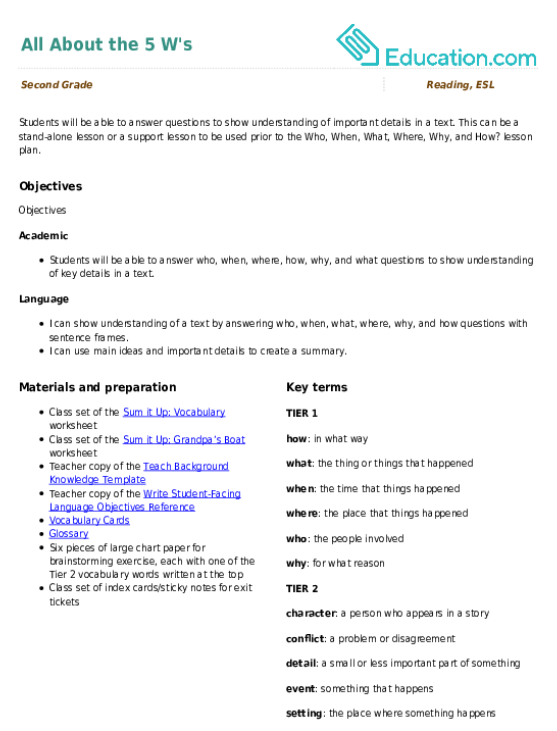
All About the 5 W's
Lesson Plan
All About the 5 W's
Second Grade
Students will be able to answer questions to show understanding of important details in a text. This can be a stand-alone lesson or a support lesson to be used prior to the Who, When, What, Where, Why, and How? lesson plan.
Lesson Plan
All About the 5 W's
Lesson Plan
All About the 5 W's
Students will be able to answer questions to show understanding of important details in a text. This can be a stand-alone lesson or a support lesson to be used prior to the Who, When, What, Where, Why, and How? lesson plan.
Second Grade
Lesson Plan
Renewable and Non-Renewable Energy
Lesson Plan
Renewable and Non-Renewable Energy
Second Grade
Physical Science
Energy is an essential part of our daily lives, but the resources that power the Earth are being threatened. In this lesson, students learn about renewable and non-renewable resources, including those that need protection.
Lesson Plan
Renewable and Non-Renewable Energy
Lesson Plan
Renewable and Non-Renewable Energy
Energy is an essential part of our daily lives, but the resources that power the Earth are being threatened. In this lesson, students learn about renewable and non-renewable resources, including those that need protection.
Second Grade
Physical Science
Lesson Plan
Opinion Writing: Brainstorming to Establish Credibility
Lesson Plan
Opinion Writing: Brainstorming to Establish Credibility
Third Grade
Opinion writers need to establish credibility so that their audience will value their opinion. In this lesson, your students learn how to establish themselves as authorities on their chosen writing topics.
Lesson Plan
Opinion Writing: Brainstorming to Establish Credibility
Lesson Plan
Opinion Writing: Brainstorming to Establish Credibility
Opinion writers need to establish credibility so that their audience will value their opinion. In this lesson, your students learn how to establish themselves as authorities on their chosen writing topics.
Third Grade
Lesson Plan
Learn to Compare and Contrast
Lesson Plan
Learn to Compare and Contrast
Second Grade
Reading
Your students will learn academic vocabulary and use a graphic organizer to compare and contrast two short stories. Use this as a stand-alone lesson or as an introduction to the Comparing and Contrasting Short Stories lesson plan.
Lesson Plan
Learn to Compare and Contrast
Lesson Plan
Learn to Compare and Contrast
Your students will learn academic vocabulary and use a graphic organizer to compare and contrast two short stories. Use this as a stand-alone lesson or as an introduction to the Comparing and Contrasting Short Stories lesson plan.
Second Grade
Reading
Lesson Plan
See It, Don't Say It!
Lesson Plan
See It, Don't Say It!
Fourth Grade
You know the expression, “Say it, don’t spray it!” In this lesson, we don’t want you to say it or spray it, we just want you to see it! Students will practice identifying, reading, and creating words with silent letters.
Lesson Plan
See It, Don't Say It!
Lesson Plan
See It, Don't Say It!
You know the expression, “Say it, don’t spray it!” In this lesson, we don’t want you to say it or spray it, we just want you to see it! Students will practice identifying, reading, and creating words with silent letters.
Fourth Grade
Lesson Plan
Service for Our School Community
Lesson Plan
Service for Our School Community
Second Grade
Service can bring out the best in people and communities. In this lesson, students discuss what it means to serve and explore ways that they would like to support their school and community with service work.
Lesson Plan
Service for Our School Community
Lesson Plan
Service for Our School Community
Service can bring out the best in people and communities. In this lesson, students discuss what it means to serve and explore ways that they would like to support their school and community with service work.
Second Grade
Lesson Plan
Fairy Tales: Identifying Story Elements
Lesson Plan
Fairy Tales: Identifying Story Elements
Second Grade
Reading
Story elements help to bring beloved fairy tales to life in this literacy lesson. Your students will learn to identify the title, author, setting, characters, problem, and solution in a fiction text.
Lesson Plan
Fairy Tales: Identifying Story Elements
Lesson Plan
Fairy Tales: Identifying Story Elements
Story elements help to bring beloved fairy tales to life in this literacy lesson. Your students will learn to identify the title, author, setting, characters, problem, and solution in a fiction text.
Second Grade
Reading
Lesson Plan
Rounding with Number Lines
Lesson Plan
Rounding with Number Lines
Fourth Grade
Teach your students to round to the thousands place using number lines.
Lesson Plan
Rounding with Number Lines
Lesson Plan
Rounding with Number Lines
Teach your students to round to the thousands place using number lines.
Fourth Grade
Lesson Plan
What is it Telling Me? Creating and Interpreting Line Plots
Lesson Plan
What is it Telling Me? Creating and Interpreting Line Plots
Third Grade
Data and Graphing
Line plots are a great way to introduce your students to graphing data. In this lesson, your students will learn how to create a line plot and also practice interpreting line plots.
Lesson Plan
What is it Telling Me? Creating and Interpreting Line Plots
Lesson Plan
What is it Telling Me? Creating and Interpreting Line Plots
Line plots are a great way to introduce your students to graphing data. In this lesson, your students will learn how to create a line plot and also practice interpreting line plots.
Third Grade
Data and Graphing
Lesson Plan
Division and Multiplication Relationship
Lesson Plan
Division and Multiplication Relationship
Third Grade
Let's better understand multiplication and division concepts! Use this lesson to help students understand inverse operations between multiplication and division.
Lesson Plan
Division and Multiplication Relationship
Lesson Plan
Division and Multiplication Relationship
Let's better understand multiplication and division concepts! Use this lesson to help students understand inverse operations between multiplication and division.
Third Grade
Lesson Plan
Realism and Fantasy
Lesson Plan
Realism and Fantasy
Third Grade
Use this lesson to help your ELs learn about the differences between realism and fantasy. This lesson can stand alone or be used as a pre-lesson for the
Making Sense of Realism and Fantasy
lesson.
Lesson Plan
Realism and Fantasy
Lesson Plan
Realism and Fantasy
Use this lesson to help your ELs learn about the differences between realism and fantasy. This lesson can stand alone or be used as a pre-lesson for the
Making Sense of Realism and Fantasy
lesson.
Third Grade
Lesson Plan
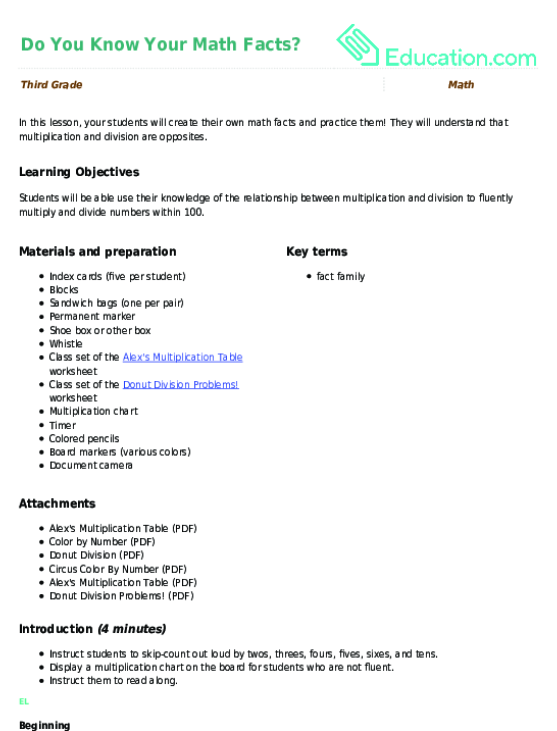
Do You Know Your Math Facts?
Lesson Plan
Do You Know Your Math Facts?
Third Grade
In this lesson, your students will create their own math facts and practice them! They will understand that multiplication and division are opposites.
Lesson Plan
Do You Know Your Math Facts?
Lesson Plan
Do You Know Your Math Facts?
In this lesson, your students will create their own math facts and practice them! They will understand that multiplication and division are opposites.
Third Grade
Lesson Plan
Nonfiction Comprehension: Compare and Contrast
Lesson Plan
Nonfiction Comprehension: Compare and Contrast
Third Grade
Teach your students to compare and contrast to boost their comprehension! Use this lesson to teach your students to compare and contrast information from two nonfiction texts on the same topic.
Lesson Plan
Nonfiction Comprehension: Compare and Contrast
Lesson Plan
Nonfiction Comprehension: Compare and Contrast
Teach your students to compare and contrast to boost their comprehension! Use this lesson to teach your students to compare and contrast information from two nonfiction texts on the same topic.
Third Grade
Lesson Plan
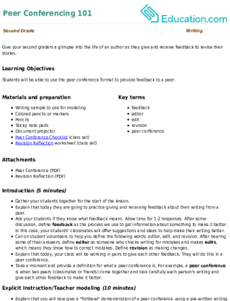
Peer Conferencing 101
Lesson Plan
Peer Conferencing 101
Second Grade
Give your second graders a glimpse into the life of an author as they give and receive feedback to revise their stories.
Lesson Plan
Peer Conferencing 101
Lesson Plan
Peer Conferencing 101
Give your second graders a glimpse into the life of an author as they give and receive feedback to revise their stories.
Second Grade
Lesson Plan
Strategies to Make Multiplication a Breeze
Lesson Plan
Strategies to Make Multiplication a Breeze
Third Grade
Multiplication
With this lesson, your students will see how the order of the factors does not affect the product in a multiplication expression. Use this on its own or alongside
You're On a Roll! Practicing Multiplication Facts.
Lesson Plan
Strategies to Make Multiplication a Breeze
Lesson Plan
Strategies to Make Multiplication a Breeze
With this lesson, your students will see how the order of the factors does not affect the product in a multiplication expression. Use this on its own or alongside
You're On a Roll! Practicing Multiplication Facts.
Third Grade
Multiplication
Lesson Plan
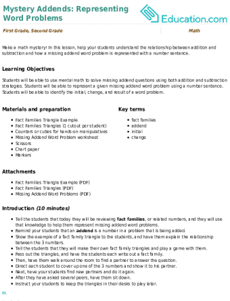
Mystery Addends: Representing Word Problems
Lesson Plan
Mystery Addends: Representing Word Problems
First Grade
Make a math mystery! In this lesson, help your students understand the relationship between addition and subtraction and how a missing addend word problem is represented with a number sentence.
Lesson Plan
Mystery Addends: Representing Word Problems
Lesson Plan
Mystery Addends: Representing Word Problems
Make a math mystery! In this lesson, help your students understand the relationship between addition and subtraction and how a missing addend word problem is represented with a number sentence.
First Grade
Lesson Plan
1
…
20
21
22
…
39