SKIP TO CONTENT
Worksheet Generator
Subjects
Grades
Worksheets
Games
Build a Worksheet
More Resources
Roly Recommends
Subjects
Grades
Worksheets
Games
Build a Worksheet
More Resources
Roly Recommends
2nd - 4th Grade Lesson Plans for 'all' : Page 21
Filters
682 results
Search for: all
✕
Lesson Plans
✕
2nd - 4th Grade
✕
Clear all
682 results
Filters
Search for: all
✕
Lesson Plans
✕
2nd - 4th Grade
✕
Subjects
Math
English Language Arts
Science
Social Studies
Technology
Grade Level
Pre-K
K
1st
2nd
3rd
4th
5th
6th
7th
8th
Early Childhood
Elementary School
Middle School
Resource Type
Worksheets
Games
Lesson Plans
Interactive Worksheets
Workbooks
Activities
Exercises
Stories
Songs
Offline Games
Guided Lessons
Teacher Resources
Common Core
Yes
Roly Recommends
Social Emotional Learning
English Language Support
Yes
Clear all
View 682 results
2nd - 4th Grade Lesson Plans for 'all' : Page 21
Filters
682 results
Search for: all
✕
Lesson Plans
✕
2nd - 4th Grade
✕
Clear all
682 results
What's My Area?
Lesson Plan
What's My Area?
Third Grade
Young mathematicians will enjoy demonstrating their skills with this lesson on finding area. It addresses the concepts of length, width, and square units.
Lesson Plan
What's My Area?
Lesson Plan
What's My Area?
Young mathematicians will enjoy demonstrating their skills with this lesson on finding area. It addresses the concepts of length, width, and square units.
Third Grade
Lesson Plan
How Do You Solve a Problem?
Lesson Plan
How Do You Solve a Problem?
Third Grade
Some problems are easy to fix, while some are more complicated. Use this lesson to teach your students to identify the characters’ attempts in a story to solve problems.
Lesson Plan
How Do You Solve a Problem?
Lesson Plan
How Do You Solve a Problem?
Some problems are easy to fix, while some are more complicated. Use this lesson to teach your students to identify the characters’ attempts in a story to solve problems.
Third Grade
Lesson Plan
EL
First- and Third-Person Point of View
Lesson Plan
First- and Third-Person Point of View
Third Grade
Use this lesson to help your ELs understand which pronouns to use when writing from different points of view. Use this as a stand-alone lesson or as a support lesson for the
My View as an Ant
lesson.
Lesson Plan
EL
First- and Third-Person Point of View
Lesson Plan
First- and Third-Person Point of View
Use this lesson to help your ELs understand which pronouns to use when writing from different points of view. Use this as a stand-alone lesson or as a support lesson for the
My View as an Ant
lesson.
Third Grade
Lesson Plan
EL
Writing Questions for Word Problems
Lesson Plan
Writing Questions for Word Problems
Fourth Grade
Empower students to think like mathematicians by having them create word problems related to subtracting mixed numbers. Use this lesson on its own or as support to the lesson Subtracting Mixed Numbers Using the Decomposition Strategy.
Lesson Plan
EL
Writing Questions for Word Problems
Lesson Plan
Writing Questions for Word Problems
Empower students to think like mathematicians by having them create word problems related to subtracting mixed numbers. Use this lesson on its own or as support to the lesson Subtracting Mixed Numbers Using the Decomposition Strategy.
Fourth Grade
Lesson Plan
EL
Showing Numbers in Different Ways
Lesson Plan
Showing Numbers in Different Ways
Second Grade
Place Value
Use this hands-on lesson to encourage collaboration amongst students as they review base-ten numerals, number names, and expanded form. This lesson can be used as a pre-lesson to Base Ten Block Party or as a stand-alone activity.
Lesson Plan
EL
Showing Numbers in Different Ways
Lesson Plan
Showing Numbers in Different Ways
Use this hands-on lesson to encourage collaboration amongst students as they review base-ten numerals, number names, and expanded form. This lesson can be used as a pre-lesson to Base Ten Block Party or as a stand-alone activity.
Second Grade
Place Value
Lesson Plan
Whose Point Is It Anyway?
Lesson Plan
Whose Point Is It Anyway?
Fourth Grade
Writing
What if Cinderella’s stepsisters weren’t really evil? In this engaging lesson, you will introduce your students to multiple points of view and discuss how these different perspectives can change a reader’s experience.
Lesson Plan
Whose Point Is It Anyway?
Lesson Plan
Whose Point Is It Anyway?
What if Cinderella’s stepsisters weren’t really evil? In this engaging lesson, you will introduce your students to multiple points of view and discuss how these different perspectives can change a reader’s experience.
Fourth Grade
Writing
Lesson Plan
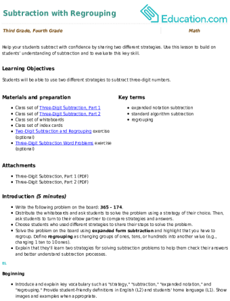
Subtraction with Regrouping
Lesson Plan
Subtraction with Regrouping
Third Grade
Subtraction
Help your students subtract with confidence by sharing two different strategies. Use this lesson to build on students’ understanding of subtraction and to evaluate this key skill.
Lesson Plan
Subtraction with Regrouping
Lesson Plan
Subtraction with Regrouping
Help your students subtract with confidence by sharing two different strategies. Use this lesson to build on students’ understanding of subtraction and to evaluate this key skill.
Third Grade
Subtraction
Lesson Plan
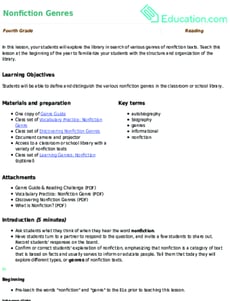
Nonfiction Genres
Lesson Plan
Nonfiction Genres
Fourth Grade
Writing
In this lesson, your students will explore the library in search of various genres of nonfiction texts. Teach this lesson at the beginning of the year to familiarize your students with the structure and organization of the library.
Lesson Plan
Nonfiction Genres
Lesson Plan
Nonfiction Genres
In this lesson, your students will explore the library in search of various genres of nonfiction texts. Teach this lesson at the beginning of the year to familiarize your students with the structure and organization of the library.
Fourth Grade
Writing
Lesson Plan
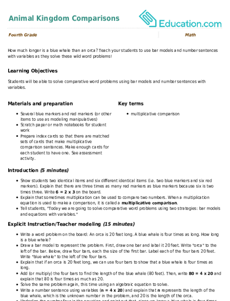
Animal Kingdom Comparisons
Lesson Plan
Animal Kingdom Comparisons
Fourth Grade
How much longer is a blue whale than an orca? Teach your students to use bar models and number sentences with variables as they solve these wild word problems!
Lesson Plan
Animal Kingdom Comparisons
Lesson Plan
Animal Kingdom Comparisons
How much longer is a blue whale than an orca? Teach your students to use bar models and number sentences with variables as they solve these wild word problems!
Fourth Grade
Lesson Plan
EL
Many Measurement Tools
Lesson Plan
Many Measurement Tools
Second Grade
Measurement
This support lesson provides students the opportunity to use two different tools to measure the length of familiar objects while introducing content specific vocabulary words. Use alone or alongside the lesson How Big is the Playground?
Lesson Plan
EL
Many Measurement Tools
Lesson Plan
Many Measurement Tools
This support lesson provides students the opportunity to use two different tools to measure the length of familiar objects while introducing content specific vocabulary words. Use alone or alongside the lesson How Big is the Playground?
Second Grade
Measurement
Lesson Plan
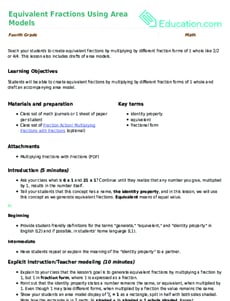
Equivalent Fractions Using Area Models
Lesson Plan
Equivalent Fractions Using Area Models
Fourth Grade
Teach your students to create equivalent fractions by multiplying by different fraction forms of 1 whole like 2/2 or 4/4. This lesson also includes drafts of area models.
Lesson Plan
Equivalent Fractions Using Area Models
Lesson Plan
Equivalent Fractions Using Area Models
Teach your students to create equivalent fractions by multiplying by different fraction forms of 1 whole like 2/2 or 4/4. This lesson also includes drafts of area models.
Fourth Grade
Lesson Plan
EL
Read with Expression!
Lesson Plan
Read with Expression!
Fourth Grade
Knowing how to identify types of sentences and read each kind with expression is an important component of reading fluency. This EL support lesson can be taught on its own or used as precursor to the lesson Fourth Grade Fluency Fun!
Lesson Plan
EL
Read with Expression!
Lesson Plan
Read with Expression!
Knowing how to identify types of sentences and read each kind with expression is an important component of reading fluency. This EL support lesson can be taught on its own or used as precursor to the lesson Fourth Grade Fluency Fun!
Fourth Grade
Lesson Plan
Comparing Texts by the Same Author
Lesson Plan
Comparing Texts by the Same Author
Third Grade
Reading
Getting hooked on a series or type of character creates reader engagement! Use this lesson to challenge your students to compare and contrast fictional texts as they find the joy in reading books by the same author.
Lesson Plan
Comparing Texts by the Same Author
Lesson Plan
Comparing Texts by the Same Author
Getting hooked on a series or type of character creates reader engagement! Use this lesson to challenge your students to compare and contrast fictional texts as they find the joy in reading books by the same author.
Third Grade
Reading
Lesson Plan
EL
Main Idea or Topic? You Decide!
Lesson Plan
Main Idea or Topic? You Decide!
First Grade
Life Science
Provide students with an opportunity to closely examine the difference between a topic and main idea in a nonfiction text. Use as a stand-alone activity or a support for the Finding the Main Idea and Details in a Nonfiction Text lesson.
Lesson Plan
EL
Main Idea or Topic? You Decide!
Lesson Plan
Main Idea or Topic? You Decide!
Provide students with an opportunity to closely examine the difference between a topic and main idea in a nonfiction text. Use as a stand-alone activity or a support for the Finding the Main Idea and Details in a Nonfiction Text lesson.
First Grade
Life Science
Lesson Plan
Story Structure Rollercoaster
Lesson Plan
Story Structure Rollercoaster
Third Grade
Reading
Reading can be a rollercoaster with its ups and downs! Use this lesson that features a rollercoaster-themed story map to teach your students about story structure and how to use a graphic organizer to visualize it.
Lesson Plan
Story Structure Rollercoaster
Lesson Plan
Story Structure Rollercoaster
Reading can be a rollercoaster with its ups and downs! Use this lesson that features a rollercoaster-themed story map to teach your students about story structure and how to use a graphic organizer to visualize it.
Third Grade
Reading
Lesson Plan
This May Take Time: Growth Mindset
Lesson Plan
This May Take Time: Growth Mindset
Second Grade
In this lesson, students will explore growth mindset and learn to shift from saying “This is too hard,” to “This may take time.” They will practice slowing down and building patience when things are challenging and require effort.
Lesson Plan
This May Take Time: Growth Mindset
Lesson Plan
This May Take Time: Growth Mindset
In this lesson, students will explore growth mindset and learn to shift from saying “This is too hard,” to “This may take time.” They will practice slowing down and building patience when things are challenging and require effort.
Second Grade
Lesson Plan
EL
Read with Expression!
Lesson Plan
Read with Expression!
Fourth Grade
Knowing how to identify types of sentences and read each kind with expression is an important component of reading fluency. This English Learner support lesson can be taught on its own or used as precursor to Fourth Grade Fluency Fun!
Lesson Plan
EL
Read with Expression!
Lesson Plan
Read with Expression!
Knowing how to identify types of sentences and read each kind with expression is an important component of reading fluency. This English Learner support lesson can be taught on its own or used as precursor to Fourth Grade Fluency Fun!
Fourth Grade
Lesson Plan
Hey! What’s the Big Idea?
Lesson Plan
Hey! What’s the Big Idea?
Fourth Grade
Writing
Your students will practice searching for clues to uncover the main idea and supporting details in nonfiction texts about John Muir and Day of the Dead traditions around the world.
Lesson Plan
Hey! What’s the Big Idea?
Lesson Plan
Hey! What’s the Big Idea?
Your students will practice searching for clues to uncover the main idea and supporting details in nonfiction texts about John Muir and Day of the Dead traditions around the world.
Fourth Grade
Writing
Lesson Plan
Fiction Comprehension: Problem and Solution
Lesson Plan
Fiction Comprehension: Problem and Solution
Third Grade
If you've ever had something go wrong, you know how it feels to search for a solution! Use this lesson to teach your students to identify problems and solutions in fictional text.
Lesson Plan
Fiction Comprehension: Problem and Solution
Lesson Plan
Fiction Comprehension: Problem and Solution
If you've ever had something go wrong, you know how it feels to search for a solution! Use this lesson to teach your students to identify problems and solutions in fictional text.
Third Grade
Lesson Plan
Fiction Genres Library Exploration
Lesson Plan
Fiction Genres Library Exploration
Fourth Grade
How familiar are your fourth graders with the fictional genres available in their class or school libraries? This lesson introduces them to many genres of fictional books so they can get off to a terrific start of fourth grade reading.
Lesson Plan
Fiction Genres Library Exploration
Lesson Plan
Fiction Genres Library Exploration
How familiar are your fourth graders with the fictional genres available in their class or school libraries? This lesson introduces them to many genres of fictional books so they can get off to a terrific start of fourth grade reading.
Fourth Grade
Lesson Plan
Beginning, Middle, and End Mix Up
Lesson Plan
Beginning, Middle, and End Mix Up
Second Grade
In this lesson, students get practice with finding the beginning, middle, and end of the story. Have your students help you fix a mixed up story while they learn the parts of a story.
Lesson Plan
Beginning, Middle, and End Mix Up
Lesson Plan
Beginning, Middle, and End Mix Up
In this lesson, students get practice with finding the beginning, middle, and end of the story. Have your students help you fix a mixed up story while they learn the parts of a story.
Second Grade
Lesson Plan
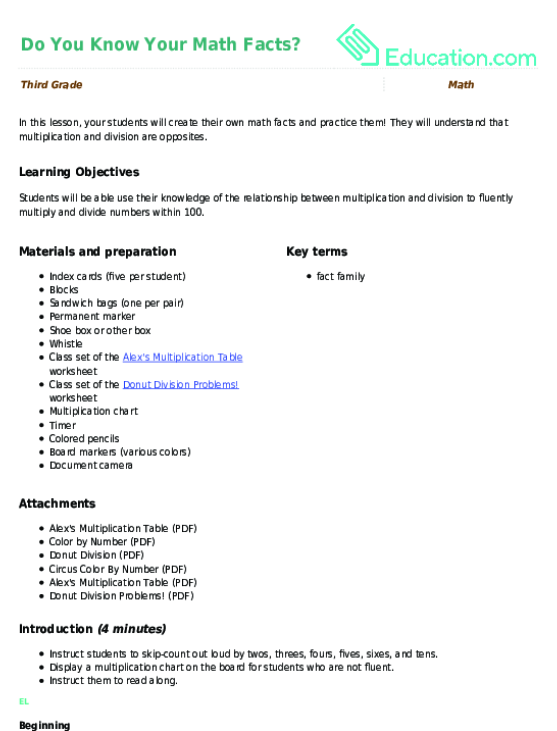
Do You Know Your Math Facts?
Lesson Plan
Do You Know Your Math Facts?
Third Grade
In this lesson, your students will create their own math facts and practice them! They will understand that multiplication and division are opposites.
Lesson Plan
Do You Know Your Math Facts?
Lesson Plan
Do You Know Your Math Facts?
In this lesson, your students will create their own math facts and practice them! They will understand that multiplication and division are opposites.
Third Grade
Lesson Plan
EL
Which Number is the Greatest?
Lesson Plan
Which Number is the Greatest?
Second Grade
Place Value
Use this lesson to support students in understanding the symbols used to record numbers. This lesson can be used alongside Comparing Three-Digit Numbers or as a standalone, scaffolded EL support lesson.
Lesson Plan
EL
Which Number is the Greatest?
Lesson Plan
Which Number is the Greatest?
Use this lesson to support students in understanding the symbols used to record numbers. This lesson can be used alongside Comparing Three-Digit Numbers or as a standalone, scaffolded EL support lesson.
Second Grade
Place Value
Lesson Plan
EL
Exploring Sequence with Signal Words
Lesson Plan
Exploring Sequence with Signal Words
Third Grade
Use this lesson to teach your students how to retell the beginning, middle, and end of a story using sequencing words and phrases. This lesson can stand alone or be used as a pre-lesson for the
Story Structure Rollercoaster
lesson.
Lesson Plan
EL
Exploring Sequence with Signal Words
Lesson Plan
Exploring Sequence with Signal Words
Use this lesson to teach your students how to retell the beginning, middle, and end of a story using sequencing words and phrases. This lesson can stand alone or be used as a pre-lesson for the
Story Structure Rollercoaster
lesson.
Third Grade
Lesson Plan
EL
Adding Within 20
Lesson Plan
Adding Within 20
Second Grade
This scaffolded EL lesson will help your students fluently add within 20, while reinforcing parts of a whole. Use as a pre-lesson for Addition: Over in a Flash, or as a stand alone activity.
Lesson Plan
EL
Adding Within 20
Lesson Plan
Adding Within 20
This scaffolded EL lesson will help your students fluently add within 20, while reinforcing parts of a whole. Use as a pre-lesson for Addition: Over in a Flash, or as a stand alone activity.
Second Grade
Lesson Plan
EL
Creating Cause and Effect Skits
Lesson Plan
Creating Cause and Effect Skits
Second Grade
Help your ELs look deeply at cause and effect at the sentence level. Using skits to reinforce comprehension, this lesson can be used as a support lesson for Learning About Cause and Effect! or a stand alone activity.
Lesson Plan
EL
Creating Cause and Effect Skits
Lesson Plan
Creating Cause and Effect Skits
Help your ELs look deeply at cause and effect at the sentence level. Using skits to reinforce comprehension, this lesson can be used as a support lesson for Learning About Cause and Effect! or a stand alone activity.
Second Grade
Lesson Plan
EL
What Was the Problem?
Lesson Plan
What Was the Problem?
Third Grade
Use this lesson to teach your students to use the correct past tense language when speaking about a story they have read. This lesson can stand alone or be used as a pre-lesson for the
Fiction Comprehension: Problem and Solution
lesson.
Lesson Plan
EL
What Was the Problem?
Lesson Plan
What Was the Problem?
Use this lesson to teach your students to use the correct past tense language when speaking about a story they have read. This lesson can stand alone or be used as a pre-lesson for the
Fiction Comprehension: Problem and Solution
lesson.
Third Grade
Lesson Plan
Mystery Addends: Representing Word Problems
Lesson Plan
Mystery Addends: Representing Word Problems
First Grade
Make a math mystery! In this lesson, help your students understand the relationship between addition and subtraction and how a missing addend word problem is represented with a number sentence.
Lesson Plan
Mystery Addends: Representing Word Problems
Lesson Plan
Mystery Addends: Representing Word Problems
Make a math mystery! In this lesson, help your students understand the relationship between addition and subtraction and how a missing addend word problem is represented with a number sentence.
First Grade
Lesson Plan
Take a Walk with Idioms
Lesson Plan
Take a Walk with Idioms
Third Grade
Get your students moving! In this lesson, your students will walk around the classroom as they practice using and interpreting idioms.
Lesson Plan
Take a Walk with Idioms
Lesson Plan
Take a Walk with Idioms
Get your students moving! In this lesson, your students will walk around the classroom as they practice using and interpreting idioms.
Third Grade
Lesson Plan
Illustrating Fraction and Whole Number Products with Tape Models
Lesson Plan
Illustrating Fraction and Whole Number Products with Tape Models
Fourth Grade
Teach your students to use tape diagrams to solve equations involving whole numbers and fractions.
Lesson Plan
Illustrating Fraction and Whole Number Products with Tape Models
Lesson Plan
Illustrating Fraction and Whole Number Products with Tape Models
Teach your students to use tape diagrams to solve equations involving whole numbers and fractions.
Fourth Grade
Lesson Plan
1
…
20
21
22
23