SKIP TO CONTENT
Worksheet Generator
Subjects
Grades
Worksheets
Games
Build a Worksheet
More Resources
Roly Recommends
Subjects
Grades
Worksheets
Games
Build a Worksheet
More Resources
Roly Recommends
Filters
2nd - 4th Grade
✕
English Language Support
✕
Subjects
Math
English Language Arts
Science
Grade Level
Pre-K
K
1st
2nd
3rd
4th
5th
6th
7th
8th
Early Childhood
Elementary School
Middle School
Resource Type
Lesson Plans
Common Core
Yes
English Language Support
Yes
See More
Clear All
View 237 results
2nd - 4th Grade English Language Support Educational Resources : Page 6
237 results
2nd - 4th Grade
✕
English Language Support
✕
Clear All
Sort by:
Most popular
Featured
Most recent
Alphabetical A-Z
Alphabetical Z-A
Relevance
All filters
237 results
Sort by:
Most popular
Featured
Most recent
Alphabetical A-Z
Alphabetical Z-A
Relevance
Connecting the Coasts: Effects of the Transcontinental Railroad
Lesson Plan
Connecting the Coasts: Effects of the Transcontinental Railroad
Fourth Grade
Reading
Look at history! In this lesson, guide students through an exploration of the context, causes, and effects of the Transcontinental Railroad, and help them practice identifying the main idea and supporting details in a nonfiction text.
Lesson Plan
Connecting the Coasts: Effects of the Transcontinental Railroad
Lesson Plan
Connecting the Coasts: Effects of the Transcontinental Railroad
Look at history! In this lesson, guide students through an exploration of the context, causes, and effects of the Transcontinental Railroad, and help them practice identifying the main idea and supporting details in a nonfiction text.
Fourth Grade
Reading
Lesson Plan
Multiplication Bingo: Two-Digit Numbers
Lesson Plan
Multiplication Bingo: Two-Digit Numbers
Fourth Grade
Your students will go bonkers for bingo as they play this baffling multiplication game! Who will get five in a row first?
Lesson Plan
Multiplication Bingo: Two-Digit Numbers
Lesson Plan
Multiplication Bingo: Two-Digit Numbers
Your students will go bonkers for bingo as they play this baffling multiplication game! Who will get five in a row first?
Fourth Grade
Lesson Plan
Addition with Regrouping
Lesson Plan
Addition with Regrouping
Third Grade
In this lesson, students will add three-digit numbers using expanded form addition and standard algorithm addition. They'll explain their answers and highlight the steps for each of the strategies.
Lesson Plan
Addition with Regrouping
Lesson Plan
Addition with Regrouping
In this lesson, students will add three-digit numbers using expanded form addition and standard algorithm addition. They'll explain their answers and highlight the steps for each of the strategies.
Third Grade
Lesson Plan
What Happened?
Lesson Plan
What Happened?
First Grade
Reading
Help your students' story telling abilities grow with this lesson that helps them recount what happened in a story and has them point out key details.
Lesson Plan
What Happened?
Lesson Plan
What Happened?
Help your students' story telling abilities grow with this lesson that helps them recount what happened in a story and has them point out key details.
First Grade
Reading
Lesson Plan
Nonfiction Comprehension: Cause and Effect
Lesson Plan
Nonfiction Comprehension: Cause and Effect
Third Grade
What is the cause, and what is the effect? Use this resource to teach your students how to identify examples of cause and effect in nonfiction text.
Lesson Plan
Nonfiction Comprehension: Cause and Effect
Lesson Plan
Nonfiction Comprehension: Cause and Effect
What is the cause, and what is the effect? Use this resource to teach your students how to identify examples of cause and effect in nonfiction text.
Third Grade
Lesson Plan
Who, When, What, Where, Why, and How?
Lesson Plan
Who, When, What, Where, Why, and How?
First Grade
Reading
Do you have students who are constantly asking what, who, where, why, how, and when? It's your turn to ask now! Have them read various stories and ask them to answer these questions in this lesson.
Lesson Plan
Who, When, What, Where, Why, and How?
Lesson Plan
Who, When, What, Where, Why, and How?
Do you have students who are constantly asking what, who, where, why, how, and when? It's your turn to ask now! Have them read various stories and ask them to answer these questions in this lesson.
First Grade
Reading
Lesson Plan
Fiction Comprehension: Problem and Solution
Lesson Plan
Fiction Comprehension: Problem and Solution
Third Grade
If you've ever had something go wrong, you know how it feels to search for a solution! Use this lesson to teach your students to identify problems and solutions in fictional text.
Lesson Plan
Fiction Comprehension: Problem and Solution
Lesson Plan
Fiction Comprehension: Problem and Solution
If you've ever had something go wrong, you know how it feels to search for a solution! Use this lesson to teach your students to identify problems and solutions in fictional text.
Third Grade
Lesson Plan
Find The Perimeter: Real Life Objects
Lesson Plan
Find The Perimeter: Real Life Objects
Third Grade
This lesson on perimeter will let your students walk around the class to see the border, use a measuring tape to measure the walls in their classroom, and enable them to understand how math is related to real life!
Lesson Plan
Find The Perimeter: Real Life Objects
Lesson Plan
Find The Perimeter: Real Life Objects
This lesson on perimeter will let your students walk around the class to see the border, use a measuring tape to measure the walls in their classroom, and enable them to understand how math is related to real life!
Third Grade
Lesson Plan
Color Coding Nonfiction Text
Lesson Plan
Color Coding Nonfiction Text
Third Grade
Jazz up your nonfiction reading and add a little color! Use this lesson with your students to teach them to cite text evidence as they answer questions by color coding.
Lesson Plan
Color Coding Nonfiction Text
Lesson Plan
Color Coding Nonfiction Text
Jazz up your nonfiction reading and add a little color! Use this lesson with your students to teach them to cite text evidence as they answer questions by color coding.
Third Grade
Lesson Plan
Let's Compare and Contrast Nonfiction Texts!
Lesson Plan
Let's Compare and Contrast Nonfiction Texts!
Second Grade
Vocabulary
This lesson provides students with the opportunity to compare and contrast two athletes who have been instrumental in changing the world of women's sports.
Lesson Plan
Let's Compare and Contrast Nonfiction Texts!
Lesson Plan
Let's Compare and Contrast Nonfiction Texts!
This lesson provides students with the opportunity to compare and contrast two athletes who have been instrumental in changing the world of women's sports.
Second Grade
Vocabulary
Lesson Plan
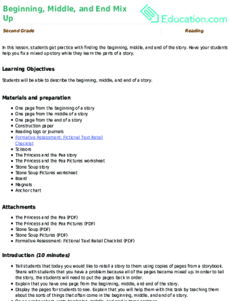
Beginning, Middle, and End Mix Up
Lesson Plan
Beginning, Middle, and End Mix Up
Second Grade
In this lesson, students get practice with finding the beginning, middle, and end of the story. Have your students help you fix a mixed up story while they learn the parts of a story.
Lesson Plan
Beginning, Middle, and End Mix Up
Lesson Plan
Beginning, Middle, and End Mix Up
In this lesson, students get practice with finding the beginning, middle, and end of the story. Have your students help you fix a mixed up story while they learn the parts of a story.
Second Grade
Lesson Plan
What's the Big Idea? Summarizing Nonfiction Texts
Lesson Plan
What's the Big Idea? Summarizing Nonfiction Texts
Fourth Grade
Reading
Understanding the big idea of a nonfiction text and being able to write a succinct summary are key fourth grade skills. This lesson focuses on summarizing a nonfiction passage in three to four sentences.
Lesson Plan
What's the Big Idea? Summarizing Nonfiction Texts
Lesson Plan
What's the Big Idea? Summarizing Nonfiction Texts
Understanding the big idea of a nonfiction text and being able to write a succinct summary are key fourth grade skills. This lesson focuses on summarizing a nonfiction passage in three to four sentences.
Fourth Grade
Reading
Lesson Plan
What Does the Author Think?
Lesson Plan
What Does the Author Think?
Third Grade
Can you tell what the author thinks about this subject? What do
you
think about it? Use this resource to help your students recognize the author's point of view and establish their own.
Lesson Plan
What Does the Author Think?
Lesson Plan
What Does the Author Think?
Can you tell what the author thinks about this subject? What do
you
think about it? Use this resource to help your students recognize the author's point of view and establish their own.
Third Grade
Lesson Plan
Reader's Theater: Read the Script
Lesson Plan
Reader's Theater: Read the Script
Third Grade
Reading
Did you know that Reader's Theater promotes fluency and builds students' reading confidence? Use this lesson to inspire your students to practice reading and understanding text in the drama genre.
Lesson Plan
Reader's Theater: Read the Script
Lesson Plan
Reader's Theater: Read the Script
Did you know that Reader's Theater promotes fluency and builds students' reading confidence? Use this lesson to inspire your students to practice reading and understanding text in the drama genre.
Third Grade
Reading
Lesson Plan
Slap and Roll Timed Multiplication
Lesson Plan
Slap and Roll Timed Multiplication
Third Grade
Students will "roll" to this quick game and "slap out" multiplication facts to reinforce multiplication skills and beat their own scores!
Lesson Plan
Slap and Roll Timed Multiplication
Lesson Plan
Slap and Roll Timed Multiplication
Students will "roll" to this quick game and "slap out" multiplication facts to reinforce multiplication skills and beat their own scores!
Third Grade
Lesson Plan
Let’s Compare! Place Value Disks & Three-Digit Numbers
Lesson Plan
Let’s Compare! Place Value Disks & Three-Digit Numbers
Second Grade
Dive into understanding place value by using place value disks to represent and compare numbers.
Lesson Plan
Let’s Compare! Place Value Disks & Three-Digit Numbers
Lesson Plan
Let’s Compare! Place Value Disks & Three-Digit Numbers
Dive into understanding place value by using place value disks to represent and compare numbers.
Second Grade
Lesson Plan
Do You Know Your Math Facts?
Lesson Plan
Do You Know Your Math Facts?
Third Grade
In this lesson, your students will create their own math facts and practice them! They will understand that multiplication and division are opposites.
Lesson Plan
Do You Know Your Math Facts?
Lesson Plan
Do You Know Your Math Facts?
In this lesson, your students will create their own math facts and practice them! They will understand that multiplication and division are opposites.
Third Grade
Lesson Plan
Making Predictions Lesson
Lesson Plan
Making Predictions Lesson
Third Grade
This lesson thoughtfully scaffolds the reading skill of predicting. Students are introduced to the concept and get to practice making predictions. They will apply what they have learned during a focused independent reading activity.
Lesson Plan
Making Predictions Lesson
Lesson Plan
Making Predictions Lesson
This lesson thoughtfully scaffolds the reading skill of predicting. Students are introduced to the concept and get to practice making predictions. They will apply what they have learned during a focused independent reading activity.
Third Grade
Lesson Plan
Finding the Area of a Rectangle
Lesson Plan
Finding the Area of a Rectangle
Third Grade
Let your students learn how to find the area of rectangular objects by doing hands-on activities. Your students will love finding the area of various rectangular objects around the classroom!
Lesson Plan
Finding the Area of a Rectangle
Lesson Plan
Finding the Area of a Rectangle
Let your students learn how to find the area of rectangular objects by doing hands-on activities. Your students will love finding the area of various rectangular objects around the classroom!
Third Grade
Lesson Plan
Multiplication and Area in the Community Garden
Lesson Plan
Multiplication and Area in the Community Garden
Third Grade
Help your students get creative as they apply multiplication skills to find the area of a community garden of their own design! In this lesson, students will practice finding the area of a rectangle within a real-world context.
Lesson Plan
Multiplication and Area in the Community Garden
Lesson Plan
Multiplication and Area in the Community Garden
Help your students get creative as they apply multiplication skills to find the area of a community garden of their own design! In this lesson, students will practice finding the area of a rectangle within a real-world context.
Third Grade
Lesson Plan
Author’s Purpose in Fiction Texts
Lesson Plan
Author’s Purpose in Fiction Texts
Second Grade
Introduce the concept of author’s purpose in fiction texts with this fun reading lesson! Students will discuss three examples of fictional texts to determine the purpose of each.
Lesson Plan
Author’s Purpose in Fiction Texts
Lesson Plan
Author’s Purpose in Fiction Texts
Introduce the concept of author’s purpose in fiction texts with this fun reading lesson! Students will discuss three examples of fictional texts to determine the purpose of each.
Second Grade
Lesson Plan
Fiction Comprehension: Cause and Effect
Lesson Plan
Fiction Comprehension: Cause and Effect
Third Grade
Improve reading comprehension with a lesson on cause and effect! In this lesson, students will use a T-chart to identify examples of cause and effect in and by the end, you’ll all be singing along to the cause and effect song!
Lesson Plan
Fiction Comprehension: Cause and Effect
Lesson Plan
Fiction Comprehension: Cause and Effect
Improve reading comprehension with a lesson on cause and effect! In this lesson, students will use a T-chart to identify examples of cause and effect in and by the end, you’ll all be singing along to the cause and effect song!
Third Grade
Lesson Plan
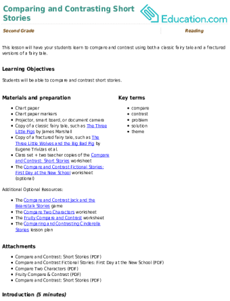
Comparing and Contrasting Short Stories
Lesson Plan
Comparing and Contrasting Short Stories
Second Grade
Reading
This lesson will have your students learn to compare and contrast using both a classic fairy tale and a fractured versions of a fairy tale.
Lesson Plan
Comparing and Contrasting Short Stories
Lesson Plan
Comparing and Contrasting Short Stories
This lesson will have your students learn to compare and contrast using both a classic fairy tale and a fractured versions of a fairy tale.
Second Grade
Reading
Lesson Plan
The Same or Different? You Decide!
Lesson Plan
The Same or Different? You Decide!
Third Grade
Reading
Are the stories the same or different? You decide! Use this lesson with your students to practice comparing the story elements in two fictional stories written by the same author.
Lesson Plan
The Same or Different? You Decide!
Lesson Plan
The Same or Different? You Decide!
Are the stories the same or different? You decide! Use this lesson with your students to practice comparing the story elements in two fictional stories written by the same author.
Third Grade
Reading
Lesson Plan
Multiplication: Musical Chairs
Lesson Plan
Multiplication: Musical Chairs
Fourth Grade
In this fun, fast-paced multiplication review lesson, students will play a musical game as they practice their facts while applying different techniques to their problem-solving skills.
Lesson Plan
Multiplication: Musical Chairs
Lesson Plan
Multiplication: Musical Chairs
In this fun, fast-paced multiplication review lesson, students will play a musical game as they practice their facts while applying different techniques to their problem-solving skills.
Fourth Grade
Lesson Plan
What's My Line?
Lesson Plan
What's My Line?
Fourth Grade
Geometry
In this lesson, students engage in interesting hands-on activities that help them discover the properties of parallel, perpendicular, and intersecting lines. Your little mathematicians will have a blast as they learn about geometry.
Lesson Plan
What's My Line?
Lesson Plan
What's My Line?
In this lesson, students engage in interesting hands-on activities that help them discover the properties of parallel, perpendicular, and intersecting lines. Your little mathematicians will have a blast as they learn about geometry.
Fourth Grade
Geometry
Lesson Plan
Understanding Academic Vocabulary in a Nonfiction Text
Lesson Plan
Understanding Academic Vocabulary in a Nonfiction Text
Second Grade
Grammar and Mechanics
This lesson will provide students with an opportunity to become more comfortable with identifying and defining academic vocabulary words in a nonfiction text about a chicken's life cycle to support comprehension.
Lesson Plan
Understanding Academic Vocabulary in a Nonfiction Text
Lesson Plan
Understanding Academic Vocabulary in a Nonfiction Text
This lesson will provide students with an opportunity to become more comfortable with identifying and defining academic vocabulary words in a nonfiction text about a chicken's life cycle to support comprehension.
Second Grade
Grammar and Mechanics
Lesson Plan
Learning About Cause and Effect!
Lesson Plan
Learning About Cause and Effect!
Second Grade
Help your students understand what cause and effect looks like in everyday situations! This hands-on, engaging lesson plan allows students to examine cause and effect in their own lives as well as fictional text!
Lesson Plan
Learning About Cause and Effect!
Lesson Plan
Learning About Cause and Effect!
Help your students understand what cause and effect looks like in everyday situations! This hands-on, engaging lesson plan allows students to examine cause and effect in their own lives as well as fictional text!
Second Grade
Lesson Plan
Greater Than, Less Than: Comparing Three-Digit Numbers
Lesson Plan
Greater Than, Less Than: Comparing Three-Digit Numbers
Second Grade
In this lesson, your students will compare numbers to one thousand using place value charts and symbols. Your students will love practicing with numbers!
Lesson Plan
Greater Than, Less Than: Comparing Three-Digit Numbers
Lesson Plan
Greater Than, Less Than: Comparing Three-Digit Numbers
In this lesson, your students will compare numbers to one thousand using place value charts and symbols. Your students will love practicing with numbers!
Second Grade
Lesson Plan
Up, Up, and Array
Lesson Plan
Up, Up, and Array
Second Grade
In this lesson, your students will use repeated addition to find the total number of objects in arrays. This lesson will help your students build upon the skills needed to learn multiplication.
Lesson Plan
Up, Up, and Array
Lesson Plan
Up, Up, and Array
In this lesson, your students will use repeated addition to find the total number of objects in arrays. This lesson will help your students build upon the skills needed to learn multiplication.
Second Grade
Lesson Plan
1
…
5
6
7
8