SKIP TO CONTENT
Worksheet Generator
Subjects
Grades
Worksheets
Games
Build a Worksheet
More Resources
Roly Recommends
Reading Month
Subjects
Grades
Worksheets
Games
Build a Worksheet
More Resources
Roly Recommends
Reading Month
Filters
Search for: why, is, the, sky, blue
✕
Lesson Plans
✕
2nd and 3rd Grade
✕
Subjects
Math
English Language Arts
Science
Social Studies
Grade Level
Pre-K
K
1st
2nd
3rd
4th
5th
6th
7th
8th
Early Childhood
Elementary School
Middle School
Resource Type
Worksheets
Games
Lesson Plans
Interactive Worksheets
Workbooks
Activities
Stories
Songs
Offline Games
Guided Lessons
Teacher Resources
Common Core
Yes
Roly Recommends
Social Emotional Learning
English Language Support
Yes
See More
Clear All
View 387 results
Showing Results for why is the sky blue
387 results
Search for: why, is, the, sky, blue
✕
Lesson Plans
✕
2nd and 3rd Grade
✕
Clear All
Sort by:
Relevance
Most recent
Most popular
Alphabetical A-Z
Alphabetical Z-A
All filters
387 results
Sort by:
Relevance
Most recent
Most popular
Alphabetical A-Z
Alphabetical Z-A
How and Why Stories
Lesson Plan
How and Why Stories
First Grade
In this lesson, students have a great time using their imaginations to collaborate and create their own story following the "how and why" style of common folktales.
Lesson Plan
How and Why Stories
Lesson Plan
How and Why Stories
In this lesson, students have a great time using their imaginations to collaborate and create their own story following the "how and why" style of common folktales.
First Grade
Lesson Plan
Who, When, What, Where, Why, and How?
Lesson Plan
Who, When, What, Where, Why, and How?
First Grade
Reading
Do you have students who are constantly asking what, who, where, why, how, and when? It's your turn to ask now! Have them read various stories and ask them to answer these questions in this lesson.
Lesson Plan
Who, When, What, Where, Why, and How?
Lesson Plan
Who, When, What, Where, Why, and How?
Do you have students who are constantly asking what, who, where, why, how, and when? It's your turn to ask now! Have them read various stories and ask them to answer these questions in this lesson.
First Grade
Reading
Lesson Plan
Answering "Why" Questions
Lesson Plan
Answering "Why" Questions
Third Grade
Teach your students how to use specific vocabulary as they answer questions. This lesson can stand alone or be used as a pre-lesson for the
Questions that Gauge Comprehension
lesson plan.
Lesson Plan
Answering "Why" Questions
Lesson Plan
Answering "Why" Questions
Teach your students how to use specific vocabulary as they answer questions. This lesson can stand alone or be used as a pre-lesson for the
Questions that Gauge Comprehension
lesson plan.
Third Grade
Lesson Plan
Why I Write
Lesson Plan
Why I Write
Second Grade
Reading
Second grade students will step into the author’s shoes as they hunt for evidence to determine what a nonfiction author’s purpose might be.
Lesson Plan
Why I Write
Lesson Plan
Why I Write
Second grade students will step into the author’s shoes as they hunt for evidence to determine what a nonfiction author’s purpose might be.
Second Grade
Reading
Lesson Plan
What Are Arrays?
Lesson Plan
What Are Arrays?
Second Grade
In this lesson, students will explore the characteristics of arrays and find out why they are important. Use this lesson independently or alongside Come Array With Us!
Lesson Plan
What Are Arrays?
Lesson Plan
What Are Arrays?
In this lesson, students will explore the characteristics of arrays and find out why they are important. Use this lesson independently or alongside Come Array With Us!
Second Grade
Lesson Plan
My Teacher for President!
Lesson Plan
My Teacher for President!
Second Grade
Writing
Need a promotion? Then have your students participate in a writing lesson that will have them voting for you! Give students the opportunity to place teachers in the spotlight, as they persuade others why teachers make the best presidents.
Lesson Plan
My Teacher for President!
Lesson Plan
My Teacher for President!
Need a promotion? Then have your students participate in a writing lesson that will have them voting for you! Give students the opportunity to place teachers in the spotlight, as they persuade others why teachers make the best presidents.
Second Grade
Writing
Lesson Plan
The Five W's of Notetaking
Lesson Plan
The Five W's of Notetaking
Second Grade
Writing
Thinking about who, what, when, where, and why isn’t just for detectives! Students will practice gleaning important information from texts using these questions and a few other tools.
Lesson Plan
The Five W's of Notetaking
Lesson Plan
The Five W's of Notetaking
Thinking about who, what, when, where, and why isn’t just for detectives! Students will practice gleaning important information from texts using these questions and a few other tools.
Second Grade
Writing
Lesson Plan
Math Story Problems
Lesson Plan
Math Story Problems
Second Grade
Help your students make the connection between what they're learning in the classroom and why they need it in the real world with this lesson on word problems.
Lesson Plan
Math Story Problems
Lesson Plan
Math Story Problems
Help your students make the connection between what they're learning in the classroom and why they need it in the real world with this lesson on word problems.
Second Grade
Lesson Plan
Examining Author's Purpose in a Fictional Text
Lesson Plan
Examining Author's Purpose in a Fictional Text
Second Grade
Reading
Students will read a short fictional story and discuss why the author included certain details and words. Use this lesson to help your students navigate parts of fictional text to determine the author's purpose!
Lesson Plan
Examining Author's Purpose in a Fictional Text
Lesson Plan
Examining Author's Purpose in a Fictional Text
Students will read a short fictional story and discuss why the author included certain details and words. Use this lesson to help your students navigate parts of fictional text to determine the author's purpose!
Second Grade
Reading
Lesson Plan
Array Models in Multiplication
Lesson Plan
Array Models in Multiplication
Third Grade
This lesson allows students to explore the concept of multiplication hands on. Kids will also come to understand why multiplication is important as well as how to solve multiplication problems using array models.
Lesson Plan
Array Models in Multiplication
Lesson Plan
Array Models in Multiplication
This lesson allows students to explore the concept of multiplication hands on. Kids will also come to understand why multiplication is important as well as how to solve multiplication problems using array models.
Third Grade
Lesson Plan
All About the 5 W's
Lesson Plan
All About the 5 W's
Second Grade
Students will be able to answer questions to show understanding of important details in a text. This can be a stand-alone lesson or a support lesson to be used prior to the Who, When, What, Where, Why, and How? lesson plan.
Lesson Plan
All About the 5 W's
Lesson Plan
All About the 5 W's
Students will be able to answer questions to show understanding of important details in a text. This can be a stand-alone lesson or a support lesson to be used prior to the Who, When, What, Where, Why, and How? lesson plan.
Second Grade
Lesson Plan
The Purpose of Fiction Texts
Lesson Plan
The Purpose of Fiction Texts
Second Grade
Why does someone write a story? Give your students the tools to find out the author's purpose! Use this as a stand-alone lesson or as an introduction to the Author’s Purpose in Fiction Texts lesson plan.
Lesson Plan
The Purpose of Fiction Texts
Lesson Plan
The Purpose of Fiction Texts
Why does someone write a story? Give your students the tools to find out the author's purpose! Use this as a stand-alone lesson or as an introduction to the Author’s Purpose in Fiction Texts lesson plan.
Second Grade
Lesson Plan
Decomposing Numbers
Lesson Plan
Decomposing Numbers
Third Grade
Numbers and Counting
Why make things harder on ourselves? Teach your students to decompose numbers to make math easier! Use this as a stand alone lesson or a pre-lesson for
Decompose to Multiply: 6, 7, 8, and 9.
Lesson Plan
Decomposing Numbers
Lesson Plan
Decomposing Numbers
Why make things harder on ourselves? Teach your students to decompose numbers to make math easier! Use this as a stand alone lesson or a pre-lesson for
Decompose to Multiply: 6, 7, 8, and 9.
Third Grade
Numbers and Counting
Lesson Plan
What's Your Phase?
Lesson Plan
What's Your Phase?
Third Grade
Earth and Space Science
This lesson engages students in activity to help them understand the phases of the Moon, and why they occur. Students read literature, analyze it, and then apply it to the small group performance of one cycle of the Moon’s phases.
Lesson Plan
What's Your Phase?
Lesson Plan
What's Your Phase?
This lesson engages students in activity to help them understand the phases of the Moon, and why they occur. Students read literature, analyze it, and then apply it to the small group performance of one cycle of the Moon’s phases.
Third Grade
Earth and Space Science
Lesson Plan
Exploring Author's Purpose and Point of View
Lesson Plan
Exploring Author's Purpose and Point of View
Third Grade
Life Science
We aren’t mind readers, but we can still figure out why the author wrote a text and what an author thinks about the topic! This lesson will teach your students the main purposes for writing.
Lesson Plan
Exploring Author's Purpose and Point of View
Lesson Plan
Exploring Author's Purpose and Point of View
We aren’t mind readers, but we can still figure out why the author wrote a text and what an author thinks about the topic! This lesson will teach your students the main purposes for writing.
Third Grade
Life Science
Lesson Plan
Text Features: Reading that Makes Sense
Lesson Plan
Text Features: Reading that Makes Sense
Third Grade
Reading
Improve your students' comprehension of non-fictional reading through this lesson that teaches them about text features. Students will find their own text features and explain why they aid in the reading process.
Lesson Plan
Text Features: Reading that Makes Sense
Lesson Plan
Text Features: Reading that Makes Sense
Improve your students' comprehension of non-fictional reading through this lesson that teaches them about text features. Students will find their own text features and explain why they aid in the reading process.
Third Grade
Reading
Lesson Plan
Indentation Intentions
Lesson Plan
Indentation Intentions
Third Grade
Writing
What is the intention of an indentation within a paragraph? Within this lesson, students will explore the reasons why we indent. They’ll categorize and classify content to construct paragraphs that include indentations.
Lesson Plan
Indentation Intentions
Lesson Plan
Indentation Intentions
What is the intention of an indentation within a paragraph? Within this lesson, students will explore the reasons why we indent. They’ll categorize and classify content to construct paragraphs that include indentations.
Third Grade
Writing
Lesson Plan
What are Checks and Balances?
Lesson Plan
What are Checks and Balances?
Third Grade
Life is about balance, and that applies to government too! Use this civics lesson with your students to teach them about the system of checks and balances, and why these are an important part of American government.
Lesson Plan
What are Checks and Balances?
Lesson Plan
What are Checks and Balances?
Life is about balance, and that applies to government too! Use this civics lesson with your students to teach them about the system of checks and balances, and why these are an important part of American government.
Third Grade
Lesson Plan
Questions that Gauge Comprehension
Lesson Plan
Questions that Gauge Comprehension
Third Grade
Vocabulary
Use this lesson to gauge your students’ basic comprehension of fiction text. If they can answer who, what, when, where, why, and how questions, you know they have a handle on it and it’s time to get into more critical thinking!
Lesson Plan
Questions that Gauge Comprehension
Lesson Plan
Questions that Gauge Comprehension
Use this lesson to gauge your students’ basic comprehension of fiction text. If they can answer who, what, when, where, why, and how questions, you know they have a handle on it and it’s time to get into more critical thinking!
Third Grade
Vocabulary
Lesson Plan
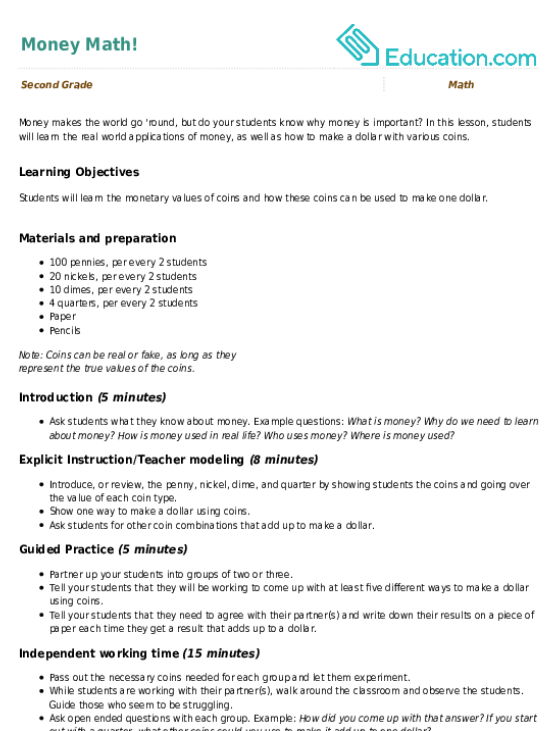
Money Math!
Lesson Plan
Money Math!
Second Grade
Time and Money
Money makes the world go 'round, but do your students know why money is important? In this lesson, students will learn the real world applications of money, as well as how to make a dollar with various coins.
Lesson Plan
Money Math!
Lesson Plan
Money Math!
Money makes the world go 'round, but do your students know why money is important? In this lesson, students will learn the real world applications of money, as well as how to make a dollar with various coins.
Second Grade
Time and Money
Lesson Plan
Synonyms: Using Shades of Meaning
Lesson Plan
Synonyms: Using Shades of Meaning
Second Grade
Why walk when you can mosey? In this lesson, students will learn how to use synonyms to express shades of meaning in their writing. Introduce the topic with a book, then brainstorm descriptive options for overused words.
Lesson Plan
Synonyms: Using Shades of Meaning
Lesson Plan
Synonyms: Using Shades of Meaning
Why walk when you can mosey? In this lesson, students will learn how to use synonyms to express shades of meaning in their writing. Introduce the topic with a book, then brainstorm descriptive options for overused words.
Second Grade
Lesson Plan
Law of the Land
Lesson Plan
Law of the Land
Second Grade
Community and Culture
In this lesson, your students will use their imaginations to picture why all communities need laws. Help them brainstorm the important role that laws and rules play in a variety of communities through these engaging activities.
Lesson Plan
Law of the Land
Lesson Plan
Law of the Land
In this lesson, your students will use their imaginations to picture why all communities need laws. Help them brainstorm the important role that laws and rules play in a variety of communities through these engaging activities.
Second Grade
Community and Culture
Lesson Plan
Distinguish Between Facts and Opinions
Lesson Plan
Distinguish Between Facts and Opinions
Third Grade
Teach your students the difference between facts and opinions, and why an author would choose to use each type of information. This can stand-alone or be used as a pre-lesson for the
Exploring Author's Purpose and Point of View
lesson.
Lesson Plan
Distinguish Between Facts and Opinions
Lesson Plan
Distinguish Between Facts and Opinions
Teach your students the difference between facts and opinions, and why an author would choose to use each type of information. This can stand-alone or be used as a pre-lesson for the
Exploring Author's Purpose and Point of View
lesson.
Third Grade
Lesson Plan
Constellation Connections
Lesson Plan
Constellation Connections
Third Grade
Earth and Space Science
Students connect dots to find stars used to navigate north and create a constellation of their own in this creative game format.
Lesson Plan
Constellation Connections
Lesson Plan
Constellation Connections
Students connect dots to find stars used to navigate north and create a constellation of their own in this creative game format.
Third Grade
Earth and Space Science
Lesson Plan
I Spy Clouds
Lesson Plan
I Spy Clouds
Third Grade
Earth and Space Science
Heads up! Students become cloud experts before making custom clouds, complete with weather predictions!
Lesson Plan
I Spy Clouds
Lesson Plan
I Spy Clouds
Heads up! Students become cloud experts before making custom clouds, complete with weather predictions!
Third Grade
Earth and Space Science
Lesson Plan
The Weather and its Clouds
Lesson Plan
The Weather and its Clouds
Third Grade
It’s raining, it’s pouring! Did you know that clouds can help you predict the weather? Use this lesson with your students to teach them about five different types of clouds and the weather to expect with each type.
Lesson Plan
The Weather and its Clouds
Lesson Plan
The Weather and its Clouds
It’s raining, it’s pouring! Did you know that clouds can help you predict the weather? Use this lesson with your students to teach them about five different types of clouds and the weather to expect with each type.
Third Grade
Lesson Plan
Fantastic Fables: 5 W's
Lesson Plan
Fantastic Fables: 5 W's
Second Grade
Writing
In this lesson, students use highlighters, graphic organizers, and a classic fable to exercise their understanding of key details and main idea in a text. They will use manipulatives to promote visual and kinetic learning styles.
Lesson Plan
Fantastic Fables: 5 W's
Lesson Plan
Fantastic Fables: 5 W's
In this lesson, students use highlighters, graphic organizers, and a classic fable to exercise their understanding of key details and main idea in a text. They will use manipulatives to promote visual and kinetic learning styles.
Second Grade
Writing
Lesson Plan
Comparing Even and Odd Groups
Lesson Plan
Comparing Even and Odd Groups
Second Grade
This lesson helps students identify even and odd numbers, which sets the foundation for learning about division, prime numbers, and even square roots. Use this hands on lesson alongside Odd One Out!
Lesson Plan
Comparing Even and Odd Groups
Lesson Plan
Comparing Even and Odd Groups
This lesson helps students identify even and odd numbers, which sets the foundation for learning about division, prime numbers, and even square roots. Use this hands on lesson alongside Odd One Out!
Second Grade
Lesson Plan
Tricky Time Telling
Lesson Plan
Tricky Time Telling
Second Grade
We all know how tricky telling time can be for our students. This terrific time lesson will have your students understanding analog clocks in no time!
Lesson Plan
Tricky Time Telling
Lesson Plan
Tricky Time Telling
We all know how tricky telling time can be for our students. This terrific time lesson will have your students understanding analog clocks in no time!
Second Grade
Lesson Plan
Got Water? How the Water Cycle Works
Lesson Plan
Got Water? How the Water Cycle Works
Third Grade
Earth and Space Science
Come on in, the water’s fun! In this activity, students see the water cycle in action with ordinary objects and learn the water the dinosaurs tasted is still around.
Lesson Plan
Got Water? How the Water Cycle Works
Lesson Plan
Got Water? How the Water Cycle Works
Come on in, the water’s fun! In this activity, students see the water cycle in action with ordinary objects and learn the water the dinosaurs tasted is still around.
Third Grade
Earth and Space Science
Lesson Plan
1
2
3
4
…
13