2nd Grade Common Core Classifying Three-Dimensional Shapes Interactive Worksheets
Common Core Quick Links:
Common Core Standards for 2nd Grade Math, Common Core Standards for 2nd Grade ELA
1 result
Math
✕Interactive Worksheets
✕2nd Grade
✕Common Core
✕1 result
2nd Grade Common Core Classifying Three-Dimensional Shapes Interactive Worksheets
Common Core Quick Links:
Common Core Standards for 2nd Grade Math, Common Core Standards for 2nd Grade ELA1 result
Math
✕Interactive Worksheets
✕2nd Grade
✕Common Core
✕1 result


About 2nd Grade Common Core Classifying Three-dimensional Shapes Interactive Worksheets
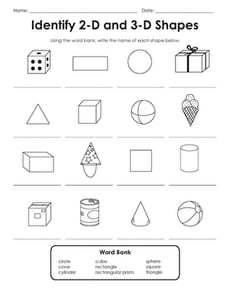
On Education.com, the 2nd Grade Common Core classifying 3D shapes page provides educators and parents with materials that help students identify and distinguish between different three-dimensional objects. Interactive worksheets include drag-and-drop, sorting, and matching games that encourage children to recognize shapes like cubes, spheres, cones, cylinders, and prisms while learning about faces, edges, and vertices. These digital resources make learning engaging and accessible, supporting students' understanding of geometric concepts aligned with the Common Core standards.
The site offers hands-on activities, printable worksheets, and interactive lessons designed to reinforce shape identification and classification. By engaging in activities such as matching shapes to objects or categorizing by features, 2nd graders develop skills in pattern recognition, spatial awareness, and mathematical reasoning. These resources provide structured yet fun approaches to exploring geometry that are suitable for classroom and home learning environments.
Educators and parents can utilize these resources to save time creating lesson plans and to provide students with consistent practice connecting geometric shapes to real-world objects. These activities not only strengthen mathematical skills but also promote critical thinking and visual discrimination. Exploring 3D shapes through these interactive tools enhances foundational geometry knowledge that supports future math and science education.
The site offers hands-on activities, printable worksheets, and interactive lessons designed to reinforce shape identification and classification. By engaging in activities such as matching shapes to objects or categorizing by features, 2nd graders develop skills in pattern recognition, spatial awareness, and mathematical reasoning. These resources provide structured yet fun approaches to exploring geometry that are suitable for classroom and home learning environments.
Educators and parents can utilize these resources to save time creating lesson plans and to provide students with consistent practice connecting geometric shapes to real-world objects. These activities not only strengthen mathematical skills but also promote critical thinking and visual discrimination. Exploring 3D shapes through these interactive tools enhances foundational geometry knowledge that supports future math and science education.