4th Grade Common Core Exponents and Roots Resources
Common Core Quick Links:
Common Core Standards for 4th Grade Math, Common Core Standards for 4th Grade ELA
1 result
Math
✕4th Grade
✕Common Core
✕1 result
Subtopics:
4th Grade Common Core Exponents and Roots Resources
Common Core Quick Links:
Common Core Standards for 4th Grade Math, Common Core Standards for 4th Grade ELA1 result
Math
✕4th Grade
✕Common Core
✕1 result

About 4th Grade Common Core Exponents And Roots Resources
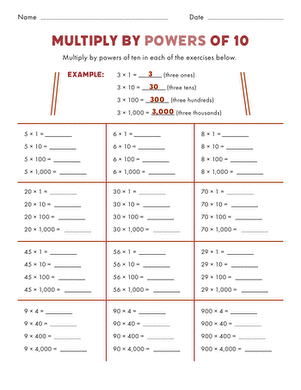
On Education.com, 4th grade students can explore exponent and root concepts through interactive lessons, worksheets, and activities that lay the foundation for understanding these advanced topics. While formal instruction on exponents and roots does not typically occur in 4th grade, students begin to build the basic arithmetic skills needed to eventually grasp these concepts. Resources include number pattern exercises, multiplication tables, and strategies for comparing exponential expressions.
This page provides teacher-created lessons and printable worksheets that introduce younger students to foundational power and root ideas. By engaging with these materials, learners practice strengthening basic math skills, recognize number patterns, and prepare to understand more complex mathematical operations. Educators and parents can use structured guides to review early arithmetic and encourage problem-solving exercises that connect to future algebra concepts.
Using these resources in a classroom or at-home learning environment saves educators and parents time by providing structured activities that support math skill development. Students gain fluency in multiplying and dividing numbers, which paves the way for later lessons involving exponents and roots. This approach promotes confidence and critical thinking, equipping learners with essential skills for ongoing math success.
This page provides teacher-created lessons and printable worksheets that introduce younger students to foundational power and root ideas. By engaging with these materials, learners practice strengthening basic math skills, recognize number patterns, and prepare to understand more complex mathematical operations. Educators and parents can use structured guides to review early arithmetic and encourage problem-solving exercises that connect to future algebra concepts.
Using these resources in a classroom or at-home learning environment saves educators and parents time by providing structured activities that support math skill development. Students gain fluency in multiplying and dividing numbers, which paves the way for later lessons involving exponents and roots. This approach promotes confidence and critical thinking, equipping learners with essential skills for ongoing math success.