SKIP TO CONTENT
Worksheet Generator
Subjects
Grades
Worksheets
Games
Build a Worksheet
More Resources
Roly Recommends
Math Month
Subjects
Grades
Worksheets
Games
Build a Worksheet
More Resources
Roly Recommends
Math Month
Filters
Search for: support, contact
✕
Lesson Plans
✕
1st - 4th Grade
✕
Subjects
Math
English Language Arts
Science
Social Studies
Grade Level
Pre-K
K
1st
2nd
3rd
4th
5th
6th
7th
8th
Early Childhood
Elementary School
Middle School
Resource Type
Worksheets
Games
Lesson Plans
Interactive Worksheets
Workbooks
Activities
Offline Games
Guided Lessons
Teacher Resources
Common Core
Yes
Roly Recommends
Social Emotional Learning
English Language Support
Yes
See More
Clear All
View 1,587 results
Showing Results for support contact
1,587 results
Search for: support, contact
✕
Lesson Plans
✕
1st - 4th Grade
✕
Clear All
Sort by:
Relevance
Most recent
Most popular
Alphabetical A-Z
Alphabetical Z-A
All filters
1,587 results
Sort by:
Relevance
Most recent
Most popular
Alphabetical A-Z
Alphabetical Z-A
EL
Reading Fluently to Support Comprehension
Lesson Plan
Reading Fluently to Support Comprehension
Second Grade
Writing
Use this lesson to teach students about the importance of reading fluently to support comprehension. Use as a stand alone activity or a support for the Increasing Reading Stamina and Comprehension lesson plan.
Lesson Plan
EL
Reading Fluently to Support Comprehension
Lesson Plan
Reading Fluently to Support Comprehension
Use this lesson to teach students about the importance of reading fluently to support comprehension. Use as a stand alone activity or a support for the Increasing Reading Stamina and Comprehension lesson plan.
Second Grade
Writing
Lesson Plan
Strong Supports
Lesson Plan
Strong Supports
Third Grade
When writing, authors need to create a strong hook and ending to draw their readers into the text. In this lesson, students will develop strong support for a movie or book that engages the reader.
Lesson Plan
Strong Supports
Lesson Plan
Strong Supports
When writing, authors need to create a strong hook and ending to draw their readers into the text. In this lesson, students will develop strong support for a movie or book that engages the reader.
Third Grade
Lesson Plan
EL
Main Idea and Supporting Evidence
Lesson Plan
Main Idea and Supporting Evidence
Fourth Grade
Use this lesson to help your ELs identify the main idea and supporting evidence in a short fictional text. It can be a stand-alone lesson or used as support for the lesson Reading Closely.
Lesson Plan
EL
Main Idea and Supporting Evidence
Lesson Plan
Main Idea and Supporting Evidence
Use this lesson to help your ELs identify the main idea and supporting evidence in a short fictional text. It can be a stand-alone lesson or used as support for the lesson Reading Closely.
Fourth Grade
Lesson Plan
Supporting Opinions with Style
Lesson Plan
Supporting Opinions with Style
Third Grade
Writing
Your students’ organization and prewriting skills will shine as they introduce their topic, state an opinion, and list three supporting reasons.
Lesson Plan
Supporting Opinions with Style
Lesson Plan
Supporting Opinions with Style
Your students’ organization and prewriting skills will shine as they introduce their topic, state an opinion, and list three supporting reasons.
Third Grade
Writing
Lesson Plan
EL
Which Number is the Greatest?
Lesson Plan
Which Number is the Greatest?
Second Grade
Place Value
Use this lesson to support students in understanding the symbols used to record numbers. This lesson can be used alongside Comparing Three-Digit Numbers or as a standalone, scaffolded EL support lesson.
Lesson Plan
EL
Which Number is the Greatest?
Lesson Plan
Which Number is the Greatest?
Use this lesson to support students in understanding the symbols used to record numbers. This lesson can be used alongside Comparing Three-Digit Numbers or as a standalone, scaffolded EL support lesson.
Second Grade
Place Value
Lesson Plan
EL
Emotion Charades
Lesson Plan
Emotion Charades
Second Grade
Vocabulary
Help your ELs practice identifying how their peers are feeling to develop emotions vocabulary and support comprehension. It can be used as a stand-alone lesson or a support lesson.
Lesson Plan
EL
Emotion Charades
Lesson Plan
Emotion Charades
Help your ELs practice identifying how their peers are feeling to develop emotions vocabulary and support comprehension. It can be used as a stand-alone lesson or a support lesson.
Second Grade
Vocabulary
Lesson Plan
EL
Using the 5 W's
Lesson Plan
Using the 5 W's
Second Grade
Reading
This lesson will provide your ELs with support as they learn about nouns and practice retelling a story with a 5 W's graphic organizer. This lesson can be used as a stand alone activity or a support lesson.
Lesson Plan
EL
Using the 5 W's
Lesson Plan
Using the 5 W's
This lesson will provide your ELs with support as they learn about nouns and practice retelling a story with a 5 W's graphic organizer. This lesson can be used as a stand alone activity or a support lesson.
Second Grade
Reading
Lesson Plan
EL
Exploring Fictional Text
Lesson Plan
Exploring Fictional Text
Second Grade
This lesson will provide your EL students with support as they explore the elements of fictional text and learn about verbs in the present participle tense. This lesson can be used as a stand alone activity or a support lesson.
Lesson Plan
EL
Exploring Fictional Text
Lesson Plan
Exploring Fictional Text
This lesson will provide your EL students with support as they explore the elements of fictional text and learn about verbs in the present participle tense. This lesson can be used as a stand alone activity or a support lesson.
Second Grade
Lesson Plan
EL
The Key Elements of Fictional Text
Lesson Plan
The Key Elements of Fictional Text
Second Grade
Vocabulary
This lesson will provide your ELs with support as they learn about the key elements of fictional text, including characters, setting, and plot. Use as a stand alone activity or a support lesson.
Lesson Plan
EL
The Key Elements of Fictional Text
Lesson Plan
The Key Elements of Fictional Text
This lesson will provide your ELs with support as they learn about the key elements of fictional text, including characters, setting, and plot. Use as a stand alone activity or a support lesson.
Second Grade
Vocabulary
Lesson Plan
Main Ideas, Please!
Lesson Plan
Main Ideas, Please!
Third Grade
Writing
Your students will be introduced to the concept of a main idea in this fun lesson using props to support their thinking.
Lesson Plan
Main Ideas, Please!
Lesson Plan
Main Ideas, Please!
Your students will be introduced to the concept of a main idea in this fun lesson using props to support their thinking.
Third Grade
Writing
Lesson Plan
EL
Adding Like Mixed Numbers
Lesson Plan
Adding Like Mixed Numbers
Fourth Grade
Solve for the sum of two mixed numbers! They will use scaffolds such as fraction models to support the visualization of mixed numbers. This can be used on its own or as support for the lesson Sums for Mixed Numbers and Improper Fractions.
Lesson Plan
EL
Adding Like Mixed Numbers
Lesson Plan
Adding Like Mixed Numbers
Solve for the sum of two mixed numbers! They will use scaffolds such as fraction models to support the visualization of mixed numbers. This can be used on its own or as support for the lesson Sums for Mixed Numbers and Improper Fractions.
Fourth Grade
Lesson Plan
Main Idea and Details in Nonfiction Text
Lesson Plan
Main Idea and Details in Nonfiction Text
Second Grade
Writing
Use this lesson to help your students learn how to find the main idea and details in a nonfiction text using a graphic organizer for support.
Lesson Plan
Main Idea and Details in Nonfiction Text
Lesson Plan
Main Idea and Details in Nonfiction Text
Use this lesson to help your students learn how to find the main idea and details in a nonfiction text using a graphic organizer for support.
Second Grade
Writing
Lesson Plan
What's Your Opinion?
Lesson Plan
What's Your Opinion?
Third Grade
Writing
Being able to express and support opinions is greatly beneficial for young learners. This lesson plan includes fun exercises to help students learn about opinions and write supporting statements for their own opinions.
Lesson Plan
What's Your Opinion?
Lesson Plan
What's Your Opinion?
Being able to express and support opinions is greatly beneficial for young learners. This lesson plan includes fun exercises to help students learn about opinions and write supporting statements for their own opinions.
Third Grade
Writing
Lesson Plan
EL
Collect, Organize, and Discuss the Data
Lesson Plan
Collect, Organize, and Discuss the Data
Third Grade
Support your students as they collect, organize, and discuss measurement data! Use this lesson independently or alongside
Making Measurements for Line Plots
.
Lesson Plan
EL
Collect, Organize, and Discuss the Data
Lesson Plan
Collect, Organize, and Discuss the Data
Support your students as they collect, organize, and discuss measurement data! Use this lesson independently or alongside
Making Measurements for Line Plots
.
Third Grade
Lesson Plan
It’s My Opinion
Lesson Plan
It’s My Opinion
First Grade
Forming and sharing opinions is a vital part of self-expression. Use the following lesson to help your students write opinions and support them with three convincing reasons.
Lesson Plan
It’s My Opinion
Lesson Plan
It’s My Opinion
Forming and sharing opinions is a vital part of self-expression. Use the following lesson to help your students write opinions and support them with three convincing reasons.
First Grade
Lesson Plan
Fairy Tales: Character Traits
Lesson Plan
Fairy Tales: Character Traits
Second Grade
Vocabulary
In this literary lesson, students use fairy tales to practice identifying character traits. Students are challenged to justify their reasoning using text based support.
Lesson Plan
Fairy Tales: Character Traits
Lesson Plan
Fairy Tales: Character Traits
In this literary lesson, students use fairy tales to practice identifying character traits. Students are challenged to justify their reasoning using text based support.
Second Grade
Vocabulary
Lesson Plan
EL
Number Relationships in Division
Lesson Plan
Number Relationships in Division
Third Grade
Help your students use multiplication to support their conceptual understanding of division. Use this lesson alone or as a pre-lesson for
Division: Solving for Unknown Factors
.
Lesson Plan
EL
Number Relationships in Division
Lesson Plan
Number Relationships in Division
Help your students use multiplication to support their conceptual understanding of division. Use this lesson alone or as a pre-lesson for
Division: Solving for Unknown Factors
.
Third Grade
Lesson Plan
How to Analyze a Character
Lesson Plan
How to Analyze a Character
First Grade
Your students become masters at character analysis as they learn how to describe fictional characters by identifying traits and providing concrete evidence to support their thinking.
Lesson Plan
How to Analyze a Character
Lesson Plan
How to Analyze a Character
Your students become masters at character analysis as they learn how to describe fictional characters by identifying traits and providing concrete evidence to support their thinking.
First Grade
Lesson Plan
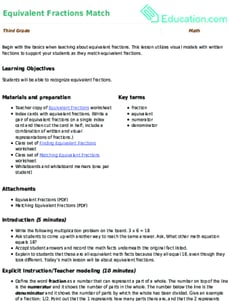
Equivalent Fractions Match
Lesson Plan
Equivalent Fractions Match
Third Grade
Begin with the basics when teaching about equivalent fractions. This lesson utilizes visual models with written fractions to support your students as they match equivalent fractions.
Lesson Plan
Equivalent Fractions Match
Lesson Plan
Equivalent Fractions Match
Begin with the basics when teaching about equivalent fractions. This lesson utilizes visual models with written fractions to support your students as they match equivalent fractions.
Third Grade
Lesson Plan
EL
Create Your Own Story
Lesson Plan
Create Your Own Story
Second Grade
Provide your ELs with extra practice using transition words to create a story. This activity can be used as a stand alone or a support lesson.
Lesson Plan
EL
Create Your Own Story
Lesson Plan
Create Your Own Story
Provide your ELs with extra practice using transition words to create a story. This activity can be used as a stand alone or a support lesson.
Second Grade
Lesson Plan
EL
Character Comparisons
Lesson Plan
Character Comparisons
Fourth Grade
Reading
Use this lesson to help your ELs compare and contrast supporting characters from excerpted texts. It can be a stand-alone lesson or support the lesson Understanding Character Traits, Understanding Plot Lesson Part III.
Lesson Plan
EL
Character Comparisons
Lesson Plan
Character Comparisons
Use this lesson to help your ELs compare and contrast supporting characters from excerpted texts. It can be a stand-alone lesson or support the lesson Understanding Character Traits, Understanding Plot Lesson Part III.
Fourth Grade
Reading
Lesson Plan
EL
The Language of Estimation
Lesson Plan
The Language of Estimation
Second Grade
Use this support lesson to provide students with the opportunity to explore what it means to estimate. This hands on activity can be used alone or alongside the lesson Estimating Length.
Lesson Plan
EL
The Language of Estimation
Lesson Plan
The Language of Estimation
Use this support lesson to provide students with the opportunity to explore what it means to estimate. This hands on activity can be used alone or alongside the lesson Estimating Length.
Second Grade
Lesson Plan
Reflections on Positive Relationships
Lesson Plan
Reflections on Positive Relationships
Fourth Grade
Reflecting on growth can support deeper learning and understanding of ourselves. In this lesson, students will reflect on ways they have grown in practicing mindfulness and living in a community through writing and planting a tree together.
Lesson Plan
Reflections on Positive Relationships
Lesson Plan
Reflections on Positive Relationships
Reflecting on growth can support deeper learning and understanding of ourselves. In this lesson, students will reflect on ways they have grown in practicing mindfulness and living in a community through writing and planting a tree together.
Fourth Grade
Lesson Plan
Understanding Academic Vocabulary in a Nonfiction Text
Lesson Plan
Understanding Academic Vocabulary in a Nonfiction Text
Second Grade
Grammar and Mechanics
This lesson will provide students with an opportunity to become more comfortable with identifying and defining academic vocabulary words in a nonfiction text about a chicken's life cycle to support comprehension.
Lesson Plan
Understanding Academic Vocabulary in a Nonfiction Text
Lesson Plan
Understanding Academic Vocabulary in a Nonfiction Text
This lesson will provide students with an opportunity to become more comfortable with identifying and defining academic vocabulary words in a nonfiction text about a chicken's life cycle to support comprehension.
Second Grade
Grammar and Mechanics
Lesson Plan
EL
Main Idea and Details in Nonfiction
Lesson Plan
Main Idea and Details in Nonfiction
Fourth Grade
Reading
In this lesson, students will identify nouns and pronouns as they distinguish between the main idea and supporting details. It may be taught on its own or used as support for the lesson Compare and Contrast Texts on the Same Topic.
Lesson Plan
EL
Main Idea and Details in Nonfiction
Lesson Plan
Main Idea and Details in Nonfiction
In this lesson, students will identify nouns and pronouns as they distinguish between the main idea and supporting details. It may be taught on its own or used as support for the lesson Compare and Contrast Texts on the Same Topic.
Fourth Grade
Reading
Lesson Plan
EL
Putting it Together to Find the Main Idea
Lesson Plan
Putting it Together to Find the Main Idea
First Grade
Reading
Get students curious about reading with these activities designed to support comprehension. This lesson plan can be used alone or with the Main Ideas and Details lesson plan.
Lesson Plan
EL
Putting it Together to Find the Main Idea
Lesson Plan
Putting it Together to Find the Main Idea
Get students curious about reading with these activities designed to support comprehension. This lesson plan can be used alone or with the Main Ideas and Details lesson plan.
First Grade
Reading
Lesson Plan
EL
Skip Counting with Visuals
Lesson Plan
Skip Counting with Visuals
Third Grade
Give your students visuals to support their understanding of skip counting. Use this lesson on its own or as a pre-lesson for
Roll the Dice: Skip Counting by Fives
.
Lesson Plan
EL
Skip Counting with Visuals
Lesson Plan
Skip Counting with Visuals
Give your students visuals to support their understanding of skip counting. Use this lesson on its own or as a pre-lesson for
Roll the Dice: Skip Counting by Fives
.
Third Grade
Lesson Plan
EL
Multiples of 10
Lesson Plan
Multiples of 10
Second Grade
Vocabulary
Help students gain confidence in recognizing multiples of 10 as they critique a flawed response. Use as a stand-alone scaffolded EL support lesson or prior to teaching Big Spenders.
Lesson Plan
EL
Multiples of 10
Lesson Plan
Multiples of 10
Help students gain confidence in recognizing multiples of 10 as they critique a flawed response. Use as a stand-alone scaffolded EL support lesson or prior to teaching Big Spenders.
Second Grade
Vocabulary
Lesson Plan
EL
Nonfiction Text Features
Lesson Plan
Nonfiction Text Features
Second Grade
Students will be able to use and identify nonfiction text features. It can be a stand-alone lesson or a support lesson to the How Many Features? lesson plan.
Lesson Plan
EL
Nonfiction Text Features
Lesson Plan
Nonfiction Text Features
Students will be able to use and identify nonfiction text features. It can be a stand-alone lesson or a support lesson to the How Many Features? lesson plan.
Second Grade
Lesson Plan
EL
Rounding Roundtable
Lesson Plan
Rounding Roundtable
Fourth Grade
Challenge students to talk about rounded numbers to the millions place value. Use this lesson as a standalone lesson or as support to the lesson Numbers All A-Round.
Lesson Plan
EL
Rounding Roundtable
Lesson Plan
Rounding Roundtable
Challenge students to talk about rounded numbers to the millions place value. Use this lesson as a standalone lesson or as support to the lesson Numbers All A-Round.
Fourth Grade
Lesson Plan
1
2
3
4
…
53