SKIP TO CONTENT
Worksheet Generator
Subjects
Grades
Worksheets
Games
Build a Worksheet
More Resources
Roly Recommends
Subjects
Grades
Worksheets
Games
Build a Worksheet
More Resources
Roly Recommends
Filters
Search for: how, when
✕
Lesson Plans
✕
1st - 4th Grade
✕
Subjects
Math
English Language Arts
Science
Social Studies
Grade Level
Pre-K
K
1st
2nd
3rd
4th
5th
6th
7th
8th
Early Childhood
Elementary School
Middle School
Resource Type
Worksheets
Games
Lesson Plans
Interactive Worksheets
Workbooks
Activities
Exercises
Stories
Songs
Offline Games
Guided Lessons
Teacher Resources
Common Core
Yes
Roly Recommends
Social Emotional Learning
English Language Support
Yes
See More
Clear All
View 1,576 results
Showing Results for how when : Page 9
1,576 results
Search for: how, when
✕
Lesson Plans
✕
1st - 4th Grade
✕
Clear All
Sort by:
Relevance
Most recent
Most popular
Alphabetical A-Z
Alphabetical Z-A
All filters
1,576 results
Sort by:
Relevance
Most recent
Most popular
Alphabetical A-Z
Alphabetical Z-A
Identify and Develop an Opinion
Lesson Plan
Identify and Develop an Opinion
Third Grade
Grammar and Mechanics
Use this lesson to teach your students how to express opinions about nonfiction topics. This lesson can stand alone or be used as a pre-lesson for the
What Does the Author Think?
lesson.
Lesson Plan
Identify and Develop an Opinion
Lesson Plan
Identify and Develop an Opinion
Use this lesson to teach your students how to express opinions about nonfiction topics. This lesson can stand alone or be used as a pre-lesson for the
What Does the Author Think?
lesson.
Third Grade
Grammar and Mechanics
Lesson Plan
Opinion Writing: Brainstorming to Establish Credibility
Lesson Plan
Opinion Writing: Brainstorming to Establish Credibility
Third Grade
Opinion writers need to establish credibility so that their audience will value their opinion. In this lesson, your students learn how to establish themselves as authorities on their chosen writing topics.
Lesson Plan
Opinion Writing: Brainstorming to Establish Credibility
Lesson Plan
Opinion Writing: Brainstorming to Establish Credibility
Opinion writers need to establish credibility so that their audience will value their opinion. In this lesson, your students learn how to establish themselves as authorities on their chosen writing topics.
Third Grade
Lesson Plan
Simple Machines: Wheel and Axle
Lesson Plan
Simple Machines: Wheel and Axle
Second Grade
Physical Science
What do a bicycle and a car have in common? They both move using the simple machine wheel and axle. In this lesson, students learn about how this simple machine works, and will identify objects that use a wheel and axle.
Lesson Plan
Simple Machines: Wheel and Axle
Lesson Plan
Simple Machines: Wheel and Axle
What do a bicycle and a car have in common? They both move using the simple machine wheel and axle. In this lesson, students learn about how this simple machine works, and will identify objects that use a wheel and axle.
Second Grade
Physical Science
Lesson Plan
Nonfiction Text Features
Lesson Plan
Nonfiction Text Features
Second Grade
Students will be able to use and identify nonfiction text features. It can be a stand-alone lesson or a support lesson to the How Many Features? lesson plan.
Lesson Plan
Nonfiction Text Features
Lesson Plan
Nonfiction Text Features
Students will be able to use and identify nonfiction text features. It can be a stand-alone lesson or a support lesson to the How Many Features? lesson plan.
Second Grade
Lesson Plan
Place Value Tower
Lesson Plan
Place Value Tower
Second Grade
Place Value
Students will learn how to find the actual value of three-digit numbers with this activity that has them use manipulatives to create the expanded form of a number.
Lesson Plan
Place Value Tower
Lesson Plan
Place Value Tower
Students will learn how to find the actual value of three-digit numbers with this activity that has them use manipulatives to create the expanded form of a number.
Second Grade
Place Value
Lesson Plan
Read with Expression!
Lesson Plan
Read with Expression!
Fourth Grade
Knowing how to identify types of sentences and read each kind with expression is an important component of reading fluency. This EL support lesson can be taught on its own or used as precursor to the lesson Fourth Grade Fluency Fun!
Lesson Plan
Read with Expression!
Lesson Plan
Read with Expression!
Knowing how to identify types of sentences and read each kind with expression is an important component of reading fluency. This EL support lesson can be taught on its own or used as precursor to the lesson Fourth Grade Fluency Fun!
Fourth Grade
Lesson Plan
Read with Expression!
Lesson Plan
Read with Expression!
Fourth Grade
Knowing how to identify types of sentences and read each kind with expression is an important component of reading fluency. This English Learner support lesson can be taught on its own or used as precursor to Fourth Grade Fluency Fun!
Lesson Plan
Read with Expression!
Lesson Plan
Read with Expression!
Knowing how to identify types of sentences and read each kind with expression is an important component of reading fluency. This English Learner support lesson can be taught on its own or used as precursor to Fourth Grade Fluency Fun!
Fourth Grade
Lesson Plan
Double It!: A Lesson on Suffixes and Changing Verb Tense
Lesson Plan
Double It!: A Lesson on Suffixes and Changing Verb Tense
Third Grade
This lesson won’t be double trouble! Your students will learn how to correctly double consonants to form past tense verbs. Students will be able to read and write verbs that do and don’t have double consonants.
Lesson Plan
Double It!: A Lesson on Suffixes and Changing Verb Tense
Lesson Plan
Double It!: A Lesson on Suffixes and Changing Verb Tense
This lesson won’t be double trouble! Your students will learn how to correctly double consonants to form past tense verbs. Students will be able to read and write verbs that do and don’t have double consonants.
Third Grade
Lesson Plan
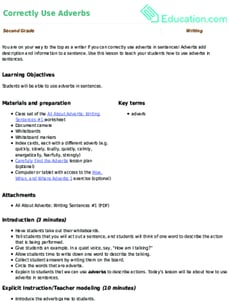
Correctly Use Adverbs
Lesson Plan
Correctly Use Adverbs
Second Grade
You are on your way to the top as a writer if you can correctly use adverbs in sentences! Adverbs add description and information to a sentence. Use this lesson to teach your students how to use adverbs in sentences.
Lesson Plan
Correctly Use Adverbs
Lesson Plan
Correctly Use Adverbs
You are on your way to the top as a writer if you can correctly use adverbs in sentences! Adverbs add description and information to a sentence. Use this lesson to teach your students how to use adverbs in sentences.
Second Grade
Lesson Plan
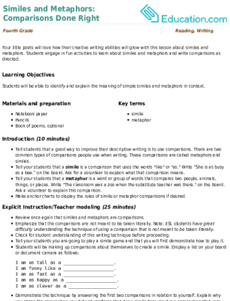
Similes and Metaphors: Comparisons Done Right
Lesson Plan
Similes and Metaphors: Comparisons Done Right
Fourth Grade
Reading
Your little poets will love how their creative writing abilities will grow with this lesson about similes and metaphors. Students engage in fun activities to learn about similes and metaphors and write comparisons as directed.
Lesson Plan
Similes and Metaphors: Comparisons Done Right
Lesson Plan
Similes and Metaphors: Comparisons Done Right
Your little poets will love how their creative writing abilities will grow with this lesson about similes and metaphors. Students engage in fun activities to learn about similes and metaphors and write comparisons as directed.
Fourth Grade
Reading
Lesson Plan
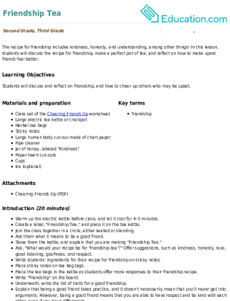
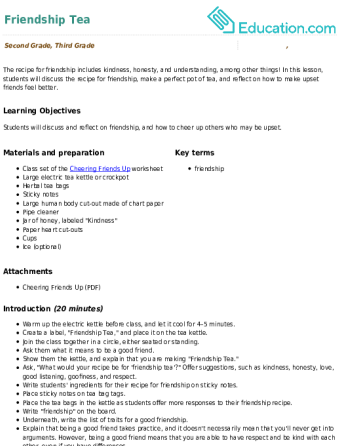
Friendship Tea
Lesson Plan
Friendship Tea
Second Grade
The recipe for friendship includes kindness, honesty, and understanding, among other things! In this lesson, students will discuss the recipe for friendship, make a perfect pot of tea, and reflect on how to make upset friends feel better.
Lesson Plan
Friendship Tea
Lesson Plan
Friendship Tea
The recipe for friendship includes kindness, honesty, and understanding, among other things! In this lesson, students will discuss the recipe for friendship, make a perfect pot of tea, and reflect on how to make upset friends feel better.
Second Grade
Lesson Plan
Do You Want More Coins or More Money?
Lesson Plan
Do You Want More Coins or More Money?
Second Grade
Time and Money
In this lesson, you will teach your students how to count money to buy small items! Show students which coins they can use to buy their lunch and other small items in the classroom.
Lesson Plan
Do You Want More Coins or More Money?
Lesson Plan
Do You Want More Coins or More Money?
In this lesson, you will teach your students how to count money to buy small items! Show students which coins they can use to buy their lunch and other small items in the classroom.
Second Grade
Time and Money
Lesson Plan
Reflecting on Multiplication and Division Word Problems
Lesson Plan
Reflecting on Multiplication and Division Word Problems
Third Grade
Teach your students how to reflect upon the information in multiplication and division word problems before solving them. Use this lesson on its own or as a pre-lesson to
Stepping Through Multiplication and Division Word Problems
.
Lesson Plan
Reflecting on Multiplication and Division Word Problems
Lesson Plan
Reflecting on Multiplication and Division Word Problems
Teach your students how to reflect upon the information in multiplication and division word problems before solving them. Use this lesson on its own or as a pre-lesson to
Stepping Through Multiplication and Division Word Problems
.
Third Grade
Lesson Plan
Town Signage
Lesson Plan
Town Signage
Third Grade
In this lesson, students will learn about the history of their town while improving their writing and research skills. No matter how big or small the town, there’s always something fun to uncover in this assignment!
Lesson Plan
Town Signage
Lesson Plan
Town Signage
In this lesson, students will learn about the history of their town while improving their writing and research skills. No matter how big or small the town, there’s always something fun to uncover in this assignment!
Third Grade
Lesson Plan
Sweet Addition
Lesson Plan
Sweet Addition
First Grade
Yum, yum, yum! In this sweet lesson, students will explore concepts of addition, including how to begin with a number and count on to find a sum.
Lesson Plan
Sweet Addition
Lesson Plan
Sweet Addition
Yum, yum, yum! In this sweet lesson, students will explore concepts of addition, including how to begin with a number and count on to find a sum.
First Grade
Lesson Plan
Text Features and Their Purposes
Lesson Plan
Text Features and Their Purposes
Fourth Grade
This lesson helps your ELs identify nonfiction text features and explain how they enhance comprehension of the text. Use it as a stand-alone lesson or a support lesson for the Searching for Text Features lesson plan.
Lesson Plan
Text Features and Their Purposes
Lesson Plan
Text Features and Their Purposes
This lesson helps your ELs identify nonfiction text features and explain how they enhance comprehension of the text. Use it as a stand-alone lesson or a support lesson for the Searching for Text Features lesson plan.
Fourth Grade
Lesson Plan
Solving Elapsed Time Word Problems
Lesson Plan
Solving Elapsed Time Word Problems
Third Grade
Get your students thinking about how the number line and the word problem are related! Use this lesson alongside
Get There On Time: Elapsed Time Word Problems
or on its own.
Lesson Plan
Solving Elapsed Time Word Problems
Lesson Plan
Solving Elapsed Time Word Problems
Get your students thinking about how the number line and the word problem are related! Use this lesson alongside
Get There On Time: Elapsed Time Word Problems
or on its own.
Third Grade
Lesson Plan
Explanations for Expressions
Lesson Plan
Explanations for Expressions
Fourth Grade
Do your students need instruction in how to find and determine the meaning of figurative language? In this lesson, students will explore the exaggerations found in hyperbole and elements of idioms.
Lesson Plan
Explanations for Expressions
Lesson Plan
Explanations for Expressions
Do your students need instruction in how to find and determine the meaning of figurative language? In this lesson, students will explore the exaggerations found in hyperbole and elements of idioms.
Fourth Grade
Lesson Plan
Sentences: Complete or Fragment?
Lesson Plan
Sentences: Complete or Fragment?
Fourth Grade
Grammar and Mechanics
A deeper understanding of what constitutes a complete sentence will help your young writers understand how to create technically correct and more complex sentences. This practice will help students edit and revise their writing.
Lesson Plan
Sentences: Complete or Fragment?
Lesson Plan
Sentences: Complete or Fragment?
A deeper understanding of what constitutes a complete sentence will help your young writers understand how to create technically correct and more complex sentences. This practice will help students edit and revise their writing.
Fourth Grade
Grammar and Mechanics
Lesson Plan
Readers Record Their Thinking
Lesson Plan
Readers Record Their Thinking
First Grade
It is important for students to stop and think as they read. This activity/lesson is a fun and quick way to see how students are thinking as they read.
Lesson Plan
Readers Record Their Thinking
Lesson Plan
Readers Record Their Thinking
It is important for students to stop and think as they read. This activity/lesson is a fun and quick way to see how students are thinking as they read.
First Grade
Lesson Plan
Rein in the Run-Ons
Lesson Plan
Rein in the Run-Ons
Fourth Grade
Grammar and Mechanics
Are your students having trouble taming run-on sentences into a more manageable length? In this lesson, your students will learn to not only recognize a run-on sentence, but also how to stop it in its tracks.
Lesson Plan
Rein in the Run-Ons
Lesson Plan
Rein in the Run-Ons
Are your students having trouble taming run-on sentences into a more manageable length? In this lesson, your students will learn to not only recognize a run-on sentence, but also how to stop it in its tracks.
Fourth Grade
Grammar and Mechanics
Lesson Plan
Regrouping with Popsicle Sticks: Double-Digit Subtraction
Lesson Plan
Regrouping with Popsicle Sticks: Double-Digit Subtraction
Third Grade
Can you break a ten? An everyday exchange of money can help students think about regrouping to subtract. Students will use bundled popsicle sticks to see how values grouped into tens can be regrouped into ones to allow us to subtract.
Lesson Plan
Regrouping with Popsicle Sticks: Double-Digit Subtraction
Lesson Plan
Regrouping with Popsicle Sticks: Double-Digit Subtraction
Can you break a ten? An everyday exchange of money can help students think about regrouping to subtract. Students will use bundled popsicle sticks to see how values grouped into tens can be regrouped into ones to allow us to subtract.
Third Grade
Lesson Plan
Read about and Discuss Historic Heroes
Lesson Plan
Read about and Discuss Historic Heroes
Fourth Grade
Reading
In this lesson plan, students will discuss characteristics of a hero and how to get information from texts to understand why a person is considered a hero. Partner discussions will help students have a deeper understanding.
Lesson Plan
Read about and Discuss Historic Heroes
Lesson Plan
Read about and Discuss Historic Heroes
In this lesson plan, students will discuss characteristics of a hero and how to get information from texts to understand why a person is considered a hero. Partner discussions will help students have a deeper understanding.
Fourth Grade
Reading
Lesson Plan
Story Structure Rollercoaster
Lesson Plan
Story Structure Rollercoaster
Third Grade
Reading
Reading can be a rollercoaster with its ups and downs! Use this lesson that features a rollercoaster-themed story map to teach your students about story structure and how to use a graphic organizer to visualize it.
Lesson Plan
Story Structure Rollercoaster
Lesson Plan
Story Structure Rollercoaster
Reading can be a rollercoaster with its ups and downs! Use this lesson that features a rollercoaster-themed story map to teach your students about story structure and how to use a graphic organizer to visualize it.
Third Grade
Reading
Lesson Plan
Show Me the Money: Understanding Value
Lesson Plan
Show Me the Money: Understanding Value
Second Grade
Time and Money
In this lesson, your students will learn how to buy items and use money to purchase items in the real world. You will set up a store for the students to learn about money.
Lesson Plan
Show Me the Money: Understanding Value
Lesson Plan
Show Me the Money: Understanding Value
In this lesson, your students will learn how to buy items and use money to purchase items in the real world. You will set up a store for the students to learn about money.
Second Grade
Time and Money
Lesson Plan
Easter Word Problems
Lesson Plan
Easter Word Problems
First Grade
It’s time to start adding and subtracting with word problems! In this Easter-themed lesson, students will get to practice their reading and math skills as they figure out how to write equations and solve addition and subtraction word problems.
Lesson Plan
Easter Word Problems
Lesson Plan
Easter Word Problems
It’s time to start adding and subtracting with word problems! In this Easter-themed lesson, students will get to practice their reading and math skills as they figure out how to write equations and solve addition and subtraction word problems.
First Grade
Lesson Plan
Interesting Introductions
Lesson Plan
Interesting Introductions
Third Grade
Reading
Teach young authors how to "hook" readers with this hands-on lesson. By examining novels and developing their own introductions, students will be able to hone their writing skills.
Lesson Plan
Interesting Introductions
Lesson Plan
Interesting Introductions
Teach young authors how to "hook" readers with this hands-on lesson. By examining novels and developing their own introductions, students will be able to hone their writing skills.
Third Grade
Reading
Lesson Plan
Caring for the Earth and Our Global Community
Lesson Plan
Caring for the Earth and Our Global Community
Fourth Grade
Caring for the Earth is an important part of responsible decision-making and global citizenship. Through this lesson, students will strengthen their social and emotional learning skills by exploring how they can be a steward for the Earth.
Lesson Plan
Caring for the Earth and Our Global Community
Lesson Plan
Caring for the Earth and Our Global Community
Caring for the Earth is an important part of responsible decision-making and global citizenship. Through this lesson, students will strengthen their social and emotional learning skills by exploring how they can be a steward for the Earth.
Fourth Grade
Lesson Plan
Charts and Graphs and Diagrams, Oh My!
Lesson Plan
Charts and Graphs and Diagrams, Oh My!
Fourth Grade
Reading
Students will learn about three nonfiction text features: charts, graphs, and diagrams. They will analyze and interpret the information represented in these visual forms and discover how they aid in the comprehension of nonfiction texts.
Lesson Plan
Charts and Graphs and Diagrams, Oh My!
Lesson Plan
Charts and Graphs and Diagrams, Oh My!
Students will learn about three nonfiction text features: charts, graphs, and diagrams. They will analyze and interpret the information represented in these visual forms and discover how they aid in the comprehension of nonfiction texts.
Fourth Grade
Reading
Lesson Plan
Parts of Speech: Interjections
Lesson Plan
Parts of Speech: Interjections
Fourth Grade
Grammar and Mechanics
Interjections, one of the eight parts of speech, can be the most exciting. They help students interject some fun and drama into their writing and conversations. In this lesson, they'll brainstorm how to use interjections in their sentences.
Lesson Plan
Parts of Speech: Interjections
Lesson Plan
Parts of Speech: Interjections
Interjections, one of the eight parts of speech, can be the most exciting. They help students interject some fun and drama into their writing and conversations. In this lesson, they'll brainstorm how to use interjections in their sentences.
Fourth Grade
Grammar and Mechanics
Lesson Plan
1
…
8
9
10
…
53