SKIP TO CONTENT
Worksheet Generator
Subjects
Grades
Worksheets
Games
Build a Worksheet
More Resources
Roly Recommends
Math Month
Subjects
Grades
Worksheets
Games
Build a Worksheet
More Resources
Roly Recommends
Math Month
Filters
Search for: exploring, data, sorting, comparing
✕
Lesson Plans
✕
1st - 4th Grade
✕
Subjects
Math
English Language Arts
Science
Social Studies
Grade Level
Pre-K
K
1st
2nd
3rd
4th
5th
6th
7th
8th
Early Childhood
Elementary School
Middle School
Resource Type
Worksheets
Games
Lesson Plans
Interactive Worksheets
Workbooks
Activities
Exercises
Stories
Songs
Offline Games
Guided Lessons
Teacher Resources
Common Core
Yes
Roly Recommends
Social Emotional Learning
English Language Support
Yes
See More
Clear All
View 274 results
Showing Results for exploring data sorting comparing : Page 6
274 results
Search for: exploring, data, sorting, comparing
✕
Lesson Plans
✕
1st - 4th Grade
✕
Clear All
Sort by:
Relevance
Most recent
Most popular
Alphabetical A-Z
Alphabetical Z-A
All filters
274 results
Sort by:
Relevance
Most recent
Most popular
Alphabetical A-Z
Alphabetical Z-A
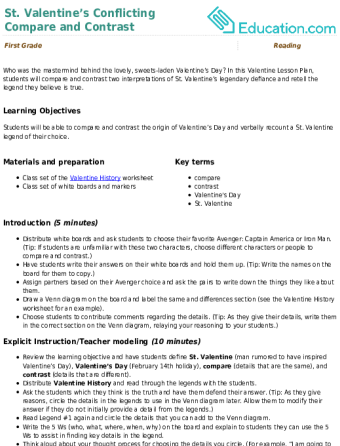
St. Valentine’s Conflicting Compare and Contrast
Lesson Plan
St. Valentine’s Conflicting Compare and Contrast
First Grade
Who was the mastermind behind the lovely, sweets-laden Valentine’s Day? In this Valentine Lesson Plan, students will compare and contrast two interpretations of St. Valentine’s legendary defiance and retell the legend they believe is true.
Lesson Plan
St. Valentine’s Conflicting Compare and Contrast
Lesson Plan
St. Valentine’s Conflicting Compare and Contrast
Who was the mastermind behind the lovely, sweets-laden Valentine’s Day? In this Valentine Lesson Plan, students will compare and contrast two interpretations of St. Valentine’s legendary defiance and retell the legend they believe is true.
First Grade
Lesson Plan
Scavenger Hunt: I Can See a...
Lesson Plan
Scavenger Hunt: I Can See a...
Kindergarten
This lesson, which features The Eye Book by Theo Lesieg, will keep young learners engaged with scavenger hunt activities that test their observational skills.
Lesson Plan
Scavenger Hunt: I Can See a...
Lesson Plan
Scavenger Hunt: I Can See a...
This lesson, which features The Eye Book by Theo Lesieg, will keep young learners engaged with scavenger hunt activities that test their observational skills.
Kindergarten
Lesson Plan
Compare and Contrast Texts on the Same Topic
Lesson Plan
Compare and Contrast Texts on the Same Topic
Fourth Grade
Vocabulary
Did you know that comparative tasks improve comprehension and help students develop higher order thinking skills? In this lesson, students will compare nonfiction texts on the same topic using Venn diagrams and performance!
Lesson Plan
Compare and Contrast Texts on the Same Topic
Lesson Plan
Compare and Contrast Texts on the Same Topic
Did you know that comparative tasks improve comprehension and help students develop higher order thinking skills? In this lesson, students will compare nonfiction texts on the same topic using Venn diagrams and performance!
Fourth Grade
Vocabulary
Lesson Plan
Springtime Interview
Lesson Plan
Springtime Interview
First Grade
It's springtime! What better way to celebrate than by interviewing your classmate with a range of spring-related questions? Students will practice interviewing one another and recording answers using complete sentences.
Lesson Plan
Springtime Interview
Lesson Plan
Springtime Interview
It's springtime! What better way to celebrate than by interviewing your classmate with a range of spring-related questions? Students will practice interviewing one another and recording answers using complete sentences.
First Grade
Lesson Plan
What's the Value?
Lesson Plan
What's the Value?
Second Grade
This lesson provides students with practice as they find the missing parts of a whole and justify their reasoning. Use alongside the What's That Number lesson or alone as a support lesson for students.
Lesson Plan
What's the Value?
Lesson Plan
What's the Value?
This lesson provides students with practice as they find the missing parts of a whole and justify their reasoning. Use alongside the What's That Number lesson or alone as a support lesson for students.
Second Grade
Lesson Plan
Fact vs. Opinion Sort
Lesson Plan
Fact vs. Opinion Sort
Second Grade
In this lesson, students develop an understand of the difference between facts and opinions. After analyzing different statements, students write their own sentences to sort and analyze.
Lesson Plan
Fact vs. Opinion Sort
Lesson Plan
Fact vs. Opinion Sort
In this lesson, students develop an understand of the difference between facts and opinions. After analyzing different statements, students write their own sentences to sort and analyze.
Second Grade
Lesson Plan
Commuting and Computing
Lesson Plan
Commuting and Computing
First Grade
Discovery is exciting! In this hands-on lesson, your students will discover for themselves the rule behind the commutative property of addition.
Lesson Plan
Commuting and Computing
Lesson Plan
Commuting and Computing
Discovery is exciting! In this hands-on lesson, your students will discover for themselves the rule behind the commutative property of addition.
First Grade
Lesson Plan
Making Sense of Realism and Fantasy
Lesson Plan
Making Sense of Realism and Fantasy
Third Grade
Vocabulary
Is it real or is it fantasy? This lesson introduces students to the literary concepts of realism and fantasy. Readers will practice this skill by using details in texts to distinguish the two genre elements.
Lesson Plan
Making Sense of Realism and Fantasy
Lesson Plan
Making Sense of Realism and Fantasy
Is it real or is it fantasy? This lesson introduces students to the literary concepts of realism and fantasy. Readers will practice this skill by using details in texts to distinguish the two genre elements.
Third Grade
Vocabulary
Lesson Plan
Mad Scientist: Electric Circuits
Lesson Plan
Mad Scientist: Electric Circuits
Fourth Grade
Physical Science
Mad scientists! In this lesson, your students will explore electrical circuits and engage in a hands-on activity to create them. They will identify the differences between parallel and series circuits.
Lesson Plan
Mad Scientist: Electric Circuits
Lesson Plan
Mad Scientist: Electric Circuits
Mad scientists! In this lesson, your students will explore electrical circuits and engage in a hands-on activity to create them. They will identify the differences between parallel and series circuits.
Fourth Grade
Physical Science
Lesson Plan
Alphabet Names
Lesson Plan
Alphabet Names
First Grade
Alphabet
Students will love using their own names as they learn about alphabetical order in this fun lesson!
Lesson Plan
Alphabet Names
Lesson Plan
Alphabet Names
Students will love using their own names as they learn about alphabetical order in this fun lesson!
First Grade
Alphabet
Lesson Plan
Alphabetical Order
Lesson Plan
Alphabetical Order
Second Grade
Alphabet
Students will practice real world organizing as they learn how to alphabetize the classroom library.
Lesson Plan
Alphabetical Order
Lesson Plan
Alphabetical Order
Students will practice real world organizing as they learn how to alphabetize the classroom library.
Second Grade
Alphabet
Lesson Plan
Finding Area: What Information Do I Need?
Lesson Plan
Finding Area: What Information Do I Need?
Third Grade
You need the length and the width to find the area of a rectangle or square, but what if one piece of information is missing? Use this lesson alongside
What's My Area?
or on its own.
Lesson Plan
Finding Area: What Information Do I Need?
Lesson Plan
Finding Area: What Information Do I Need?
You need the length and the width to find the area of a rectangle or square, but what if one piece of information is missing? Use this lesson alongside
What's My Area?
or on its own.
Third Grade
Lesson Plan
Flipped Coin
Lesson Plan
Flipped Coin
Fourth Grade
In this lesson, students will listen to, discuss, and understand two perspectives on a difficult situation. They will flip a coin, with each side representing one side of the story, and role-play the perspectives and reach a resolution.
Lesson Plan
Flipped Coin
Lesson Plan
Flipped Coin
In this lesson, students will listen to, discuss, and understand two perspectives on a difficult situation. They will flip a coin, with each side representing one side of the story, and role-play the perspectives and reach a resolution.
Fourth Grade
Lesson Plan
What's the Big Idea? Summarizing Nonfiction Texts
Lesson Plan
What's the Big Idea? Summarizing Nonfiction Texts
Fourth Grade
Writing
Understanding the big idea of a nonfiction text and being able to write a succinct summary are key fourth grade skills. This lesson focuses on summarizing a nonfiction passage in 3-4 sentences.
Lesson Plan
What's the Big Idea? Summarizing Nonfiction Texts
Lesson Plan
What's the Big Idea? Summarizing Nonfiction Texts
Understanding the big idea of a nonfiction text and being able to write a succinct summary are key fourth grade skills. This lesson focuses on summarizing a nonfiction passage in 3-4 sentences.
Fourth Grade
Writing
Lesson Plan
A.M. or P.M.?
Lesson Plan
A.M. or P.M.?
First Grade
Help your students learn the difference between a.m. and p.m. while getting them comfortable with the idea of telling time with this lesson that has them identify whether they would do a given activity in the morning or evening.
Lesson Plan
A.M. or P.M.?
Lesson Plan
A.M. or P.M.?
Help your students learn the difference between a.m. and p.m. while getting them comfortable with the idea of telling time with this lesson that has them identify whether they would do a given activity in the morning or evening.
First Grade
Lesson Plan
Meter Stick Mambo
Lesson Plan
Meter Stick Mambo
Second Grade
Get ready to shake things up with this fun measurement lesson! Students start by seeing if they can fit under a meter stick and then turn their attention to creating towers to fit under the meter stick.
Lesson Plan
Meter Stick Mambo
Lesson Plan
Meter Stick Mambo
Get ready to shake things up with this fun measurement lesson! Students start by seeing if they can fit under a meter stick and then turn their attention to creating towers to fit under the meter stick.
Second Grade
Lesson Plan
Fraction Action: Rectangles
Lesson Plan
Fraction Action: Rectangles
Third Grade
Let's divide! In this hands-on lesson, your students will get in on some fraction action when they pair up to create and compare fraction models with the same denominator.
Lesson Plan
Fraction Action: Rectangles
Lesson Plan
Fraction Action: Rectangles
Let's divide! In this hands-on lesson, your students will get in on some fraction action when they pair up to create and compare fraction models with the same denominator.
Third Grade
Lesson Plan
Are You a Producer or a Consumer?
Lesson Plan
Are You a Producer or a Consumer?
Second Grade
Economics
In this lesson, your students will learn about their roles as consumers and producers in a community through engaging activities and discussion.
Lesson Plan
Are You a Producer or a Consumer?
Lesson Plan
Are You a Producer or a Consumer?
In this lesson, your students will learn about their roles as consumers and producers in a community through engaging activities and discussion.
Second Grade
Economics
Lesson Plan
Character Comparisons
Lesson Plan
Character Comparisons
Fourth Grade
Reading
Use this lesson to help your ELs compare and contrast supporting characters from excerpted texts. It can be a stand-alone lesson or support the lesson Understanding Character Traits, Understanding Plot Lesson Part III.
Lesson Plan
Character Comparisons
Lesson Plan
Character Comparisons
Use this lesson to help your ELs compare and contrast supporting characters from excerpted texts. It can be a stand-alone lesson or support the lesson Understanding Character Traits, Understanding Plot Lesson Part III.
Fourth Grade
Reading
Lesson Plan
Main Topic
Lesson Plan
Main Topic
First Grade
It's time to dig into some nonfiction books! In this lesson, students will practice identifying the main topic of nonfiction texts. This lesson can be used alone or with the How to Find the Main Idea lesson plan.
Lesson Plan
Main Topic
Lesson Plan
Main Topic
It's time to dig into some nonfiction books! In this lesson, students will practice identifying the main topic of nonfiction texts. This lesson can be used alone or with the How to Find the Main Idea lesson plan.
First Grade
Lesson Plan
Elements of Poetry
Lesson Plan
Elements of Poetry
Fourth Grade
Reading
Introduce your students to some of the major structural elements of poetry in this comprehensive lesson.
Lesson Plan
Elements of Poetry
Lesson Plan
Elements of Poetry
Introduce your students to some of the major structural elements of poetry in this comprehensive lesson.
Fourth Grade
Reading
Lesson Plan
Folding for Angles
Lesson Plan
Folding for Angles
Third Grade
Students will create angles by folding construction paper, creating angle addition sentences, and then adding the sum of angles on their models.
Lesson Plan
Folding for Angles
Lesson Plan
Folding for Angles
Students will create angles by folding construction paper, creating angle addition sentences, and then adding the sum of angles on their models.
Third Grade
Lesson Plan
The Sound of Silence
Lesson Plan
The Sound of Silence
Fourth Grade
Students will read a story and listen to a song to explore the sound of silence, its meaning, and significance. They will share their experience and reflect on how and why silence or space can be important.
Lesson Plan
The Sound of Silence
Lesson Plan
The Sound of Silence
Students will read a story and listen to a song to explore the sound of silence, its meaning, and significance. They will share their experience and reflect on how and why silence or space can be important.
Fourth Grade
Lesson Plan
All About Me: Character Traits
Lesson Plan
All About Me: Character Traits
First Grade
It's all about me! In this lesson, students will identify character traits in a story and decide if they have the same traits. This lesson incorporates literature, writing, comparison skills, and social skills.
Lesson Plan
All About Me: Character Traits
Lesson Plan
All About Me: Character Traits
It's all about me! In this lesson, students will identify character traits in a story and decide if they have the same traits. This lesson incorporates literature, writing, comparison skills, and social skills.
First Grade
Lesson Plan
What's the Big Idea? Summarizing Nonfiction Texts
Lesson Plan
What's the Big Idea? Summarizing Nonfiction Texts
Fourth Grade
Reading
Understanding the big idea of a nonfiction text and being able to write a succinct summary are key fourth grade skills. This lesson focuses on summarizing a nonfiction passage in three to four sentences.
Lesson Plan
What's the Big Idea? Summarizing Nonfiction Texts
Lesson Plan
What's the Big Idea? Summarizing Nonfiction Texts
Understanding the big idea of a nonfiction text and being able to write a succinct summary are key fourth grade skills. This lesson focuses on summarizing a nonfiction passage in three to four sentences.
Fourth Grade
Reading
Lesson Plan
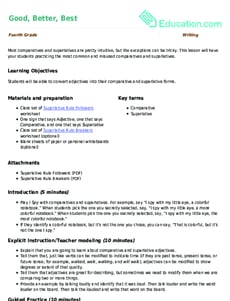
Good, Better, Best
Lesson Plan
Good, Better, Best
Fourth Grade
Most comparatives and superlatives are pretty intuitive, but the exceptions can be tricky. This lesson will have your students practicing the most common and misused comparatives and superlatives.
Lesson Plan
Good, Better, Best
Lesson Plan
Good, Better, Best
Most comparatives and superlatives are pretty intuitive, but the exceptions can be tricky. This lesson will have your students practicing the most common and misused comparatives and superlatives.
Fourth Grade
Lesson Plan
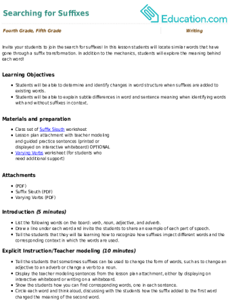
Searching for Suffixes
Lesson Plan
Searching for Suffixes
Fourth Grade
Invite your students to join the search for suffixes! In this lesson students will locate similar words that have gone through a suffix transformation. In addition to the mechanics, students will explore the meaning behind each word!
Lesson Plan
Searching for Suffixes
Lesson Plan
Searching for Suffixes
Invite your students to join the search for suffixes! In this lesson students will locate similar words that have gone through a suffix transformation. In addition to the mechanics, students will explore the meaning behind each word!
Fourth Grade
Lesson Plan
Close Reading Strategy
Lesson Plan
Close Reading Strategy
Third Grade
Grammar and Mechanics
This lesson teaches your students to pay attention to small words, such as adjectives, adverbs, and verbs, to make a big difference in reading comprehension! Use as a stand-alone lesson or as a pre-lesson for
Close Reading: Introduction
.
Lesson Plan
Close Reading Strategy
Lesson Plan
Close Reading Strategy
This lesson teaches your students to pay attention to small words, such as adjectives, adverbs, and verbs, to make a big difference in reading comprehension! Use as a stand-alone lesson or as a pre-lesson for
Close Reading: Introduction
.
Third Grade
Grammar and Mechanics
Lesson Plan
Curiosity vs. Judgment
Lesson Plan
Curiosity vs. Judgment
Fourth Grade
Curiosity can be a powerful way to work with our judgments. In this lesson, students will explore curiosity and judgment. They'll participate in an outdoor activity to practice mindfulness of senses and attentiveness to the present moment.
Lesson Plan
Curiosity vs. Judgment
Lesson Plan
Curiosity vs. Judgment
Curiosity can be a powerful way to work with our judgments. In this lesson, students will explore curiosity and judgment. They'll participate in an outdoor activity to practice mindfulness of senses and attentiveness to the present moment.
Fourth Grade
Lesson Plan
Think Like a Scientist: Observe, Sort, and Classify
Lesson Plan
Think Like a Scientist: Observe, Sort, and Classify
First Grade
Engineering and Science Inquiry
Scientists observe and classify the world around them! In this lesson, your students will practice their processing skills by observing a group of objects and grouping the objects based on their attributes.
Lesson Plan
Think Like a Scientist: Observe, Sort, and Classify
Lesson Plan
Think Like a Scientist: Observe, Sort, and Classify
Scientists observe and classify the world around them! In this lesson, your students will practice their processing skills by observing a group of objects and grouping the objects based on their attributes.
First Grade
Engineering and Science Inquiry
Lesson Plan
1
…
5
6
7
…
10