SKIP TO CONTENT
Worksheet Generator
Subjects
Grades
Worksheets
Games
Build a Worksheet
More Resources
Roly Recommends
Subjects
Grades
Worksheets
Games
Build a Worksheet
More Resources
Roly Recommends
Filters
Search for: descriptive, 2
✕
Lesson Plans
✕
1st - 4th Grade
✕
Subjects
Math
English Language Arts
Science
Social Studies
Grade Level
Pre-K
K
1st
2nd
3rd
4th
5th
6th
7th
8th
Early Childhood
Elementary School
Middle School
Resource Type
Worksheets
Games
Lesson Plans
Interactive Worksheets
Workbooks
Activities
Exercises
Stories
Songs
Offline Games
Guided Lessons
Teacher Resources
Teacher Editions
Common Core
Yes
Roly Recommends
Social Emotional Learning
English Language Support
Yes
See More
Clear All
View 1,310 results
Showing Results for descriptive 2 : Page 28
1,310 results
Search for: descriptive, 2
✕
Lesson Plans
✕
1st - 4th Grade
✕
Clear All
Sort by:
Relevance
Most recent
Most popular
Alphabetical A-Z
Alphabetical Z-A
All filters
1,310 results
Sort by:
Relevance
Most recent
Most popular
Alphabetical A-Z
Alphabetical Z-A
States Of Matter: Identifying Solids, Liquids, and Gases
Lesson Plan
States Of Matter: Identifying Solids, Liquids, and Gases
Second Grade
Physical Science
Use this lesson to show your students the different types of solids, liquids, and gases. Show them how a solid turns into a liquid and how a liquid turns into a gas by using real life examples.
Lesson Plan
States Of Matter: Identifying Solids, Liquids, and Gases
Lesson Plan
States Of Matter: Identifying Solids, Liquids, and Gases
Use this lesson to show your students the different types of solids, liquids, and gases. Show them how a solid turns into a liquid and how a liquid turns into a gas by using real life examples.
Second Grade
Physical Science
Lesson Plan
Using Evidence to Analyze a Character
Lesson Plan
Using Evidence to Analyze a Character
First Grade
Writing
Your students will love learning all about the playful characters in a classic read-aloud text while digging into what makes characters unique. Use as a stand-alone or support lesson for the How to Analyze a Character lesson plan.
Lesson Plan
Using Evidence to Analyze a Character
Lesson Plan
Using Evidence to Analyze a Character
Your students will love learning all about the playful characters in a classic read-aloud text while digging into what makes characters unique. Use as a stand-alone or support lesson for the How to Analyze a Character lesson plan.
First Grade
Writing
Lesson Plan
Exploring Systems with the See, Think, Wonder Thinking Routine
Lesson Plan
Exploring Systems with the See, Think, Wonder Thinking Routine
Kindergarten
Give your students the opportunity to explore systems by using the "See Think Wonder" Visible Thinking Routine from Harvard's Project Zero.
Lesson Plan
Exploring Systems with the See, Think, Wonder Thinking Routine
Lesson Plan
Exploring Systems with the See, Think, Wonder Thinking Routine
Give your students the opportunity to explore systems by using the "See Think Wonder" Visible Thinking Routine from Harvard's Project Zero.
Kindergarten
Lesson Plan
Use Your Mind and Visualize!
Lesson Plan
Use Your Mind and Visualize!
Kindergarten
Help students learn the crucial reading strategy of visualizing. Visualizing is a key component of learning to infer from a text. Kids will love using their imagination and drawing pictures of their visualizations.
Lesson Plan
Use Your Mind and Visualize!
Lesson Plan
Use Your Mind and Visualize!
Help students learn the crucial reading strategy of visualizing. Visualizing is a key component of learning to infer from a text. Kids will love using their imagination and drawing pictures of their visualizations.
Kindergarten
Lesson Plan
Is It True?
Lesson Plan
Is It True?
Fourth Grade
Don't believe everything you read! Teach students to differentiate between statements of fact and opinion. This important skill will help students become critical and discerning readers.
Lesson Plan
Is It True?
Lesson Plan
Is It True?
Don't believe everything you read! Teach students to differentiate between statements of fact and opinion. This important skill will help students become critical and discerning readers.
Fourth Grade
Lesson Plan
Graph My Design
Lesson Plan
Graph My Design
First Grade
Geometry
Geometry meets data in this fun lesson! Students will build a design using pattern blocks and then graph the number of each shape used. This scaffolded EL lesson can be used alone or alongside
Graphing Colored Counters.
Lesson Plan
Graph My Design
Lesson Plan
Graph My Design
Geometry meets data in this fun lesson! Students will build a design using pattern blocks and then graph the number of each shape used. This scaffolded EL lesson can be used alone or alongside
Graphing Colored Counters.
First Grade
Geometry
Lesson Plan
Place Value Hop
Lesson Plan
Place Value Hop
Second Grade
Place Value
Your students will “hop their way” into understanding place value with this fun and active game! In this lesson, they will learn that changing the order of the digits in a number changes its value.
Lesson Plan
Place Value Hop
Lesson Plan
Place Value Hop
Your students will “hop their way” into understanding place value with this fun and active game! In this lesson, they will learn that changing the order of the digits in a number changes its value.
Second Grade
Place Value
Lesson Plan
Multiples and Skip Counting
Lesson Plan
Multiples and Skip Counting
Fourth Grade
Help your students understand the connection between skip counting, multiples, and multiplication with this lesson. Teach it on its own or use it as support to the lesson Clap Counting with Multiples.
Lesson Plan
Multiples and Skip Counting
Lesson Plan
Multiples and Skip Counting
Help your students understand the connection between skip counting, multiples, and multiplication with this lesson. Teach it on its own or use it as support to the lesson Clap Counting with Multiples.
Fourth Grade
Lesson Plan
Exploring Author's Purpose and Point of View
Lesson Plan
Exploring Author's Purpose and Point of View
Third Grade
Life Science
We aren’t mind readers, but we can still figure out why the author wrote a text and what an author thinks about the topic! This lesson will teach your students the main purposes for writing.
Lesson Plan
Exploring Author's Purpose and Point of View
Lesson Plan
Exploring Author's Purpose and Point of View
We aren’t mind readers, but we can still figure out why the author wrote a text and what an author thinks about the topic! This lesson will teach your students the main purposes for writing.
Third Grade
Life Science
Lesson Plan
Characters and Settings
Lesson Plan
Characters and Settings
Fourth Grade
In this lesson, your students will identify adjectives in noun phrases and understand how noun phrases are used to describe characters and settings in fictional texts. Use it as a stand-alone lesson or as support to Tell Me More.
Lesson Plan
Characters and Settings
Lesson Plan
Characters and Settings
In this lesson, your students will identify adjectives in noun phrases and understand how noun phrases are used to describe characters and settings in fictional texts. Use it as a stand-alone lesson or as support to Tell Me More.
Fourth Grade
Lesson Plan
Read about and Discuss Historic Heroes
Lesson Plan
Read about and Discuss Historic Heroes
Fourth Grade
Reading
In this lesson plan, students will discuss characteristics of a hero and how to get information from texts to understand why a person is considered a hero. Partner discussions will help students have a deeper understanding.
Lesson Plan
Read about and Discuss Historic Heroes
Lesson Plan
Read about and Discuss Historic Heroes
In this lesson plan, students will discuss characteristics of a hero and how to get information from texts to understand why a person is considered a hero. Partner discussions will help students have a deeper understanding.
Fourth Grade
Reading
Lesson Plan
Summarizing with Sequence Words
Lesson Plan
Summarizing with Sequence Words
Fourth Grade
This lesson helps students summarize fictional stories using sequence words. Students will have a chance to practice distinguishing the different parts of a story in this lesson, which can be taught as a precursor to Storyboard Superstars.
Lesson Plan
Summarizing with Sequence Words
Lesson Plan
Summarizing with Sequence Words
This lesson helps students summarize fictional stories using sequence words. Students will have a chance to practice distinguishing the different parts of a story in this lesson, which can be taught as a precursor to Storyboard Superstars.
Fourth Grade
Lesson Plan
Nonfiction Comprehension: Cause and Effect
Lesson Plan
Nonfiction Comprehension: Cause and Effect
Third Grade
What is the cause, and what is the effect? Use this resource to teach your students how to identify examples of cause and effect in nonfiction text.
Lesson Plan
Nonfiction Comprehension: Cause and Effect
Lesson Plan
Nonfiction Comprehension: Cause and Effect
What is the cause, and what is the effect? Use this resource to teach your students how to identify examples of cause and effect in nonfiction text.
Third Grade
Lesson Plan
Fiction Comprehension: Problem and Solution
Lesson Plan
Fiction Comprehension: Problem and Solution
Third Grade
If you've ever had something go wrong, you know how it feels to search for a solution! Use this lesson to teach your students to identify problems and solutions in fictional text.
Lesson Plan
Fiction Comprehension: Problem and Solution
Lesson Plan
Fiction Comprehension: Problem and Solution
If you've ever had something go wrong, you know how it feels to search for a solution! Use this lesson to teach your students to identify problems and solutions in fictional text.
Third Grade
Lesson Plan
Understanding Academic Vocabulary in a Nonfiction Text
Lesson Plan
Understanding Academic Vocabulary in a Nonfiction Text
Second Grade
Grammar and Mechanics
This lesson will provide students with an opportunity to become more comfortable with identifying and defining academic vocabulary words in a nonfiction text about a chicken's life cycle to support comprehension.
Lesson Plan
Understanding Academic Vocabulary in a Nonfiction Text
Lesson Plan
Understanding Academic Vocabulary in a Nonfiction Text
This lesson will provide students with an opportunity to become more comfortable with identifying and defining academic vocabulary words in a nonfiction text about a chicken's life cycle to support comprehension.
Second Grade
Grammar and Mechanics
Lesson Plan
Solving Word Problems
Lesson Plan
Solving Word Problems
Second Grade
Word problems getting you down? Then spread the word on a lesson that will help students decide when to add or subtract, as they identify clue words that aid in solving word problems.
Lesson Plan
Solving Word Problems
Lesson Plan
Solving Word Problems
Word problems getting you down? Then spread the word on a lesson that will help students decide when to add or subtract, as they identify clue words that aid in solving word problems.
Second Grade
Lesson Plan
Mystery Addends: Representing Word Problems
Lesson Plan
Mystery Addends: Representing Word Problems
First Grade
Make a math mystery! In this lesson, help your students understand the relationship between addition and subtraction and how a missing addend word problem is represented with a number sentence.
Lesson Plan
Mystery Addends: Representing Word Problems
Lesson Plan
Mystery Addends: Representing Word Problems
Make a math mystery! In this lesson, help your students understand the relationship between addition and subtraction and how a missing addend word problem is represented with a number sentence.
First Grade
Lesson Plan
Explaining Illustrations with Declarative Sentences
Lesson Plan
Explaining Illustrations with Declarative Sentences
Fourth Grade
In this lesson, students will examine illustrations and write about them using declarative sentences. This can be used on its own or as support for the lesson A Picture Is Worth a Thousand Words: Connecting Text and Illustrations.
Lesson Plan
Explaining Illustrations with Declarative Sentences
Lesson Plan
Explaining Illustrations with Declarative Sentences
In this lesson, students will examine illustrations and write about them using declarative sentences. This can be used on its own or as support for the lesson A Picture Is Worth a Thousand Words: Connecting Text and Illustrations.
Fourth Grade
Lesson Plan
Area Arrangements
Lesson Plan
Area Arrangements
Fourth Grade
Geometry
Students will use the inverse relationship between multiplication and division to complete an area formula in a real-world situation. Use this lesson on its own or as support for the lesson The Case of the Missing Rectangle Side.
Lesson Plan
Area Arrangements
Lesson Plan
Area Arrangements
Students will use the inverse relationship between multiplication and division to complete an area formula in a real-world situation. Use this lesson on its own or as support for the lesson The Case of the Missing Rectangle Side.
Fourth Grade
Geometry
Lesson Plan
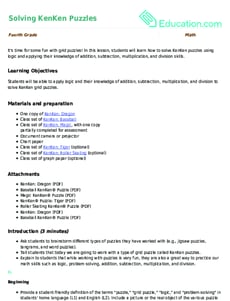
Solving KenKen Puzzles
Lesson Plan
Solving KenKen Puzzles
Fourth Grade
It's time for some fun with grid puzzles! In this lesson, students will learn how to solve KenKen puzzles using logic and applying their knowledge of addition, subtraction, multiplication, and division skills.
Lesson Plan
Solving KenKen Puzzles
Lesson Plan
Solving KenKen Puzzles
It's time for some fun with grid puzzles! In this lesson, students will learn how to solve KenKen puzzles using logic and applying their knowledge of addition, subtraction, multiplication, and division skills.
Fourth Grade
Lesson Plan
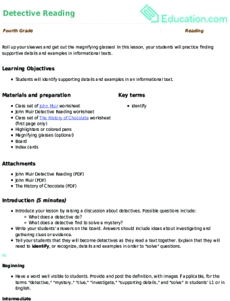
Detective Reading
Lesson Plan
Detective Reading
Fourth Grade
Reading
Roll up your sleeves and get out the magnifying glasses! In this lesson, your students will practice finding supportive details and examples in informational texts.
Lesson Plan
Detective Reading
Lesson Plan
Detective Reading
Roll up your sleeves and get out the magnifying glasses! In this lesson, your students will practice finding supportive details and examples in informational texts.
Fourth Grade
Reading
Lesson Plan
Onomatopoeia Poetry
Lesson Plan
Onomatopoeia Poetry
Third Grade
Pop, whoosh, ding! Onomatopoeia is a writing technique that makes text come alive. In this lesson, students will learn about onomatopoeia, and apply it to their writing process to create poetry, as a class and individually.
Lesson Plan
Onomatopoeia Poetry
Lesson Plan
Onomatopoeia Poetry
Pop, whoosh, ding! Onomatopoeia is a writing technique that makes text come alive. In this lesson, students will learn about onomatopoeia, and apply it to their writing process to create poetry, as a class and individually.
Third Grade
Lesson Plan
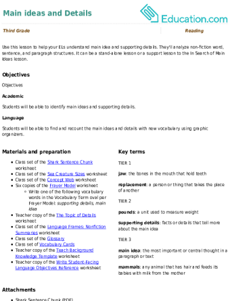
Main ideas and Details
Lesson Plan
Main ideas and Details
Third Grade
Writing
Use this lesson to help your ELs understand main idea and supporting details. They'll analyze non-fiction word, sentence, and paragraph structures. It can be a stand-alone lesson or a support lesson to the In Search of Main Ideas lesson.
Lesson Plan
Main ideas and Details
Lesson Plan
Main ideas and Details
Use this lesson to help your ELs understand main idea and supporting details. They'll analyze non-fiction word, sentence, and paragraph structures. It can be a stand-alone lesson or a support lesson to the In Search of Main Ideas lesson.
Third Grade
Writing
Lesson Plan
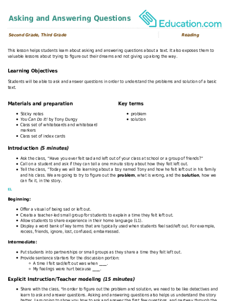
Asking and Answering Questions
Lesson Plan
Asking and Answering Questions
Second Grade
This lesson helps students learn about asking and answering questions about a text. It also exposes them to valuable lessons about trying to figure out their dreams and not giving up along the way.
Lesson Plan
Asking and Answering Questions
Lesson Plan
Asking and Answering Questions
This lesson helps students learn about asking and answering questions about a text. It also exposes them to valuable lessons about trying to figure out their dreams and not giving up along the way.
Second Grade
Lesson Plan
Musical Stories
Lesson Plan
Musical Stories
Second Grade
This interactive lesson helps students make their stories come alive! Students construct multimedia narratives that contain both written words and songs.
Lesson Plan
Musical Stories
Lesson Plan
Musical Stories
This interactive lesson helps students make their stories come alive! Students construct multimedia narratives that contain both written words and songs.
Second Grade
Lesson Plan
Shake and Roll Vowels
Lesson Plan
Shake and Roll Vowels
First Grade
Phonics
In this lesson, students pair up to play an educational dice game. By finding words and sorting them based on their vowel sounds, young learners will have fun while practicing their reading skills.
Lesson Plan
Shake and Roll Vowels
Lesson Plan
Shake and Roll Vowels
In this lesson, students pair up to play an educational dice game. By finding words and sorting them based on their vowel sounds, young learners will have fun while practicing their reading skills.
First Grade
Phonics
Lesson Plan
Mammal or Bird?
Lesson Plan
Mammal or Bird?
Third Grade
Life Science
Use this lesson to teach your students about the characteristics of mammals and birds. Teach them about unique mammals and birds that do not have the characteristics of the average mammal and bird.
Lesson Plan
Mammal or Bird?
Lesson Plan
Mammal or Bird?
Use this lesson to teach your students about the characteristics of mammals and birds. Teach them about unique mammals and birds that do not have the characteristics of the average mammal and bird.
Third Grade
Life Science
Lesson Plan
Action Words are Amazing
Lesson Plan
Action Words are Amazing
Kindergarten
Explore the world of words! In this lesson, play an amazing game to introduce action words to your students.
Lesson Plan
Action Words are Amazing
Lesson Plan
Action Words are Amazing
Explore the world of words! In this lesson, play an amazing game to introduce action words to your students.
Kindergarten
Lesson Plan
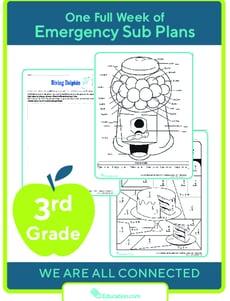
Sub Plans for Third Grade
Lesson Plan
Sub Plans for Third Grade
Third Grade
Planning for a substitute in the classroom has never been easier than with this third grade, week-long sub packet! Your substitute can supercharge learning with lessons about how we are all connected that will educate and inspire students!
Lesson Plan
Sub Plans for Third Grade
Lesson Plan
Sub Plans for Third Grade
Planning for a substitute in the classroom has never been easier than with this third grade, week-long sub packet! Your substitute can supercharge learning with lessons about how we are all connected that will educate and inspire students!
Third Grade
Lesson Plan
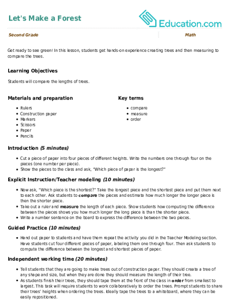
Let's Make a Forest
Lesson Plan
Let's Make a Forest
Second Grade
Get ready to see green! In this lesson, students get hands-on experience creating trees and then measuring to compare the trees.
Lesson Plan
Let's Make a Forest
Lesson Plan
Let's Make a Forest
Get ready to see green! In this lesson, students get hands-on experience creating trees and then measuring to compare the trees.
Second Grade
Lesson Plan
1
…
27
28
29
…
44