SKIP TO CONTENT
Worksheet Generator
Subjects
Grades
Worksheets
Games
Build a Worksheet
More Resources
Roly Recommends
Subjects
Grades
Worksheets
Games
Build a Worksheet
More Resources
Roly Recommends
Filters
Search for: common, 2
✕
Lesson Plans
✕
1st - 3rd Grade
✕
Subjects
Math
English Language Arts
Science
Social Studies
Grade Level
Pre-K
K
1st
2nd
3rd
4th
5th
6th
7th
8th
Early Childhood
Elementary School
Middle School
Resource Type
Worksheets
Games
Lesson Plans
Interactive Worksheets
Workbooks
Activities
Exercises
Stories
Songs
Offline Games
Guided Lessons
Teacher Resources
Teacher Editions
Common Core
Yes
Roly Recommends
Social Emotional Learning
English Language Support
Yes
See More
Clear All
View 1,017 results
Showing Results for common 2 : Page 5
1,017 results
Search for: common, 2
✕
Lesson Plans
✕
1st - 3rd Grade
✕
Clear All
Sort by:
Relevance
Most recent
Most popular
Alphabetical A-Z
Alphabetical Z-A
All filters
1,017 results
Sort by:
Relevance
Most recent
Most popular
Alphabetical A-Z
Alphabetical Z-A
Sums for Mixed Numbers and Improper Fractions
Lesson Plan
Sums for Mixed Numbers and Improper Fractions
Third Grade
Teach your students to add mixed numbers and improper fractions with the same denominator using the counting up strategy with number lines.
Lesson Plan
Sums for Mixed Numbers and Improper Fractions
Lesson Plan
Sums for Mixed Numbers and Improper Fractions
Teach your students to add mixed numbers and improper fractions with the same denominator using the counting up strategy with number lines.
Third Grade
Lesson Plan
Synonyms: Using Shades of Meaning
Lesson Plan
Synonyms: Using Shades of Meaning
Second Grade
Why walk when you can mosey? In this lesson, students will learn how to use synonyms to express shades of meaning in their writing. Introduce the topic with a book, then brainstorm descriptive options for overused words.
Lesson Plan
Synonyms: Using Shades of Meaning
Lesson Plan
Synonyms: Using Shades of Meaning
Why walk when you can mosey? In this lesson, students will learn how to use synonyms to express shades of meaning in their writing. Introduce the topic with a book, then brainstorm descriptive options for overused words.
Second Grade
Lesson Plan
Add and Subtract with Dimes
Lesson Plan
Add and Subtract with Dimes
First Grade
Get ready to break the piggy bank! Students will use dimes and pennies in this hands-on lesson to solve for 10 more or 10 less than a given number. This EL lesson can be used alone or with the lesson plan
Math Mind Magic.
Lesson Plan
Add and Subtract with Dimes
Lesson Plan
Add and Subtract with Dimes
Get ready to break the piggy bank! Students will use dimes and pennies in this hands-on lesson to solve for 10 more or 10 less than a given number. This EL lesson can be used alone or with the lesson plan
Math Mind Magic.
First Grade
Lesson Plan
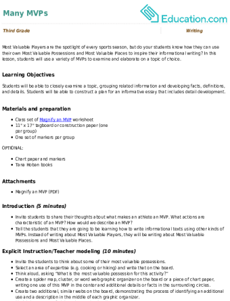
Many MVPs
Lesson Plan
Many MVPs
Third Grade
Most Valuable Players are the spotlight of every sports season, but do your students know how they can use their own Most Valuable Possessions and Most Valuable Places to inspire their informational writing? In this lesson, students will use a variety of MVPs to examine and elaborate on a topic of choice.
Lesson Plan
Many MVPs
Lesson Plan
Many MVPs
Most Valuable Players are the spotlight of every sports season, but do your students know how they can use their own Most Valuable Possessions and Most Valuable Places to inspire their informational writing? In this lesson, students will use a variety of MVPs to examine and elaborate on a topic of choice.
Third Grade
Lesson Plan
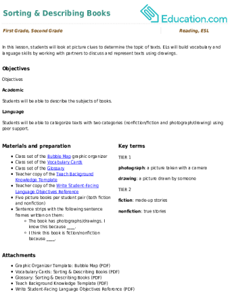
Sorting & Describing Books
Lesson Plan
Sorting & Describing Books
First Grade
In this lesson, students will look at picture clues to determine the topic of texts. ELs will build vocabulary and language skills by working with partners to discuss and represent texts using drawings.
Lesson Plan
Sorting & Describing Books
Lesson Plan
Sorting & Describing Books
In this lesson, students will look at picture clues to determine the topic of texts. ELs will build vocabulary and language skills by working with partners to discuss and represent texts using drawings.
First Grade
Lesson Plan
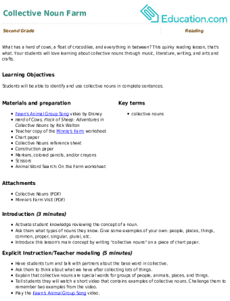
Collective Noun Farm
Lesson Plan
Collective Noun Farm
Second Grade
What has a herd of cows, a float of crocodiles, and everything in between? This quirky reading lesson, that's what. Your students will love learning about collective nouns through music, literature, writing, and arts and crafts.
Lesson Plan
Collective Noun Farm
Lesson Plan
Collective Noun Farm
What has a herd of cows, a float of crocodiles, and everything in between? This quirky reading lesson, that's what. Your students will love learning about collective nouns through music, literature, writing, and arts and crafts.
Second Grade
Lesson Plan
Get the Hang of Homophones
Lesson Plan
Get the Hang of Homophones
Third Grade
Vocabulary
Help your students get the hang of homophones with this vibrant language lesson. Your little learners will have a blast watching interesting videos and showcasing their knowledge by completing worksheets.
Lesson Plan
Get the Hang of Homophones
Lesson Plan
Get the Hang of Homophones
Help your students get the hang of homophones with this vibrant language lesson. Your little learners will have a blast watching interesting videos and showcasing their knowledge by completing worksheets.
Third Grade
Vocabulary
Lesson Plan
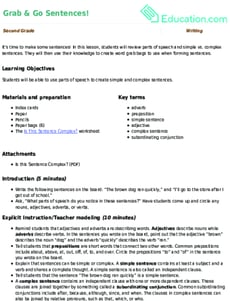
Grab & Go Sentences!
Lesson Plan
Grab & Go Sentences!
Second Grade
Grammar and Mechanics
It’s time to make some sentences! In this lesson, students will review parts of speech and simple vs. complex sentences. They will then use their knowledge to create word grab bags to use when forming sentences.
Lesson Plan
Grab & Go Sentences!
Lesson Plan
Grab & Go Sentences!
It’s time to make some sentences! In this lesson, students will review parts of speech and simple vs. complex sentences. They will then use their knowledge to create word grab bags to use when forming sentences.
Second Grade
Grammar and Mechanics
Lesson Plan
Add a Ten!
Lesson Plan
Add a Ten!
First Grade
What first grader wouldn't want ten dollars? This lesson uses one and ten dollar bills to teach students place value concepts as they develop fluency adding multiples of 10. Use alone or with the lesson plan
Ten Time.
Lesson Plan
Add a Ten!
Lesson Plan
Add a Ten!
What first grader wouldn't want ten dollars? This lesson uses one and ten dollar bills to teach students place value concepts as they develop fluency adding multiples of 10. Use alone or with the lesson plan
Ten Time.
First Grade
Lesson Plan
Characteristics of Polygons
Lesson Plan
Characteristics of Polygons
Third Grade
Vocabulary
Bring on the polygons! Your students will build their understanding of polygons and sort shapes into categories based on their attributes in this lesson.
Lesson Plan
Characteristics of Polygons
Lesson Plan
Characteristics of Polygons
Bring on the polygons! Your students will build their understanding of polygons and sort shapes into categories based on their attributes in this lesson.
Third Grade
Vocabulary
Lesson Plan
Unknown Words
Lesson Plan
Unknown Words
Second Grade
Reading
Increase student comprehension by teaching your students strategies to figure out the meaning of unknown words. This lesson can be used as a stand alone activity or a support lesson for the Be a Nonfiction Detective lesson.
Lesson Plan
Unknown Words
Lesson Plan
Unknown Words
Increase student comprehension by teaching your students strategies to figure out the meaning of unknown words. This lesson can be used as a stand alone activity or a support lesson for the Be a Nonfiction Detective lesson.
Second Grade
Reading
Lesson Plan
Dear Teacher: Opinion Letters
Lesson Plan
Dear Teacher: Opinion Letters
Second Grade
Build community and teach students that opinions matter with this activity that includes survey interviews and a letter to the teacher.
Lesson Plan
Dear Teacher: Opinion Letters
Lesson Plan
Dear Teacher: Opinion Letters
Build community and teach students that opinions matter with this activity that includes survey interviews and a letter to the teacher.
Second Grade
Lesson Plan
Collect, Organize, and Discuss the Data
Lesson Plan
Collect, Organize, and Discuss the Data
Third Grade
Support your students as they collect, organize, and discuss measurement data! Use this lesson independently or alongside
Making Measurements for Line Plots
.
Lesson Plan
Collect, Organize, and Discuss the Data
Lesson Plan
Collect, Organize, and Discuss the Data
Support your students as they collect, organize, and discuss measurement data! Use this lesson independently or alongside
Making Measurements for Line Plots
.
Third Grade
Lesson Plan
Parking Lot Multiplication
Lesson Plan
Parking Lot Multiplication
Third Grade
Help your students make sense of the commutative property of multiplication by relating it to arrangements of cars in parking lots.
Lesson Plan
Parking Lot Multiplication
Lesson Plan
Parking Lot Multiplication
Help your students make sense of the commutative property of multiplication by relating it to arrangements of cars in parking lots.
Third Grade
Lesson Plan
Ways to Represent Skip Counting
Lesson Plan
Ways to Represent Skip Counting
Third Grade
There are many ways to represent skip counting, so help students find their chosen method! Use this as a stand alone lesson or as a pre-lesson for
Skip Counting to Understand Multiplication
.
Lesson Plan
Ways to Represent Skip Counting
Lesson Plan
Ways to Represent Skip Counting
There are many ways to represent skip counting, so help students find their chosen method! Use this as a stand alone lesson or as a pre-lesson for
Skip Counting to Understand Multiplication
.
Third Grade
Lesson Plan
Show Me Equivalent Fractions!
Lesson Plan
Show Me Equivalent Fractions!
Third Grade
In this lesson, students will construct their own number lines and bar models to find equivalent fractions.
Lesson Plan
Show Me Equivalent Fractions!
Lesson Plan
Show Me Equivalent Fractions!
In this lesson, students will construct their own number lines and bar models to find equivalent fractions.
Third Grade
Lesson Plan
Sequencing the Order of Events
Lesson Plan
Sequencing the Order of Events
Third Grade
The sequence of events help readers recount the most important parts of the story in order. Use this lesson with your students to read fables and a classic picture book as you practice recounting the sequence of events.
Lesson Plan
Sequencing the Order of Events
Lesson Plan
Sequencing the Order of Events
The sequence of events help readers recount the most important parts of the story in order. Use this lesson with your students to read fables and a classic picture book as you practice recounting the sequence of events.
Third Grade
Lesson Plan
Line Plots: Representing the Length of Classroom Items
Lesson Plan
Line Plots: Representing the Length of Classroom Items
Second Grade
Measurement
In this lesson, your students will measure the lengths of items and then make a line plot to show the measurement data. They will get hands-on by measuring and surveying the class.
Lesson Plan
Line Plots: Representing the Length of Classroom Items
Lesson Plan
Line Plots: Representing the Length of Classroom Items
In this lesson, your students will measure the lengths of items and then make a line plot to show the measurement data. They will get hands-on by measuring and surveying the class.
Second Grade
Measurement
Lesson Plan
I Have, Who Has? Sight Word Practice
Lesson Plan
I Have, Who Has? Sight Word Practice
First Grade
Alphabet
A fun spin on a classic game! This sight word game will help your students with their reading fluency and reinforce foundational reading skills. Students should be fairly fluent in reading Pre-Primer Dolch sight words prior to the lesson.
Lesson Plan
I Have, Who Has? Sight Word Practice
Lesson Plan
I Have, Who Has? Sight Word Practice
A fun spin on a classic game! This sight word game will help your students with their reading fluency and reinforce foundational reading skills. Students should be fairly fluent in reading Pre-Primer Dolch sight words prior to the lesson.
First Grade
Alphabet
Lesson Plan
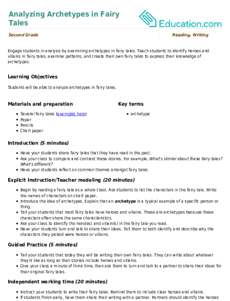
Analyzing Archetypes in Fairy Tales
Lesson Plan
Analyzing Archetypes in Fairy Tales
Second Grade
Reading
Engage students in analysis by examining archetypes in fairy tales. Teach students to identify heroes and villains in fairy tales, examine patterns, and create their own fairy tales to express their knowledge of archetypes.
Lesson Plan
Analyzing Archetypes in Fairy Tales
Lesson Plan
Analyzing Archetypes in Fairy Tales
Engage students in analysis by examining archetypes in fairy tales. Teach students to identify heroes and villains in fairy tales, examine patterns, and create their own fairy tales to express their knowledge of archetypes.
Second Grade
Reading
Lesson Plan
Idioms
Lesson Plan
Idioms
Second Grade
Idioms are especially difficult for English Language Learners! Give your students an introduction to idioms with this lesson.
Lesson Plan
Idioms
Lesson Plan
Idioms
Idioms are especially difficult for English Language Learners! Give your students an introduction to idioms with this lesson.
Second Grade
Lesson Plan
Opinions Matter
Lesson Plan
Opinions Matter
Third Grade
Help your students learn how opinions are formed with this engaging lesson on likes, dislikes, and what they have to do with perspective. They'll love making connections between their personal opinions and those of book characters.
Lesson Plan
Opinions Matter
Lesson Plan
Opinions Matter
Help your students learn how opinions are formed with this engaging lesson on likes, dislikes, and what they have to do with perspective. They'll love making connections between their personal opinions and those of book characters.
Third Grade
Lesson Plan
Curious Science with Curious George
Lesson Plan
Curious Science with Curious George
Second Grade
Physical Science
The science of matter becomes as fun as it is educational when George gets in the mix! After watching Curious George work with his 'floppafication' pot, students will learn about matter and force.
Lesson Plan
Curious Science with Curious George
Lesson Plan
Curious Science with Curious George
The science of matter becomes as fun as it is educational when George gets in the mix! After watching Curious George work with his 'floppafication' pot, students will learn about matter and force.
Second Grade
Physical Science
Lesson Plan
Elapseable
Lesson Plan
Elapseable
Second Grade
Vocabulary
It's time to learn about time. In this hands-on lesson, students manipulate clock hands and jump across timelines in order to calculate the "distance" between different times and events.
Lesson Plan
Elapseable
Lesson Plan
Elapseable
It's time to learn about time. In this hands-on lesson, students manipulate clock hands and jump across timelines in order to calculate the "distance" between different times and events.
Second Grade
Vocabulary
Lesson Plan
First- and Third-Person Point of View
Lesson Plan
First- and Third-Person Point of View
Third Grade
Use this lesson to help your ELs understand which pronouns to use when writing from different points of view. Use this as a stand-alone lesson or as a support lesson for the
My View as an Ant
lesson.
Lesson Plan
First- and Third-Person Point of View
Lesson Plan
First- and Third-Person Point of View
Use this lesson to help your ELs understand which pronouns to use when writing from different points of view. Use this as a stand-alone lesson or as a support lesson for the
My View as an Ant
lesson.
Third Grade
Lesson Plan
Writing Christmas-Themed Word Problems
Lesson Plan
Writing Christmas-Themed Word Problems
First Grade
Addition
Your students will turn boring number sentences into fun, Christmas-themed word problems! They will get practice with math and writing as they use their creative juices to write and solve single digit addition word problems.
Lesson Plan
Writing Christmas-Themed Word Problems
Lesson Plan
Writing Christmas-Themed Word Problems
Your students will turn boring number sentences into fun, Christmas-themed word problems! They will get practice with math and writing as they use their creative juices to write and solve single digit addition word problems.
First Grade
Addition
Lesson Plan
Using Adjectives and Similes to Describe
Lesson Plan
Using Adjectives and Similes to Describe
Third Grade
Vocabulary
Use this lesson to help your ELs explore adjectives and how we can use them to describe things. This lesson can stand alone or be used as a pre-lesson for the
Similes that Describe ME!
lesson.
Lesson Plan
Using Adjectives and Similes to Describe
Lesson Plan
Using Adjectives and Similes to Describe
Use this lesson to help your ELs explore adjectives and how we can use them to describe things. This lesson can stand alone or be used as a pre-lesson for the
Similes that Describe ME!
lesson.
Third Grade
Vocabulary
Lesson Plan
Building in Base-Ten
Lesson Plan
Building in Base-Ten
First Grade
Build a solid foundation in number sense with this lesson all about the friendly number 10! Students will count with both fingers and base-ten blocks. This lesson can be used alone or with the lesson plan
Place Value Concentration.
Lesson Plan
Building in Base-Ten
Lesson Plan
Building in Base-Ten
Build a solid foundation in number sense with this lesson all about the friendly number 10! Students will count with both fingers and base-ten blocks. This lesson can be used alone or with the lesson plan
Place Value Concentration.
First Grade
Lesson Plan
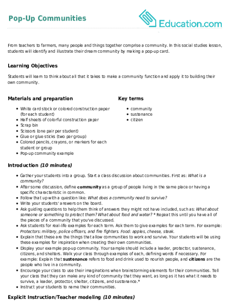
Pop-Up Communities
Lesson Plan
Pop-Up Communities
Second Grade
Community and Culture
From teachers to farmers, many people and things together comprise a community. In this social studies lesson, students will identify and illustrate their dream community by making a pop-up card.
Lesson Plan
Pop-Up Communities
Lesson Plan
Pop-Up Communities
From teachers to farmers, many people and things together comprise a community. In this social studies lesson, students will identify and illustrate their dream community by making a pop-up card.
Second Grade
Community and Culture
Lesson Plan
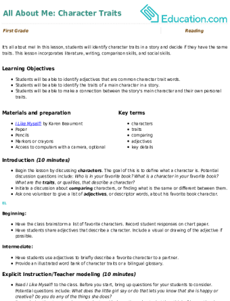
All About Me: Character Traits
Lesson Plan
All About Me: Character Traits
First Grade
It's all about me! In this lesson, students will identify character traits in a story and decide if they have the same traits. This lesson incorporates literature, writing, comparison skills, and social skills.
Lesson Plan
All About Me: Character Traits
Lesson Plan
All About Me: Character Traits
It's all about me! In this lesson, students will identify character traits in a story and decide if they have the same traits. This lesson incorporates literature, writing, comparison skills, and social skills.
First Grade
Lesson Plan
1
…
4
5
6
…
34