SKIP TO CONTENT
Worksheet Generator
Subjects
Grades
Worksheets
Games
Build a Worksheet
More Resources
Roly Recommends
Subjects
Grades
Worksheets
Games
Build a Worksheet
More Resources
Roly Recommends
Showing Results for 1 : Page 2
Filters
991 results
Search for: 1
✕
1st - 3rd Grade
✕
Lesson Plans
✕
Common Core
✕
Clear all
991 results
Filters
Search for: 1
✕
1st - 3rd Grade
✕
Lesson Plans
✕
Common Core
✕
Subjects
Math
English Language Arts
Science
Social Studies
Technology
Grade Level
Pre-K
K
1st
2nd
3rd
4th
5th
6th
7th
8th
Early Childhood
Elementary School
Middle School
Resource Type
Worksheets
Games
Lesson Plans
Interactive Worksheets
Workbooks
Activities
Exercises
Songs
Offline Games
Teacher Resources
Teacher Editions
Occasion
Back to School
Common Core
Yes
Roly Recommends
Social Emotional Learning
English Language Support
Yes
Clear all
View 991 results
Showing Results for 1 : Page 2
Filters
991 results
Search for: 1
✕
1st - 3rd Grade
✕
Lesson Plans
✕
Common Core
✕
Clear all
991 results
A Hearty Valentine’s Day
Lesson Plan
A Hearty Valentine’s Day
Third Grade
Happy Valentine’s Day! Use this fun hands-on lesson with your students to practice solving division problems with one-digit divisors. Students will explore different strategies they can use to solve division problems.
Lesson Plan
A Hearty Valentine’s Day
Lesson Plan
A Hearty Valentine’s Day
Happy Valentine’s Day! Use this fun hands-on lesson with your students to practice solving division problems with one-digit divisors. Students will explore different strategies they can use to solve division problems.
Third Grade
Lesson Plan
Counting Hours: What Time Is It?
Lesson Plan
Counting Hours: What Time Is It?
First Grade
Give first graders a sense of time by introducing them to telling time by the hour. Students who have mastered the numbers 1 to 12 will be eager to keep the class on a time schedule.
Lesson Plan
Counting Hours: What Time Is It?
Lesson Plan
Counting Hours: What Time Is It?
Give first graders a sense of time by introducing them to telling time by the hour. Students who have mastered the numbers 1 to 12 will be eager to keep the class on a time schedule.
First Grade
Lesson Plan
Rhyming Word Family Fun Houses
Lesson Plan
Rhyming Word Family Fun Houses
Kindergarten
Word Families
It's rhyme time! Students will color-code rhyming words and put each one in its “word family house” with this fun rhyming mini book and fill in the "stair steps" writing activity page.
Lesson Plan
Rhyming Word Family Fun Houses
Lesson Plan
Rhyming Word Family Fun Houses
It's rhyme time! Students will color-code rhyming words and put each one in its “word family house” with this fun rhyming mini book and fill in the "stair steps" writing activity page.
Kindergarten
Word Families
Lesson Plan
Counting Collections
Lesson Plan
Counting Collections
First Grade
Counting collections are a great way to help students practice counting while gaining practice recording and justifying their thinking. Students will work specifically with the numbers 1-30 to develop fluency counting and writing numbers.
Lesson Plan
Counting Collections
Lesson Plan
Counting Collections
Counting collections are a great way to help students practice counting while gaining practice recording and justifying their thinking. Students will work specifically with the numbers 1-30 to develop fluency counting and writing numbers.
First Grade
Lesson Plan
EL
Fact or Opinion
Lesson Plan
Fact or Opinion
Second Grade
Help your ELs learn to understand and differentiate between fact and opinion through the analysis of nonfiction text. This can be a stand-alone lesson or a support lesson to the Fact or Opinion: Part 1 lesson plan.
Lesson Plan
EL
Fact or Opinion
Lesson Plan
Fact or Opinion
Help your ELs learn to understand and differentiate between fact and opinion through the analysis of nonfiction text. This can be a stand-alone lesson or a support lesson to the Fact or Opinion: Part 1 lesson plan.
Second Grade
Lesson Plan
Calling All Characters!
Lesson Plan
Calling All Characters!
Third Grade
Come one, come all! In this lesson, reading and writing are intertwined as students determine a character's traits from the character's actions. Reading extends into creative writing as students imagine what a character might do next.
Lesson Plan
Calling All Characters!
Lesson Plan
Calling All Characters!
Come one, come all! In this lesson, reading and writing are intertwined as students determine a character's traits from the character's actions. Reading extends into creative writing as students imagine what a character might do next.
Third Grade
Lesson Plan
EL
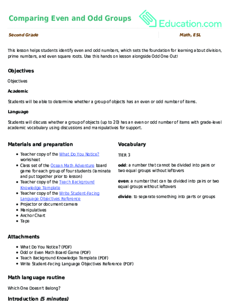
Comparing Even and Odd Groups
Lesson Plan
Comparing Even and Odd Groups
Second Grade
This lesson helps students identify even and odd numbers, which sets the foundation for learning about division, prime numbers, and even square roots. Use this hands on lesson alongside Odd One Out!
Lesson Plan
EL
Comparing Even and Odd Groups
Lesson Plan
Comparing Even and Odd Groups
This lesson helps students identify even and odd numbers, which sets the foundation for learning about division, prime numbers, and even square roots. Use this hands on lesson alongside Odd One Out!
Second Grade
Lesson Plan
EL
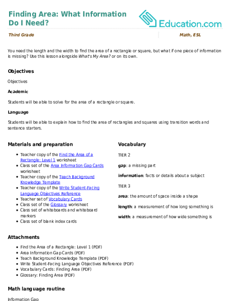
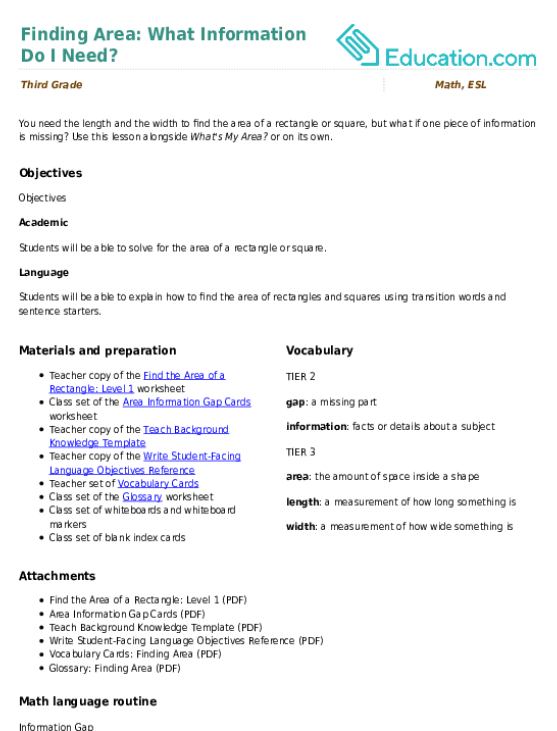
Finding Area: What Information Do I Need?
Lesson Plan
Finding Area: What Information Do I Need?
Third Grade
You need the length and the width to find the area of a rectangle or square, but what if one piece of information is missing? Use this lesson alongside
What's My Area?
or on its own.
Lesson Plan
EL
Finding Area: What Information Do I Need?
Lesson Plan
Finding Area: What Information Do I Need?
You need the length and the width to find the area of a rectangle or square, but what if one piece of information is missing? Use this lesson alongside
What's My Area?
or on its own.
Third Grade
Lesson Plan
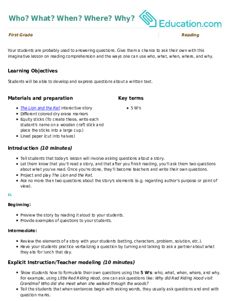
Who? What? When? Where? Why?
Lesson Plan
Who? What? When? Where? Why?
First Grade
Your students are probably used to answering questions. Give them a chance to ask their own with this imaginative lesson on reading comprehension and the ways one can use who, what, when, where, and why.
Lesson Plan
Who? What? When? Where? Why?
Lesson Plan
Who? What? When? Where? Why?
Your students are probably used to answering questions. Give them a chance to ask their own with this imaginative lesson on reading comprehension and the ways one can use who, what, when, where, and why.
First Grade
Lesson Plan
What's Your Phase?
Lesson Plan
What's Your Phase?
Third Grade
Earth and Space Science
This lesson engages students in activity to help them understand the phases of the Moon, and why they occur. Students read literature, analyze it, and then apply it to the small group performance of one cycle of the Moon’s phases.
Lesson Plan
What's Your Phase?
Lesson Plan
What's Your Phase?
This lesson engages students in activity to help them understand the phases of the Moon, and why they occur. Students read literature, analyze it, and then apply it to the small group performance of one cycle of the Moon’s phases.
Third Grade
Earth and Space Science
Lesson Plan
EL
Strategies for Multiplying by Multiples of 10
Lesson Plan
Strategies for Multiplying by Multiples of 10
Third Grade
Help your students become detail-oriented mathematicians as they explore two strategies for multiplying a one-digit number by a multiple of 10. Use this as a stand alone lesson or alongside
Multiplying by Multiples of 10.
Lesson Plan
EL
Strategies for Multiplying by Multiples of 10
Lesson Plan
Strategies for Multiplying by Multiples of 10
Help your students become detail-oriented mathematicians as they explore two strategies for multiplying a one-digit number by a multiple of 10. Use this as a stand alone lesson or alongside
Multiplying by Multiples of 10.
Third Grade
Lesson Plan
101 and Out!
Lesson Plan
101 and Out!
Second Grade
Get the dice out and help students get targeted practice in adding 1 and 10! In this fun place value game, students keep adding to try to get to a maximum score of 100. But be careful. If you go over 100 you’re out!
Lesson Plan
101 and Out!
Lesson Plan
101 and Out!
Get the dice out and help students get targeted practice in adding 1 and 10! In this fun place value game, students keep adding to try to get to a maximum score of 100. But be careful. If you go over 100 you’re out!
Second Grade
Lesson Plan
Graphing Data: Tally Marks and Bar Graphs
Lesson Plan
Graphing Data: Tally Marks and Bar Graphs
First Grade
Collecting and graphing data can be a fantastic tool for getting to know your students and for your students to get to know one another! In this lesson, students will poll their classmates to gather data and then graph the results!
Lesson Plan
Graphing Data: Tally Marks and Bar Graphs
Lesson Plan
Graphing Data: Tally Marks and Bar Graphs
Collecting and graphing data can be a fantastic tool for getting to know your students and for your students to get to know one another! In this lesson, students will poll their classmates to gather data and then graph the results!
First Grade
Lesson Plan
Short Vowel Name Sort
Lesson Plan
Short Vowel Name Sort
First Grade
Phonics
Short vowels can be found just about anywhere. One great place to look is inside your own classroom. In this lesson, students will enjoy going through the class list to sort the names of their peers based on short vowel sounds.
Lesson Plan
Short Vowel Name Sort
Lesson Plan
Short Vowel Name Sort
Short vowels can be found just about anywhere. One great place to look is inside your own classroom. In this lesson, students will enjoy going through the class list to sort the names of their peers based on short vowel sounds.
First Grade
Phonics
Lesson Plan
Slice it Up! (Part Two)
Lesson Plan
Slice it Up! (Part Two)
Second Grade
Fractions
Slice those pieces and mix it up! In this lesson that follows “Slice It Up! Part One,” students will begin recognizing different ways to create equal shares in whole shapes, creating a fraction poster by the end of the lesson.
Lesson Plan
Slice it Up! (Part Two)
Lesson Plan
Slice it Up! (Part Two)
Slice those pieces and mix it up! In this lesson that follows “Slice It Up! Part One,” students will begin recognizing different ways to create equal shares in whole shapes, creating a fraction poster by the end of the lesson.
Second Grade
Fractions
Lesson Plan
African American Poets
Lesson Plan
African American Poets
Third Grade
Students will use a combination of graphic organizers in this lesson plan to learn about famous African American poets and their poetry. They will work in groups to research a famous poet, and choose one of their poems to analyze. Then, they'll share their findings with the class.
Lesson Plan
African American Poets
Lesson Plan
African American Poets
Students will use a combination of graphic organizers in this lesson plan to learn about famous African American poets and their poetry. They will work in groups to research a famous poet, and choose one of their poems to analyze. Then, they'll share their findings with the class.
Third Grade
Lesson Plan
Black Revolutionaries: Malcolm X
Lesson Plan
Black Revolutionaries: Malcolm X
Second Grade
Writing
This lesson teaches kids all about Malcolm X and how his childhood influenced him to become one of America's most well known, controversial, and revolutionary figures. First kids will listen to a read-aloud authored by Malcolm X's daughter, Ilyasah Shabazz, and then they will write an informative paragraph.
Lesson Plan
Black Revolutionaries: Malcolm X
Lesson Plan
Black Revolutionaries: Malcolm X
This lesson teaches kids all about Malcolm X and how his childhood influenced him to become one of America's most well known, controversial, and revolutionary figures. First kids will listen to a read-aloud authored by Malcolm X's daughter, Ilyasah Shabazz, and then they will write an informative paragraph.
Second Grade
Writing
Lesson Plan
Place Value Party
Lesson Plan
Place Value Party
First Grade
Now that your first graders are able to count consecutively, introduce them to the tens and ones place values. Using tens and ones blocks will make math easy and fun for everyone!
Lesson Plan
Place Value Party
Lesson Plan
Place Value Party
Now that your first graders are able to count consecutively, introduce them to the tens and ones place values. Using tens and ones blocks will make math easy and fun for everyone!
First Grade
Lesson Plan
Are You Connected to Me?
Lesson Plan
Are You Connected to Me?
Third Grade
How are quadrilaterals connected? In this lesson, your students will learn about the relationship between quadrilaterals by drawing, defining, and labeling different ones.
Lesson Plan
Are You Connected to Me?
Lesson Plan
Are You Connected to Me?
How are quadrilaterals connected? In this lesson, your students will learn about the relationship between quadrilaterals by drawing, defining, and labeling different ones.
Third Grade
Lesson Plan
Place Value Concentration
Lesson Plan
Place Value Concentration
First Grade
Put your students to the test with this lesson that helps them learn the tens and ones places with a memory game and worksheet!
Lesson Plan
Place Value Concentration
Lesson Plan
Place Value Concentration
Put your students to the test with this lesson that helps them learn the tens and ones places with a memory game and worksheet!
First Grade
Lesson Plan
EL
Money Values
Lesson Plan
Money Values
Second Grade
Place Value
Use this scaffolded EL lesson to teach students about money and the bills we use to pay for things. Use alongside Base Ten Money: Hundreds, Tens, and Ones or alone as an independent lesson.
Lesson Plan
EL
Money Values
Lesson Plan
Money Values
Use this scaffolded EL lesson to teach students about money and the bills we use to pay for things. Use alongside Base Ten Money: Hundreds, Tens, and Ones or alone as an independent lesson.
Second Grade
Place Value
Lesson Plan
Skip Counting by Twos
Lesson Plan
Skip Counting by Twos
First Grade
Make counting fun with colorful counting bears. Students will learn that skip counting is faster than counting by ones. They will also come away from the lesson with ideas of when skip counting can be used.
Lesson Plan
Skip Counting by Twos
Lesson Plan
Skip Counting by Twos
Make counting fun with colorful counting bears. Students will learn that skip counting is faster than counting by ones. They will also come away from the lesson with ideas of when skip counting can be used.
First Grade
Lesson Plan
Regrouping with Popsicle Sticks: Double-Digit Subtraction
Lesson Plan
Regrouping with Popsicle Sticks: Double-Digit Subtraction
Third Grade
Can you break a ten? An everyday exchange of money can help students think about regrouping to subtract. Students will use bundled popsicle sticks to see how values grouped into tens can be regrouped into ones to allow us to subtract.
Lesson Plan
Regrouping with Popsicle Sticks: Double-Digit Subtraction
Lesson Plan
Regrouping with Popsicle Sticks: Double-Digit Subtraction
Can you break a ten? An everyday exchange of money can help students think about regrouping to subtract. Students will use bundled popsicle sticks to see how values grouped into tens can be regrouped into ones to allow us to subtract.
Third Grade
Lesson Plan
Break It Down
Lesson Plan
Break It Down
Second Grade
What exactly does the number 97 mean? How about 454? In this lesson, students explore how two-digit numbers are made up of tens and ones. Then they use this understanding to subtract numbers within 1000.
Lesson Plan
Break It Down
Lesson Plan
Break It Down
What exactly does the number 97 mean? How about 454? In this lesson, students explore how two-digit numbers are made up of tens and ones. Then they use this understanding to subtract numbers within 1000.
Second Grade
Lesson Plan
Fraction Fun
Lesson Plan
Fraction Fun
Third Grade
Review halves, thirds, and quarters with this activity that gives hands-on students a way to learn about fractions actively.
Lesson Plan
Fraction Fun
Lesson Plan
Fraction Fun
Review halves, thirds, and quarters with this activity that gives hands-on students a way to learn about fractions actively.
Third Grade
Lesson Plan
Unit Fraction Frenzy
Lesson Plan
Unit Fraction Frenzy
Third Grade
Help your students get familiar with creating models for unit fractions with this hands-on activity. Students will get into a frenzy creating many unit fraction models to reference as they learn more about fractions!
Lesson Plan
Unit Fraction Frenzy
Lesson Plan
Unit Fraction Frenzy
Help your students get familiar with creating models for unit fractions with this hands-on activity. Students will get into a frenzy creating many unit fraction models to reference as they learn more about fractions!
Third Grade
Lesson Plan
Making Models with Different Denominators
Lesson Plan
Making Models with Different Denominators
Third Grade
Increase your students' knowledge of fractions with this lesson that has them compare fractions with different denominators.
Lesson Plan
Making Models with Different Denominators
Lesson Plan
Making Models with Different Denominators
Increase your students' knowledge of fractions with this lesson that has them compare fractions with different denominators.
Third Grade
Lesson Plan
Fractions as Part of a Whole
Lesson Plan
Fractions as Part of a Whole
Third Grade
In this lesson, students will learn how to understand that a fraction is a number that describes the relationship between a part and a whole.
Lesson Plan
Fractions as Part of a Whole
Lesson Plan
Fractions as Part of a Whole
In this lesson, students will learn how to understand that a fraction is a number that describes the relationship between a part and a whole.
Third Grade
Lesson Plan
A Liter Please
Lesson Plan
A Liter Please
Third Grade
This lesson introduces students to measuring and estimating liquid volume, using liters (l) as the standard unit of measurement.
Lesson Plan
A Liter Please
Lesson Plan
A Liter Please
This lesson introduces students to measuring and estimating liquid volume, using liters (l) as the standard unit of measurement.
Third Grade
Lesson Plan
Even Numbers Rule
Lesson Plan
Even Numbers Rule
Second Grade
Teach about odd and even numbers through this fun card game. After reading a book about even numbers, students get engaged in spotting even and odd numbers by sight.
Lesson Plan
Even Numbers Rule
Lesson Plan
Even Numbers Rule
Teach about odd and even numbers through this fun card game. After reading a book about even numbers, students get engaged in spotting even and odd numbers by sight.
Second Grade
Lesson Plan
1
2
3
4
…
34