SKIP TO CONTENT
Worksheet Generator
Subjects
Grades
Worksheets
Games
Build a Worksheet
More Resources
Roly Recommends
Reading Month
Subjects
Grades
Worksheets
Games
Build a Worksheet
More Resources
Roly Recommends
Reading Month
Filters
Search for: use, comma, to, indicate, direct, address
✕
Lesson Plans
✕
1st and 2nd Grade
✕
Subjects
Math
English Language Arts
Science
Social Studies
Grade Level
Pre-K
K
1st
2nd
3rd
4th
5th
6th
7th
8th
Early Childhood
Elementary School
Middle School
Resource Type
Worksheets
Games
Lesson Plans
Interactive Worksheets
Workbooks
Activities
Exercises
Stories
Songs
Offline Games
Guided Lessons
Teacher Resources
Common Core
Yes
Roly Recommends
Social Emotional Learning
English Language Support
Yes
See More
Clear All
View 764 results
Showing Results for use comma to indicate direct address
764 results
Search for: use, comma, to, indicate, direct, address
✕
Lesson Plans
✕
1st and 2nd Grade
✕
Clear All
Sort by:
Relevance
Most recent
Most popular
Alphabetical A-Z
Alphabetical Z-A
All filters
764 results
Sort by:
Relevance
Most recent
Most popular
Alphabetical A-Z
Alphabetical Z-A
Correctly Use Adverbs
Lesson Plan
Correctly Use Adverbs
Second Grade
You are on your way to the top as a writer if you can correctly use adverbs in sentences! Adverbs add description and information to a sentence. Use this lesson to teach your students how to use adverbs in sentences.
Lesson Plan
Correctly Use Adverbs
Lesson Plan
Correctly Use Adverbs
You are on your way to the top as a writer if you can correctly use adverbs in sentences! Adverbs add description and information to a sentence. Use this lesson to teach your students how to use adverbs in sentences.
Second Grade
Lesson Plan
Use Your Mind and Visualize!
Lesson Plan
Use Your Mind and Visualize!
Kindergarten
Help students learn the crucial reading strategy of visualizing. Visualizing is a key component of learning to infer from a text. Kids will love using their imagination and drawing pictures of their visualizations.
Lesson Plan
Use Your Mind and Visualize!
Lesson Plan
Use Your Mind and Visualize!
Help students learn the crucial reading strategy of visualizing. Visualizing is a key component of learning to infer from a text. Kids will love using their imagination and drawing pictures of their visualizations.
Kindergarten
Lesson Plan
Searching for Text Features
Lesson Plan
Searching for Text Features
First Grade
Vocabulary
Direct instruction about text features will help ELs better comprehend nonfiction texts. In this lesson, students will practice identifying text features. This lesson can be used alone or with the What's in a Text Feature? lesson plan.
Lesson Plan
Searching for Text Features
Lesson Plan
Searching for Text Features
Direct instruction about text features will help ELs better comprehend nonfiction texts. In this lesson, students will practice identifying text features. This lesson can be used alone or with the What's in a Text Feature? lesson plan.
First Grade
Vocabulary
Lesson Plan
Slice It Up! (Part One)
Lesson Plan
Slice It Up! (Part One)
Second Grade
Fractions
It’s pizza time! Students will be introduced to the concept of partitioning shapes to create fractions that demonstrate halves, fourths, and eighths. This lesson is the first of two lessons that address second grade fraction concepts.
Lesson Plan
Slice It Up! (Part One)
Lesson Plan
Slice It Up! (Part One)
It’s pizza time! Students will be introduced to the concept of partitioning shapes to create fractions that demonstrate halves, fourths, and eighths. This lesson is the first of two lessons that address second grade fraction concepts.
Second Grade
Fractions
Lesson Plan
Using Text Features
Lesson Plan
Using Text Features
First Grade
Help students enrich their informational writing by learning to use text features.
Lesson Plan
Using Text Features
Lesson Plan
Using Text Features
Help students enrich their informational writing by learning to use text features.
First Grade
Lesson Plan
Using Regrouping to Add
Lesson Plan
Using Regrouping to Add
Second Grade
Guide students to use base ten blocks to solve two-digit by one-digit addition problems with regrouping. This lesson can be used independently or paired with the lesson Adding it All Up.
Lesson Plan
Using Regrouping to Add
Lesson Plan
Using Regrouping to Add
Guide students to use base ten blocks to solve two-digit by one-digit addition problems with regrouping. This lesson can be used independently or paired with the lesson Adding it All Up.
Second Grade
Lesson Plan
Using Sentence Level Context to Decode Text
Lesson Plan
Using Sentence Level Context to Decode Text
Second Grade
Reading
Use this lesson to reinforce using sentence level context clues to decode challenging words in a nonfiction text. This can be used as a stand alone activity or a support the Using Context Clues to Understand Word Meanings lesson.
Lesson Plan
Using Sentence Level Context to Decode Text
Lesson Plan
Using Sentence Level Context to Decode Text
Use this lesson to reinforce using sentence level context clues to decode challenging words in a nonfiction text. This can be used as a stand alone activity or a support the Using Context Clues to Understand Word Meanings lesson.
Second Grade
Reading
Lesson Plan
Synonyms: Using Shades of Meaning
Lesson Plan
Synonyms: Using Shades of Meaning
Second Grade
Why walk when you can mosey? In this lesson, students will learn how to use synonyms to express shades of meaning in their writing. Introduce the topic with a book, then brainstorm descriptive options for overused words.
Lesson Plan
Synonyms: Using Shades of Meaning
Lesson Plan
Synonyms: Using Shades of Meaning
Why walk when you can mosey? In this lesson, students will learn how to use synonyms to express shades of meaning in their writing. Introduce the topic with a book, then brainstorm descriptive options for overused words.
Second Grade
Lesson Plan
Using Evidence to Analyze a Character
Lesson Plan
Using Evidence to Analyze a Character
First Grade
Writing
Your students will love learning all about the playful characters in a classic read-aloud text while digging into what makes characters unique. Use as a stand-alone or support lesson for the How to Analyze a Character lesson plan.
Lesson Plan
Using Evidence to Analyze a Character
Lesson Plan
Using Evidence to Analyze a Character
Your students will love learning all about the playful characters in a classic read-aloud text while digging into what makes characters unique. Use as a stand-alone or support lesson for the How to Analyze a Character lesson plan.
First Grade
Writing
Lesson Plan
Describing the World Using Sensory Language
Lesson Plan
Describing the World Using Sensory Language
First Grade
Life Science
What are the five senses and how do we use them everyday? Students get a chance to practice using sensory language as they think about the world around them. Can be used as a stand alone or support for the Writing a Five Senses Poem lesson.
Lesson Plan
Describing the World Using Sensory Language
Lesson Plan
Describing the World Using Sensory Language
What are the five senses and how do we use them everyday? Students get a chance to practice using sensory language as they think about the world around them. Can be used as a stand alone or support for the Writing a Five Senses Poem lesson.
First Grade
Life Science
Lesson Plan
Telling Time Using Skip Counting
Lesson Plan
Telling Time Using Skip Counting
Second Grade
Vocabulary
Teach your students to read time to the nearest five minutes by counting by fives! Use this lesson as a stand-alone support lesson for ELs or alongside Tricky Time Telling.
Lesson Plan
Telling Time Using Skip Counting
Lesson Plan
Telling Time Using Skip Counting
Teach your students to read time to the nearest five minutes by counting by fives! Use this lesson as a stand-alone support lesson for ELs or alongside Tricky Time Telling.
Second Grade
Vocabulary
Lesson Plan
Using a Dictionary to Clarify the Meaning of Unknown Words
Lesson Plan
Using a Dictionary to Clarify the Meaning of Unknown Words
Second Grade
Vocabulary
This lesson will help students explore using a dictionary to figure out tricky words with suffixes. Use as a stand-alone activity or a support for the Understanding Academic Vocabulary in a Nonfiction Text lesson.
Lesson Plan
Using a Dictionary to Clarify the Meaning of Unknown Words
Lesson Plan
Using a Dictionary to Clarify the Meaning of Unknown Words
This lesson will help students explore using a dictionary to figure out tricky words with suffixes. Use as a stand-alone activity or a support for the Understanding Academic Vocabulary in a Nonfiction Text lesson.
Second Grade
Vocabulary
Lesson Plan
Using Context Clues to Understand Word Meanings
Lesson Plan
Using Context Clues to Understand Word Meanings
Second Grade
Reading
This lesson will help your students use sentence level context clues to decode challenging words in a nonfiction text. Students will enjoy learning about maps and figuring out tricky words along the way!
Lesson Plan
Using Context Clues to Understand Word Meanings
Lesson Plan
Using Context Clues to Understand Word Meanings
This lesson will help your students use sentence level context clues to decode challenging words in a nonfiction text. Students will enjoy learning about maps and figuring out tricky words along the way!
Second Grade
Reading
Lesson Plan
Antonyms are Opposites!
Lesson Plan
Antonyms are Opposites!
Second Grade
Opposites attract! In this lesson, your students will practice matching antonyms. They will expand their vocabulary by knowing more words to use!
Lesson Plan
Antonyms are Opposites!
Lesson Plan
Antonyms are Opposites!
Opposites attract! In this lesson, your students will practice matching antonyms. They will expand their vocabulary by knowing more words to use!
Second Grade
Lesson Plan
Pronoun Unit
Lesson Plan
Pronoun Unit
First Grade
Grammar and Mechanics
Use this lesson to introduce, review, and teach pronouns! Your students will get to practice using these words and build their reading and language skills.
Lesson Plan
Pronoun Unit
Lesson Plan
Pronoun Unit
Use this lesson to introduce, review, and teach pronouns! Your students will get to practice using these words and build their reading and language skills.
First Grade
Grammar and Mechanics
Lesson Plan
One, Two, Three Resources!
Lesson Plan
One, Two, Three Resources!
Second Grade
Community and Culture
What do you use to make what you need? Resources! Students will explore the three kinds of resources producers use to create the products the use and sell.
Lesson Plan
One, Two, Three Resources!
Lesson Plan
One, Two, Three Resources!
What do you use to make what you need? Resources! Students will explore the three kinds of resources producers use to create the products the use and sell.
Second Grade
Community and Culture
Lesson Plan
Money Values
Lesson Plan
Money Values
Second Grade
Place Value
Use this scaffolded EL lesson to teach students about money and the bills we use to pay for things. Use alongside Base Ten Money: Hundreds, Tens, and Ones or alone as an independent lesson.
Lesson Plan
Money Values
Lesson Plan
Money Values
Use this scaffolded EL lesson to teach students about money and the bills we use to pay for things. Use alongside Base Ten Money: Hundreds, Tens, and Ones or alone as an independent lesson.
Second Grade
Place Value
Lesson Plan
Number Chart Subtraction
Lesson Plan
Number Chart Subtraction
Second Grade
Subtraction will be practiced through the use of a number chart, creation of subtraction problems, and a worksheet.
Lesson Plan
Number Chart Subtraction
Lesson Plan
Number Chart Subtraction
Subtraction will be practiced through the use of a number chart, creation of subtraction problems, and a worksheet.
Second Grade
Lesson Plan
Using the 5 W's
Lesson Plan
Using the 5 W's
Second Grade
Reading
This lesson will provide your ELs with support as they learn about nouns and practice retelling a story with a 5 W's graphic organizer. This lesson can be used as a stand alone activity or a support lesson.
Lesson Plan
Using the 5 W's
Lesson Plan
Using the 5 W's
This lesson will provide your ELs with support as they learn about nouns and practice retelling a story with a 5 W's graphic organizer. This lesson can be used as a stand alone activity or a support lesson.
Second Grade
Reading
Lesson Plan
Irregular Verbs in Context
Lesson Plan
Irregular Verbs in Context
Second Grade
Irregular verbs do not follow the same rules as other verbs. Use this lesson to teach your scholars how to form the past tense of irregular verbs and correctly use them in context.
Lesson Plan
Irregular Verbs in Context
Lesson Plan
Irregular Verbs in Context
Irregular verbs do not follow the same rules as other verbs. Use this lesson to teach your scholars how to form the past tense of irregular verbs and correctly use them in context.
Second Grade
Lesson Plan
Using Picture Walks to Examine Purpose
Lesson Plan
Using Picture Walks to Examine Purpose
Second Grade
Reading
Teach your students about picture walks as a strategy to understand the author's purpose in a fictional text. This lesson can be used as a stand-alone lesson or as support for the Examining Author's Purpose in a Fictional Text lesson.
Lesson Plan
Using Picture Walks to Examine Purpose
Lesson Plan
Using Picture Walks to Examine Purpose
Teach your students about picture walks as a strategy to understand the author's purpose in a fictional text. This lesson can be used as a stand-alone lesson or as support for the Examining Author's Purpose in a Fictional Text lesson.
Second Grade
Reading
Lesson Plan
Teaching Expression with Music
Lesson Plan
Teaching Expression with Music
Second Grade
In this lesson, your students will use music and art to visualize emotions and express feelings. They will love using music to practice writing!
Lesson Plan
Teaching Expression with Music
Lesson Plan
Teaching Expression with Music
In this lesson, your students will use music and art to visualize emotions and express feelings. They will love using music to practice writing!
Second Grade
Lesson Plan
Sort Through Pronouns
Lesson Plan
Sort Through Pronouns
Second Grade
Grammar and Mechanics
Life without pronouns would be repetitive and confusing! Use this lesson with your students to teach them the difference between subject and object pronouns, and when it is appropriate to use each in a sentence.
Lesson Plan
Sort Through Pronouns
Lesson Plan
Sort Through Pronouns
Life without pronouns would be repetitive and confusing! Use this lesson with your students to teach them the difference between subject and object pronouns, and when it is appropriate to use each in a sentence.
Second Grade
Grammar and Mechanics
Lesson Plan
Words That Make Us Feel: A Lesson on Sensory Language
Lesson Plan
Words That Make Us Feel: A Lesson on Sensory Language
First Grade
Use storytelling to teach your first graders about sensory language in this interactive lesson.
Lesson Plan
Words That Make Us Feel: A Lesson on Sensory Language
Lesson Plan
Words That Make Us Feel: A Lesson on Sensory Language
Use storytelling to teach your first graders about sensory language in this interactive lesson.
First Grade
Lesson Plan
Get the Picture? Take a Shot at Idioms
Lesson Plan
Get the Picture? Take a Shot at Idioms
Second Grade
Use a short story that can be told entirely in idioms and students will get the picture! Students match story strip text to idioms in this interactive exercise that includes a matching worksheet assessment.
Lesson Plan
Get the Picture? Take a Shot at Idioms
Lesson Plan
Get the Picture? Take a Shot at Idioms
Use a short story that can be told entirely in idioms and students will get the picture! Students match story strip text to idioms in this interactive exercise that includes a matching worksheet assessment.
Second Grade
Lesson Plan
Master Decoders
Lesson Plan
Master Decoders
First Grade
Being a fluent reader means being able to use different strategies to figure out unknown words. In this lesson, students learn how to use pictures and context clues.
Lesson Plan
Master Decoders
Lesson Plan
Master Decoders
Being a fluent reader means being able to use different strategies to figure out unknown words. In this lesson, students learn how to use pictures and context clues.
First Grade
Lesson Plan
Mysterious Inferences
Lesson Plan
Mysterious Inferences
Second Grade
In this lesson, students will use their schema and make inferences to find the owners of some mystery belongings!
Lesson Plan
Mysterious Inferences
Lesson Plan
Mysterious Inferences
In this lesson, students will use their schema and make inferences to find the owners of some mystery belongings!
Second Grade
Lesson Plan
Reflect with Reflexive Pronouns
Lesson Plan
Reflect with Reflexive Pronouns
Second Grade
Grammar and Mechanics
Reflexive pronouns are like mirrors—they both reflect back to the subject! Use this lesson with your students to give them practice correctly using reflexive pronouns in sentences.
Lesson Plan
Reflect with Reflexive Pronouns
Lesson Plan
Reflect with Reflexive Pronouns
Reflexive pronouns are like mirrors—they both reflect back to the subject! Use this lesson with your students to give them practice correctly using reflexive pronouns in sentences.
Second Grade
Grammar and Mechanics
Lesson Plan
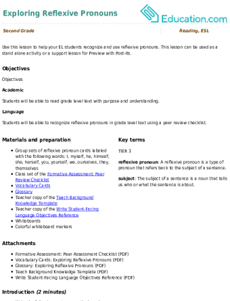
Exploring Reflexive Pronouns
Lesson Plan
Exploring Reflexive Pronouns
Second Grade
Grammar and Mechanics
Use this lesson to help your EL students recognize and use reflexive pronouns. This lesson can be used as a stand alone activity or a support lesson for Preview with Post-Its.
Lesson Plan
Exploring Reflexive Pronouns
Lesson Plan
Exploring Reflexive Pronouns
Use this lesson to help your EL students recognize and use reflexive pronouns. This lesson can be used as a stand alone activity or a support lesson for Preview with Post-Its.
Second Grade
Grammar and Mechanics
Lesson Plan
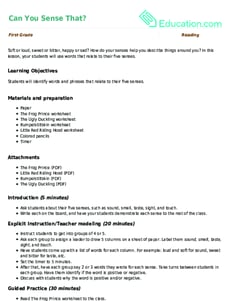
Can You Sense That?
Lesson Plan
Can You Sense That?
First Grade
Soft or loud, sweet or bitter, happy or sad? How do your senses help you describe things around you? In this lesson, your students will use words that relate to their five senses.
Lesson Plan
Can You Sense That?
Lesson Plan
Can You Sense That?
Soft or loud, sweet or bitter, happy or sad? How do your senses help you describe things around you? In this lesson, your students will use words that relate to their five senses.
First Grade
Lesson Plan
1
2
3
4
…
26