SKIP TO CONTENT
Worksheet Generator
Subjects
Grades
Worksheets
Games
Build a Worksheet
More Resources
Roly Recommends
Subjects
Grades
Worksheets
Games
Build a Worksheet
More Resources
Roly Recommends
Filters
Search for: and, in, between
✕
1st and 2nd Grade
✕
Lesson Plans
✕
Subjects
Math
English Language Arts
Science
Social Studies
Grade Level
Pre-K
K
1st
2nd
3rd
4th
5th
6th
7th
8th
Early Childhood
Elementary School
Middle School
Resource Type
Worksheets
Games
Lesson Plans
Interactive Worksheets
Workbooks
Activities
Stories
Songs
Offline Games
Guided Lessons
Teacher Resources
Common Core
Yes
Roly Recommends
Social Emotional Learning
English Language Support
Yes
See More
Clear All
View 226 results
Showing Results for and in between
226 results
Search for: and, in, between
✕
1st and 2nd Grade
✕
Lesson Plans
✕
Clear All
Sort by:
Relevance
Most recent
Most popular
Alphabetical A-Z
Alphabetical Z-A
All filters
226 results
Sort by:
Relevance
Most recent
Most popular
Alphabetical A-Z
Alphabetical Z-A
Time Between Rings
Lesson Plan
Time Between Rings
Second Grade
This support lesson provides students with the opportunity to explore elapsed time by discussing the time between timer rings. Use as a pre-lesson to Elapseable or as a stand-alone activity.
Lesson Plan
Time Between Rings
Lesson Plan
Time Between Rings
This support lesson provides students with the opportunity to explore elapsed time by discussing the time between timer rings. Use as a pre-lesson to Elapseable or as a stand-alone activity.
Second Grade
Lesson Plan
Fact or Assumption
Lesson Plan
Fact or Assumption
Second Grade
Distinguishing between facts and assumptions is an important life skill. In this lesson, students will articulate the difference between assumptions and facts through class discussion and a poster activity.
Lesson Plan
Fact or Assumption
Lesson Plan
Fact or Assumption
Distinguishing between facts and assumptions is an important life skill. In this lesson, students will articulate the difference between assumptions and facts through class discussion and a poster activity.
Second Grade
Lesson Plan
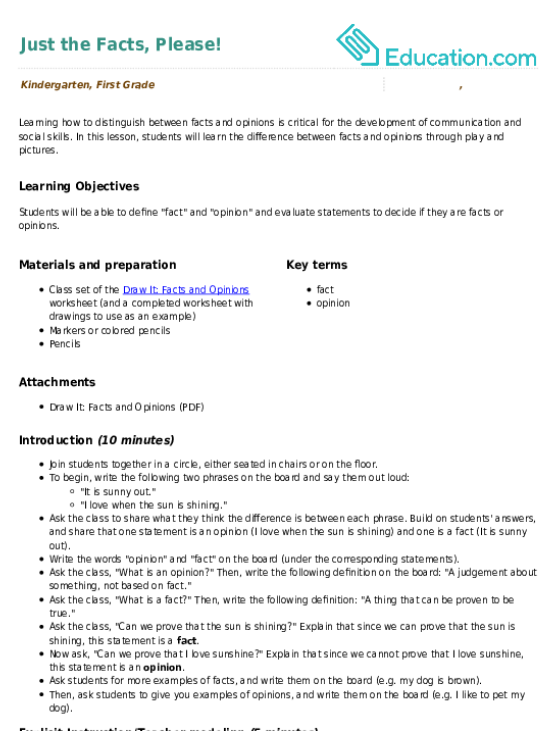
Just the Facts, Please!
Lesson Plan
Just the Facts, Please!
Kindergarten
Learning how to distinguish between facts and opinions is critical for the development of communication and social skills. In this lesson, students will learn the difference between facts and opinions through play and pictures.
Lesson Plan
Just the Facts, Please!
Lesson Plan
Just the Facts, Please!
Learning how to distinguish between facts and opinions is critical for the development of communication and social skills. In this lesson, students will learn the difference between facts and opinions through play and pictures.
Kindergarten
Lesson Plan
What's the Fact, Jack? Facts and Opinions
Lesson Plan
What's the Fact, Jack? Facts and Opinions
First Grade
Do your students know the difference between a fact and an opinion? In this lesson, your class gets the practice they need to sort fact from opinion.
Lesson Plan
What's the Fact, Jack? Facts and Opinions
Lesson Plan
What's the Fact, Jack? Facts and Opinions
Do your students know the difference between a fact and an opinion? In this lesson, your class gets the practice they need to sort fact from opinion.
First Grade
Lesson Plan
Rhyme or Rime?
Lesson Plan
Rhyme or Rime?
Second Grade
What’s the difference between rhymes and rimes? Your students will become masters at using and explaining onset, rhyme, and rime after this lesson.
Lesson Plan
Rhyme or Rime?
Lesson Plan
Rhyme or Rime?
What’s the difference between rhymes and rimes? Your students will become masters at using and explaining onset, rhyme, and rime after this lesson.
Second Grade
Lesson Plan
Fact vs. Opinion Sort
Lesson Plan
Fact vs. Opinion Sort
Second Grade
In this lesson, students develop an understand of the difference between facts and opinions. After analyzing different statements, students write their own sentences to sort and analyze.
Lesson Plan
Fact vs. Opinion Sort
Lesson Plan
Fact vs. Opinion Sort
In this lesson, students develop an understand of the difference between facts and opinions. After analyzing different statements, students write their own sentences to sort and analyze.
Second Grade
Lesson Plan
What's the Difference?
Lesson Plan
What's the Difference?
First Grade
Subtraction
What's the difference.... between two numbers? Play this fun game to get students talking and practicing subtraction. Use this scaffolded EL lesson plan alone or alongside
Subtraction Card Sharks.
Lesson Plan
What's the Difference?
Lesson Plan
What's the Difference?
What's the difference.... between two numbers? Play this fun game to get students talking and practicing subtraction. Use this scaffolded EL lesson plan alone or alongside
Subtraction Card Sharks.
First Grade
Subtraction
Lesson Plan
Base-Ten Money: Hundreds, Tens, and Ones
Lesson Plan
Base-Ten Money: Hundreds, Tens, and Ones
Second Grade
Get your students excited about money! Have them make connections between their prior knowledge of base-ten numerals and one, ten, and hundred dollar bills.
Lesson Plan
Base-Ten Money: Hundreds, Tens, and Ones
Lesson Plan
Base-Ten Money: Hundreds, Tens, and Ones
Get your students excited about money! Have them make connections between their prior knowledge of base-ten numerals and one, ten, and hundred dollar bills.
Second Grade
Lesson Plan
Picturing Goods and Services
Lesson Plan
Picturing Goods and Services
First Grade
Help your students “picture” the difference between goods and services! In this lesson which integrates art, reading, and social studies, your students will both find and create examples of goods and services.
Lesson Plan
Picturing Goods and Services
Lesson Plan
Picturing Goods and Services
Help your students “picture” the difference between goods and services! In this lesson which integrates art, reading, and social studies, your students will both find and create examples of goods and services.
First Grade
Lesson Plan
Then Came One
Lesson Plan
Then Came One
First Grade
Help students use a 100 chart while discovering patterns of one more. This fun lesson will help students find connects between numbers and gain fluency with numbers within 100.
Lesson Plan
Then Came One
Lesson Plan
Then Came One
Help students use a 100 chart while discovering patterns of one more. This fun lesson will help students find connects between numbers and gain fluency with numbers within 100.
First Grade
Lesson Plan
Kindergarten Economics: Goods and Services
Lesson Plan
Kindergarten Economics: Goods and Services
Kindergarten
Community and Culture
Children need to understand the differences between goods and services and why both of them are important. Children will learn that and more with this lesson that teaches them about everyone's roles in the economy.
Lesson Plan
Kindergarten Economics: Goods and Services
Lesson Plan
Kindergarten Economics: Goods and Services
Children need to understand the differences between goods and services and why both of them are important. Children will learn that and more with this lesson that teaches them about everyone's roles in the economy.
Kindergarten
Community and Culture
Lesson Plan
Subtraction Towers
Lesson Plan
Subtraction Towers
First Grade
Help build your students subtraction skills by finding the unknown! This lesson will help your students understand the relationship between addition and subtraction, as students build towers to find unknown addends.
Lesson Plan
Subtraction Towers
Lesson Plan
Subtraction Towers
Help build your students subtraction skills by finding the unknown! This lesson will help your students understand the relationship between addition and subtraction, as students build towers to find unknown addends.
First Grade
Lesson Plan
Math Story Problems
Lesson Plan
Math Story Problems
Second Grade
Help your students make the connection between what they're learning in the classroom and why they need it in the real world with this lesson on word problems.
Lesson Plan
Math Story Problems
Lesson Plan
Math Story Problems
Help your students make the connection between what they're learning in the classroom and why they need it in the real world with this lesson on word problems.
Second Grade
Lesson Plan
Elapseable
Lesson Plan
Elapseable
Second Grade
Vocabulary
It's time to learn about time. In this hands-on lesson, students manipulate clock hands and jump across timelines in order to calculate the "distance" between different times and events.
Lesson Plan
Elapseable
Lesson Plan
Elapseable
It's time to learn about time. In this hands-on lesson, students manipulate clock hands and jump across timelines in order to calculate the "distance" between different times and events.
Second Grade
Vocabulary
Lesson Plan
Mystery Addends: Representing Word Problems
Lesson Plan
Mystery Addends: Representing Word Problems
First Grade
Make a math mystery! In this lesson, help your students understand the relationship between addition and subtraction and how a missing addend word problem is represented with a number sentence.
Lesson Plan
Mystery Addends: Representing Word Problems
Lesson Plan
Mystery Addends: Representing Word Problems
Make a math mystery! In this lesson, help your students understand the relationship between addition and subtraction and how a missing addend word problem is represented with a number sentence.
First Grade
Lesson Plan
Do I Need It? Wants vs. Needs
Lesson Plan
Do I Need It? Wants vs. Needs
Kindergarten
Community and Culture
If you ask your students if they need ice cream, the answer may surprise you! In this lesson, your students will be able differentiate between wants and needs.
Lesson Plan
Do I Need It? Wants vs. Needs
Lesson Plan
Do I Need It? Wants vs. Needs
If you ask your students if they need ice cream, the answer may surprise you! In this lesson, your students will be able differentiate between wants and needs.
Kindergarten
Community and Culture
Lesson Plan
Half-to-Half Symmetry
Lesson Plan
Half-to-Half Symmetry
Second Grade
Where's the other half? In this lesson, young mathematicians learn the relationship between halves and symmetry through a fun scavenger hunt. Your students will have a blast figuring out what makes a shape symmetrical.
Lesson Plan
Half-to-Half Symmetry
Lesson Plan
Half-to-Half Symmetry
Where's the other half? In this lesson, young mathematicians learn the relationship between halves and symmetry through a fun scavenger hunt. Your students will have a blast figuring out what makes a shape symmetrical.
Second Grade
Lesson Plan
A.M. or P.M.?
Lesson Plan
A.M. or P.M.?
First Grade
Help your students learn the difference between a.m. and p.m. while getting them comfortable with the idea of telling time with this lesson that has them identify whether they would do a given activity in the morning or evening.
Lesson Plan
A.M. or P.M.?
Lesson Plan
A.M. or P.M.?
Help your students learn the difference between a.m. and p.m. while getting them comfortable with the idea of telling time with this lesson that has them identify whether they would do a given activity in the morning or evening.
First Grade
Lesson Plan
Fact or Opinion
Lesson Plan
Fact or Opinion
Second Grade
Help your ELs learn to understand and differentiate between fact and opinion through the analysis of nonfiction text. This can be a stand-alone lesson or a support lesson to the Fact or Opinion: Part 1 lesson plan.
Lesson Plan
Fact or Opinion
Lesson Plan
Fact or Opinion
Help your ELs learn to understand and differentiate between fact and opinion through the analysis of nonfiction text. This can be a stand-alone lesson or a support lesson to the Fact or Opinion: Part 1 lesson plan.
Second Grade
Lesson Plan
Identifying Common or Proper Nouns
Lesson Plan
Identifying Common or Proper Nouns
First Grade
Grammar and Mechanics
Help your students learn the difference between proper and common nouns with this lesson that has them come up with examples of their own and complete a worksheet to check for comprehension.
Lesson Plan
Identifying Common or Proper Nouns
Lesson Plan
Identifying Common or Proper Nouns
Help your students learn the difference between proper and common nouns with this lesson that has them come up with examples of their own and complete a worksheet to check for comprehension.
First Grade
Grammar and Mechanics
Lesson Plan
Story vs. Poem
Lesson Plan
Story vs. Poem
First Grade
Reading
What makes a poem a poem? And what makes a story a story? In this lesson, students learn to distinguish between different types of texts while analyzing the sentences and words they encounter.
Lesson Plan
Story vs. Poem
Lesson Plan
Story vs. Poem
What makes a poem a poem? And what makes a story a story? In this lesson, students learn to distinguish between different types of texts while analyzing the sentences and words they encounter.
First Grade
Reading
Lesson Plan
Jumping Into Geometry!
Lesson Plan
Jumping Into Geometry!
Second Grade
This lesson helps students understand the difference between polygons. It focuses on the root words of these terms to help students make connections to their prior knowledge, making it especially beneficial for ESLs.
Lesson Plan
Jumping Into Geometry!
Lesson Plan
Jumping Into Geometry!
This lesson helps students understand the difference between polygons. It focuses on the root words of these terms to help students make connections to their prior knowledge, making it especially beneficial for ESLs.
Second Grade
Lesson Plan
Sort Through Pronouns
Lesson Plan
Sort Through Pronouns
Second Grade
Grammar and Mechanics
Life without pronouns would be repetitive and confusing! Use this lesson with your students to teach them the difference between subject and object pronouns, and when it is appropriate to use each in a sentence.
Lesson Plan
Sort Through Pronouns
Lesson Plan
Sort Through Pronouns
Life without pronouns would be repetitive and confusing! Use this lesson with your students to teach them the difference between subject and object pronouns, and when it is appropriate to use each in a sentence.
Second Grade
Grammar and Mechanics
Lesson Plan
Punctuation: Lost and Found!
Lesson Plan
Punctuation: Lost and Found!
First Grade
Help, help! Some sentences are missing an end mark! Throughout this lesson, your students will solve the "mystery" of missing punctuation marks and learn the difference between a period, question mark, and exclamation point.
Lesson Plan
Punctuation: Lost and Found!
Lesson Plan
Punctuation: Lost and Found!
Help, help! Some sentences are missing an end mark! Throughout this lesson, your students will solve the "mystery" of missing punctuation marks and learn the difference between a period, question mark, and exclamation point.
First Grade
Lesson Plan
Collective Noun Farm
Lesson Plan
Collective Noun Farm
Second Grade
What has a herd of cows, a float of crocodiles, and everything in between? This quirky reading lesson, that's what. Your students will love learning about collective nouns through music, literature, writing, and arts and crafts.
Lesson Plan
Collective Noun Farm
Lesson Plan
Collective Noun Farm
What has a herd of cows, a float of crocodiles, and everything in between? This quirky reading lesson, that's what. Your students will love learning about collective nouns through music, literature, writing, and arts and crafts.
Second Grade
Lesson Plan
Main Idea or Topic? You Decide!
Lesson Plan
Main Idea or Topic? You Decide!
First Grade
Life Science
Provide students with an opportunity to closely examine the difference between a topic and main idea in a nonfiction text. Use as a stand-alone activity or a support for the Finding the Main Idea and Details in a Nonfiction Text lesson.
Lesson Plan
Main Idea or Topic? You Decide!
Lesson Plan
Main Idea or Topic? You Decide!
Provide students with an opportunity to closely examine the difference between a topic and main idea in a nonfiction text. Use as a stand-alone activity or a support for the Finding the Main Idea and Details in a Nonfiction Text lesson.
First Grade
Life Science
Lesson Plan
Fact or Opinion: Part 1
Lesson Plan
Fact or Opinion: Part 1
Second Grade
Vocabulary
Cats are the best! Pizza is better! My teacher rules! In Fact or Opinion: Part 1, your students will combine reading and writing to learn about the differences between facts and opinions and how those differences are communicated.
Lesson Plan
Fact or Opinion: Part 1
Lesson Plan
Fact or Opinion: Part 1
Cats are the best! Pizza is better! My teacher rules! In Fact or Opinion: Part 1, your students will combine reading and writing to learn about the differences between facts and opinions and how those differences are communicated.
Second Grade
Vocabulary
Lesson Plan
Career Math
Lesson Plan
Career Math
First Grade
Community and Culture
Help your students make the connection between what they're learning in school and how adults use math in everyday life with this art lesson. Students will sharpen their critical thinking skills and share their ideas for the future.
Lesson Plan
Career Math
Lesson Plan
Career Math
Help your students make the connection between what they're learning in school and how adults use math in everyday life with this art lesson. Students will sharpen their critical thinking skills and share their ideas for the future.
First Grade
Community and Culture
Lesson Plan
Proper Noun Town
Lesson Plan
Proper Noun Town
Second Grade
Grammar and Mechanics
Knowing when to capitalize can be confusing. This lesson serves as a review on which types of nouns require a capital letter. Students will love designing their own towns while learning about the distinction between common and proper nouns.
Lesson Plan
Proper Noun Town
Lesson Plan
Proper Noun Town
Knowing when to capitalize can be confusing. This lesson serves as a review on which types of nouns require a capital letter. Students will love designing their own towns while learning about the distinction between common and proper nouns.
Second Grade
Grammar and Mechanics
Lesson Plan
The Two Sounds of C and G
Lesson Plan
The Two Sounds of C and G
Second Grade
Does that pesky letter G say /g/ or /j/? How about the sneaky letter C, does it say /k/ or /s/? Use this lesson to teach your students how to tell the difference between the hard and soft sounds of consonants.
Lesson Plan
The Two Sounds of C and G
Lesson Plan
The Two Sounds of C and G
Does that pesky letter G say /g/ or /j/? How about the sneaky letter C, does it say /k/ or /s/? Use this lesson to teach your students how to tell the difference between the hard and soft sounds of consonants.
Second Grade
Lesson Plan
1
2
3
4
…
8