SKIP TO CONTENT
Worksheet Generator
Subjects
Grades
Worksheets
Games
Build a Worksheet
More Resources
Roly Recommends
Subjects
Grades
Worksheets
Games
Build a Worksheet
More Resources
Roly Recommends
Filters
Search for: mixed, and, improper, 3
✕
Lesson Plans
✕
Elementary School
✕
Subjects
Math
English Language Arts
Science
Social Studies
Grade Level
Pre-K
K
1st
2nd
3rd
4th
5th
6th
7th
8th
Early Childhood
Elementary School
Middle School
Resource Type
Worksheets
Games
Lesson Plans
Interactive Worksheets
Workbooks
Activities
Exercises
Stories
Songs
Offline Games
Guided Lessons
Teacher Resources
Teacher Editions
Common Core
Yes
Roly Recommends
Social Emotional Learning
English Language Support
Yes
See More
Clear All
View 1,575 results
Showing Results for mixed and improper 3 : Page 47
1,575 results
Search for: mixed, and, improper, 3
✕
Lesson Plans
✕
Elementary School
✕
Clear All
Sort by:
Relevance
Most recent
Most popular
Alphabetical A-Z
Alphabetical Z-A
All filters
1,575 results
Sort by:
Relevance
Most recent
Most popular
Alphabetical A-Z
Alphabetical Z-A
You Can't See Me!
Lesson Plan
You Can't See Me!
Fifth Grade
Measurement
Help your class gain a foundational understanding of matter by learning how to conduct inquiry and gain an understanding about the characteristics of gases. This lab will have your students amazed at what is really in the air.
Lesson Plan
You Can't See Me!
Lesson Plan
You Can't See Me!
Help your class gain a foundational understanding of matter by learning how to conduct inquiry and gain an understanding about the characteristics of gases. This lab will have your students amazed at what is really in the air.
Fifth Grade
Measurement
Lesson Plan
Chemistry Is Marie Curie
Lesson Plan
Chemistry Is Marie Curie
Fourth Grade
Reading
Marie Curie’s monumental achievements in chemistry and physics are remarkable. In this lesson, your students will read two accounts of her life, integrate the details, and assess the importance of having more than one source of information.
Lesson Plan
Chemistry Is Marie Curie
Lesson Plan
Chemistry Is Marie Curie
Marie Curie’s monumental achievements in chemistry and physics are remarkable. In this lesson, your students will read two accounts of her life, integrate the details, and assess the importance of having more than one source of information.
Fourth Grade
Reading
Lesson Plan
Searching for Text Features
Lesson Plan
Searching for Text Features
Fourth Grade
Reading
This fun combination of scavenger hunt and bingo is sure to please young learners. Not only will your students increase their knowledge of text features, they'll also enjoy a selection of engaging games.
Lesson Plan
Searching for Text Features
Lesson Plan
Searching for Text Features
This fun combination of scavenger hunt and bingo is sure to please young learners. Not only will your students increase their knowledge of text features, they'll also enjoy a selection of engaging games.
Fourth Grade
Reading
Lesson Plan
Volume and a Building
Lesson Plan
Volume and a Building
Fifth Grade
Students will apply the formula V = l × w × h to find the volume for rectangular prisms in the context of solving real-world problems.
Lesson Plan
Volume and a Building
Lesson Plan
Volume and a Building
Students will apply the formula V = l × w × h to find the volume for rectangular prisms in the context of solving real-world problems.
Fifth Grade
Lesson Plan
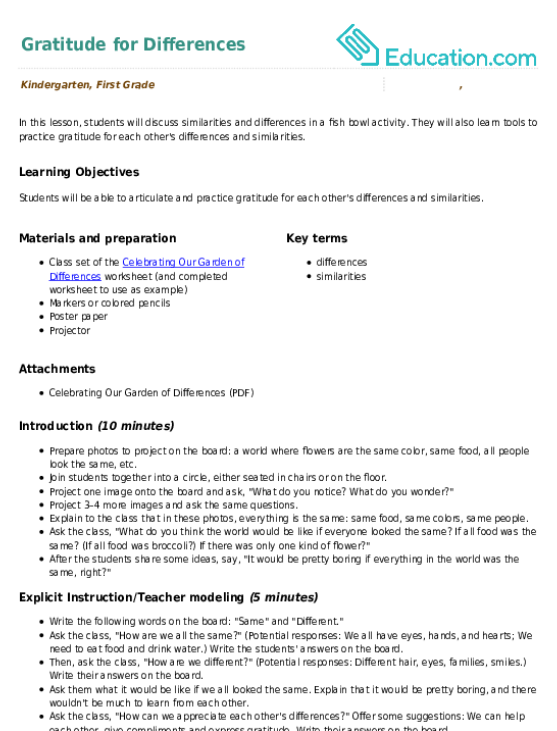
Gratitude for Differences
Lesson Plan
Gratitude for Differences
Kindergarten
In this lesson, students will discuss similarities and differences in a fish bowl activity. They will also learn tools to practice gratitude for each other's differences and similarities.
Lesson Plan
Gratitude for Differences
Lesson Plan
Gratitude for Differences
In this lesson, students will discuss similarities and differences in a fish bowl activity. They will also learn tools to practice gratitude for each other's differences and similarities.
Kindergarten
Lesson Plan
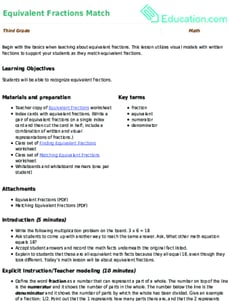
Equivalent Fractions Match
Lesson Plan
Equivalent Fractions Match
Third Grade
Begin with the basics when teaching about equivalent fractions. This lesson utilizes visual models with written fractions to support your students as they match equivalent fractions.
Lesson Plan
Equivalent Fractions Match
Lesson Plan
Equivalent Fractions Match
Begin with the basics when teaching about equivalent fractions. This lesson utilizes visual models with written fractions to support your students as they match equivalent fractions.
Third Grade
Lesson Plan
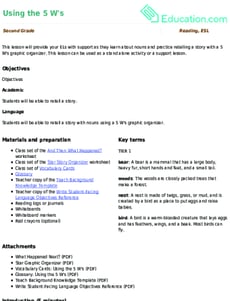
Using the 5 W's
Lesson Plan
Using the 5 W's
Second Grade
Reading
This lesson will provide your ELs with support as they learn about nouns and practice retelling a story with a 5 W's graphic organizer. This lesson can be used as a stand alone activity or a support lesson.
Lesson Plan
Using the 5 W's
Lesson Plan
Using the 5 W's
This lesson will provide your ELs with support as they learn about nouns and practice retelling a story with a 5 W's graphic organizer. This lesson can be used as a stand alone activity or a support lesson.
Second Grade
Reading
Lesson Plan
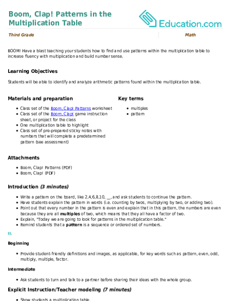
Boom, Clap! Patterns in the Multiplication Table
Lesson Plan
Boom, Clap! Patterns in the Multiplication Table
Third Grade
BOOM! Have a blast teaching your students how to find and use patterns within the multiplication table to increase fluency with multiplication and build number sense.
Lesson Plan
Boom, Clap! Patterns in the Multiplication Table
Lesson Plan
Boom, Clap! Patterns in the Multiplication Table
BOOM! Have a blast teaching your students how to find and use patterns within the multiplication table to increase fluency with multiplication and build number sense.
Third Grade
Lesson Plan
Idiom Meanings and Context Clues
Lesson Plan
Idiom Meanings and Context Clues
Third Grade
Idioms are a challenging piece of figurative language for students, but it can be an easier task with the help of context clues. Use this as a stand-alone lesson or as a pre-lesson for the
Capturing the Clues
lesson.
Lesson Plan
Idiom Meanings and Context Clues
Lesson Plan
Idiom Meanings and Context Clues
Idioms are a challenging piece of figurative language for students, but it can be an easier task with the help of context clues. Use this as a stand-alone lesson or as a pre-lesson for the
Capturing the Clues
lesson.
Third Grade
Lesson Plan
Basic Fiction Summaries
Lesson Plan
Basic Fiction Summaries
Fourth Grade
This lesson gives students a structure to help them summarize fiction texts. When they are skilled at summarizing, they will be more capable of exploring various fiction genres. Use it as a precursor to Fiction Genres Library Exploration.
Lesson Plan
Basic Fiction Summaries
Lesson Plan
Basic Fiction Summaries
This lesson gives students a structure to help them summarize fiction texts. When they are skilled at summarizing, they will be more capable of exploring various fiction genres. Use it as a precursor to Fiction Genres Library Exploration.
Fourth Grade
Lesson Plan
Who, When, What, Where, Why, and How?
Lesson Plan
Who, When, What, Where, Why, and How?
First Grade
Reading
Do you have students who are constantly asking what, who, where, why, how, and when? It's your turn to ask now! Have them read various stories and ask them to answer these questions in this lesson.
Lesson Plan
Who, When, What, Where, Why, and How?
Lesson Plan
Who, When, What, Where, Why, and How?
Do you have students who are constantly asking what, who, where, why, how, and when? It's your turn to ask now! Have them read various stories and ask them to answer these questions in this lesson.
First Grade
Reading
Lesson Plan
Discovering Nonfiction Details
Lesson Plan
Discovering Nonfiction Details
Fourth Grade
Writing
Give your ELs concrete experience with adverbs and adverbial phrases as a tool to discover details in nonfiction texts. Use this as a stand-alone lesson or as support to the Hey! What's the Big Idea? lesson.
Lesson Plan
Discovering Nonfiction Details
Lesson Plan
Discovering Nonfiction Details
Give your ELs concrete experience with adverbs and adverbial phrases as a tool to discover details in nonfiction texts. Use this as a stand-alone lesson or as support to the Hey! What's the Big Idea? lesson.
Fourth Grade
Writing
Lesson Plan
A Script with Adverbs
Lesson Plan
A Script with Adverbs
Fourth Grade
Reading
Describe what's happening in the script! Use this lesson to help your ELs describe events in a drama. It can be a stand-alone lesson or used as support to the lesson Summer Drama.
Lesson Plan
A Script with Adverbs
Lesson Plan
A Script with Adverbs
Describe what's happening in the script! Use this lesson to help your ELs describe events in a drama. It can be a stand-alone lesson or used as support to the lesson Summer Drama.
Fourth Grade
Reading
Lesson Plan
What's For Breakfast?
Lesson Plan
What's For Breakfast?
Fourth Grade
Reading
Teach your class to develop strong inferencing skills by focusing on clues and hard evidence. In this lesson, students will play a game of “What’s for Breakfast?” to help them link context clues with word meaning.
Lesson Plan
What's For Breakfast?
Lesson Plan
What's For Breakfast?
Teach your class to develop strong inferencing skills by focusing on clues and hard evidence. In this lesson, students will play a game of “What’s for Breakfast?” to help them link context clues with word meaning.
Fourth Grade
Reading
Lesson Plan
Dividing Clay Shapes
Lesson Plan
Dividing Clay Shapes
First Grade
Fractions
Students will use their hands to mold clay into shapes, then divide those shapes into equal and unequal quarters.
Lesson Plan
Dividing Clay Shapes
Lesson Plan
Dividing Clay Shapes
Students will use their hands to mold clay into shapes, then divide those shapes into equal and unequal quarters.
First Grade
Fractions
Lesson Plan
Hands-On Multiplication
Lesson Plan
Hands-On Multiplication
Third Grade
Students get hands-on practice playing this math multiplication game with their hands!
Lesson Plan
Hands-On Multiplication
Lesson Plan
Hands-On Multiplication
Students get hands-on practice playing this math multiplication game with their hands!
Third Grade
Lesson Plan
Mini Dictionaries!
Lesson Plan
Mini Dictionaries!
First Grade
Alphabet
Smaller dictionaries that are totally relevant to the material being read? In this lesson, students will learn that these miraculously really do exist and go by the name of glossaries!
Lesson Plan
Mini Dictionaries!
Lesson Plan
Mini Dictionaries!
Smaller dictionaries that are totally relevant to the material being read? In this lesson, students will learn that these miraculously really do exist and go by the name of glossaries!
First Grade
Alphabet
Lesson Plan
How to Compare?
Lesson Plan
How to Compare?
Kindergarten
This lesson is a great introduction to comparing numbers 1-10 using greater than, less than, or equal to. Using hands-on practice and language supports this can be used as a stand alone or pre-lesson for the
More, Less, or Equal: Comparing Quantities
lesson plan.
Lesson Plan
How to Compare?
Lesson Plan
How to Compare?
This lesson is a great introduction to comparing numbers 1-10 using greater than, less than, or equal to. Using hands-on practice and language supports this can be used as a stand alone or pre-lesson for the
More, Less, or Equal: Comparing Quantities
lesson plan.
Kindergarten
Lesson Plan
Let's Choose Less
Lesson Plan
Let's Choose Less
Pre-K
Numbers and Counting
More or less? In this hands-on lesson, your students hone important fine motor skills and learn how to compare quantities.
Lesson Plan
Let's Choose Less
Lesson Plan
Let's Choose Less
More or less? In this hands-on lesson, your students hone important fine motor skills and learn how to compare quantities.
Pre-K
Numbers and Counting
Lesson Plan
Addition Problem Solving
Lesson Plan
Addition Problem Solving
Kindergarten
Can be used alone or as an EL support lesson for the
One Fish, Two Fish
lesson plan.
Lesson Plan
Addition Problem Solving
Lesson Plan
Addition Problem Solving
Can be used alone or as an EL support lesson for the
One Fish, Two Fish
lesson plan.
Kindergarten
Lesson Plan
Battle of the Texts: Print vs. Electronics
Lesson Plan
Battle of the Texts: Print vs. Electronics
Fourth Grade
Are you a page turner or a mouse clicker? In this lesson, students compare and contrast text features in two types of nonfictions texts: print and electronic.
Lesson Plan
Battle of the Texts: Print vs. Electronics
Lesson Plan
Battle of the Texts: Print vs. Electronics
Are you a page turner or a mouse clicker? In this lesson, students compare and contrast text features in two types of nonfictions texts: print and electronic.
Fourth Grade
Lesson Plan
Get to Know Mae Jemison
Lesson Plan
Get to Know Mae Jemison
Kindergarten
Math
Mae Jemison was the first African American female astronaut to enter space. Use the Get to Know Mae Jemison lesson plan to learn more about this famous scientist. Children will then read and write about her, and create their own paper rocket.
Lesson Plan
Get to Know Mae Jemison
Lesson Plan
Get to Know Mae Jemison
Mae Jemison was the first African American female astronaut to enter space. Use the Get to Know Mae Jemison lesson plan to learn more about this famous scientist. Children will then read and write about her, and create their own paper rocket.
Kindergarten
Math
Lesson Plan
Freeze and Flow
Lesson Plan
Freeze and Flow
Fourth Grade
In this lesson, students will participate in a freeze dance, then be guided in slow-motion movements using mindfulness. Finally, they will discuss how movement and music can help them feel calm or energized.
Lesson Plan
Freeze and Flow
Lesson Plan
Freeze and Flow
In this lesson, students will participate in a freeze dance, then be guided in slow-motion movements using mindfulness. Finally, they will discuss how movement and music can help them feel calm or energized.
Fourth Grade
Lesson Plan
You Compare Them! Fiction in Sub-Genre
Lesson Plan
You Compare Them! Fiction in Sub-Genre
Fifth Grade
Comparing and contrasting fiction sub-genres encourages young learners to recognize more intricate details in texts. Use this lesson plan to teach your students to compare and contrast traits within a sub-genre.
Lesson Plan
You Compare Them! Fiction in Sub-Genre
Lesson Plan
You Compare Them! Fiction in Sub-Genre
Comparing and contrasting fiction sub-genres encourages young learners to recognize more intricate details in texts. Use this lesson plan to teach your students to compare and contrast traits within a sub-genre.
Fifth Grade
Lesson Plan
Math Meanings with Synonyms & Antonyms
Lesson Plan
Math Meanings with Synonyms & Antonyms
Fourth Grade
Vocabulary
Use this lesson to increase your students’ understanding of math vocabulary by completing a Frayer Model. This model focuses on finding antonyms, synonyms, and meanings for the key vocabulary term.
Lesson Plan
Math Meanings with Synonyms & Antonyms
Lesson Plan
Math Meanings with Synonyms & Antonyms
Use this lesson to increase your students’ understanding of math vocabulary by completing a Frayer Model. This model focuses on finding antonyms, synonyms, and meanings for the key vocabulary term.
Fourth Grade
Vocabulary
Lesson Plan
The Guiding Beliefs of Martin Luther King, Jr.
Lesson Plan
The Guiding Beliefs of Martin Luther King, Jr.
Third Grade
This lesson will teach your students about the six guiding principles of Martin Luther King, Jr. They'll read a picture book to learn about these beliefs. Then they'll write about how these principles were present in MLK Jr.'s life, and how they're present in their own lives.
Lesson Plan
The Guiding Beliefs of Martin Luther King, Jr.
Lesson Plan
The Guiding Beliefs of Martin Luther King, Jr.
This lesson will teach your students about the six guiding principles of Martin Luther King, Jr. They'll read a picture book to learn about these beliefs. Then they'll write about how these principles were present in MLK Jr.'s life, and how they're present in their own lives.
Third Grade
Lesson Plan
The Legacy of Dr. Martin Luther King, Jr.
Lesson Plan
The Legacy of Dr. Martin Luther King, Jr.
Third Grade
Use this lesson to teach your students about Martin Luther King, Jr.'s legacy he left behind. With a picture book that shares facts and beautiful illustrations to teach about his life, students will show understanding by organizing information on a graphic organizer.
Lesson Plan
The Legacy of Dr. Martin Luther King, Jr.
Lesson Plan
The Legacy of Dr. Martin Luther King, Jr.
Use this lesson to teach your students about Martin Luther King, Jr.'s legacy he left behind. With a picture book that shares facts and beautiful illustrations to teach about his life, students will show understanding by organizing information on a graphic organizer.
Third Grade
Lesson Plan
What Is the Electoral College?
Lesson Plan
What Is the Electoral College?
Fifth Grade
In this civics lesson, your students will learn about the electoral college through first-hand experience! Then, they will write about the best way to vote using evidence to support their opinion.
Lesson Plan
What Is the Electoral College?
Lesson Plan
What Is the Electoral College?
In this civics lesson, your students will learn about the electoral college through first-hand experience! Then, they will write about the best way to vote using evidence to support their opinion.
Fifth Grade
Lesson Plan
The Declaration's Purpose
Lesson Plan
The Declaration's Purpose
Third Grade
July 4, 1776, was an important day in U.S. history because an important document was signed. Use this civics lesson to help young historians learn about the purpose of the Declaration of Independence.
Lesson Plan
The Declaration's Purpose
Lesson Plan
The Declaration's Purpose
July 4, 1776, was an important day in U.S. history because an important document was signed. Use this civics lesson to help young historians learn about the purpose of the Declaration of Independence.
Third Grade
Lesson Plan
Cooking Up a How-To Story
Lesson Plan
Cooking Up a How-To Story
Kindergarten
Cooking up a delicious Peanut Butter and Jelly is as simple as writing a how-to story in this lesson designed to teach students the different parts of a how-to story. Everyone will walk away with their heads and tummies filled!
Lesson Plan
Cooking Up a How-To Story
Lesson Plan
Cooking Up a How-To Story
Cooking up a delicious Peanut Butter and Jelly is as simple as writing a how-to story in this lesson designed to teach students the different parts of a how-to story. Everyone will walk away with their heads and tummies filled!
Kindergarten
Lesson Plan
1
…
46
47
48
…
53