SKIP TO CONTENT
Worksheet Generator
Subjects
Grades
Worksheets
Games
Build a Worksheet
More Resources
Roly Recommends
Reading Month
Subjects
Grades
Worksheets
Games
Build a Worksheet
More Resources
Roly Recommends
Reading Month
Filters
Search for: beginning, sounds
✕
Lesson Plans
✕
Elementary School
✕
Subjects
Math
English Language Arts
Science
Social Studies
Grade Level
Pre-K
K
1st
2nd
3rd
4th
5th
6th
7th
8th
Early Childhood
Elementary School
Middle School
Resource Type
Worksheets
Games
Lesson Plans
Interactive Worksheets
Workbooks
Activities
Exercises
Stories
Songs
Offline Games
Guided Lessons
Teacher Resources
Common Core
Yes
Roly Recommends
Social Emotional Learning
English Language Support
Yes
See More
Clear All
View 1,246 results
Showing Results for beginning sounds : Page 41
1,246 results
Search for: beginning, sounds
✕
Lesson Plans
✕
Elementary School
✕
Clear All
Sort by:
Relevance
Most recent
Most popular
Alphabetical A-Z
Alphabetical Z-A
All filters
1,246 results
Sort by:
Relevance
Most recent
Most popular
Alphabetical A-Z
Alphabetical Z-A
3-D Scavenger Hunt
Lesson Plan
3-D Scavenger Hunt
Second Grade
Explore 3-D shapes with your students and help them identify and talk about the relevant attributes of three-dimensional shapes, all while using real-world examples! Use this as a stand-alone lesson or alongside the Shape Models lesson.
Lesson Plan
3-D Scavenger Hunt
Lesson Plan
3-D Scavenger Hunt
Explore 3-D shapes with your students and help them identify and talk about the relevant attributes of three-dimensional shapes, all while using real-world examples! Use this as a stand-alone lesson or alongside the Shape Models lesson.
Second Grade
Lesson Plan
Sharing the Subtraction Process
Lesson Plan
Sharing the Subtraction Process
Fourth Grade
In this lesson, students will practice explaining the process of subtracting numbers up to 1,000 using base-ten blocks and peer feedback. Use this lesson on its own or as support to the lesson Fluently Subtracting within 1,000.
Lesson Plan
Sharing the Subtraction Process
Lesson Plan
Sharing the Subtraction Process
In this lesson, students will practice explaining the process of subtracting numbers up to 1,000 using base-ten blocks and peer feedback. Use this lesson on its own or as support to the lesson Fluently Subtracting within 1,000.
Fourth Grade
Lesson Plan
Measure with Cubes
Lesson Plan
Measure with Cubes
First Grade
Get your students thinking about the importance of standard measurement units with this fun hands-on activity. Use this scaffolded EL lesson plan alone or with
Measurement Madness
.
Lesson Plan
Measure with Cubes
Lesson Plan
Measure with Cubes
Get your students thinking about the importance of standard measurement units with this fun hands-on activity. Use this scaffolded EL lesson plan alone or with
Measurement Madness
.
First Grade
Lesson Plan
Geometry Vocabulary: Lines
Lesson Plan
Geometry Vocabulary: Lines
Fourth Grade
Geometry
Perpendicular, intersect, parallel! In this lesson, students work in teams to complete a Frayer Model on each of these terms to become masters of geometry vocabulary. Teach this lesson on its own or as support to the lesson What's My Line?
Lesson Plan
Geometry Vocabulary: Lines
Lesson Plan
Geometry Vocabulary: Lines
Perpendicular, intersect, parallel! In this lesson, students work in teams to complete a Frayer Model on each of these terms to become masters of geometry vocabulary. Teach this lesson on its own or as support to the lesson What's My Line?
Fourth Grade
Geometry
Lesson Plan
Multiplication and Division Fact Families
Lesson Plan
Multiplication and Division Fact Families
Third Grade
Mixed Operations
Support your students' math fluency by teaching them about the relationship between multiplication and division through fact families. This lesson can stand alone or be used as a pre-lesson for the
Do You Know Your Math Facts?
lesson.
Lesson Plan
Multiplication and Division Fact Families
Lesson Plan
Multiplication and Division Fact Families
Support your students' math fluency by teaching them about the relationship between multiplication and division through fact families. This lesson can stand alone or be used as a pre-lesson for the
Do You Know Your Math Facts?
lesson.
Third Grade
Mixed Operations
Lesson Plan
More, Less, or the Same?
Lesson Plan
More, Less, or the Same?
Second Grade
Help students learn the academic vocabulary and symbols used to record the results of comparing two three-digit numbers. This lesson can be used as a stand-alone activity or prior to Greater Than, Less Than: Comparing Three-Digit Numbers.
Lesson Plan
More, Less, or the Same?
Lesson Plan
More, Less, or the Same?
Help students learn the academic vocabulary and symbols used to record the results of comparing two three-digit numbers. This lesson can be used as a stand-alone activity or prior to Greater Than, Less Than: Comparing Three-Digit Numbers.
Second Grade
Lesson Plan
Multi-Digit Multiplication Strategies
Lesson Plan
Multi-Digit Multiplication Strategies
Fourth Grade
Facilitate an exploration and comparison of multiplication strategies for your students to see the variety of ways to solve the same problem. Use this lesson on its own or teach it prior to the lesson Multiplication: Musical Chairs.
Lesson Plan
Multi-Digit Multiplication Strategies
Lesson Plan
Multi-Digit Multiplication Strategies
Facilitate an exploration and comparison of multiplication strategies for your students to see the variety of ways to solve the same problem. Use this lesson on its own or teach it prior to the lesson Multiplication: Musical Chairs.
Fourth Grade
Lesson Plan
Area Strategies
Lesson Plan
Area Strategies
Third Grade
Geometry
Allow your students to explore the pros and cons of different strategies used to find the area of rectangles. Use this as a stand alone lesson or as a pre-lesson for the Multiplication and Area in the Community Garden lesson.
Lesson Plan
Area Strategies
Lesson Plan
Area Strategies
Allow your students to explore the pros and cons of different strategies used to find the area of rectangles. Use this as a stand alone lesson or as a pre-lesson for the Multiplication and Area in the Community Garden lesson.
Third Grade
Geometry
Lesson Plan
Understanding Place Value
Lesson Plan
Understanding Place Value
Second Grade
Place Value
Use this lesson to familiarize students with the place value of each digit within a three-digit number, along with practicing the written form of three-digit numbers. Use prior to teaching Place Value Hop or as a stand alone activity.
Lesson Plan
Understanding Place Value
Lesson Plan
Understanding Place Value
Use this lesson to familiarize students with the place value of each digit within a three-digit number, along with practicing the written form of three-digit numbers. Use prior to teaching Place Value Hop or as a stand alone activity.
Second Grade
Place Value
Lesson Plan
What Does the Graph Show?
Lesson Plan
What Does the Graph Show?
Third Grade
Get your students familiar with talking about the data they see in bar graphs. This lesson can stand alone or be used alongside the
Organize Your Data
lesson.
Lesson Plan
What Does the Graph Show?
Lesson Plan
What Does the Graph Show?
Get your students familiar with talking about the data they see in bar graphs. This lesson can stand alone or be used alongside the
Organize Your Data
lesson.
Third Grade
Lesson Plan
Talk About Your Strategy: Fractions of a Whole
Lesson Plan
Talk About Your Strategy: Fractions of a Whole
Fourth Grade
Get your students comfortable with math conversations with this lesson on multiplying fractions by a whole number. It can be taught on its own or used as support for the lesson Fractions of a Whole.
Lesson Plan
Talk About Your Strategy: Fractions of a Whole
Lesson Plan
Talk About Your Strategy: Fractions of a Whole
Get your students comfortable with math conversations with this lesson on multiplying fractions by a whole number. It can be taught on its own or used as support for the lesson Fractions of a Whole.
Fourth Grade
Lesson Plan
Telling Time Using Skip Counting
Lesson Plan
Telling Time Using Skip Counting
Second Grade
Vocabulary
Teach your students to read time to the nearest five minutes by counting by fives! Use this lesson as a stand-alone support lesson for ELs or alongside Tricky Time Telling.
Lesson Plan
Telling Time Using Skip Counting
Lesson Plan
Telling Time Using Skip Counting
Teach your students to read time to the nearest five minutes by counting by fives! Use this lesson as a stand-alone support lesson for ELs or alongside Tricky Time Telling.
Second Grade
Vocabulary
Lesson Plan
Base-Ten Blocks
Lesson Plan
Base-Ten Blocks
Second Grade
Place Value
Use this lesson to introduce the tool of base-ten blocks to your students. This scaffolded EL support lesson can be used as a stand-alone activity, or prior to teaching Three-Digit Addition with Base-Ten Models.
Lesson Plan
Base-Ten Blocks
Lesson Plan
Base-Ten Blocks
Use this lesson to introduce the tool of base-ten blocks to your students. This scaffolded EL support lesson can be used as a stand-alone activity, or prior to teaching Three-Digit Addition with Base-Ten Models.
Second Grade
Place Value
Lesson Plan
Using a Dictionary to Clarify the Meaning of Unknown Words
Lesson Plan
Using a Dictionary to Clarify the Meaning of Unknown Words
Second Grade
Vocabulary
This lesson will help students explore using a dictionary to figure out tricky words with suffixes. Use as a stand-alone activity or a support for the Understanding Academic Vocabulary in a Nonfiction Text lesson.
Lesson Plan
Using a Dictionary to Clarify the Meaning of Unknown Words
Lesson Plan
Using a Dictionary to Clarify the Meaning of Unknown Words
This lesson will help students explore using a dictionary to figure out tricky words with suffixes. Use as a stand-alone activity or a support for the Understanding Academic Vocabulary in a Nonfiction Text lesson.
Second Grade
Vocabulary
Lesson Plan
Analyzing Primary Sources with Past Tense Verbs
Lesson Plan
Analyzing Primary Sources with Past Tense Verbs
Fourth Grade
Reading
Students will analyze census data from Sojourner Truth and Walt Disney using past tense verbs and sentence frames. It can be used on its own or as support to the lesson Researching the Past Using Primary Sources.
Lesson Plan
Analyzing Primary Sources with Past Tense Verbs
Lesson Plan
Analyzing Primary Sources with Past Tense Verbs
Students will analyze census data from Sojourner Truth and Walt Disney using past tense verbs and sentence frames. It can be used on its own or as support to the lesson Researching the Past Using Primary Sources.
Fourth Grade
Reading
Lesson Plan
Factor Friend or Foe?
Lesson Plan
Factor Friend or Foe?
Fourth Grade
Multiplication
Which number doesn't belong? This lesson requires students to think critically as they determine which number is not a factor of a particular number. Teach it on its own or as support for the lesson Factors Over the Rainbow.
Lesson Plan
Factor Friend or Foe?
Lesson Plan
Factor Friend or Foe?
Which number doesn't belong? This lesson requires students to think critically as they determine which number is not a factor of a particular number. Teach it on its own or as support for the lesson Factors Over the Rainbow.
Fourth Grade
Multiplication
Lesson Plan
Adding Like Mixed Numbers
Lesson Plan
Adding Like Mixed Numbers
Fourth Grade
Solve for the sum of two mixed numbers! They will use scaffolds such as fraction models to support the visualization of mixed numbers. This can be used on its own or as support for the lesson Sums for Mixed Numbers and Improper Fractions.
Lesson Plan
Adding Like Mixed Numbers
Lesson Plan
Adding Like Mixed Numbers
Solve for the sum of two mixed numbers! They will use scaffolds such as fraction models to support the visualization of mixed numbers. This can be used on its own or as support for the lesson Sums for Mixed Numbers and Improper Fractions.
Fourth Grade
Lesson Plan
Finding Area: What Information Do I Need?
Lesson Plan
Finding Area: What Information Do I Need?
Third Grade
You need the length and the width to find the area of a rectangle or square, but what if one piece of information is missing? Use this lesson alongside
What's My Area?
or on its own.
Lesson Plan
Finding Area: What Information Do I Need?
Lesson Plan
Finding Area: What Information Do I Need?
You need the length and the width to find the area of a rectangle or square, but what if one piece of information is missing? Use this lesson alongside
What's My Area?
or on its own.
Third Grade
Lesson Plan
Multiples of 10
Lesson Plan
Multiples of 10
Second Grade
Vocabulary
Help students gain confidence in recognizing multiples of 10 as they critique a flawed response. Use as a stand-alone scaffolded EL support lesson or prior to teaching Big Spenders.
Lesson Plan
Multiples of 10
Lesson Plan
Multiples of 10
Help students gain confidence in recognizing multiples of 10 as they critique a flawed response. Use as a stand-alone scaffolded EL support lesson or prior to teaching Big Spenders.
Second Grade
Vocabulary
Lesson Plan
Naming Shapes and their Attributes
Lesson Plan
Naming Shapes and their Attributes
Third Grade
Teach your students about the attributes that make each shape unique. Use this as a stand alone lesson or as a pre-lesson for
Are You Connected to Me?
Lesson Plan
Naming Shapes and their Attributes
Lesson Plan
Naming Shapes and their Attributes
Teach your students about the attributes that make each shape unique. Use this as a stand alone lesson or as a pre-lesson for
Are You Connected to Me?
Third Grade
Lesson Plan
Number Talks with Mixed Numbers Addition
Lesson Plan
Number Talks with Mixed Numbers Addition
Fourth Grade
Students will practice mental math and harness their discussion skills through addition problems of like mixed numbers. This lesson may be used on its own or as support for the lesson Adding Mixed Numbers Using the Decomposition Strategy.
Lesson Plan
Number Talks with Mixed Numbers Addition
Lesson Plan
Number Talks with Mixed Numbers Addition
Students will practice mental math and harness their discussion skills through addition problems of like mixed numbers. This lesson may be used on its own or as support for the lesson Adding Mixed Numbers Using the Decomposition Strategy.
Fourth Grade
Lesson Plan
Money Values
Lesson Plan
Money Values
Second Grade
Place Value
Use this scaffolded EL lesson to teach students about money and the bills we use to pay for things. Use alongside Base Ten Money: Hundreds, Tens, and Ones or alone as an independent lesson.
Lesson Plan
Money Values
Lesson Plan
Money Values
Use this scaffolded EL lesson to teach students about money and the bills we use to pay for things. Use alongside Base Ten Money: Hundreds, Tens, and Ones or alone as an independent lesson.
Second Grade
Place Value
Lesson Plan
Discussing Fraction Representations
Lesson Plan
Discussing Fraction Representations
Third Grade
Support your students as they utilize key academy language to speak about visual and numerical representations of fractions. Use this as a stand alone lesson or as a pre-lesson for
Fractions in Action
.
Lesson Plan
Discussing Fraction Representations
Lesson Plan
Discussing Fraction Representations
Support your students as they utilize key academy language to speak about visual and numerical representations of fractions. Use this as a stand alone lesson or as a pre-lesson for
Fractions in Action
.
Third Grade
Lesson Plan
Compare and Contrast Clocks
Lesson Plan
Compare and Contrast Clocks
Second Grade
Help students develop compare and contrast skills while they examine digital and analog clocks. This lesson can be used independently or in conjunction with the lesson Time to Tell Time: Showing and Writing Time.
Lesson Plan
Compare and Contrast Clocks
Lesson Plan
Compare and Contrast Clocks
Help students develop compare and contrast skills while they examine digital and analog clocks. This lesson can be used independently or in conjunction with the lesson Time to Tell Time: Showing and Writing Time.
Second Grade
Lesson Plan
Let's Collect Data!
Lesson Plan
Let's Collect Data!
Second Grade
This hands-on EL Math Lesson will help students develop compare and contrast skills while they think about effective ways to collect data. Use alongside Bar Graphs: Interpreting Data or as a stand-alone lesson.
Lesson Plan
Let's Collect Data!
Lesson Plan
Let's Collect Data!
This hands-on EL Math Lesson will help students develop compare and contrast skills while they think about effective ways to collect data. Use alongside Bar Graphs: Interpreting Data or as a stand-alone lesson.
Second Grade
Lesson Plan
Talk About Patterns
Lesson Plan
Talk About Patterns
Third Grade
Analyzing and discussing arithmetic patterns builds a strong number sense in your students! Use this as a stand alone lesson or as a pre-lesson for
Boom, Clap! Patterns in the Multiplication Table.
Lesson Plan
Talk About Patterns
Lesson Plan
Talk About Patterns
Analyzing and discussing arithmetic patterns builds a strong number sense in your students! Use this as a stand alone lesson or as a pre-lesson for
Boom, Clap! Patterns in the Multiplication Table.
Third Grade
Lesson Plan
Reflect on the Context First!
Lesson Plan
Reflect on the Context First!
Second Grade
Subtraction
Emphasize student understanding and reasoning! This lesson plan helps learners solve story problems using sense-making strategies. This can be used alongside the lesson Solving Word Problems or as a stand-alone lesson.
Lesson Plan
Reflect on the Context First!
Lesson Plan
Reflect on the Context First!
Emphasize student understanding and reasoning! This lesson plan helps learners solve story problems using sense-making strategies. This can be used alongside the lesson Solving Word Problems or as a stand-alone lesson.
Second Grade
Subtraction
Lesson Plan
Think About What Went Wrong!
Lesson Plan
Think About What Went Wrong!
Second Grade
Use this lesson to help students build their speaking and listening skills as they learn how to critique a flawed response using discussion cards. Use this as a stand-alone support lesson or alongside the activity Break it Down!
Lesson Plan
Think About What Went Wrong!
Lesson Plan
Think About What Went Wrong!
Use this lesson to help students build their speaking and listening skills as they learn how to critique a flawed response using discussion cards. Use this as a stand-alone support lesson or alongside the activity Break it Down!
Second Grade
Lesson Plan
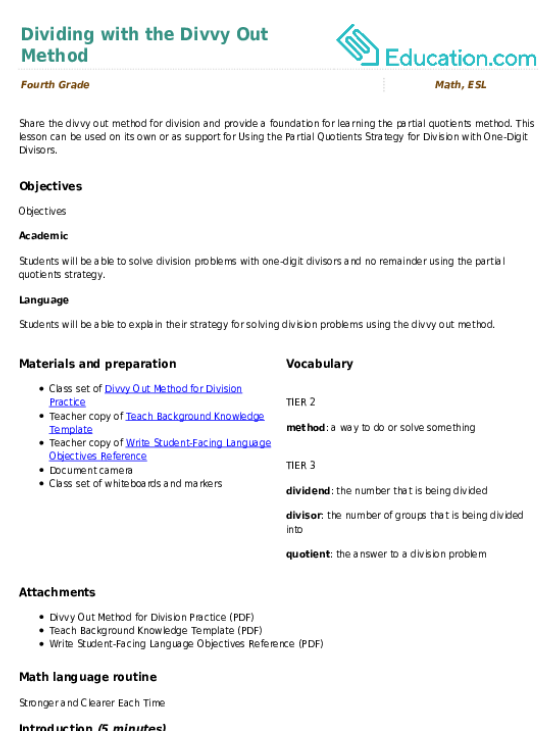
Dividing with the Divvy Out Method
Lesson Plan
Dividing with the Divvy Out Method
Fourth Grade
Share the divvy out method for division and provide a foundation for learning the partial quotients method. This lesson can be used on its own or as support for Using the Partial Quotients Strategy for Division with One-Digit Divisors.
Lesson Plan
Dividing with the Divvy Out Method
Lesson Plan
Dividing with the Divvy Out Method
Share the divvy out method for division and provide a foundation for learning the partial quotients method. This lesson can be used on its own or as support for Using the Partial Quotients Strategy for Division with One-Digit Divisors.
Fourth Grade
Lesson Plan
Comparing Values
Lesson Plan
Comparing Values
Second Grade
Math
Help students use two strategies that will help them figure out which three-digit number is greater than, less than, or equal to another three-digit number. Use on its own or with Let's Compare! Place Value Disks & Three-Digit Numbers.
Lesson Plan
Comparing Values
Lesson Plan
Comparing Values
Help students use two strategies that will help them figure out which three-digit number is greater than, less than, or equal to another three-digit number. Use on its own or with Let's Compare! Place Value Disks & Three-Digit Numbers.
Second Grade
Math
Lesson Plan
1
…
39
40
41
42