SKIP TO CONTENT
Worksheet Generator
Subjects
Grades
Worksheets
Games
Build a Worksheet
More Resources
Roly Recommends
Subjects
Grades
Worksheets
Games
Build a Worksheet
More Resources
Roly Recommends
Filters
Search for: true, grid
✕
Lesson Plans
✕
Elementary School
✕
Subjects
Math
English Language Arts
Science
Social Studies
Grade Level
Pre-K
K
1st
2nd
3rd
4th
5th
6th
7th
8th
Early Childhood
Elementary School
Middle School
Resource Type
Worksheets
Games
Lesson Plans
Interactive Worksheets
Workbooks
Activities
Offline Games
Teacher Resources
Common Core
Yes
Roly Recommends
Social Emotional Learning
English Language Support
Yes
See More
Clear All
View 158 results
Showing Results for true grid : Page 4
158 results
Search for: true, grid
✕
Lesson Plans
✕
Elementary School
✕
Clear All
Sort by:
Relevance
Most recent
Most popular
Alphabetical A-Z
Alphabetical Z-A
All filters
158 results
Sort by:
Relevance
Most recent
Most popular
Alphabetical A-Z
Alphabetical Z-A
Read the Sign: Fact or Opinion?
Lesson Plan
Read the Sign: Fact or Opinion?
First Grade
Is it a fact or an opinion? In this lesson, students practice identifying and writing different facts and opinions.
Lesson Plan
Read the Sign: Fact or Opinion?
Lesson Plan
Read the Sign: Fact or Opinion?
Is it a fact or an opinion? In this lesson, students practice identifying and writing different facts and opinions.
First Grade
Lesson Plan
Fact or Opinion
Lesson Plan
Fact or Opinion
Second Grade
Help your ELs learn to understand and differentiate between fact and opinion through the analysis of nonfiction text. This can be a stand-alone lesson or a support lesson to the Fact or Opinion: Part 1 lesson plan.
Lesson Plan
Fact or Opinion
Lesson Plan
Fact or Opinion
Help your ELs learn to understand and differentiate between fact and opinion through the analysis of nonfiction text. This can be a stand-alone lesson or a support lesson to the Fact or Opinion: Part 1 lesson plan.
Second Grade
Lesson Plan
Figurative Language
Lesson Plan
Figurative Language
Second Grade
Figurative language is so tricky, especially for English Learners! Use this lesson to introduce the concept with a focus on similes and metaphors.
Lesson Plan
Figurative Language
Lesson Plan
Figurative Language
Figurative language is so tricky, especially for English Learners! Use this lesson to introduce the concept with a focus on similes and metaphors.
Second Grade
Lesson Plan
Equivalent Fractions Memory Game
Lesson Plan
Equivalent Fractions Memory Game
Fourth Grade
Your fourth graders will not only have fun creating and playing an equivalent fractions memory game in this interactive lesson, they will also become much stronger mathemeticians in the process.
Lesson Plan
Equivalent Fractions Memory Game
Lesson Plan
Equivalent Fractions Memory Game
Your fourth graders will not only have fun creating and playing an equivalent fractions memory game in this interactive lesson, they will also become much stronger mathemeticians in the process.
Fourth Grade
Lesson Plan
Which Holds More?
Lesson Plan
Which Holds More?
Kindergarten
Measurement
Fill ‘em up! This lesson teaches students to compare how much different containers can hold. Get ready for some overflowing fun!
Lesson Plan
Which Holds More?
Lesson Plan
Which Holds More?
Fill ‘em up! This lesson teaches students to compare how much different containers can hold. Get ready for some overflowing fun!
Kindergarten
Measurement
Lesson Plan
Geometry Vocabulary: Lines
Lesson Plan
Geometry Vocabulary: Lines
Fourth Grade
Geometry
Perpendicular, intersect, parallel! In this lesson, students work in teams to complete a Frayer Model on each of these terms to become masters of geometry vocabulary. Teach this lesson on its own or as support to the lesson What's My Line?
Lesson Plan
Geometry Vocabulary: Lines
Lesson Plan
Geometry Vocabulary: Lines
Perpendicular, intersect, parallel! In this lesson, students work in teams to complete a Frayer Model on each of these terms to become masters of geometry vocabulary. Teach this lesson on its own or as support to the lesson What's My Line?
Fourth Grade
Geometry
Lesson Plan
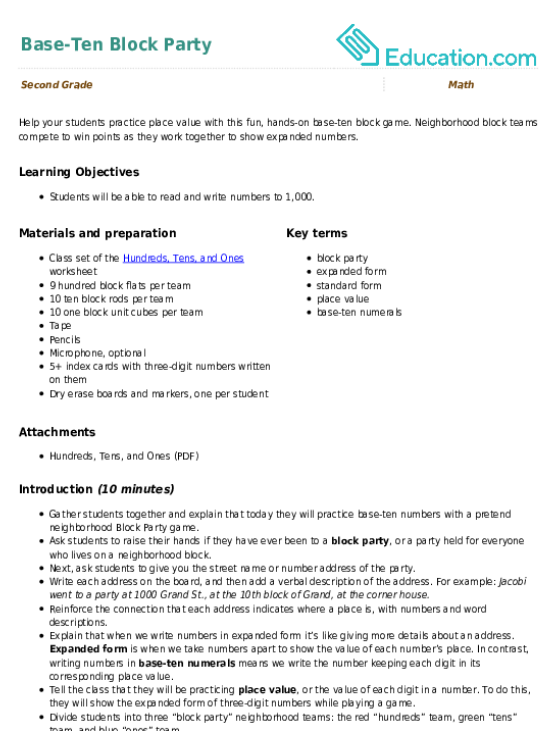
Base-Ten Block Party
Lesson Plan
Base-Ten Block Party
Second Grade
Help your students practice place value with this fun, hands-on base-ten block game. Neighborhood block teams compete to win points as they work together to show expanded numbers.
Lesson Plan
Base-Ten Block Party
Lesson Plan
Base-Ten Block Party
Help your students practice place value with this fun, hands-on base-ten block game. Neighborhood block teams compete to win points as they work together to show expanded numbers.
Second Grade
Lesson Plan
Perfect Perimeter
Lesson Plan
Perfect Perimeter
Fourth Grade
Geometry
Go to any length to test your students' understanding of perimeter calculations. Students will use their understanding of the perimeter of rectangular shapes to create rectangles that have different side measurements but equal perimeters.
Lesson Plan
Perfect Perimeter
Lesson Plan
Perfect Perimeter
Go to any length to test your students' understanding of perimeter calculations. Students will use their understanding of the perimeter of rectangular shapes to create rectangles that have different side measurements but equal perimeters.
Fourth Grade
Geometry
Lesson Plan
Fact or Opinion: Part 1
Lesson Plan
Fact or Opinion: Part 1
Second Grade
Vocabulary
Cats are the best! Pizza is better! My teacher rules! In Fact or Opinion: Part 1, your students will combine reading and writing to learn about the differences between facts and opinions and how those differences are communicated.
Lesson Plan
Fact or Opinion: Part 1
Lesson Plan
Fact or Opinion: Part 1
Cats are the best! Pizza is better! My teacher rules! In Fact or Opinion: Part 1, your students will combine reading and writing to learn about the differences between facts and opinions and how those differences are communicated.
Second Grade
Vocabulary
Lesson Plan
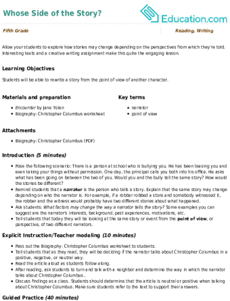
Whose Side of the Story?
Lesson Plan
Whose Side of the Story?
Fifth Grade
Reading
Allow your students to explore how stories may change depending on the perspectives from which they're told. Interesting texts and a creative writing assignment make this quite the engaging lesson.
Lesson Plan
Whose Side of the Story?
Lesson Plan
Whose Side of the Story?
Allow your students to explore how stories may change depending on the perspectives from which they're told. Interesting texts and a creative writing assignment make this quite the engaging lesson.
Fifth Grade
Reading
Lesson Plan
Nonfiction Reading: Learning and Recording New Information
Lesson Plan
Nonfiction Reading: Learning and Recording New Information
First Grade
As students reread nonfiction, have them draw or write new information they learn. Students then share these new learnings with reading partners.
Lesson Plan
Nonfiction Reading: Learning and Recording New Information
Lesson Plan
Nonfiction Reading: Learning and Recording New Information
As students reread nonfiction, have them draw or write new information they learn. Students then share these new learnings with reading partners.
First Grade
Lesson Plan
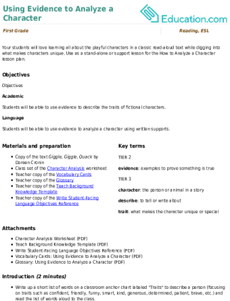
Using Evidence to Analyze a Character
Lesson Plan
Using Evidence to Analyze a Character
First Grade
Writing
Your students will love learning all about the playful characters in a classic read-aloud text while digging into what makes characters unique. Use as a stand-alone or support lesson for the How to Analyze a Character lesson plan.
Lesson Plan
Using Evidence to Analyze a Character
Lesson Plan
Using Evidence to Analyze a Character
Your students will love learning all about the playful characters in a classic read-aloud text while digging into what makes characters unique. Use as a stand-alone or support lesson for the How to Analyze a Character lesson plan.
First Grade
Writing
Lesson Plan
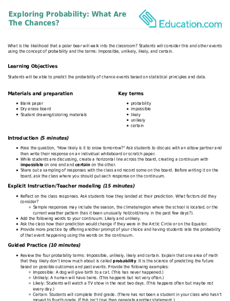
Exploring Probability: What Are The Chances?
Lesson Plan
Exploring Probability: What Are The Chances?
Third Grade
Probability
What is the likelihood that a polar bear will walk into the classroom? Students will consider this and other events using the concept of probability and the terms: Impossible, unlikely, likely, and certain.
Lesson Plan
Exploring Probability: What Are The Chances?
Lesson Plan
Exploring Probability: What Are The Chances?
What is the likelihood that a polar bear will walk into the classroom? Students will consider this and other events using the concept of probability and the terms: Impossible, unlikely, likely, and certain.
Third Grade
Probability
Lesson Plan
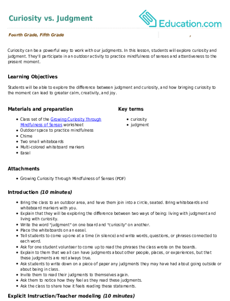
Curiosity vs. Judgment
Lesson Plan
Curiosity vs. Judgment
Fourth Grade
Curiosity can be a powerful way to work with our judgments. In this lesson, students will explore curiosity and judgment. They'll participate in an outdoor activity to practice mindfulness of senses and attentiveness to the present moment.
Lesson Plan
Curiosity vs. Judgment
Lesson Plan
Curiosity vs. Judgment
Curiosity can be a powerful way to work with our judgments. In this lesson, students will explore curiosity and judgment. They'll participate in an outdoor activity to practice mindfulness of senses and attentiveness to the present moment.
Fourth Grade
Lesson Plan
Journey on the Underground Railroad
Lesson Plan
Journey on the Underground Railroad
Fourth Grade
Reading
This lesson combines historical facts and creative writing to engage students in exercises that enhance both vocabulary and social studies knowledge.
Lesson Plan
Journey on the Underground Railroad
Lesson Plan
Journey on the Underground Railroad
This lesson combines historical facts and creative writing to engage students in exercises that enhance both vocabulary and social studies knowledge.
Fourth Grade
Reading
Lesson Plan
It’s My Opinion
Lesson Plan
It’s My Opinion
First Grade
Forming and sharing opinions is a vital part of self-expression. Use the following lesson to help your students write opinions and support them with three convincing reasons.
Lesson Plan
It’s My Opinion
Lesson Plan
It’s My Opinion
Forming and sharing opinions is a vital part of self-expression. Use the following lesson to help your students write opinions and support them with three convincing reasons.
First Grade
Lesson Plan
Finding the Details and Asking for Answers
Lesson Plan
Finding the Details and Asking for Answers
Kindergarten
Reading
ELs will get a chance to practice their listening and reading comprehension skills as they answer questions about the key details in a read-aloud text. Use as a stand-alone or pre-lesson for the Questions for Comprehension lesson plan.
Lesson Plan
Finding the Details and Asking for Answers
Lesson Plan
Finding the Details and Asking for Answers
ELs will get a chance to practice their listening and reading comprehension skills as they answer questions about the key details in a read-aloud text. Use as a stand-alone or pre-lesson for the Questions for Comprehension lesson plan.
Kindergarten
Reading
Lesson Plan
Fact Family Houses
Lesson Plan
Fact Family Houses
First Grade
Mixed Operations
Math meets art in this fun lesson where students create a house for a fact family. Use the scaffolded EL lesson plan alone or with
Dots & Dots of Fact Families.
Lesson Plan
Fact Family Houses
Lesson Plan
Fact Family Houses
Math meets art in this fun lesson where students create a house for a fact family. Use the scaffolded EL lesson plan alone or with
Dots & Dots of Fact Families.
First Grade
Mixed Operations
Lesson Plan
Chains of Strengths
Lesson Plan
Chains of Strengths
Fourth Grade
In this lesson, students will create a paper chain based on their greatest strengths and attributes. They will also work with peers to share and identify each other's strengths.
Lesson Plan
Chains of Strengths
Lesson Plan
Chains of Strengths
In this lesson, students will create a paper chain based on their greatest strengths and attributes. They will also work with peers to share and identify each other's strengths.
Fourth Grade
Lesson Plan
Extra, Extra! Read All About It
Lesson Plan
Extra, Extra! Read All About It
First Grade
Writing
Students will learn to structure their written arguments as they create their own class paper full of opinion editorial pieces in this fun, real-world driven lesson. Step right up and write all about it!
Lesson Plan
Extra, Extra! Read All About It
Lesson Plan
Extra, Extra! Read All About It
Students will learn to structure their written arguments as they create their own class paper full of opinion editorial pieces in this fun, real-world driven lesson. Step right up and write all about it!
First Grade
Writing
Lesson Plan
Reflect with Reflexive Pronouns
Lesson Plan
Reflect with Reflexive Pronouns
Second Grade
Grammar and Mechanics
Reflexive pronouns are like mirrors—they both reflect back to the subject! Use this lesson with your students to give them practice correctly using reflexive pronouns in sentences.
Lesson Plan
Reflect with Reflexive Pronouns
Lesson Plan
Reflect with Reflexive Pronouns
Reflexive pronouns are like mirrors—they both reflect back to the subject! Use this lesson with your students to give them practice correctly using reflexive pronouns in sentences.
Second Grade
Grammar and Mechanics
Lesson Plan
Mindfulness: Mindful Movement
Lesson Plan
Mindfulness: Mindful Movement
Pre-K
Imagine wild animals teaching students to walk mindfully, and camoflauge teaching about stillness. This lesson takes a cue from animal adaptations as students practice walking and pausing mindfully.
Lesson Plan
Mindfulness: Mindful Movement
Lesson Plan
Mindfulness: Mindful Movement
Imagine wild animals teaching students to walk mindfully, and camoflauge teaching about stillness. This lesson takes a cue from animal adaptations as students practice walking and pausing mindfully.
Pre-K
Lesson Plan
Just the Facts, Please!
Lesson Plan
Just the Facts, Please!
Kindergarten
Learning how to distinguish between facts and opinions is critical for the development of communication and social skills. In this lesson, students will learn the difference between facts and opinions through play and pictures.
Lesson Plan
Just the Facts, Please!
Lesson Plan
Just the Facts, Please!
Learning how to distinguish between facts and opinions is critical for the development of communication and social skills. In this lesson, students will learn the difference between facts and opinions through play and pictures.
Kindergarten
Lesson Plan
State Your Claim
Lesson Plan
State Your Claim
Fifth Grade
Writing
Help your students explain how an author uses reasons and evidence to support particular points in a text by giving them high-interest nonfiction texts to read.
Lesson Plan
State Your Claim
Lesson Plan
State Your Claim
Help your students explain how an author uses reasons and evidence to support particular points in a text by giving them high-interest nonfiction texts to read.
Fifth Grade
Writing
Lesson Plan
Introduction to Charts and Diagrams
Lesson Plan
Introduction to Charts and Diagrams
Fourth Grade
Reading
Charts, graphs, and diagrams are complex text features for students to decipher. Use this lesson to familiarize students with these features. It can be taught on its own or before the lesson Charts and Graphs and Diagrams, Oh My!
Lesson Plan
Introduction to Charts and Diagrams
Lesson Plan
Introduction to Charts and Diagrams
Charts, graphs, and diagrams are complex text features for students to decipher. Use this lesson to familiarize students with these features. It can be taught on its own or before the lesson Charts and Graphs and Diagrams, Oh My!
Fourth Grade
Reading
Lesson Plan
Build It on a Ten Frame
Lesson Plan
Build It on a Ten Frame
First Grade
Addition
Students will get plenty of practice composing tens with ten frames to add to 20! Use this scaffolded EL Lesson alone or for more addition practice before teaching the
Scavenger Hunt Addition
lesson.
Lesson Plan
Build It on a Ten Frame
Lesson Plan
Build It on a Ten Frame
Students will get plenty of practice composing tens with ten frames to add to 20! Use this scaffolded EL Lesson alone or for more addition practice before teaching the
Scavenger Hunt Addition
lesson.
First Grade
Addition
Lesson Plan
Searching for Text Features
Lesson Plan
Searching for Text Features
First Grade
Vocabulary
Direct instruction about text features will help ELs better comprehend nonfiction texts. In this lesson, students will practice identifying text features. This lesson can be used alone or with the What's in a Text Feature? lesson plan.
Lesson Plan
Searching for Text Features
Lesson Plan
Searching for Text Features
Direct instruction about text features will help ELs better comprehend nonfiction texts. In this lesson, students will practice identifying text features. This lesson can be used alone or with the What's in a Text Feature? lesson plan.
First Grade
Vocabulary
Lesson Plan
St. Patrick's Day Celebrations
Lesson Plan
St. Patrick's Day Celebrations
Third Grade
Writing
St. Patrick's Day is a widely popular holiday all over the world. Teach your students about some interesting traditions as they write an informative text about how St. Patrick's Day is celebrated.
Lesson Plan
St. Patrick's Day Celebrations
Lesson Plan
St. Patrick's Day Celebrations
St. Patrick's Day is a widely popular holiday all over the world. Teach your students about some interesting traditions as they write an informative text about how St. Patrick's Day is celebrated.
Third Grade
Writing
Lesson Plan
Basic Fiction Summaries
Lesson Plan
Basic Fiction Summaries
Fourth Grade
This lesson gives students a structure to help them summarize fiction texts. When they are skilled at summarizing, they will be more capable of exploring various fiction genres. Use it as a precursor to Fiction Genres Library Exploration.
Lesson Plan
Basic Fiction Summaries
Lesson Plan
Basic Fiction Summaries
This lesson gives students a structure to help them summarize fiction texts. When they are skilled at summarizing, they will be more capable of exploring various fiction genres. Use it as a precursor to Fiction Genres Library Exploration.
Fourth Grade
Lesson Plan
Adjectives in Informational Texts
Lesson Plan
Adjectives in Informational Texts
Fourth Grade
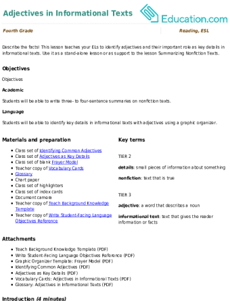
Describe the facts! This lesson teaches your ELs to identify adjectives and their important role as key details in informational texts. Use it as a stand-alone lesson or as support to the lesson Summarizing Nonfiction Texts.
Lesson Plan
Adjectives in Informational Texts
Lesson Plan
Adjectives in Informational Texts
Describe the facts! This lesson teaches your ELs to identify adjectives and their important role as key details in informational texts. Use it as a stand-alone lesson or as support to the lesson Summarizing Nonfiction Texts.
Fourth Grade
Lesson Plan
1
2
3
4
5
6