SKIP TO CONTENT
Worksheet Generator
Subjects
Grades
Worksheets
Games
Build a Worksheet
More Resources
Roly Recommends
Subjects
Grades
Worksheets
Games
Build a Worksheet
More Resources
Roly Recommends
Filters
Search for: similes, 1
✕
Lesson Plans
✕
Elementary School
✕
Subjects
Math
English Language Arts
Science
Social Studies
Grade Level
Pre-K
K
1st
2nd
3rd
4th
5th
6th
7th
8th
Early Childhood
Elementary School
Middle School
Resource Type
Worksheets
Games
Lesson Plans
Interactive Worksheets
Workbooks
Activities
Exercises
Stories
Songs
Offline Games
Guided Lessons
Teacher Resources
Teacher Editions
Common Core
Yes
Roly Recommends
Social Emotional Learning
English Language Support
Yes
See More
Clear All
View 2,195 results
Showing Results for similes 1 : Page 4
2,195 results
Search for: similes, 1
✕
Lesson Plans
✕
Elementary School
✕
Clear All
Sort by:
Relevance
Most recent
Most popular
Alphabetical A-Z
Alphabetical Z-A
All filters
2,195 results
Sort by:
Relevance
Most recent
Most popular
Alphabetical A-Z
Alphabetical Z-A
Multiplying by Multiples of 10
Lesson Plan
Multiplying by Multiples of 10
Third Grade
10, 20, 30, and up! In this lesson, students learn strategies for multiplying one-digit numbers by multiples of ten (10 through 90) through practice problems and playing a fun, hands-on game.
Lesson Plan
Multiplying by Multiples of 10
Lesson Plan
Multiplying by Multiples of 10
10, 20, 30, and up! In this lesson, students learn strategies for multiplying one-digit numbers by multiples of ten (10 through 90) through practice problems and playing a fun, hands-on game.
Third Grade
Lesson Plan
Five Busy Little Bees
Lesson Plan
Five Busy Little Bees
Pre-K
Numbers and Counting
Buzz, buzz! Can you count the five busy little bees? In this bee-themed lesson on counting and number recognition, students will use bees to learn how to count the numbers one through five.
Lesson Plan
Five Busy Little Bees
Lesson Plan
Five Busy Little Bees
Buzz, buzz! Can you count the five busy little bees? In this bee-themed lesson on counting and number recognition, students will use bees to learn how to count the numbers one through five.
Pre-K
Numbers and Counting
Lesson Plan
Solving Mixed Number Word Problems Using the Three-Reads Strategy
Lesson Plan
Solving Mixed Number Word Problems Using the Three-Reads Strategy
Fifth Grade
Fractions
There’s more than one way to add and subtract mixed numbers! Use this witty lesson plan to teach your students to illustrate mixed number sums and difference while giggling with delight.
Lesson Plan
Solving Mixed Number Word Problems Using the Three-Reads Strategy
Lesson Plan
Solving Mixed Number Word Problems Using the Three-Reads Strategy
There’s more than one way to add and subtract mixed numbers! Use this witty lesson plan to teach your students to illustrate mixed number sums and difference while giggling with delight.
Fifth Grade
Fractions
Lesson Plan
Springtime Interview
Lesson Plan
Springtime Interview
First Grade
It's springtime! What better way to celebrate than by interviewing your classmate with a range of spring-related questions? Students will practice interviewing one another and recording answers using complete sentences.
Lesson Plan
Springtime Interview
Lesson Plan
Springtime Interview
It's springtime! What better way to celebrate than by interviewing your classmate with a range of spring-related questions? Students will practice interviewing one another and recording answers using complete sentences.
First Grade
Lesson Plan
A Hearty Valentine’s Day
Lesson Plan
A Hearty Valentine’s Day
Third Grade
Happy Valentine’s Day! Use this fun hands-on lesson with your students to practice solving division problems with one-digit divisors. Students will explore different strategies they can use to solve division problems.
Lesson Plan
A Hearty Valentine’s Day
Lesson Plan
A Hearty Valentine’s Day
Happy Valentine’s Day! Use this fun hands-on lesson with your students to practice solving division problems with one-digit divisors. Students will explore different strategies they can use to solve division problems.
Third Grade
Lesson Plan
Counting Hours: What Time Is It?
Lesson Plan
Counting Hours: What Time Is It?
First Grade
Give first graders a sense of time by introducing them to telling time by the hour. Students who have mastered the numbers 1 to 12 will be eager to keep the class on a time schedule.
Lesson Plan
Counting Hours: What Time Is It?
Lesson Plan
Counting Hours: What Time Is It?
Give first graders a sense of time by introducing them to telling time by the hour. Students who have mastered the numbers 1 to 12 will be eager to keep the class on a time schedule.
First Grade
Lesson Plan
All About Plural Nouns
Lesson Plan
All About Plural Nouns
Kindergarten
This lesson plan is a great introduction to recognizing and forming plural nouns for your kindergarten ELs. This can be used as a stand alone or support lesson for the More Than One Nouns lesson plan.
Lesson Plan
All About Plural Nouns
Lesson Plan
All About Plural Nouns
This lesson plan is a great introduction to recognizing and forming plural nouns for your kindergarten ELs. This can be used as a stand alone or support lesson for the More Than One Nouns lesson plan.
Kindergarten
Lesson Plan
Rhyming Word Family Fun Houses
Lesson Plan
Rhyming Word Family Fun Houses
Kindergarten
Word Families
It's rhyme time! Students will color-code rhyming words and put each one in its “word family house” with this fun rhyming mini book and fill in the "stair steps" writing activity page.
Lesson Plan
Rhyming Word Family Fun Houses
Lesson Plan
Rhyming Word Family Fun Houses
It's rhyme time! Students will color-code rhyming words and put each one in its “word family house” with this fun rhyming mini book and fill in the "stair steps" writing activity page.
Kindergarten
Word Families
Lesson Plan
Counting Collections
Lesson Plan
Counting Collections
First Grade
Counting collections are a great way to help students practice counting while gaining practice recording and justifying their thinking. Students will work specifically with the numbers 1-30 to develop fluency counting and writing numbers.
Lesson Plan
Counting Collections
Lesson Plan
Counting Collections
Counting collections are a great way to help students practice counting while gaining practice recording and justifying their thinking. Students will work specifically with the numbers 1-30 to develop fluency counting and writing numbers.
First Grade
Lesson Plan
Hundreds Chart Hunt
Lesson Plan
Hundreds Chart Hunt
First Grade
Place Value
Expose your students to numerical sequencing and patterns with an interactive lesson that focuses on identifying, writing, and ordering numbers from 1-100. This lesson can be used alone or with the lesson plan
Popping Numbers.
Lesson Plan
Hundreds Chart Hunt
Lesson Plan
Hundreds Chart Hunt
Expose your students to numerical sequencing and patterns with an interactive lesson that focuses on identifying, writing, and ordering numbers from 1-100. This lesson can be used alone or with the lesson plan
Popping Numbers.
First Grade
Place Value
Lesson Plan
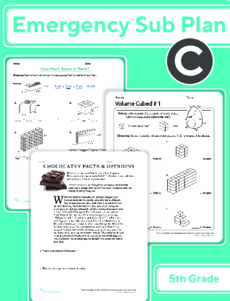
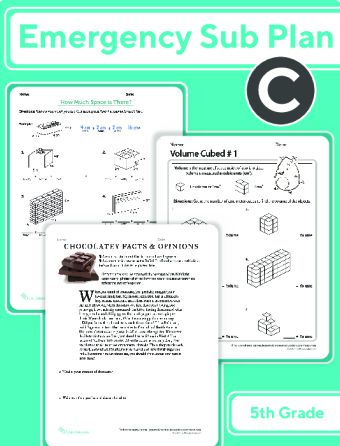
Fifth Grade Daily Sub Plan C
Lesson Plan
Fifth Grade Daily Sub Plan C
Fifth Grade
Substitutes can keep your students learning in your absence by using these engaging lessons, worksheets, and activities. In this one-day sub plan, students will measure volume, consider facts and opinions, and write an opinion piece.
Lesson Plan
Fifth Grade Daily Sub Plan C
Lesson Plan
Fifth Grade Daily Sub Plan C
Substitutes can keep your students learning in your absence by using these engaging lessons, worksheets, and activities. In this one-day sub plan, students will measure volume, consider facts and opinions, and write an opinion piece.
Fifth Grade
Lesson Plan
Add a Ten!
Lesson Plan
Add a Ten!
First Grade
What first grader wouldn't want ten dollars? This lesson uses one and ten dollar bills to teach students place value concepts as they develop fluency adding multiples of 10. Use alone or with the lesson plan
Ten Time.
Lesson Plan
Add a Ten!
Lesson Plan
Add a Ten!
What first grader wouldn't want ten dollars? This lesson uses one and ten dollar bills to teach students place value concepts as they develop fluency adding multiples of 10. Use alone or with the lesson plan
Ten Time.
First Grade
Lesson Plan
Fact or Opinion
Lesson Plan
Fact or Opinion
Second Grade
Help your ELs learn to understand and differentiate between fact and opinion through the analysis of nonfiction text. This can be a stand-alone lesson or a support lesson to the Fact or Opinion: Part 1 lesson plan.
Lesson Plan
Fact or Opinion
Lesson Plan
Fact or Opinion
Help your ELs learn to understand and differentiate between fact and opinion through the analysis of nonfiction text. This can be a stand-alone lesson or a support lesson to the Fact or Opinion: Part 1 lesson plan.
Second Grade
Lesson Plan
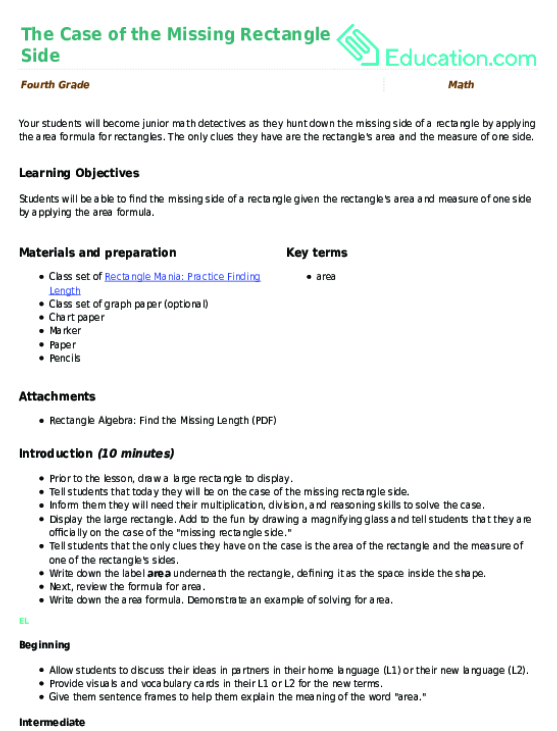
The Case of the Missing Rectangle Side
Lesson Plan
The Case of the Missing Rectangle Side
Fourth Grade
Your students will become junior math detectives as they hunt down the missing side of a rectangle by applying the area formula for rectangles. The only clues they have are the rectangle's area and the measure of one side.
Lesson Plan
The Case of the Missing Rectangle Side
Lesson Plan
The Case of the Missing Rectangle Side
Your students will become junior math detectives as they hunt down the missing side of a rectangle by applying the area formula for rectangles. The only clues they have are the rectangle's area and the measure of one side.
Fourth Grade
Lesson Plan
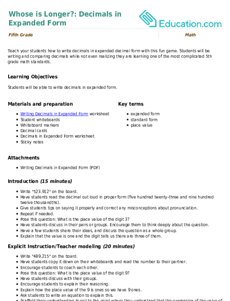
Whose is Longer?: Decimals in Expanded Form
Lesson Plan
Whose is Longer?: Decimals in Expanded Form
Fifth Grade
Decimals
Teach your students how to write decimals in expanded decimal form with this fun game. Students will be writing and comparing decimals while not even realizing they are learning one of the most complicated 5th grade math standards.
Lesson Plan
Whose is Longer?: Decimals in Expanded Form
Lesson Plan
Whose is Longer?: Decimals in Expanded Form
Teach your students how to write decimals in expanded decimal form with this fun game. Students will be writing and comparing decimals while not even realizing they are learning one of the most complicated 5th grade math standards.
Fifth Grade
Decimals
Lesson Plan
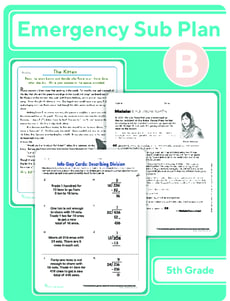
Fifth Grade Daily Sub Plan B
Lesson Plan
Fifth Grade Daily Sub Plan B
Fifth Grade
Substitutes can keep your students learning in your absence by using these engaging lessons, worksheets, and activities. In this one-day sub plan, students will fluently solve division problems, write a fictional piece, and read fictional stories closely.
Lesson Plan
Fifth Grade Daily Sub Plan B
Lesson Plan
Fifth Grade Daily Sub Plan B
Substitutes can keep your students learning in your absence by using these engaging lessons, worksheets, and activities. In this one-day sub plan, students will fluently solve division problems, write a fictional piece, and read fictional stories closely.
Fifth Grade
Lesson Plan
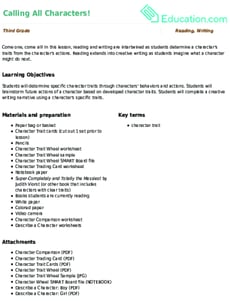
Calling All Characters!
Lesson Plan
Calling All Characters!
Third Grade
Come one, come all! In this lesson, reading and writing are intertwined as students determine a character's traits from the character's actions. Reading extends into creative writing as students imagine what a character might do next.
Lesson Plan
Calling All Characters!
Lesson Plan
Calling All Characters!
Come one, come all! In this lesson, reading and writing are intertwined as students determine a character's traits from the character's actions. Reading extends into creative writing as students imagine what a character might do next.
Third Grade
Lesson Plan
Comparing Even and Odd Groups
Lesson Plan
Comparing Even and Odd Groups
Second Grade
This lesson helps students identify even and odd numbers, which sets the foundation for learning about division, prime numbers, and even square roots. Use this hands on lesson alongside Odd One Out!
Lesson Plan
Comparing Even and Odd Groups
Lesson Plan
Comparing Even and Odd Groups
This lesson helps students identify even and odd numbers, which sets the foundation for learning about division, prime numbers, and even square roots. Use this hands on lesson alongside Odd One Out!
Second Grade
Lesson Plan
Finding Area: What Information Do I Need?
Lesson Plan
Finding Area: What Information Do I Need?
Third Grade
You need the length and the width to find the area of a rectangle or square, but what if one piece of information is missing? Use this lesson alongside
What's My Area?
or on its own.
Lesson Plan
Finding Area: What Information Do I Need?
Lesson Plan
Finding Area: What Information Do I Need?
You need the length and the width to find the area of a rectangle or square, but what if one piece of information is missing? Use this lesson alongside
What's My Area?
or on its own.
Third Grade
Lesson Plan
Who? What? When? Where? Why?
Lesson Plan
Who? What? When? Where? Why?
First Grade
Your students are probably used to answering questions. Give them a chance to ask their own with this imaginative lesson on reading comprehension and the ways one can use who, what, when, where, and why.
Lesson Plan
Who? What? When? Where? Why?
Lesson Plan
Who? What? When? Where? Why?
Your students are probably used to answering questions. Give them a chance to ask their own with this imaginative lesson on reading comprehension and the ways one can use who, what, when, where, and why.
First Grade
Lesson Plan
What's Your Phase?
Lesson Plan
What's Your Phase?
Third Grade
Earth and Space Science
This lesson engages students in activity to help them understand the phases of the Moon, and why they occur. Students read literature, analyze it, and then apply it to the small group performance of one cycle of the Moon’s phases.
Lesson Plan
What's Your Phase?
Lesson Plan
What's Your Phase?
This lesson engages students in activity to help them understand the phases of the Moon, and why they occur. Students read literature, analyze it, and then apply it to the small group performance of one cycle of the Moon’s phases.
Third Grade
Earth and Space Science
Lesson Plan
Strategies for Multiplying by Multiples of 10
Lesson Plan
Strategies for Multiplying by Multiples of 10
Third Grade
Help your students become detail-oriented mathematicians as they explore two strategies for multiplying a one-digit number by a multiple of 10. Use this as a stand alone lesson or alongside
Multiplying by Multiples of 10.
Lesson Plan
Strategies for Multiplying by Multiples of 10
Lesson Plan
Strategies for Multiplying by Multiples of 10
Help your students become detail-oriented mathematicians as they explore two strategies for multiplying a one-digit number by a multiple of 10. Use this as a stand alone lesson or alongside
Multiplying by Multiples of 10.
Third Grade
Lesson Plan
Living or Nonliving? How to Tell
Lesson Plan
Living or Nonliving? How to Tell
Second Grade
Life Science
One of the basic concepts in science is recognizing that all things can be classified as living or nonliving. In this lesson, your students will explore the characteristics of living and nonliving things with engaging hands-on activities.
Lesson Plan
Living or Nonliving? How to Tell
Lesson Plan
Living or Nonliving? How to Tell
One of the basic concepts in science is recognizing that all things can be classified as living or nonliving. In this lesson, your students will explore the characteristics of living and nonliving things with engaging hands-on activities.
Second Grade
Life Science
Lesson Plan
Chemistry Is Marie Curie
Lesson Plan
Chemistry Is Marie Curie
Fourth Grade
Reading
Marie Curie’s monumental achievements in chemistry and physics are remarkable. In this lesson, your students will read two accounts of her life, integrate the details, and assess the importance of having more than one source of information.
Lesson Plan
Chemistry Is Marie Curie
Lesson Plan
Chemistry Is Marie Curie
Marie Curie’s monumental achievements in chemistry and physics are remarkable. In this lesson, your students will read two accounts of her life, integrate the details, and assess the importance of having more than one source of information.
Fourth Grade
Reading
Lesson Plan
101 and Out!
Lesson Plan
101 and Out!
Second Grade
Get the dice out and help students get targeted practice in adding 1 and 10! In this fun place value game, students keep adding to try to get to a maximum score of 100. But be careful. If you go over 100 you’re out!
Lesson Plan
101 and Out!
Lesson Plan
101 and Out!
Get the dice out and help students get targeted practice in adding 1 and 10! In this fun place value game, students keep adding to try to get to a maximum score of 100. But be careful. If you go over 100 you’re out!
Second Grade
Lesson Plan
Parts of Speech: Interjections
Lesson Plan
Parts of Speech: Interjections
Fourth Grade
Grammar and Mechanics
Interjections, one of the eight parts of speech, can be the most exciting. They help students interject some fun and drama into their writing and conversations. In this lesson, they'll brainstorm how to use interjections in their sentences.
Lesson Plan
Parts of Speech: Interjections
Lesson Plan
Parts of Speech: Interjections
Interjections, one of the eight parts of speech, can be the most exciting. They help students interject some fun and drama into their writing and conversations. In this lesson, they'll brainstorm how to use interjections in their sentences.
Fourth Grade
Grammar and Mechanics
Lesson Plan
Graphing Data: Tally Marks and Bar Graphs
Lesson Plan
Graphing Data: Tally Marks and Bar Graphs
First Grade
Collecting and graphing data can be a fantastic tool for getting to know your students and for your students to get to know one another! In this lesson, students will poll their classmates to gather data and then graph the results!
Lesson Plan
Graphing Data: Tally Marks and Bar Graphs
Lesson Plan
Graphing Data: Tally Marks and Bar Graphs
Collecting and graphing data can be a fantastic tool for getting to know your students and for your students to get to know one another! In this lesson, students will poll their classmates to gather data and then graph the results!
First Grade
Lesson Plan
Parts of Speech and Using Suffixes to Turn Adjectives Into Nouns
Lesson Plan
Parts of Speech and Using Suffixes to Turn Adjectives Into Nouns
Fifth Grade
This engaging lesson will revisit the basic parts of speech and address why some words have can have more than one part of speech. Students will then enjoy a fun group challenge to turn adjectives into nouns by modifying the word endings.
Lesson Plan
Parts of Speech and Using Suffixes to Turn Adjectives Into Nouns
Lesson Plan
Parts of Speech and Using Suffixes to Turn Adjectives Into Nouns
This engaging lesson will revisit the basic parts of speech and address why some words have can have more than one part of speech. Students will then enjoy a fun group challenge to turn adjectives into nouns by modifying the word endings.
Fifth Grade
Lesson Plan
Flipped Coin
Lesson Plan
Flipped Coin
Fourth Grade
In this lesson, students will listen to, discuss, and understand two perspectives on a difficult situation. They will flip a coin, with each side representing one side of the story, and role-play the perspectives and reach a resolution.
Lesson Plan
Flipped Coin
Lesson Plan
Flipped Coin
In this lesson, students will listen to, discuss, and understand two perspectives on a difficult situation. They will flip a coin, with each side representing one side of the story, and role-play the perspectives and reach a resolution.
Fourth Grade
Lesson Plan
Short Vowel Name Sort
Lesson Plan
Short Vowel Name Sort
First Grade
Phonics
Short vowels can be found just about anywhere. One great place to look is inside your own classroom. In this lesson, students will enjoy going through the class list to sort the names of their peers based on short vowel sounds.
Lesson Plan
Short Vowel Name Sort
Lesson Plan
Short Vowel Name Sort
Short vowels can be found just about anywhere. One great place to look is inside your own classroom. In this lesson, students will enjoy going through the class list to sort the names of their peers based on short vowel sounds.
First Grade
Phonics
Lesson Plan
1
2
3
4
5
…
74