SKIP TO CONTENT
Worksheet Generator
Subjects
Grades
Worksheets
Games
Build a Worksheet
More Resources
Roly Recommends
Subjects
Grades
Worksheets
Games
Build a Worksheet
More Resources
Roly Recommends
Filters
Search for: learn, to, multiply
✕
Lesson Plans
✕
Elementary School
✕
Subjects
Math
English Language Arts
Science
Social Studies
Grade Level
Pre-K
K
1st
2nd
3rd
4th
5th
6th
7th
8th
Early Childhood
Elementary School
Middle School
Resource Type
Worksheets
Games
Lesson Plans
Interactive Worksheets
Workbooks
Activities
Exercises
Stories
Songs
Offline Games
Guided Lessons
Teacher Resources
Common Core
Yes
Roly Recommends
Social Emotional Learning
English Language Support
Yes
See More
Clear All
View 1,037 results
Showing Results for learn to multiply : Page 12
1,037 results
Search for: learn, to, multiply
✕
Lesson Plans
✕
Elementary School
✕
Clear All
Sort by:
Relevance
Most recent
Most popular
Alphabetical A-Z
Alphabetical Z-A
All filters
1,037 results
Sort by:
Relevance
Most recent
Most popular
Alphabetical A-Z
Alphabetical Z-A
Ben Franklin
Lesson Plan
Ben Franklin
Fifth Grade
History
Benjamin Franklin wasn't just a Founding Father of the United States of America—he was so much more. In this lesson, students will learn how Ben Franklin changed the shape of Philadelphia.
Lesson Plan
Ben Franklin
Lesson Plan
Ben Franklin
Benjamin Franklin wasn't just a Founding Father of the United States of America—he was so much more. In this lesson, students will learn how Ben Franklin changed the shape of Philadelphia.
Fifth Grade
History
Lesson Plan
Go Fish! Homophones
Lesson Plan
Go Fish! Homophones
Third Grade
Students will love this lesson where they learn about homophones while playing a card game! Students will also get the chance to use their new found knowledge in a fun story setting.
Lesson Plan
Go Fish! Homophones
Lesson Plan
Go Fish! Homophones
Students will love this lesson where they learn about homophones while playing a card game! Students will also get the chance to use their new found knowledge in a fun story setting.
Third Grade
Lesson Plan
Combining Words
Lesson Plan
Combining Words
Fifth Grade
Condense and combine! In this lesson, students will learn how to combine words to form contractions and hyphenated compound words. Spelling becomes easy when it’s just a matter of pairing words up!
Lesson Plan
Combining Words
Lesson Plan
Combining Words
Condense and combine! In this lesson, students will learn how to combine words to form contractions and hyphenated compound words. Spelling becomes easy when it’s just a matter of pairing words up!
Fifth Grade
Lesson Plan
Pondering Prefixes
Lesson Plan
Pondering Prefixes
Fourth Grade
Beyond just prefix identification, this meaty lesson taps into your students’ thinking. Using a combination of analogies, constructing, and deconstructing words with prefixes, students will learn the meaning and mechanics of prefixes.
Lesson Plan
Pondering Prefixes
Lesson Plan
Pondering Prefixes
Beyond just prefix identification, this meaty lesson taps into your students’ thinking. Using a combination of analogies, constructing, and deconstructing words with prefixes, students will learn the meaning and mechanics of prefixes.
Fourth Grade
Lesson Plan
Fairy Tales: Identifying Story Elements
Lesson Plan
Fairy Tales: Identifying Story Elements
Second Grade
Reading
Story elements help to bring beloved fairy tales to life in this literacy lesson. Your students will learn to identify the title, author, setting, characters, problem, and solution in a fiction text.
Lesson Plan
Fairy Tales: Identifying Story Elements
Lesson Plan
Fairy Tales: Identifying Story Elements
Story elements help to bring beloved fairy tales to life in this literacy lesson. Your students will learn to identify the title, author, setting, characters, problem, and solution in a fiction text.
Second Grade
Reading
Lesson Plan
Stop and Jot!
Lesson Plan
Stop and Jot!
First Grade
Use this interactive activity to help students learn blends and digraphs and the active reading strategy stop and jot! This lesson can be used as a stand alone activity or a support lesson.
Lesson Plan
Stop and Jot!
Lesson Plan
Stop and Jot!
Use this interactive activity to help students learn blends and digraphs and the active reading strategy stop and jot! This lesson can be used as a stand alone activity or a support lesson.
First Grade
Lesson Plan
Choosing Character Traits
Lesson Plan
Choosing Character Traits
Third Grade
Reading
Use this lesson to help your ELs learn character traits and find them in a text. It can be a stand-alone lesson or a support lesson to the Identifying Character Traits lesson.
Lesson Plan
Choosing Character Traits
Lesson Plan
Choosing Character Traits
Use this lesson to help your ELs learn character traits and find them in a text. It can be a stand-alone lesson or a support lesson to the Identifying Character Traits lesson.
Third Grade
Reading
Lesson Plan
Rounding Up and Down
Lesson Plan
Rounding Up and Down
Third Grade
Give your students a head start in rounding with this fun lesson that gives them an easy trick to help them learn if they should round up or down to the nearest 10.
Lesson Plan
Rounding Up and Down
Lesson Plan
Rounding Up and Down
Give your students a head start in rounding with this fun lesson that gives them an easy trick to help them learn if they should round up or down to the nearest 10.
Third Grade
Lesson Plan
Sounds Familiar!
Lesson Plan
Sounds Familiar!
Fourth Grade
Reading is about to come alive with onomatopoeia! In this lesson students will learn to differentiate between alliteration and onomatopoeia and practice determining how onomatopoeia is used by authors to convey rich meaning.
Lesson Plan
Sounds Familiar!
Lesson Plan
Sounds Familiar!
Reading is about to come alive with onomatopoeia! In this lesson students will learn to differentiate between alliteration and onomatopoeia and practice determining how onomatopoeia is used by authors to convey rich meaning.
Fourth Grade
Lesson Plan
Story vs. Poem
Lesson Plan
Story vs. Poem
First Grade
Reading
What makes a poem a poem? And what makes a story a story? In this lesson, students learn to distinguish between different types of texts while analyzing the sentences and words they encounter.
Lesson Plan
Story vs. Poem
Lesson Plan
Story vs. Poem
What makes a poem a poem? And what makes a story a story? In this lesson, students learn to distinguish between different types of texts while analyzing the sentences and words they encounter.
First Grade
Reading
Lesson Plan
A.M. or P.M.?
Lesson Plan
A.M. or P.M.?
First Grade
Help your students learn the difference between a.m. and p.m. while getting them comfortable with the idea of telling time with this lesson that has them identify whether they would do a given activity in the morning or evening.
Lesson Plan
A.M. or P.M.?
Lesson Plan
A.M. or P.M.?
Help your students learn the difference between a.m. and p.m. while getting them comfortable with the idea of telling time with this lesson that has them identify whether they would do a given activity in the morning or evening.
First Grade
Lesson Plan
Adverb Basics
Lesson Plan
Adverb Basics
Fourth Grade
Adverbs—they're anything but basic! Introduce your students to a misunderstood part of speech with this adverb lesson plan. Students will learn to identify the different ways adverbs are used before writing their own descriptive sentences.
Lesson Plan
Adverb Basics
Lesson Plan
Adverb Basics
Adverbs—they're anything but basic! Introduce your students to a misunderstood part of speech with this adverb lesson plan. Students will learn to identify the different ways adverbs are used before writing their own descriptive sentences.
Fourth Grade
Lesson Plan
Fill My Cup (Gratitude Jar)
Lesson Plan
Fill My Cup (Gratitude Jar)
Kindergarten
In this lesson, students will discuss, generate a list, and practice appropriate activities that may improve the way they feel. Students will engage in a gratitude practice and learn strategies for changing their mood.
Lesson Plan
Fill My Cup (Gratitude Jar)
Lesson Plan
Fill My Cup (Gratitude Jar)
In this lesson, students will discuss, generate a list, and practice appropriate activities that may improve the way they feel. Students will engage in a gratitude practice and learn strategies for changing their mood.
Kindergarten
Lesson Plan
Less Than or Greater Than Alligators
Lesson Plan
Less Than or Greater Than Alligators
First Grade
Your students will learn when to use less than and greater than and how to differentiate the two symbols in this lesson. They will have fun playing the role of the Less Than and Greater Than alligators!
Lesson Plan
Less Than or Greater Than Alligators
Lesson Plan
Less Than or Greater Than Alligators
Your students will learn when to use less than and greater than and how to differentiate the two symbols in this lesson. They will have fun playing the role of the Less Than and Greater Than alligators!
First Grade
Lesson Plan
Place Value Hop
Lesson Plan
Place Value Hop
Second Grade
Place Value
Your students will “hop their way” into understanding place value with this fun and active game! In this lesson, they will learn that changing the order of the digits in a number changes its value.
Lesson Plan
Place Value Hop
Lesson Plan
Place Value Hop
Your students will “hop their way” into understanding place value with this fun and active game! In this lesson, they will learn that changing the order of the digits in a number changes its value.
Second Grade
Place Value
Lesson Plan
Sentence Variety
Lesson Plan
Sentence Variety
Fourth Grade
During this lesson, students will learn how to edit their writing. They will edit their writing by adding variety to their sentences. Students will also work on writing sentences that are clearer to the reader.
Lesson Plan
Sentence Variety
Lesson Plan
Sentence Variety
During this lesson, students will learn how to edit their writing. They will edit their writing by adding variety to their sentences. Students will also work on writing sentences that are clearer to the reader.
Fourth Grade
Lesson Plan
Linking Line Plots and Fractions
Lesson Plan
Linking Line Plots and Fractions
Fifth Grade
Fractions
Can your students link line plots with fractions? In this interactive, hands-on math lesson, students will learn how to use a line plot to add fractions and solve corresponding word problems.
Lesson Plan
Linking Line Plots and Fractions
Lesson Plan
Linking Line Plots and Fractions
Can your students link line plots with fractions? In this interactive, hands-on math lesson, students will learn how to use a line plot to add fractions and solve corresponding word problems.
Fifth Grade
Fractions
Lesson Plan
Parts of Speech: Breaking Down Sentences
Lesson Plan
Parts of Speech: Breaking Down Sentences
Third Grade
Reading
Let your students find out that the sentences they speak so easily are formed of many different parts. Have them break down sentences to learn the various parts that form a sentence!
Lesson Plan
Parts of Speech: Breaking Down Sentences
Lesson Plan
Parts of Speech: Breaking Down Sentences
Let your students find out that the sentences they speak so easily are formed of many different parts. Have them break down sentences to learn the various parts that form a sentence!
Third Grade
Reading
Lesson Plan
Just a Minute
Lesson Plan
Just a Minute
Third Grade
Help your students learn how long a minute is with this lesson that shows them how the length of a minute can appear to change depending on the activity, all while putting their time estimation skills to the test.
Lesson Plan
Just a Minute
Lesson Plan
Just a Minute
Help your students learn how long a minute is with this lesson that shows them how the length of a minute can appear to change depending on the activity, all while putting their time estimation skills to the test.
Third Grade
Lesson Plan
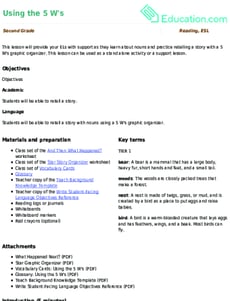
Using the 5 W's
Lesson Plan
Using the 5 W's
Second Grade
Reading
This lesson will provide your ELs with support as they learn about nouns and practice retelling a story with a 5 W's graphic organizer. This lesson can be used as a stand alone activity or a support lesson.
Lesson Plan
Using the 5 W's
Lesson Plan
Using the 5 W's
This lesson will provide your ELs with support as they learn about nouns and practice retelling a story with a 5 W's graphic organizer. This lesson can be used as a stand alone activity or a support lesson.
Second Grade
Reading
Lesson Plan
Using Adjectives and Verbs to Make Writing Come to Life
Lesson Plan
Using Adjectives and Verbs to Make Writing Come to Life
Fourth Grade
Writing
Imagery is one of the most important tools in a narrative writer's arsenal. In this lesson, students will will learn to craft vivid scenes by selecting powerful verbs and adjectives, as well as to critique descriptive writing using the same criteria.
Lesson Plan
Using Adjectives and Verbs to Make Writing Come to Life
Lesson Plan
Using Adjectives and Verbs to Make Writing Come to Life
Imagery is one of the most important tools in a narrative writer's arsenal. In this lesson, students will will learn to craft vivid scenes by selecting powerful verbs and adjectives, as well as to critique descriptive writing using the same criteria.
Fourth Grade
Writing
Lesson Plan
To Groove or Not to Groove?
Lesson Plan
To Groove or Not to Groove?
Kindergarten
In this lesson, students explore ways they can give themselves more energy or help them relax. They will also learn that movement breaks are beneficial in releasing stress and tension and providing energy.
Lesson Plan
To Groove or Not to Groove?
Lesson Plan
To Groove or Not to Groove?
In this lesson, students explore ways they can give themselves more energy or help them relax. They will also learn that movement breaks are beneficial in releasing stress and tension and providing energy.
Kindergarten
Lesson Plan
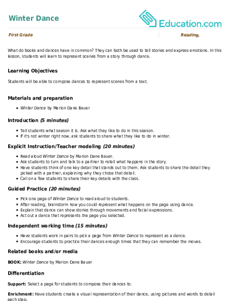
Winter Dance
Lesson Plan
Winter Dance
First Grade
What do books and dances have in common? They can both be used to tell stories and express emotions. In this lesson, students will learn to represent scenes from a story through dance.
Lesson Plan
Winter Dance
Lesson Plan
Winter Dance
What do books and dances have in common? They can both be used to tell stories and express emotions. In this lesson, students will learn to represent scenes from a story through dance.
First Grade
Lesson Plan
Reading to Find the Main Idea and Details
Lesson Plan
Reading to Find the Main Idea and Details
Fourth Grade
Writing
Informational texts isn't just found in textbooks. In this reading lesson, kids will examine the writing of a middle school student and use it to learn more about main ideas and supporting details.
Lesson Plan
Reading to Find the Main Idea and Details
Lesson Plan
Reading to Find the Main Idea and Details
Informational texts isn't just found in textbooks. In this reading lesson, kids will examine the writing of a middle school student and use it to learn more about main ideas and supporting details.
Fourth Grade
Writing
Lesson Plan
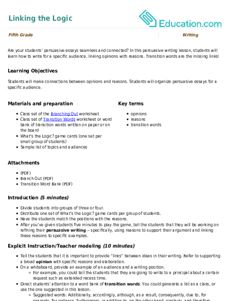
Linking the Logic
Lesson Plan
Linking the Logic
Fifth Grade
Are your students’ persuasive essays seamless and connected? In this persuasive writing lesson, students will learn how to write for a specific audience, linking opinions with reasons. Transition words are the missing links!
Lesson Plan
Linking the Logic
Lesson Plan
Linking the Logic
Are your students’ persuasive essays seamless and connected? In this persuasive writing lesson, students will learn how to write for a specific audience, linking opinions with reasons. Transition words are the missing links!
Fifth Grade
Lesson Plan
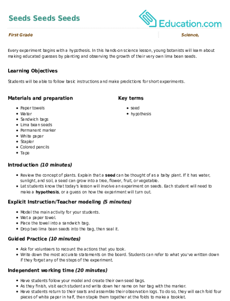
Seeds Seeds Seeds
Lesson Plan
Seeds Seeds Seeds
First Grade
Life Science
Every experiment begins with a hypothesis. In this hands-on science lesson, young botanists will learn about making educated guesses by planting and observing the growth of their very own lima bean seeds.
Lesson Plan
Seeds Seeds Seeds
Lesson Plan
Seeds Seeds Seeds
Every experiment begins with a hypothesis. In this hands-on science lesson, young botanists will learn about making educated guesses by planting and observing the growth of their very own lima bean seeds.
First Grade
Life Science
Lesson Plan
Just the Facts, Please!
Lesson Plan
Just the Facts, Please!
Kindergarten
Learning how to distinguish between facts and opinions is critical for the development of communication and social skills. In this lesson, students will learn the difference between facts and opinions through play and pictures.
Lesson Plan
Just the Facts, Please!
Lesson Plan
Just the Facts, Please!
Learning how to distinguish between facts and opinions is critical for the development of communication and social skills. In this lesson, students will learn the difference between facts and opinions through play and pictures.
Kindergarten
Lesson Plan
Paragraphs That POP!
Lesson Plan
Paragraphs That POP!
Fourth Grade
Writing
If young writers can learn how to write a solid paragraph, then they have the building blocks of an essay. In this lesson, students will study paragraph structure and practice organizing ideas into paragraphs.
Lesson Plan
Paragraphs That POP!
Lesson Plan
Paragraphs That POP!
If young writers can learn how to write a solid paragraph, then they have the building blocks of an essay. In this lesson, students will study paragraph structure and practice organizing ideas into paragraphs.
Fourth Grade
Writing
Lesson Plan
In Search of the Main Idea
Lesson Plan
In Search of the Main Idea
Third Grade
Writing
Young learners will love finding the main ideas in short informational texts. Featuring a bunch of fun worksheets, this lesson will help students learn about different topics while improving their reading skills.
Lesson Plan
In Search of the Main Idea
Lesson Plan
In Search of the Main Idea
Young learners will love finding the main ideas in short informational texts. Featuring a bunch of fun worksheets, this lesson will help students learn about different topics while improving their reading skills.
Third Grade
Writing
Lesson Plan
Fact or Opinion: Part 1
Lesson Plan
Fact or Opinion: Part 1
Second Grade
Vocabulary
Cats are the best! Pizza is better! My teacher rules! In Fact or Opinion: Part 1, your students will combine reading and writing to learn about the differences between facts and opinions and how those differences are communicated.
Lesson Plan
Fact or Opinion: Part 1
Lesson Plan
Fact or Opinion: Part 1
Cats are the best! Pizza is better! My teacher rules! In Fact or Opinion: Part 1, your students will combine reading and writing to learn about the differences between facts and opinions and how those differences are communicated.
Second Grade
Vocabulary
Lesson Plan
1
…
11
12
13
…
35