SKIP TO CONTENT
Worksheet Generator
Subjects
Grades
Worksheets
Games
Build a Worksheet
More Resources
Roly Recommends
Subjects
Grades
Worksheets
Games
Build a Worksheet
More Resources
Roly Recommends
Filters
Search for: detective
✕
Lesson Plans
✕
Elementary School
✕
Common Core
✕
Subjects
Math
English Language Arts
Grade Level
Pre-K
K
1st
2nd
3rd
4th
5th
6th
7th
8th
Early Childhood
Elementary School
Middle School
Resource Type
Worksheets
Games
Lesson Plans
Interactive Worksheets
Workbooks
Stories
Offline Games
Common Core
Yes
English Language Support
Yes
See More
Clear All
View 30 results
Showing Results for detective
30 results
Search for: detective
✕
Lesson Plans
✕
Elementary School
✕
Common Core
✕
Clear All
Sort by:
Relevance
Most recent
Most popular
Alphabetical A-Z
Alphabetical Z-A
All filters
30 results
Sort by:
Relevance
Most recent
Most popular
Alphabetical A-Z
Alphabetical Z-A
Be a Nonfiction Detective!
Lesson Plan
Be a Nonfiction Detective!
First Grade
Take the mystery out of comprehending nonfiction by becoming a text feature detective! Find clues before reading to get your brain ready to learn!
Lesson Plan
Be a Nonfiction Detective!
Lesson Plan
Be a Nonfiction Detective!
Take the mystery out of comprehending nonfiction by becoming a text feature detective! Find clues before reading to get your brain ready to learn!
First Grade
Lesson Plan
Detective Reading
Lesson Plan
Detective Reading
Fourth Grade
Reading
Roll up your sleeves and get out the magnifying glasses! In this lesson, your students will practice finding supportive details and examples in informational texts.
Lesson Plan
Detective Reading
Lesson Plan
Detective Reading
Roll up your sleeves and get out the magnifying glasses! In this lesson, your students will practice finding supportive details and examples in informational texts.
Fourth Grade
Reading
Lesson Plan
Informational Text: Citing Evidence Like a Detective
Lesson Plan
Informational Text: Citing Evidence Like a Detective
Third Grade
Vocabulary
Get your magnifying glasses—it’s time to play text detective. In this lesson, students will learn the importance of reading comprehension and making inferences while learning to correctly label the 5 Ws within a text.
Lesson Plan
Informational Text: Citing Evidence Like a Detective
Lesson Plan
Informational Text: Citing Evidence Like a Detective
Get your magnifying glasses—it’s time to play text detective. In this lesson, students will learn the importance of reading comprehension and making inferences while learning to correctly label the 5 Ws within a text.
Third Grade
Vocabulary
Lesson Plan
Text Feature Detective
Lesson Plan
Text Feature Detective
First Grade
Reading
From labeled pictures to glossaries, there are lots of different nonfiction text features for students to learn about. In this lesson, students hunt for text features while learning how they provide meaning and present information.
Lesson Plan
Text Feature Detective
Lesson Plan
Text Feature Detective
From labeled pictures to glossaries, there are lots of different nonfiction text features for students to learn about. In this lesson, students hunt for text features while learning how they provide meaning and present information.
First Grade
Reading
Lesson Plan
Sentence Detectives
Lesson Plan
Sentence Detectives
Second Grade
Are your students ready to become detectives? This engaging lesson will have them searching for clues while improving their reading skills.
Lesson Plan
Sentence Detectives
Lesson Plan
Sentence Detectives
Are your students ready to become detectives? This engaging lesson will have them searching for clues while improving their reading skills.
Second Grade
Lesson Plan
Word Detectives
Lesson Plan
Word Detectives
First Grade
In this lesson, students will practice finding and reading sight words in books. This lesson can be used alone or with the Context Clue Detectives lesson plan.
Lesson Plan
Word Detectives
Lesson Plan
Word Detectives
In this lesson, students will practice finding and reading sight words in books. This lesson can be used alone or with the Context Clue Detectives lesson plan.
First Grade
Lesson Plan
Character Detectives
Lesson Plan
Character Detectives
First Grade
Writing
Your students will learn all about what makes a fictional character special when they become character detectives! Use this lesson to introduce the concept of using key details from a text to gather information.
Lesson Plan
Character Detectives
Lesson Plan
Character Detectives
Your students will learn all about what makes a fictional character special when they become character detectives! Use this lesson to introduce the concept of using key details from a text to gather information.
First Grade
Writing
Lesson Plan
Is It the Same?
Lesson Plan
Is It the Same?
Kindergarten
Grammar and Mechanics
Students will enjoy this fast-paced lesson as they incorporate acting, reading, and detective work while learning how to use context clues in fiction.
Lesson Plan
Is It the Same?
Lesson Plan
Is It the Same?
Students will enjoy this fast-paced lesson as they incorporate acting, reading, and detective work while learning how to use context clues in fiction.
Kindergarten
Grammar and Mechanics
Lesson Plan
Counting Cookies!
Lesson Plan
Counting Cookies!
Pre-K
Your students will love helping two stuffed animals solve a cookie argument! They will practice their detective skills as they play a Missing Cookie Game.
Lesson Plan
Counting Cookies!
Lesson Plan
Counting Cookies!
Your students will love helping two stuffed animals solve a cookie argument! They will practice their detective skills as they play a Missing Cookie Game.
Pre-K
Lesson Plan
Context Clue Detectives
Lesson Plan
Context Clue Detectives
First Grade
Young detectives will have a blast as they find context clues and solve a mystery in this fun-filled lesson plan. By paying close attention to a story, students will figure out missing letters to decipher a hidden message.
Lesson Plan
Context Clue Detectives
Lesson Plan
Context Clue Detectives
Young detectives will have a blast as they find context clues and solve a mystery in this fun-filled lesson plan. By paying close attention to a story, students will figure out missing letters to decipher a hidden message.
First Grade
Lesson Plan
Prepositional Phrases as Key Details
Lesson Plan
Prepositional Phrases as Key Details
Fourth Grade
Writing
Help your ELs familiarize themselves with prepositional phrases as they search for supporting details in nonfiction texts. This lesson could stand alone or be taught prior to teaching the Detective Reading lesson.
Lesson Plan
Prepositional Phrases as Key Details
Lesson Plan
Prepositional Phrases as Key Details
Help your ELs familiarize themselves with prepositional phrases as they search for supporting details in nonfiction texts. This lesson could stand alone or be taught prior to teaching the Detective Reading lesson.
Fourth Grade
Writing
Lesson Plan
Unknown Words
Lesson Plan
Unknown Words
Second Grade
Reading
Increase student comprehension by teaching your students strategies to figure out the meaning of unknown words. This lesson can be used as a stand alone activity or a support lesson for the Be a Nonfiction Detective lesson.
Lesson Plan
Unknown Words
Lesson Plan
Unknown Words
Increase student comprehension by teaching your students strategies to figure out the meaning of unknown words. This lesson can be used as a stand alone activity or a support lesson for the Be a Nonfiction Detective lesson.
Second Grade
Reading
Lesson Plan
Subtraction Detectives: Missing Numbers
Lesson Plan
Subtraction Detectives: Missing Numbers
Third Grade
In this lesson, students must become detectives to solve for the missing number in each subtraction problem. They will develop and use their powers of mathematical reasoning using number bonds to find differences.
Lesson Plan
Subtraction Detectives: Missing Numbers
Lesson Plan
Subtraction Detectives: Missing Numbers
In this lesson, students must become detectives to solve for the missing number in each subtraction problem. They will develop and use their powers of mathematical reasoning using number bonds to find differences.
Third Grade
Lesson Plan
Inference Detectives
Lesson Plan
Inference Detectives
Fourth Grade
Vocabulary
It’s time to make an educated guess! In this lesson, your students will practice using their background knowledge and evidence from the text to make inferences in nonfiction pieces about Martin Luther King, Jr., and Cesar Chavez.
Lesson Plan
Inference Detectives
Lesson Plan
Inference Detectives
It’s time to make an educated guess! In this lesson, your students will practice using their background knowledge and evidence from the text to make inferences in nonfiction pieces about Martin Luther King, Jr., and Cesar Chavez.
Fourth Grade
Vocabulary
Lesson Plan
Root Word Detectives
Lesson Plan
Root Word Detectives
Fifth Grade
Vocabulary
In this lesson, your students will use root words and patterns to explore new and unfamiliar words.
Lesson Plan
Root Word Detectives
Lesson Plan
Root Word Detectives
In this lesson, your students will use root words and patterns to explore new and unfamiliar words.
Fifth Grade
Vocabulary
Lesson Plan
Shape Detectives: What's in the Bag?
Lesson Plan
Shape Detectives: What's in the Bag?
Second Grade
What's in the bag? This fun math lesson involves using defining attributes as clues to draw conclusions. Young learners will have a great time making guesses about different objects and creating their own shape riddles.
Lesson Plan
Shape Detectives: What's in the Bag?
Lesson Plan
Shape Detectives: What's in the Bag?
What's in the bag? This fun math lesson involves using defining attributes as clues to draw conclusions. Young learners will have a great time making guesses about different objects and creating their own shape riddles.
Second Grade
Lesson Plan
Super Sleuth
Lesson Plan
Super Sleuth
Second Grade
Your little detectives will love stretching their observation muscles in this lesson on sleuthing and finding clues. After paying close attention to their classmates, they'll make lists of clues and use them in a fun-filled guessing game.
Lesson Plan
Super Sleuth
Lesson Plan
Super Sleuth
Your little detectives will love stretching their observation muscles in this lesson on sleuthing and finding clues. After paying close attention to their classmates, they'll make lists of clues and use them in a fun-filled guessing game.
Second Grade
Lesson Plan
Capturing the Clues
Lesson Plan
Capturing the Clues
Third Grade
Vocabulary
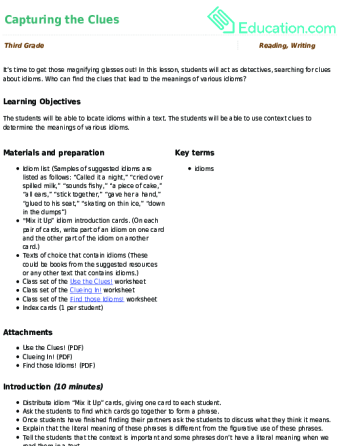
It’s time to get those magnifying glasses out! In this lesson, students will act as detectives, searching for clues about idioms. Who can find the clues that lead to the meanings of various idioms?
Lesson Plan
Capturing the Clues
Lesson Plan
Capturing the Clues
It’s time to get those magnifying glasses out! In this lesson, students will act as detectives, searching for clues about idioms. Who can find the clues that lead to the meanings of various idioms?
Third Grade
Vocabulary
Lesson Plan
The Case of the Missing Rectangle Side
Lesson Plan
The Case of the Missing Rectangle Side
Fourth Grade
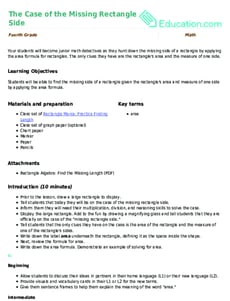
Your students will become junior math detectives as they hunt down the missing side of a rectangle by applying the area formula for rectangles. The only clues they have are the rectangle's area and the measure of one side.
Lesson Plan
The Case of the Missing Rectangle Side
Lesson Plan
The Case of the Missing Rectangle Side
Your students will become junior math detectives as they hunt down the missing side of a rectangle by applying the area formula for rectangles. The only clues they have are the rectangle's area and the measure of one side.
Fourth Grade
Lesson Plan
Steps to Make an Inference
Lesson Plan
Steps to Make an Inference
Fourth Grade
Vocabulary
It's time to infer! Students will read a variety of short passages and make inferences using modals and a step-by-step graphic organizer. It can be used on its own or as support for the lesson Inference Detectives.
Lesson Plan
Steps to Make an Inference
Lesson Plan
Steps to Make an Inference
It's time to infer! Students will read a variety of short passages and make inferences using modals and a step-by-step graphic organizer. It can be used on its own or as support for the lesson Inference Detectives.
Fourth Grade
Vocabulary
Lesson Plan
Fact or Opinion
Lesson Plan
Fact or Opinion
Third Grade
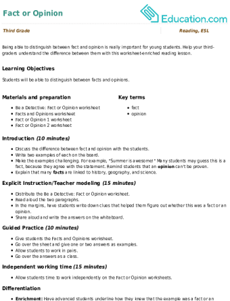
Being able to distinguish between fact and opinion is really important for young students. Help your third-graders understand the difference between them with this worksheet-enriched reading lesson.
Lesson Plan
Fact or Opinion
Lesson Plan
Fact or Opinion
Being able to distinguish between fact and opinion is really important for young students. Help your third-graders understand the difference between them with this worksheet-enriched reading lesson.
Third Grade
Lesson Plan
F is for Fire Safety!
Lesson Plan
F is for Fire Safety!
Pre-K
Handwriting
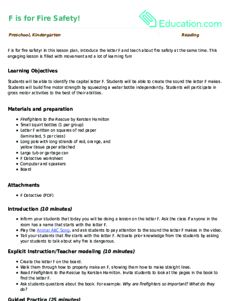
F is for fire safety! In this lesson plan, introduce the letter F and teach about fire safety at the same time. This engaging lesson is filled with movement and a lot of learning fun!
Lesson Plan
F is for Fire Safety!
Lesson Plan
F is for Fire Safety!
F is for fire safety! In this lesson plan, introduce the letter F and teach about fire safety at the same time. This engaging lesson is filled with movement and a lot of learning fun!
Pre-K
Handwriting
Lesson Plan
Comparing Texts by the Same Author
Lesson Plan
Comparing Texts by the Same Author
Third Grade
Reading
Getting hooked on a series or type of character creates reader engagement! Use this lesson to challenge your students to compare and contrast fictional texts as they find the joy in reading books by the same author.
Lesson Plan
Comparing Texts by the Same Author
Lesson Plan
Comparing Texts by the Same Author
Getting hooked on a series or type of character creates reader engagement! Use this lesson to challenge your students to compare and contrast fictional texts as they find the joy in reading books by the same author.
Third Grade
Reading
Lesson Plan
Distinguish Between Facts and Opinions
Lesson Plan
Distinguish Between Facts and Opinions
Third Grade
Teach your students the difference between facts and opinions, and why an author would choose to use each type of information. This can stand-alone or be used as a pre-lesson for the
Exploring Author's Purpose and Point of View
lesson.
Lesson Plan
Distinguish Between Facts and Opinions
Lesson Plan
Distinguish Between Facts and Opinions
Teach your students the difference between facts and opinions, and why an author would choose to use each type of information. This can stand-alone or be used as a pre-lesson for the
Exploring Author's Purpose and Point of View
lesson.
Third Grade
Lesson Plan
Summertime Math Stories
Lesson Plan
Summertime Math Stories
Second Grade
Addition
Give your students the resources they need to solve word problems with this math lesson. Your class will learn how to categorize important keywords using a WIKED map, a visual tool that helps them through the problem-solving process.
Lesson Plan
Summertime Math Stories
Lesson Plan
Summertime Math Stories
Give your students the resources they need to solve word problems with this math lesson. Your class will learn how to categorize important keywords using a WIKED map, a visual tool that helps them through the problem-solving process.
Second Grade
Addition
Lesson Plan
Adorable Adjectives!
Lesson Plan
Adorable Adjectives!
First Grade
Encourage your kids to describe the world around them with this vibrant lesson on adjectives. Using various images and their own vocabularies, students will write descriptions for a multitude of different things.
Lesson Plan
Adorable Adjectives!
Lesson Plan
Adorable Adjectives!
Encourage your kids to describe the world around them with this vibrant lesson on adjectives. Using various images and their own vocabularies, students will write descriptions for a multitude of different things.
First Grade
Lesson Plan
Things We Love: Counting to 100
Lesson Plan
Things We Love: Counting to 100
Kindergarten
Numbers and Counting
In this fun literature and art infused lesson plan, students will learn how to use a hundreds chart when extending the number sequence to 100! Can be used as a stand alone or support lesson plan for the
Number Jump
lesson.
Lesson Plan
Things We Love: Counting to 100
Lesson Plan
Things We Love: Counting to 100
In this fun literature and art infused lesson plan, students will learn how to use a hundreds chart when extending the number sequence to 100! Can be used as a stand alone or support lesson plan for the
Number Jump
lesson.
Kindergarten
Numbers and Counting
Lesson Plan
What's For Breakfast?
Lesson Plan
What's For Breakfast?
Fourth Grade
Reading
Teach your class to develop strong inferencing skills by focusing on clues and hard evidence. In this lesson, students will play a game of “What’s for Breakfast?” to help them link context clues with word meaning.
Lesson Plan
What's For Breakfast?
Lesson Plan
What's For Breakfast?
Teach your class to develop strong inferencing skills by focusing on clues and hard evidence. In this lesson, students will play a game of “What’s for Breakfast?” to help them link context clues with word meaning.
Fourth Grade
Reading
Lesson Plan
Multiplying with Arrays
Lesson Plan
Multiplying with Arrays
Fourth Grade
Writing
Making mistakes helps us learn! Your students will flex their analytical muscles to pinpoint errors in multiplication problems using arrays. Use the lesson on its own or as support to Base Ten Arrays for Multi-Digit Multiplication.
Lesson Plan
Multiplying with Arrays
Lesson Plan
Multiplying with Arrays
Making mistakes helps us learn! Your students will flex their analytical muscles to pinpoint errors in multiplication problems using arrays. Use the lesson on its own or as support to Base Ten Arrays for Multi-Digit Multiplication.
Fourth Grade
Writing
Lesson Plan
Making Predictions Lesson
Lesson Plan
Making Predictions Lesson
Third Grade
This lesson thoughtfully scaffolds the reading skill of predicting. Students are introduced to the concept and get to practice making predictions. They will apply what they have learned during a focused independent reading activity.
Lesson Plan
Making Predictions Lesson
Lesson Plan
Making Predictions Lesson
This lesson thoughtfully scaffolds the reading skill of predicting. Students are introduced to the concept and get to practice making predictions. They will apply what they have learned during a focused independent reading activity.
Third Grade
Lesson Plan
1