SKIP TO CONTENT
Worksheet Generator
Subjects
Grades
Worksheets
Games
Build a Worksheet
More Resources
Roly Recommends
Reading Month
Subjects
Grades
Worksheets
Games
Build a Worksheet
More Resources
Roly Recommends
Reading Month
Filters
Search for: standard, algorithm, 1
✕
Elementary School
✕
English Language Support
✕
Subjects
Math
English Language Arts
Science
Grade Level
Pre-K
K
1st
2nd
3rd
4th
5th
6th
7th
8th
Early Childhood
Elementary School
Middle School
Resource Type
Lesson Plans
Common Core
Yes
English Language Support
Yes
See More
Clear All
View 436 results
Showing Results for standard algorithm 1 : Page 15
436 results
Search for: standard, algorithm, 1
✕
Elementary School
✕
English Language Support
✕
Clear All
Sort by:
Relevance
Most recent
Most popular
Alphabetical A-Z
Alphabetical Z-A
All filters
436 results
Sort by:
Relevance
Most recent
Most popular
Alphabetical A-Z
Alphabetical Z-A
Using Story Elements to Compare and Contrast Fiction Texts
Lesson Plan
Using Story Elements to Compare and Contrast Fiction Texts
Fourth Grade
Reading
All fictional stories have story elements but they sure can differ between stories. In this lesson, students will compare and contrast the story elements of two fictional stories and document their findings in a graphic organizer.
Lesson Plan
Using Story Elements to Compare and Contrast Fiction Texts
Lesson Plan
Using Story Elements to Compare and Contrast Fiction Texts
All fictional stories have story elements but they sure can differ between stories. In this lesson, students will compare and contrast the story elements of two fictional stories and document their findings in a graphic organizer.
Fourth Grade
Reading
Lesson Plan
What's My Area?
Lesson Plan
What's My Area?
Third Grade
Young mathematicians will enjoy demonstrating their skills with this lesson on finding area. It addresses the concepts of length, width, and square units.
Lesson Plan
What's My Area?
Lesson Plan
What's My Area?
Young mathematicians will enjoy demonstrating their skills with this lesson on finding area. It addresses the concepts of length, width, and square units.
Third Grade
Lesson Plan
Silly Socks: Poetry Featuring the Letter S!
Lesson Plan
Silly Socks: Poetry Featuring the Letter S!
Kindergarten
Rhyming, moving, coloring and silliness...How can your class resist? Your students will love reading and moving with a poem, writing the letter S, and designing their own socks!
Lesson Plan
Silly Socks: Poetry Featuring the Letter S!
Lesson Plan
Silly Socks: Poetry Featuring the Letter S!
Rhyming, moving, coloring and silliness...How can your class resist? Your students will love reading and moving with a poem, writing the letter S, and designing their own socks!
Kindergarten
Lesson Plan
Exploring Different Points of View
Lesson Plan
Exploring Different Points of View
Fifth Grade
The activities in this lesson will engage students in thinking about how a person’s position, needs, and concerns affect their point of view on an issue. Students will apply this to characters in "The Memory String" by Eve Bunting.
Lesson Plan
Exploring Different Points of View
Lesson Plan
Exploring Different Points of View
The activities in this lesson will engage students in thinking about how a person’s position, needs, and concerns affect their point of view on an issue. Students will apply this to characters in "The Memory String" by Eve Bunting.
Fifth Grade
Lesson Plan
Story Structure Rollercoaster
Lesson Plan
Story Structure Rollercoaster
Third Grade
Reading
Reading can be a rollercoaster with its ups and downs! Use this lesson that features a rollercoaster-themed story map to teach your students about story structure and how to use a graphic organizer to visualize it.
Lesson Plan
Story Structure Rollercoaster
Lesson Plan
Story Structure Rollercoaster
Reading can be a rollercoaster with its ups and downs! Use this lesson that features a rollercoaster-themed story map to teach your students about story structure and how to use a graphic organizer to visualize it.
Third Grade
Reading
Lesson Plan
What Does the Author Think?
Lesson Plan
What Does the Author Think?
Third Grade
Can you tell what the author thinks about this subject? What do
you
think about it? Use this resource to help your students recognize the author's point of view and establish their own.
Lesson Plan
What Does the Author Think?
Lesson Plan
What Does the Author Think?
Can you tell what the author thinks about this subject? What do
you
think about it? Use this resource to help your students recognize the author's point of view and establish their own.
Third Grade
Lesson Plan
Traditional Literature: Story Mapping
Lesson Plan
Traditional Literature: Story Mapping
Second Grade
Reading
Students will learn how to identify story elements and create a short and sweet summary. They will fill out a graphic organizer and solidify their understanding by creating illustrations to show major plot points that they find themselves!
Lesson Plan
Traditional Literature: Story Mapping
Lesson Plan
Traditional Literature: Story Mapping
Students will learn how to identify story elements and create a short and sweet summary. They will fill out a graphic organizer and solidify their understanding by creating illustrations to show major plot points that they find themselves!
Second Grade
Reading
Lesson Plan
“Oh, My Word!” with Amelia Bedelia
Lesson Plan
“Oh, My Word!” with Amelia Bedelia
Second Grade
Let Amelia Bedelia introduce figurative language in this fun and interactive lesson that includes a game, group work and a chance for students to shine as idiom authors!
Lesson Plan
“Oh, My Word!” with Amelia Bedelia
Lesson Plan
“Oh, My Word!” with Amelia Bedelia
Let Amelia Bedelia introduce figurative language in this fun and interactive lesson that includes a game, group work and a chance for students to shine as idiom authors!
Second Grade
Lesson Plan
Finding Similarities and Differences
Lesson Plan
Finding Similarities and Differences
Third Grade
Reading
Good readers analyze texts by looking at similarities and differences. Use this lesson to teach your students to compare and contrast the story elements of two fiction texts.
Lesson Plan
Finding Similarities and Differences
Lesson Plan
Finding Similarities and Differences
Good readers analyze texts by looking at similarities and differences. Use this lesson to teach your students to compare and contrast the story elements of two fiction texts.
Third Grade
Reading
Lesson Plan
In Search of the Main Idea
Lesson Plan
In Search of the Main Idea
Third Grade
Writing
Young learners will love finding the main ideas in short informational texts. Featuring a bunch of fun worksheets, this lesson will help students learn about different topics while improving their reading skills.
Lesson Plan
In Search of the Main Idea
Lesson Plan
In Search of the Main Idea
Young learners will love finding the main ideas in short informational texts. Featuring a bunch of fun worksheets, this lesson will help students learn about different topics while improving their reading skills.
Third Grade
Writing
Lesson Plan
Candy Multiplication
Lesson Plan
Candy Multiplication
Third Grade
Multiplication
Delicious multiplication! In this sweet lesson, your students will learn how to relate multiplication to repeated addition using candy counters.
Lesson Plan
Candy Multiplication
Lesson Plan
Candy Multiplication
Delicious multiplication! In this sweet lesson, your students will learn how to relate multiplication to repeated addition using candy counters.
Third Grade
Multiplication
Lesson Plan
Multiplication and Area in the Community Garden
Lesson Plan
Multiplication and Area in the Community Garden
Third Grade
Help your students get creative as they apply multiplication skills to find the area of a community garden of their own design! In this lesson, students will practice finding the area of a rectangle within a real-world context.
Lesson Plan
Multiplication and Area in the Community Garden
Lesson Plan
Multiplication and Area in the Community Garden
Help your students get creative as they apply multiplication skills to find the area of a community garden of their own design! In this lesson, students will practice finding the area of a rectangle within a real-world context.
Third Grade
Lesson Plan
How'd You Get That Many?
Lesson Plan
How'd You Get That Many?
First Grade
Drawing on various problem solving techniques, students will challenge themselves to solve word problems involving three whole numbers. Problem solving, critical thinking, and real life applications? This lesson has it all.
Lesson Plan
How'd You Get That Many?
Lesson Plan
How'd You Get That Many?
Drawing on various problem solving techniques, students will challenge themselves to solve word problems involving three whole numbers. Problem solving, critical thinking, and real life applications? This lesson has it all.
First Grade
Lesson Plan
Connecting the Coasts: Effects of the Transcontinental Railroad
Lesson Plan
Connecting the Coasts: Effects of the Transcontinental Railroad
Fourth Grade
Reading
Look at history! In this lesson, guide students through an exploration of the context, causes, and effects of the Transcontinental Railroad, and help them practice identifying the main idea and supporting details in a nonfiction text.
Lesson Plan
Connecting the Coasts: Effects of the Transcontinental Railroad
Lesson Plan
Connecting the Coasts: Effects of the Transcontinental Railroad
Look at history! In this lesson, guide students through an exploration of the context, causes, and effects of the Transcontinental Railroad, and help them practice identifying the main idea and supporting details in a nonfiction text.
Fourth Grade
Reading
Lesson Plan
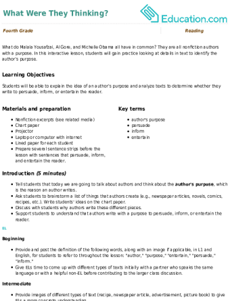
What Were They Thinking?
Lesson Plan
What Were They Thinking?
Fourth Grade
What do Malala Yousafzai, Al Gore, and Michelle Obama all have in common? They are all nonfiction authors with a purpose. In this interactive lesson, students will gain practice looking at details in text to identify the author’s purpose.
Lesson Plan
What Were They Thinking?
Lesson Plan
What Were They Thinking?
What do Malala Yousafzai, Al Gore, and Michelle Obama all have in common? They are all nonfiction authors with a purpose. In this interactive lesson, students will gain practice looking at details in text to identify the author’s purpose.
Fourth Grade
Lesson Plan
A Picture Is Worth a Thousand Words: Connecting Text and Illustrations
Lesson Plan
A Picture Is Worth a Thousand Words: Connecting Text and Illustrations
Fourth Grade
By analzying picture books, students will make connections between the text and the illustrations of a story. They will compare and contrast the text and the illustrations and reflect upon how they impact their comprehension of a text.
Lesson Plan
A Picture Is Worth a Thousand Words: Connecting Text and Illustrations
Lesson Plan
A Picture Is Worth a Thousand Words: Connecting Text and Illustrations
By analzying picture books, students will make connections between the text and the illustrations of a story. They will compare and contrast the text and the illustrations and reflect upon how they impact their comprehension of a text.
Fourth Grade
Lesson Plan
1
…
12
13
14
15