SKIP TO CONTENT
Worksheet Generator
Subjects
Grades
Worksheets
Games
Build a Worksheet
More Resources
Roly Recommends
Halloween
Subjects
Grades
Worksheets
Games
Build a Worksheet
More Resources
Roly Recommends
Halloween
Showing results for 'text detective weird' : Page 18
Filters
1,848 results
Search for: text, detective, weird
✕
Clear all
1,848 results
Filters
Search for: text, detective, weird
✕
Subjects
Math
English Language Arts
Science
Social Studies
Foreign Language
Technology
Grade Level
Pre-K
K
1st
2nd
3rd
4th
5th
6th
7th
8th
Early Childhood
Elementary School
Middle School
Resource Type
Worksheets
Games
Lesson Plans
Interactive Worksheets
Workbooks
Activities
Exercises
Stories
Songs
Offline Games
Guided Lessons
Teacher Resources
See more
Occasion
Birthdays
Women's History Month
Passover
Spring
Easter
Earth Day
Asian Pacific American Heritage Month
Father's Day
Independence Day
Fall
Hispanic Heritage Month
Halloween
Dia de los Muertos
Veterans Day
Winter
Holidays
Thanksgiving
Christmas
New Year
Martin Luther King Jr. Day
Valentine's Day
Presidents' Day
Black History Month
Juneteenth
See more
Common Core
Yes
Roly Recommends
Social Emotional Learning
Game Type
Mazes
Dot to Dot
Crossword
Group Games
Outdoor Games
Printable Board Games
Puzzles & Sudoku
Word Puzzles
Word Search
See more
Arts & Crafts
Arts & Crafts
Paper & Glue Crafts
Construction & Sculpture
Painting & Drawing
Coloring
Yes
Recipes
Mains
Sides
English Language Support
Yes
Clear all
View 1,848 results
Showing results for 'text detective weird' : Page 18
Filters
1,848 results
Search for: text, detective, weird
✕
Clear all
1,848 results
EL
Explaining Illustrations with Declarative Sentences
Lesson Plan
Explaining Illustrations with Declarative Sentences
Fourth Grade
In this lesson, students will examine illustrations and write about them using declarative sentences. This can be used on its own or as support for the lesson A Picture Is Worth a Thousand Words: Connecting Text and Illustrations.
Lesson Plan
EL
Explaining Illustrations with Declarative Sentences
Lesson Plan
Explaining Illustrations with Declarative Sentences
In this lesson, students will examine illustrations and write about them using declarative sentences. This can be used on its own or as support for the lesson A Picture Is Worth a Thousand Words: Connecting Text and Illustrations.
Fourth Grade
Lesson Plan
Subject and Predicate Worksheet
Worksheet
Subject and Predicate Worksheet
Third Grade
Grammar and Mechanics
This subject and predicate worksheet challenges kids to find the subjects and predicates in text. Use this subject and predicate worksheet with your child.
Worksheet
Subject and Predicate Worksheet
Worksheet
Subject and Predicate Worksheet
This subject and predicate worksheet challenges kids to find the subjects and predicates in text. Use this subject and predicate worksheet with your child.
Third Grade
Grammar and Mechanics
Worksheet
Fiction Comprehension: Problem and Solution
Lesson Plan
Fiction Comprehension: Problem and Solution
Third Grade
If you've ever had something go wrong, you know how it feels to search for a solution! Use this lesson to teach your students to identify problems and solutions in fictional text.
Lesson Plan
Fiction Comprehension: Problem and Solution
Lesson Plan
Fiction Comprehension: Problem and Solution
If you've ever had something go wrong, you know how it feels to search for a solution! Use this lesson to teach your students to identify problems and solutions in fictional text.
Third Grade
Lesson Plan
Close Reading Through Word Choice
Lesson Plan
Close Reading Through Word Choice
Fourth Grade
Reading
Every great reader and writer knows that syntax matters. During this lesson, students will use the close reading strategy to focus on word choice, and use their understanding of syntax to develop theories about patterns in the text.
Lesson Plan
Close Reading Through Word Choice
Lesson Plan
Close Reading Through Word Choice
Every great reader and writer knows that syntax matters. During this lesson, students will use the close reading strategy to focus on word choice, and use their understanding of syntax to develop theories about patterns in the text.
Fourth Grade
Reading
Lesson Plan
Chameleon Table of Contents
Worksheet
Chameleon Table of Contents
Second Grade
Reading
Review or assess your second graders' understanding of simple non-fiction text features with this table of contents activity. Young readers will practice using a table of contents to find information and answer questions about chameleons.
Worksheet
Chameleon Table of Contents
Worksheet
Chameleon Table of Contents
Review or assess your second graders' understanding of simple non-fiction text features with this table of contents activity. Young readers will practice using a table of contents to find information and answer questions about chameleons.
Second Grade
Reading
Worksheet
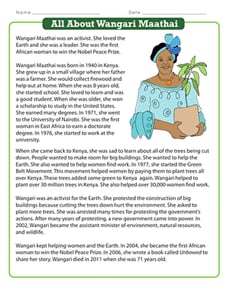
All About Wangari Maathai
Worksheet
All About Wangari Maathai
Second Grade
Reading
Introduce students to the inspiring environmental activist Wangari Maathai. Children will read a short biography about the first African woman to win the Nobel Peace Prize and answer nonfiction comprehension questions about the text.
Worksheet
All About Wangari Maathai
Worksheet
All About Wangari Maathai
Introduce students to the inspiring environmental activist Wangari Maathai. Children will read a short biography about the first African woman to win the Nobel Peace Prize and answer nonfiction comprehension questions about the text.
Second Grade
Reading
Worksheet
Get Ready to Write Nonfiction
Worksheet
Get Ready to Write Nonfiction
First Grade
Writing
One of the best ways to prepare for writing is by examining another author’s work. In this activity, students look closely at a nonfiction text and answer questions about what they find in preparation for writing their own.
Worksheet
Get Ready to Write Nonfiction
Worksheet
Get Ready to Write Nonfiction
One of the best ways to prepare for writing is by examining another author’s work. In this activity, students look closely at a nonfiction text and answer questions about what they find in preparation for writing their own.
First Grade
Writing
Worksheet
Glossary: The Purpose of Fiction Texts
Worksheet
Glossary: The Purpose of Fiction Texts
Second Grade
Reading
Use this glossary with the EL Support Lesson Plan: The Purpose of Fiction Texts.
Worksheet
Glossary: The Purpose of Fiction Texts
Worksheet
Glossary: The Purpose of Fiction Texts
Use this glossary with the EL Support Lesson Plan: The Purpose of Fiction Texts.
Second Grade
Reading
Worksheet
EL
Create a Nonfiction Big Book
Lesson Plan
Create a Nonfiction Big Book
First Grade
Vocabulary
Share the pen in this lesson on text features as you work together as a class to create a nonfiction big book. This lesson can be used alone or with the Studying Authors: Nonfiction Writing lesson plan.
Lesson Plan
EL
Create a Nonfiction Big Book
Lesson Plan
Create a Nonfiction Big Book
Share the pen in this lesson on text features as you work together as a class to create a nonfiction big book. This lesson can be used alone or with the Studying Authors: Nonfiction Writing lesson plan.
First Grade
Vocabulary
Lesson Plan
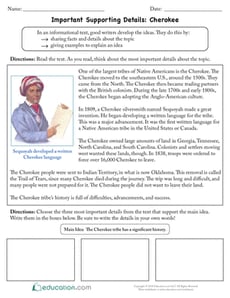
Important Supporting Details: Cherokee
Worksheet
Important Supporting Details: Cherokee
Third Grade
Writing
Use this resource with your students to practice picking out the most important details to support a main idea. Students will read about an significant Native American tribe and determine the most important information in the text.
Worksheet
Important Supporting Details: Cherokee
Worksheet
Important Supporting Details: Cherokee
Use this resource with your students to practice picking out the most important details to support a main idea. Students will read about an significant Native American tribe and determine the most important information in the text.
Third Grade
Writing
Worksheet
EL
Nonfiction Main Idea
Lesson Plan
Nonfiction Main Idea
Fourth Grade
Reading
Let's get reading! In this lesson, students will identify the main idea and details of a nonfiction text. Use this on its own or as support for the lesson Connecting the Coasts: Effects of the Transcontinental Railroad.
Lesson Plan
EL
Nonfiction Main Idea
Lesson Plan
Nonfiction Main Idea
Let's get reading! In this lesson, students will identify the main idea and details of a nonfiction text. Use this on its own or as support for the lesson Connecting the Coasts: Effects of the Transcontinental Railroad.
Fourth Grade
Reading
Lesson Plan
Fact vs. Opinion in Texts
Lesson Plan
Fact vs. Opinion in Texts
Fifth Grade
Understanding the difference between fact and opinion is a critical skill. Your students will practice differentiating between facts and opinions in nonfiction texts and will apply the skills they learn to write their own statements.
Lesson Plan
Fact vs. Opinion in Texts
Lesson Plan
Fact vs. Opinion in Texts
Understanding the difference between fact and opinion is a critical skill. Your students will practice differentiating between facts and opinions in nonfiction texts and will apply the skills they learn to write their own statements.
Fifth Grade
Lesson Plan
Questions that Gauge Comprehension
Lesson Plan
Questions that Gauge Comprehension
Third Grade
Vocabulary
Use this lesson to gauge your students’ basic comprehension of fiction text. If they can answer who, what, when, where, why, and how questions, you know they have a handle on it and it’s time to get into more critical thinking!
Lesson Plan
Questions that Gauge Comprehension
Lesson Plan
Questions that Gauge Comprehension
Use this lesson to gauge your students’ basic comprehension of fiction text. If they can answer who, what, when, where, why, and how questions, you know they have a handle on it and it’s time to get into more critical thinking!
Third Grade
Vocabulary
Lesson Plan
EL
Main Idea and Supporting Evidence
Lesson Plan
Main Idea and Supporting Evidence
Fourth Grade
Use this lesson to help your ELs identify the main idea and supporting evidence in a short fictional text. It can be a stand-alone lesson or used as support for the lesson Reading Closely.
Lesson Plan
EL
Main Idea and Supporting Evidence
Lesson Plan
Main Idea and Supporting Evidence
Use this lesson to help your ELs identify the main idea and supporting evidence in a short fictional text. It can be a stand-alone lesson or used as support for the lesson Reading Closely.
Fourth Grade
Lesson Plan
Plant Structures and their Functions
Lesson Plan
Plant Structures and their Functions
Third Grade
A caption reveals important information to a reader. Use this lesson with your students to teach them about plant structures and their functions, while they learn how to be a text feature author.
Lesson Plan
Plant Structures and their Functions
Lesson Plan
Plant Structures and their Functions
A caption reveals important information to a reader. Use this lesson with your students to teach them about plant structures and their functions, while they learn how to be a text feature author.
Third Grade
Lesson Plan
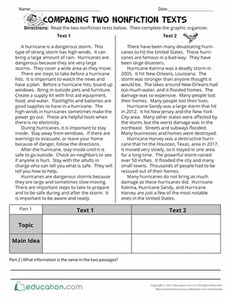
Comparing Two Nonfiction Texts
Worksheet
Comparing Two Nonfiction Texts
Third Grade
Reading
With this resource, your students will read and compare two nonfiction texts on the same topic.
Worksheet
Comparing Two Nonfiction Texts
Worksheet
Comparing Two Nonfiction Texts
With this resource, your students will read and compare two nonfiction texts on the same topic.
Third Grade
Reading
Worksheet
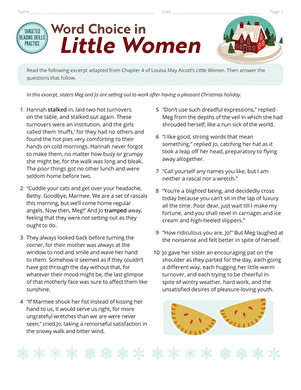
Targeted Reading Skills Practice: Word Choice in Little Women
Worksheet
Targeted Reading Skills Practice: Word Choice in Little Women
Sixth Grade
Reading
Analyze the impact an author’s words can have on the meaning and tone of a text with this excerpt from Louisa May Alcott’s classic novel
Little Women
.
Worksheet
Targeted Reading Skills Practice: Word Choice in Little Women
Worksheet
Targeted Reading Skills Practice: Word Choice in Little Women
Analyze the impact an author’s words can have on the meaning and tone of a text with this excerpt from Louisa May Alcott’s classic novel
Little Women
.
Sixth Grade
Reading
Worksheet
EL
Finding the Details and Asking for Answers
Lesson Plan
Finding the Details and Asking for Answers
Kindergarten
Reading
ELs will get a chance to practice their listening and reading comprehension skills as they answer questions about the key details in a read-aloud text. Use as a stand-alone or pre-lesson for the Questions for Comprehension lesson plan.
Lesson Plan
EL
Finding the Details and Asking for Answers
Lesson Plan
Finding the Details and Asking for Answers
ELs will get a chance to practice their listening and reading comprehension skills as they answer questions about the key details in a read-aloud text. Use as a stand-alone or pre-lesson for the Questions for Comprehension lesson plan.
Kindergarten
Reading
Lesson Plan
What Were They Thinking?
Lesson Plan
What Were They Thinking?
Fourth Grade
What do Malala Yousafzai, Al Gore, and Michelle Obama all have in common? They are all nonfiction authors with a purpose. In this interactive lesson, students will gain practice looking at details in text to identify the author’s purpose.
Lesson Plan
What Were They Thinking?
Lesson Plan
What Were They Thinking?
What do Malala Yousafzai, Al Gore, and Michelle Obama all have in common? They are all nonfiction authors with a purpose. In this interactive lesson, students will gain practice looking at details in text to identify the author’s purpose.
Fourth Grade
Lesson Plan
EL
Information from Multiple Sources
Lesson Plan
Information from Multiple Sources
Fifth Grade
Measurement
Use this lesson to help your ELs quickly find information on a specific topic by looking for a noun and its pronouns in a nonfiction text. It can be a stand-alone lesson or used as support for the lesson Ecosystems Explained.
Lesson Plan
EL
Information from Multiple Sources
Lesson Plan
Information from Multiple Sources
Use this lesson to help your ELs quickly find information on a specific topic by looking for a noun and its pronouns in a nonfiction text. It can be a stand-alone lesson or used as support for the lesson Ecosystems Explained.
Fifth Grade
Measurement
Lesson Plan
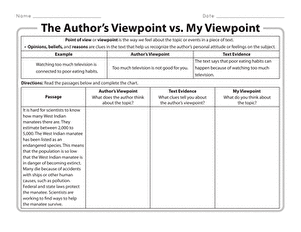
The Author’s Viewpoint vs. My Viewpoint
Worksheet
The Author’s Viewpoint vs. My Viewpoint
Third Grade
Reading
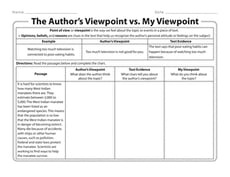
Use this resource to give your students practice reading a short nonfiction passage and recognizing the author’s viewpoint about the topic. Then, they will pick out the text evidence that supports the author’s viewpoint.
Worksheet
The Author’s Viewpoint vs. My Viewpoint
Worksheet
The Author’s Viewpoint vs. My Viewpoint
Use this resource to give your students practice reading a short nonfiction passage and recognizing the author’s viewpoint about the topic. Then, they will pick out the text evidence that supports the author’s viewpoint.
Third Grade
Reading
Worksheet
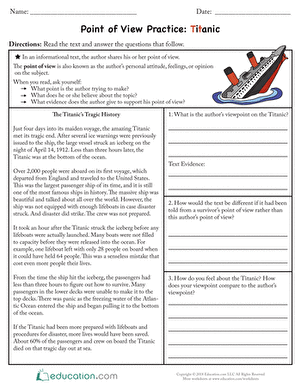
Point of View Practice: Titanic
Worksheet
Point of View Practice: Titanic
Third Grade
Reading
Use this high-interest text with your students to practice recognizing the author’s point of view. Students will determine the author’s viewpoint on the subject of the Titanic as they establish their own points of view.
Worksheet
Point of View Practice: Titanic
Worksheet
Point of View Practice: Titanic
Use this high-interest text with your students to practice recognizing the author’s point of view. Students will determine the author’s viewpoint on the subject of the Titanic as they establish their own points of view.
Third Grade
Reading
Worksheet
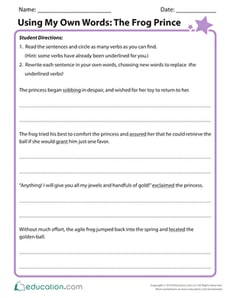
Using My Own Words: The Frog Prince
Worksheet
Using My Own Words: The Frog Prince
Second Grade
English Language Arts
Reinforce grammar and comprehension as you support your students in understanding the elements of a fictional text! In this activity, students will practice identifying verbs and rewriting the beloved story of "The Frog Prince" in their own word
Worksheet
Using My Own Words: The Frog Prince
Worksheet
Using My Own Words: The Frog Prince
Reinforce grammar and comprehension as you support your students in understanding the elements of a fictional text! In this activity, students will practice identifying verbs and rewriting the beloved story of "The Frog Prince" in their own word
Second Grade
English Language Arts
Worksheet
Read Between the Lines
Workbook
Read Between the Lines
First Grade
Reading
When it comes to reading, it’s all about inferring. Kids can learn how to use clues in a text to understand a character’s thoughts or follow the action, in this book about jumping to conclusions.
Workbook
Read Between the Lines
Workbook
Read Between the Lines
When it comes to reading, it’s all about inferring. Kids can learn how to use clues in a text to understand a character’s thoughts or follow the action, in this book about jumping to conclusions.
First Grade
Reading
Workbook
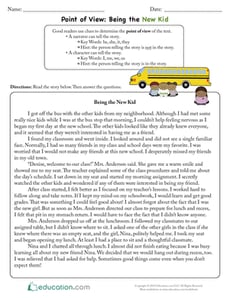
Point of View: Being the New Kid
Worksheet
Point of View: Being the New Kid
Third Grade
Reading
Have you ever been the new kid? Well, maybe you can relate to the character’s point of view. Use this resource with your students to practice identifying the point of view of a text and explaining the character’s opinions.
Worksheet
Point of View: Being the New Kid
Worksheet
Point of View: Being the New Kid
Have you ever been the new kid? Well, maybe you can relate to the character’s point of view. Use this resource with your students to practice identifying the point of view of a text and explaining the character’s opinions.
Third Grade
Reading
Worksheet
Picture This: The Ugly Duckling!
Lesson Plan
Picture This: The Ugly Duckling!
Kindergarten
Your students have probably heard of "The Ugly Duckling," but have they ever tried to put the events of the story in order? In this simple sequencing lesson, young readers match illustrations to text and put them into the proper order.
Lesson Plan
Picture This: The Ugly Duckling!
Lesson Plan
Picture This: The Ugly Duckling!
Your students have probably heard of "The Ugly Duckling," but have they ever tried to put the events of the story in order? In this simple sequencing lesson, young readers match illustrations to text and put them into the proper order.
Kindergarten
Lesson Plan
Sequencing to Summarize
Worksheet
Sequencing to Summarize
Second Grade
Reading
Stretch student understanding of story sequencing into a summary with this graphic organizer. Students will start by jotting down quick notes to remember each part of the story, then they'll use their notes to write a complete summary of the text.
Worksheet
Sequencing to Summarize
Worksheet
Sequencing to Summarize
Stretch student understanding of story sequencing into a summary with this graphic organizer. Students will start by jotting down quick notes to remember each part of the story, then they'll use their notes to write a complete summary of the text.
Second Grade
Reading
Worksheet
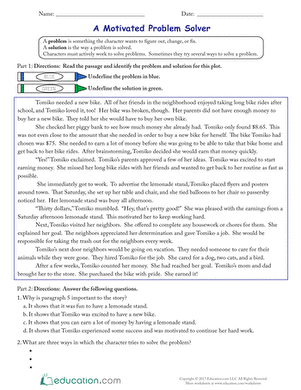
A Motivated Problem Solver
Worksheet
A Motivated Problem Solver
Third Grade
Reading
Use this resource with your students to practice not only identifying the problem and solution in a text, but also the character’s attempts at solving the problem.
Worksheet
A Motivated Problem Solver
Worksheet
A Motivated Problem Solver
Use this resource with your students to practice not only identifying the problem and solution in a text, but also the character’s attempts at solving the problem.
Third Grade
Reading
Worksheet
Activate That Background Knowledge
Worksheet
Activate That Background Knowledge
First Grade
Reading
Engage students in reading before they even start! Students prepare for reading a nonfiction text by looking at the pictures in the book and answering a series of questions that get them thinking about what they already know about the topic.
Worksheet
Activate That Background Knowledge
Worksheet
Activate That Background Knowledge
Engage students in reading before they even start! Students prepare for reading a nonfiction text by looking at the pictures in the book and answering a series of questions that get them thinking about what they already know about the topic.
First Grade
Reading
Worksheet
A Chicken's Life Cycle
Worksheet
A Chicken's Life Cycle
Second Grade
Life Science
This short nonfiction text will provide students with an opportunity to become more comfortable with identifying and defining academic vocabulary words—and they'll have fun learning all about the life cycle of a chicken in the process!
Worksheet
A Chicken's Life Cycle
Worksheet
A Chicken's Life Cycle
This short nonfiction text will provide students with an opportunity to become more comfortable with identifying and defining academic vocabulary words—and they'll have fun learning all about the life cycle of a chicken in the process!
Second Grade
Life Science
Worksheet
1
…
17
18
19
…
62